 Source:
 Hosta ‘So Sweet’ short overview
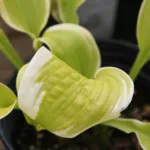
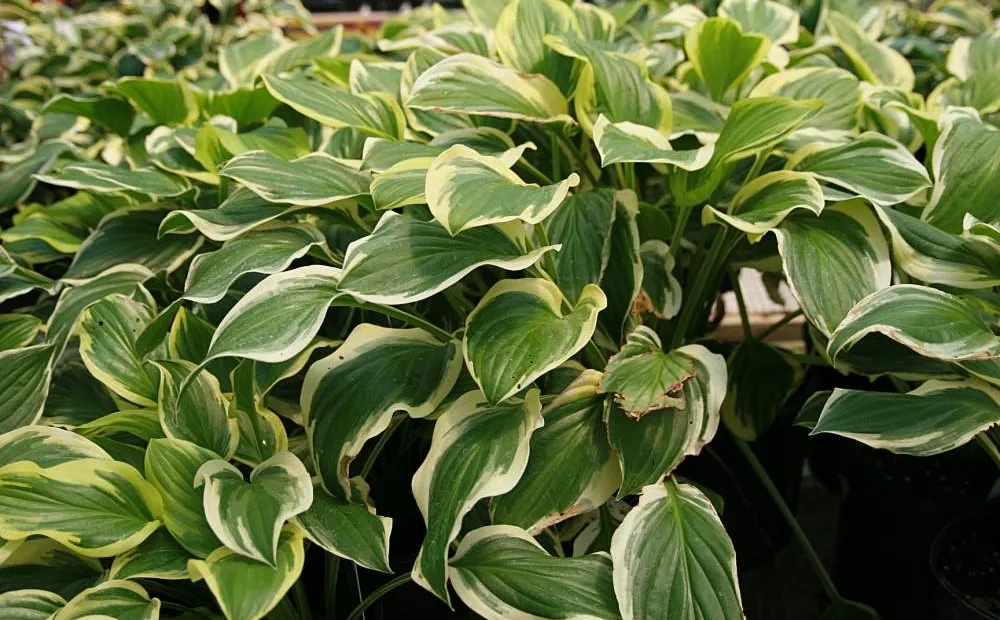
Hosta 'So Sweet' is a reliable, clump-forming perennial grown for glossy green leaves edged in cream that gradually lighten toward white. Fragrant pale lavender-white flowers rise above the foliage in mid to late summer. It performs best in moist, organically rich, well-drained soil and partial to full shade, although established plants can tolerate more morning or filtered sun when evenly watered. This award-winning cultivar is useful in borders, woodland gardens, and containers.
Taxonomic classification
Hosta ‘So Sweet’ care guide
Light and placement
Best in partial to full shade, especially with morning sun or filtered light and protection from hot afternoon exposure. It can tolerate more sun than many hostas when soil moisture is dependable. Scorched margins, faded foliage, or midday collapse suggest excessive light or drought; weak growth and reduced flowering may indicate overly dark conditions.
Watering and humidity
Water deeply when the upper inch of soil begins to dry, directing water beneath the leaves rather than over the crown. Keep soil evenly moist through spring and summer, especially in containers and sunny sites. Reduce watering after foliage dies back, but do not allow newly planted divisions to dry during establishment.
Soil and growing medium
Use fertile, moisture-retentive soil that still drains freely. Loam amended with compost is ideal; clay should be improved with organic matter rather than left compacted. A slightly acidic to neutral reaction is suitable. Mulch helps conserve moisture, but keep it away from the crown to reduce rot risk.
Feeding
Apply a balanced, slow-release fertilizer in spring as new growth begins, or top-dress with finished compost. Avoid heavy nitrogen feeding, which can produce lush, weak foliage and reduce overall balance. Do not fertilize during drought stress, immediately after planting, or late in the season when the plant is preparing for dormancy.
Growth and habit
Forms a dense, mounding clump from a rhizomatous crown and expands gradually through multiple growing points. It is a vigorous cultivar once established and can remain in place for years without division. Removing spent scapes improves tidiness, while division is useful when the clump becomes crowded or needs relocation.
Planting and repotting
Plant in spring or early fall, with the crown at soil level and roots spread outward. Space plants about 24–36 inches apart for a natural mature clump, allowing extra room where a larger specimen is desired. Water deeply after planting and maintain even moisture during establishment.
For containers, repot or divide in early spring before leaves fully expand, or in early fall after flowering. Use a roomy pot with drainage holes and a moisture-retentive but well-drained potting mix. Refresh exhausted mix every few years rather than repeatedly shifting an undisturbed garden clump.
Propagation and pruning
Propagation
Divide established clumps in early spring before leaves unfurl or in early fall. Separate crowns with a sharp, clean knife, ensuring each division has viable roots and at least one growing point. Seed is not a reliable way to reproduce the named cultivar because seedlings will not come true.
Pruning
Cut flower scapes to the base after flowering if seed-stalks are unwanted. Allow foliage to yellow naturally after frost, then remove collapsed leaves in late fall or by early spring before new shoots emerge. Disinfect tools when removing diseased tissue.
Overwintering
Plants are fully deciduous and naturally become dormant after frost. Leave the crown outdoors in USDA Zones 3–8, allowing foliage to die back before cleanup. A light mulch layer can protect shallow roots in exposed sites, but avoid burying the crown or retaining excessive winter moisture.
Uses
Primarily an ornamental foliage perennial for shade borders, woodland gardens, foundation plantings, massed displays, and large containers. Its fragrant flowers can be used as cut flowers, while the foliage provides strong texture and contrast. Do not use as an edible or medicinal plant.
Appearance
Leaves are glossy, flat to slightly wavy, lance-shaped, and medium green with broad creamy margins that commonly become whiter by midsummer. The plant forms a neat, rounded to vase-shaped mound, with upright scapes rising well above the foliage and carrying fragrant pale flowers.
Flowering
Tall, mostly upright scapes carry one-sided racemes of funnel-shaped, fragrant flowers. Flowers are generally white to pale lavender-white, sometimes opening from pale purple buds or showing pale purple striping. Bloom is usually from June through August in U.S. gardens, with strongest display in mid to late summer.
Pollination and visitors
The fragrant, tubular flowers are documented as attractive to hummingbirds and are suitable for visits by long-tongued flower visitors. Pollinator activity is concentrated during the summer flowering period. This is an ornamental ecological benefit rather than a guarantee of regular visitation in every garden.
Diseases and pests
Diseases
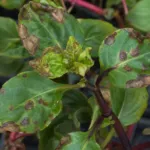
Reduce leaf wetness and avoid planting in poorly drained soil. Watch for crown rot, foliar nematodes, and leaf spots. Remove and destroy plants showing suspected Hosta Virus X or other serious virus symptoms; do not propagate from affected stock. Good air circulation and clean tools help limit disease spread.
Pests
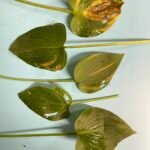
Slugs and snails commonly chew irregular holes in the leaves, especially in cool, damp weather. Hand-pick, remove hiding places, improve airflow, and use pet-conscious control methods where necessary. Deer and rabbits may also browse the foliage. Check leaves for foliar nematode damage, which appears as interveinal browning.
Related diseases and pests
Only Plant Doctor profiles whose host data indicate this plant may be affected are shown here.
 PestStrawberry foliar nematodeAphelenchoides fragariae
 DiseaseImpatiens necrotic spot virus diseaseImpatiens necrotic spot orthotospovirus
 DiseaseSouthern blightAthelia rolfsii
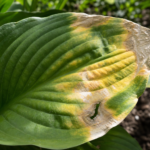 Environmental stressExcess light stress
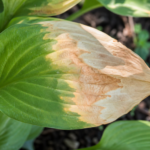 Environmental stressLeaf sunburn
 PestBrown Garden SnailCornu aspersum (Müller, 1774)
 DiseaseAlternaria leaf spot and fruit rotAlternaria alternata
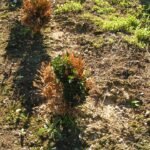 DiseasePhytophthora root and crown rotPhytophthora nicotianae
Toxicity and pollen
Hostas contain saponins and are listed as toxic to dogs and cats if eaten. Typical signs include vomiting, diarrhea, and depression. Keep pets from consuming leaves, flowers, or crowns, and contact a veterinarian or poison-control service if significant ingestion occurs. Human toxicity from normal garden contact is not well documented, but ingestion should be avoided.
- Typical season
- During flowering, generally June–August in the United States
- Pollination / pollen
- Insect-dispersed pollen
As an insect-pollinated flowering perennial, it is not generally regarded as a major airborne-pollen source. Pollen exposure is most likely close to open flowers rather than through widespread wind dispersal. People with known plant or fragrance sensitivities should still avoid direct exposure if symptoms occur.
Native habitat
The cultivar itself is a garden selection rather than a wild population. Hosta species are associated with open woodlands, woodland margins, and moist glades in East Asia. In cultivation, ‘So Sweet’ favors sheltered, humus-rich soils with reliable moisture and protection from drying exposure.
Interesting fact
‘So Sweet’ was introduced by Kevin Vaughn in 1986 from ‘Fragrant Bouquet’ crossed with a seedling. It was selected as the 1996 Hosta of the Year, the first cultivar to receive that award. Its margins commonly change from creamy yellow to white as the season advances.
Frequently asked questions (FAQ)
The most relevant questions about this plant, with short and direct answers.
🌱Quick care
What is Hosta 'So Sweet'?⌄
Hosta 'So Sweet' is a compact, deciduous perennial grown for its glossy green leaves edged in cream to white and its fragrant white summer flowers. It belongs to the Asparagaceae family and is especially suited to shady gardens.
How much sun does Hosta 'So Sweet' need?⌄
Hosta 'So Sweet' grows best in part shade to full shade, especially with morning sun or filtered light. Protect it from intense afternoon sun, which can scorch the leaves and fade the margins.
How often should I water Hosta 'So Sweet'?⌄
Water Hosta 'So Sweet' regularly enough to keep the soil evenly moist, particularly during its first growing season. Established plants tolerate short dry periods, but their foliage looks best when the soil does not dry out.
Is Hosta 'So Sweet' easy to grow?⌄
Yes, Hosta 'So Sweet' is generally an easy-care perennial when grown in moist, organically rich, well-drained soil and shade. The main recurring problems are slug damage, deer browsing, and drought stress.
🌤️Environment and placement
What USDA hardiness zones are suitable for Hosta 'So Sweet'?⌄
Hosta 'So Sweet' is very cold hardy and is commonly listed for USDA Zones 3 through 8, with some growers extending it to Zone 9. In warmer areas, deep shade and consistent moisture are especially important.
Can Hosta 'So Sweet' grow in full shade?⌄
Yes, Hosta 'So Sweet' can grow in full shade, although it may flower less heavily and develop a somewhat less vigorous form than in bright filtered shade. Avoid locations that are both deeply shaded and chronically dry.
Can Hosta 'So Sweet' tolerate morning sun?⌄
Yes, Hosta 'So Sweet' usually performs well with gentle morning sun followed by afternoon shade. More direct sun may be tolerated in cool climates if the soil stays consistently moist, but hot afternoon exposure can burn the foliage.
What soil is best for Hosta 'So Sweet'?⌄
Use moist, organically rich, well-drained loam for Hosta 'So Sweet'. Improve heavy or sandy soil with compost, but avoid poorly drained conditions that keep the crown waterlogged.
How large does Hosta 'So Sweet' get?⌄
Hosta 'So Sweet' typically forms a compact clump about 8 to 16 inches tall and 12 to 24 inches wide, although mature size varies with climate, soil, and growing conditions. Allow extra room if growing it as a mass planting.
How far apart should Hosta 'So Sweet' be planted?⌄
Space Hosta 'So Sweet' about 18 to 24 inches apart for a connected bed or mass planting. Use the wider spacing if you want each mound to remain visually distinct.
💧Care and problems
Why are the leaves of my Hosta 'So Sweet' turning brown?⌄
Brown leaf edges on Hosta 'So Sweet' are commonly caused by drought, excessive sun, hot wind, or root stress. Keep the soil evenly moist, apply a light organic mulch, and provide afternoon shade.
How do I protect Hosta 'So Sweet' from slugs?⌄
Reduce slug damage by removing hiding places, watering the soil rather than the foliage, and using a labeled slug control product or physical barriers when needed. Check plants after dark or following wet weather, when slugs are most active.
Do deer eat Hosta 'So Sweet'?⌄
Yes, deer commonly browse Hosta 'So Sweet' and other hostas, often damaging the leaves severely. Use fencing or a deer repellent program if deer regularly enter the planting area.
Why is my Hosta 'So Sweet' not growing well?⌄
Poor growth is often linked to insufficient moisture, excessive sun, root competition from trees, compacted soil, or slug damage. Check the crown and roots for rot and move or divide the plant only when necessary.
Should I fertilize Hosta 'So Sweet'?⌄
Apply a balanced, slow-release fertilizer in spring if the soil is poor or growth is weak. Avoid heavy late-season fertilizing, and do not fertilize drought-stressed or newly transplanted plants until they recover.
Does Hosta 'So Sweet' lose its leaves in winter?⌄
Yes, Hosta 'So Sweet' is deciduous and naturally dies back after frost. Remove the collapsed foliage in late fall or early spring to improve appearance and reduce overwintering debris.
🪴Planting and repotting
When is the best time to plant Hosta 'So Sweet'?⌄
Plant Hosta 'So Sweet' in spring or early fall while temperatures are moderate and soil moisture is reliable. Water thoroughly after planting and keep the root zone consistently moist during establishment.
How deep should I plant Hosta 'So Sweet'?⌄
Plant Hosta 'So Sweet' with the crown at soil level or just slightly below it, keeping the growing points near the surface. Planting too deeply can encourage crown or root problems.
Can Hosta 'So Sweet' grow in a container?⌄
Yes, Hosta 'So Sweet' grows well in a container with drainage holes, quality potting mix, and bright shade. Container plants dry out faster than plants in the ground, so monitor moisture closely during hot weather.
✂️Propagation and pruning
How do I divide Hosta 'So Sweet'?⌄
Divide Hosta 'So Sweet' by lifting the clump and separating sections with roots and at least one growing point. Early spring, before the leaves fully unfurl, is usually the easiest time, although early fall can also work.
Can Hosta 'So Sweet' be grown from seed?⌄
Hosta 'So Sweet' can produce seed, but seedlings may not resemble the parent cultivar. Division is the preferred method when you want new plants that retain the characteristic foliage and habit of 'So Sweet'.
Should I cut off the flower stalks on Hosta 'So Sweet'?⌄
Cut the flower stalks back after flowering if you prefer a tidier appearance or want to prevent seed development. Removing them is optional and does not usually improve the plant’s health.
⚠️Toxicity and safety
Is Hosta 'So Sweet' toxic to dogs?⌄
Yes, Hosta 'So Sweet' should be treated as toxic to dogs if eaten. Keep pets from consuming the leaves, flowers, roots, or crown, and contact a veterinarian or animal poison-control service if ingestion occurs.
Is Hosta 'So Sweet' toxic to cats?⌄
Yes, Hosta 'So Sweet' should be treated as toxic to cats if eaten. Prevent access to the plant and seek veterinary advice promptly if a cat chews or swallows any part of it.
Is Hosta 'So Sweet' poisonous to people?⌄
Hosta 'So Sweet' is not generally grown as a food plant, and its safety for human consumption should not be assumed. Keep children from eating the leaves, flowers, roots, or crown, and contact a medical professional or poison-control service after suspected ingestion.
🌸Flowering and special interest
When does Hosta 'So Sweet' bloom?⌄
Hosta 'So Sweet' generally blooms in summer, often from June through August depending on local climate. Tall flower scapes rise above the foliage and carry white, funnel-shaped blooms.
Are Hosta 'So Sweet' flowers fragrant?⌄
Yes, the white flowers of Hosta 'So Sweet' are fragrant, especially in warm weather. The scent is one of the cultivar’s notable features in addition to its variegated foliage.
Why is my Hosta 'So Sweet' not flowering?⌄
Limited flowering may result from deep shade, drought, transplant shock, immature plants, or excessive competition from nearby roots. Provide bright filtered light and consistent moisture, but allow the plant time to establish.
Are Hosta 'So Sweet' flowers good for pollinators?⌄
The flowers can attract hummingbirds and other garden visitors, although Hosta 'So Sweet' is primarily grown for its foliage. Blooming is usually stronger when the plant receives some filtered light and adequate moisture.