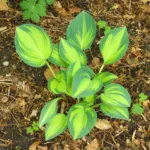
Source:
 Hosta ‘Red October’ short overview
Hosta 'Red October' is a distinctive medium-sized hosta valued for dark red petioles that contrast with matte green, pale-backed leaves. Its clump-forming foliage suits sheltered woodland borders, shade gardens, and containers, while pale lavender, funnel-shaped flowers rise on tall scapes in late summer. Grow it in consistently moist, organic, well-drained soil in partial to full shade, protecting the leaves from hot afternoon sun and wind.
Taxonomic classification
Hosta ‘Red October’ care guide
Light and placement
Give partial shade to full shade, ideally with morning light or dappled exposure and shelter from hot afternoon sun. North- and east-facing beds are suitable; a protected west-facing site can work in cooler climates. Excess sun may scorch or bleach leaves, while very dense shade can produce thinner growth and weaker flowering.
Watering and humidity
Water deeply when the upper inch of soil begins to dry, keeping the root zone consistently moist rather than alternating between drought and saturation. Increase frequency during hot, dry summer weather and reduce it after dormancy. Direct water beneath the foliage to limit leaf disease; mulch lightly without covering the crown.
Soil and growing medium
Use fertile, humus-rich soil that holds steady moisture but drains freely. Loam or improved clay is suitable if amended with compost. A slightly acidic to neutral soil is ideal, although hostas tolerate a broad pH range, including mildly alkaline conditions. Avoid chronically waterlogged ground, which increases crown-rot risk.
Feeding
Top-dress with compost in spring and apply a balanced, slow-release fertilizer at label rate as growth begins if soil fertility is modest. Avoid heavy nitrogen applications, which can encourage lush, slug-prone foliage. Do not fertilize drought-stressed, newly divided, or dormant plants; water the soil first when feeding established plants.
Growth and habit
Forms a rounded to arching clump from a rhizomatous crown and is generally medium-growing. It becomes fuller over several seasons and usually needs little maintenance beyond watering, division when crowded, and removal of spent or frost-damaged foliage. Shelter from strong wind helps preserve the leaves.
Planting and repotting
Plant in spring or early fall with the crown at soil level; do not bury the emerging buds. Space about 24 to 30 inches apart for a full mound, allowing extra room where a wider specimen is expected. Water deeply after planting and keep the root zone evenly moist while the division establishes.
Repot container-grown divisions in spring, just as shoots emerge, or in early fall. Move the plant into a container only modestly larger than the root mass and use a moisture-retentive but well-drained potting mix. Container hostas need more frequent watering than plants in the ground and should not sit in standing water.
Propagation and pruning
Propagation
Division is the practical method. Divide in early spring before leaves fully unfurl or in early fall, ensuring each division has viable buds and roots. Seed is not recommended for preserving the named cultivar because seedlings will not reliably reproduce its characteristics.
Pruning
Remove flower scapes after flowering if seed production is unwanted. Cut the foliage to the ground after a hard freeze or in late winter before new shoots emerge. Do not remove healthy leaves prematurely because they continue to support the crown late in the season.
Overwintering
Leave the plant dormant outdoors in the ground in suitable USDA zones. After frost collapses the foliage, remove it to reduce hiding places for slugs and disease. Container plants are more exposed to root freezing; cluster pots in a sheltered location and insulate them, while avoiding waterlogged winter media.
Uses
Useful as a specimen, edging plant, grouped shade perennial, woodland-border planting, or shaded container subject. Its contrasting petioles and pale leaf undersides make it valuable where foliage is viewed at close range. It is ornamental only; do not treat this named cultivar as a food or medicinal plant.
Appearance
Leaves are lance-shaped to elliptic, matte green, lightly rippled, and paler beneath. Dark red petioles show the strongest color and may bleed into the lower leaf blade and veins. Upright scapes can be green to burgundy-purple and rise well above the foliage, making the cultivar identifiable even before flowering.
Flowering
Pale lavender, funnel-shaped flowers are borne in loose to dense racemes on upright scapes above the foliage. In the United States, flowering is generally reported from August into September, with some records extending into early fall. The cultivar is noted for abundant flowering and may produce more than one scape per division.
Pollination and visitors
Hosta flowers provide nectar for insect visitors, including bees, bumblebees, and butterflies; hummingbirds may also visit tubular hosta flowers. The cultivar's late-summer bloom extends floral resources after many spring and early-summer perennials have finished.
Hosta 'Red October' photos
Click any photo for a larger view. Source, author and license are shown separately.
Diseases and pests
Diseases
Avoid overhead irrigation and improve air circulation to reduce leaf spots and crown rot. Remove badly infected foliage and discard it away from the compost pile. Buy clean, reputable stock and remove plants showing suspicious mottling or collapse because Hosta Virus X, tobacco rattle virus, and tomato ringspot virus can occur in hostas.
Pests
Slugs and snails commonly chew irregular holes in the leaves. Deer and rabbits may browse the foliage. Inspect regularly, remove hiding places, use barriers where appropriate, and avoid excessive nitrogen that produces especially soft growth. Watch for foliar nematodes, which can cause interveinal browning.
Related diseases and pests
Only Plant Doctor profiles whose host data indicate this plant may be affected are shown here.
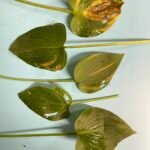 PestStrawberry foliar nematodeAphelenchoides fragariae
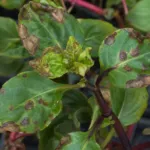 DiseaseImpatiens necrotic spot virus diseaseImpatiens necrotic spot orthotospovirus
 DiseaseSouthern blightAthelia rolfsii
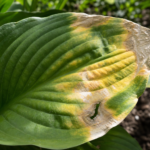 Environmental stressExcess light stress
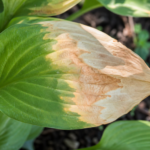 Environmental stressLeaf sunburn
 PestBrown Garden SnailCornu aspersum (Müller, 1774)
 DiseasePhytophthora cactorum crown, collar, root and fruit rotPhytophthora cactorum
 DiseaseTomato mosaic virusTobamovirus tomatotessellati
Toxicity and pollen
Hostas contain saponin compounds and are listed by ASPCA as toxic to dogs and cats; ingestion may cause vomiting, diarrhea, depression, or related gastrointestinal upset. Keep pets from chewing the plant and seek veterinary advice after ingestion, especially if symptoms develop. Human toxicity data for this exact cultivar are limited; do not eat it as an ornamental plant.
- Typical season
- Late summer to early fall
- Pollination / pollen
- Heavy, insect-carried pollen
Hosta is insect-pollinated, so its pollen is not typically released in the large, wind-dispersed quantities associated with ragweed, grasses, or many wind-pollinated trees. Individual sensitivity is still possible, and handling flowers can expose a person to pollen. The low rating reflects limited airborne dispersal, not a guarantee of zero allergy risk.
Native habitat
The species complex is associated with open woodlands, woodland margins, and glades in East Asia. In cultivation, this cultivar performs best in the cool, humus-rich, moisture-retentive conditions that resemble a sheltered woodland floor, while avoiding persistent saturation.
Interesting fact
The cultivar was registered from Roy Herold's breeding work and is associated with Hosta longipes f. hypoglauca ancestry. Its red coloration is concentrated mainly in the petioles and lower leaf bases rather than across the whole leaf. It is regarded as a notably floriferous late-season hosta.
Frequently asked questions (FAQ)
The most relevant questions about this plant, with short and direct answers.
🌱Quick care
What is Hosta 'Red October'?⌄
Hosta 'Red October' is a medium-sized, clump-forming perennial grown for its dark green, slightly blue-green leaves and distinctive red petioles. It is a shade-loving garden hosta that produces pale lavender flowers in late summer or early fall.
How big does Hosta 'Red October' get?⌄
Hosta 'Red October' typically grows about 10 to 16 inches tall and spreads roughly 24 to 28 inches wide at maturity. Size varies with soil moisture, age, and growing conditions.
What USDA hardiness zones are suitable for Hosta 'Red October'?⌄
Hosta 'Red October' is generally hardy in USDA Zones 3 through 8, with some US nursery sources listing Zone 9. In warmer regions, deep shade and dependable moisture are especially important.
🌤️Environment and placement
Does Hosta 'Red October' prefer sun or shade?⌄
Hosta 'Red October' prefers partial shade to full shade, with morning sun or filtered light usually producing the best growth. Strong afternoon sun can scorch the leaves, especially when soil moisture is limited.
Can Hosta 'Red October' grow in full shade?⌄
Yes, Hosta 'Red October' can grow in full shade, although growth may be slower and the clump may be less vigorous. Bright filtered shade or a few hours of gentle morning sun is often ideal.
What soil is best for Hosta 'Red October'?⌄
Plant Hosta 'Red October' in humus-rich, moisture-retentive, well-drained soil. Incorporating compost or other organic matter can improve both moisture holding and soil structure.
How much water does Hosta 'Red October' need?⌄
Keep the soil evenly moist, particularly during hot or dry weather. Established plants tolerate brief dry periods better than newly planted divisions, but the soil should not be allowed to dry out completely.
Can Hosta 'Red October' grow under trees?⌄
Yes, Hosta 'Red October' is well suited to woodland gardens and areas beneath trees if it receives sufficient moisture. Avoid planting where tree roots create severe competition or where the soil becomes exceptionally dry.
Can Hosta 'Red October' grow near black walnut trees?⌄
Hostas are generally considered tolerant of black walnut toxicity, and Hosta 'Red October' can be used near black walnuts when light and moisture are suitable. Root competition and dry soil may still limit performance.
💧Care and problems
How often should Hosta 'Red October' be fertilized?⌄
Hosta 'Red October' usually needs only modest fertilization when grown in fertile soil enriched with organic matter. A spring application of a balanced, slow-release fertilizer can support growth, but excessive fertilizer is unnecessary.
Why are the leaves of my Hosta 'Red October' turning brown?⌄
Brown leaves may result from drought, excessive sun, wind, hail, slug damage, or leaf-spot disease. Check soil moisture and exposure first, then inspect the foliage for holes, spotting, or other signs of damage.
What pests commonly attack Hosta 'Red October'?⌄
Slugs and snails commonly chew irregular holes in Hosta 'Red October' leaves, while deer and rabbits may also eat the foliage. Monitor plants regularly and use locally appropriate barriers or controls when damage appears.
Is Hosta 'Red October' deer resistant?⌄
No, Hosta 'Red October' should not be considered reliably deer resistant. Some nursery sources describe it as slightly less palatable than certain hostas, but deer may still browse it heavily.
Does Hosta 'Red October' have serious disease problems?⌄
Hosta 'Red October' can be affected by leaf spots, crown rot, foliar nematodes, and hosta viruses, although these problems are not inevitable. Good drainage, clean planting material, and removal of severely infected plants help reduce risk.
🪴Planting and repotting
When should I plant Hosta 'Red October' in the United States?⌄
Plant Hosta 'Red October' in spring or early fall while the soil is workable and moisture is reliable. In colder USDA Zones, spring or early fall gives new plants more time to establish before hard freezes.
How should I plant Hosta 'Red October' in the ground?⌄
Set Hosta 'Red October' at the same depth it was growing in its container, with the crown at or just above soil level. Water thoroughly after planting and apply a light organic mulch without covering the crown.
Can Hosta 'Red October' be grown in a container?⌄
Yes, Hosta 'Red October' can grow in a container with drainage holes and moisture-retentive but well-drained potting mix. Containers dry out faster than garden soil, so check moisture frequently during summer.
How far apart should Hosta 'Red October' be planted?⌄
Space Hosta 'Red October' about 24 to 28 inches apart when planning for mature spread. Closer spacing creates a faster-filled planting, but it may require division sooner.
✂️Propagation and pruning
How do you propagate Hosta 'Red October'?⌄
Propagate Hosta 'Red October' primarily by dividing the crown or rhizomatous clump. Division produces plants true to the named cultivar, unlike seed, which may not reproduce the same characteristics.
When is the best time to divide Hosta 'Red October'?⌄
The easiest time to divide Hosta 'Red October' is early spring just as shoots emerge, although early fall can also work. Water divisions well and avoid dividing during extreme heat or drought.
Can Hosta 'Red October' be grown from seed?⌄
Hosta 'Red October' can produce seed, but seed-grown plants may not match the parent cultivar and are not the preferred method for preserving its traits. Division is the more dependable home-garden propagation method.
Should I cut back Hosta 'Red October' in fall?⌄
Remove the spent foliage of Hosta 'Red October' after it naturally yellows or dies back in fall, or before new growth emerges in mid-spring. Do not remove healthy foliage early because it continues to replenish the crown.
⚠️Toxicity and safety
Is Hosta 'Red October' toxic to dogs and cats?⌄
Yes, Hosta 'Red October' should be treated as toxic to dogs and cats if eaten because hostas contain saponins. Ingestion may cause vomiting, diarrhea, or depression; contact a veterinarian or animal poison service if a pet has consumed it.
🌸Flowering and special interest
When does Hosta 'Red October' bloom?⌄
Hosta 'Red October' usually blooms in late summer or early fall, commonly from August into September and sometimes later depending on climate. Its flowers are pale lavender to purple and are carried above the foliage.
What do the flowers of Hosta 'Red October' look like?⌄
The flowers are funnel-shaped, pale lavender to purple, and arranged in loose or dense clusters on upright scapes. The flowering stems may be burgundy or reddish and typically rise above the foliage mound.
Are Hosta 'Red October' flowers fragrant?⌄
Hosta 'Red October' is grown primarily for its foliage and red petioles, and reliable sources do not identify it as notably fragrant. Do not expect the strong fragrance associated with some fragrant hosta species and cultivars.