
 Source:
 Hosta ‘Thunderbolt’ short overview
Hosta 'Thunderbolt' is a vigorous shade perennial valued for large, deeply furrowed blue-green leaves with contrasting centers that shift from golden yellow in spring to cream-white as they mature. White flowers appear on upright scapes from late spring into early summer. This broad, clumping cultivar performs best in rich, evenly moist, well-drained soil and is hardy in USDA Zones 3–8, making it a strong choice for woodland borders, foundation beds, and containers.
Taxonomic classification
Hosta ‘Thunderbolt’ care guide
Light and placement
Plant in partial shade to full shade, ideally with bright morning light or filtered light beneath deciduous trees and protection from hot afternoon sun. The blue-green leaf margins retain better color in shade, while too much direct sun can scorch the cream centers and cause pale, crispy patches. Too little light may produce slower growth and a looser clump.
Watering and humidity
Water deeply when the upper inch of soil begins to dry, keeping the root zone evenly moist rather than constantly saturated. Newly planted divisions need more frequent watering; established plants need extra irrigation during summer heat, drought, or competition from tree roots. Water at the base to keep foliage drier and reduce disease spread.
Soil and growing medium
Use rich, moisture-retentive but well-drained soil with plenty of organic matter. A loamy garden soil is ideal; improve compacted clay with compost rather than creating a sharply different planting pocket. Hosta tolerates mildly acidic through mildly alkaline conditions, but consistently wet, stagnant soil can promote crown and root problems.
Feeding
Spread compost or a balanced slow-release fertilizer around the crown in early spring as shoots emerge. A light second feeding can be used before midsummer if growth is weak, but avoid strong late-season nitrogen, which can encourage soft growth and delay dormancy. Do not place fertilizer against the crown.
Growth and habit
Forms a broad, mounding clump of substantial leaves and develops its best appearance when moisture is regular and afternoon heat is moderated. Allow room for the crown to expand, keep competing tree roots in mind, and remove old foliage after frost or before spring growth resumes.
Planting and repotting
Plant in spring or early fall when soil is workable. Set the crown at soil level, with the emerging buds just beneath the surface, and water thoroughly after planting. Allow about 24–30 inches between plants for a mature clump, adjusting spacing for a faster closed planting.
Repot container plants in early spring as growth begins, moving up only one pot size. Refresh some of the growing medium and keep the crown at its previous soil level. Large established clumps are better divided during spring transplanting than repeatedly moved into oversized containers.
Propagation and pruning
Propagation
Divide established clumps in early spring as shoots emerge or in early fall. Division preserves the cultivar exactly. The patent records asexual propagation by tip cuttings, but division is the practical home-garden method. Seed will not reliably reproduce the named cultivar.
Pruning
Remove flower scapes after bloom if seed production is unwanted or if the display distracts from the foliage. Cut back frost-damaged leaves in late fall or early spring before new shoots emerge. Do not cut healthy foliage during the growing season unless removing damaged leaves.
Overwintering
Allow foliage to die back naturally after frost, then remove collapsed leaves before spring growth. The cultivar is hardy outdoors in Zones 3–8 and normally needs no special winter cover when planted in the ground. Containers are more exposed to freezing and should be sheltered or insulated in severe winter conditions.
Uses
Use as a foliage specimen, woodland-border perennial, foundation planting, massed shade planting, or large container plant. Its bold variegation provides contrast beneath trees and among ferns and other shade perennials. Do not treat it as an edible plant, and prevent pets from chewing the foliage.
Appearance
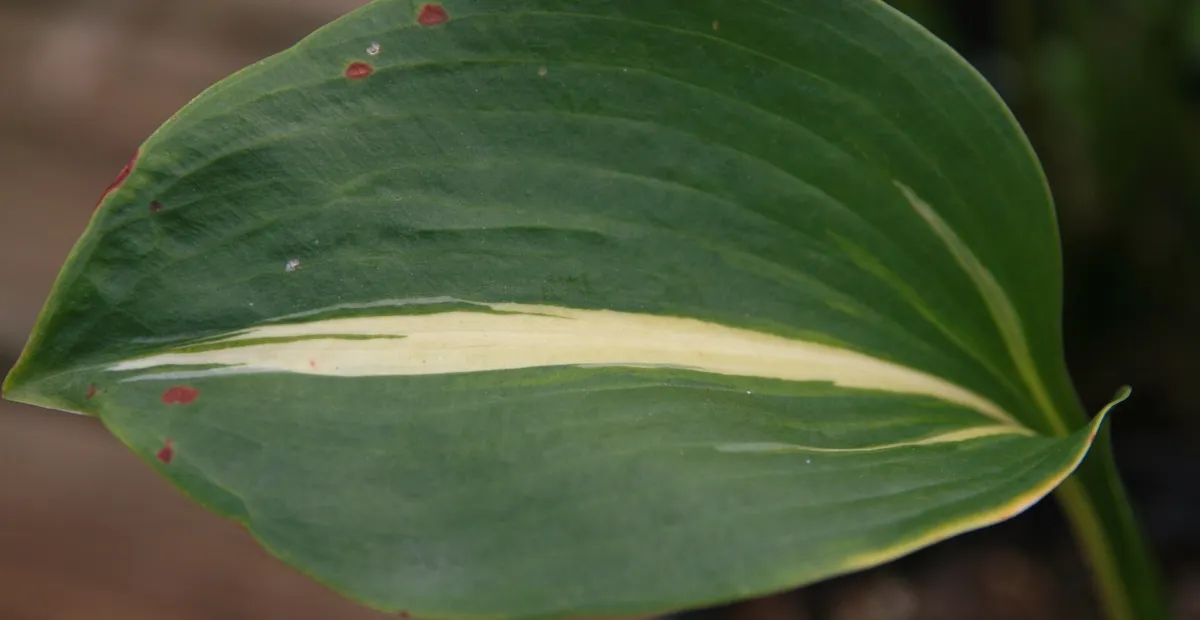
Leaves are large, thick, blue-green, heart-shaped to broadly ovate, and deeply furrowed or corrugated. New growth shows golden centers surrounded by blue-green margins; the centers mature toward cream-white while the margins darken. Upright flower scapes rise above the mound and carry pale flowers.
Flowering
Upright scapes rise above the foliage and carry racemes of small, tubular white flowers. The cultivar is documented as flowering in late spring and continuing into early summer, although timing shifts with climate. Flower display is secondary to the strongly textured foliage.
Pollination and visitors
Hosta flowers are documented as attractive to pollinators and hummingbirds. For this cultivar, the white tubular flowers can provide nectar and pollen to visiting bees, bumblebees, butterflies, and hummingbirds, although visitation varies with local habitat and competing blooms.
Hosta 'Thunderbolt' photos
Click any photo for a larger view. Source, author and license are shown separately.
Diseases and pests
Diseases
Avoid prolonged wetness around the crown and remove badly affected foliage. Hosta can develop anthracnose, crown or root rot, Hosta Virus X, tobacco rattle virus, and tomato ringspot virus. Buy clean stock, disinfect tools, improve drainage, and remove symptomatic plants when viral infection is suspected.
Pests
Slugs and snails are the main pests, leaving holes or ragged margins in leaves. Water at the soil surface, remove hiding places, use barriers or iron phosphate baits where appropriate, and avoid unnecessarily dense, wet mulch. Deer and rabbits may also browse foliage; fencing or repellents may be needed.
Related diseases and pests
Only Plant Doctor profiles whose host data indicate this plant may be affected are shown here.
 DiseaseImpatiens necrotic spot virus diseaseImpatiens necrotic spot orthotospovirus
 DiseaseSouthern blightAthelia rolfsii
 PestStrawberry foliar nematodeAphelenchoides fragariae
 Environmental stressExcess light stress
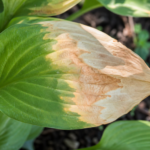 Environmental stressLeaf sunburn
 DiseaseAnthracnoseColletotrichum gloeosporioides
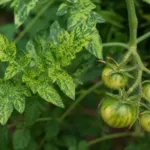 DiseaseTomato mosaic virusTobamovirus tomatotessellati
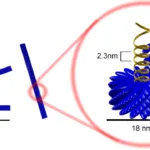 DiseaseTobacco mosaic virusTobamovirus tabaci
Toxicity and pollen
Hosta is listed by ASPCA as toxic to dogs and cats because of saponins, with vomiting, diarrhea, and depression reported after ingestion. The cultivar-specific risk is not separately studied, so keep plant material away from pets and seek veterinary advice after significant ingestion. Human toxicity evidence for this cultivar is limited; avoid eating it and wash hands after handling damaged material.
- Typical season
- Flowering period, typically June–July in much of the United States
- Pollination / pollen
- Insect-dispersed pollen
Hosta pollen is released from exposed anthers during flowering, but the plant is generally insect-pollinated rather than a major wind-pollen source. Airborne allergy relevance is therefore expected to be low, though individual sensitivity cannot be ruled out.
Native habitat
The cultivar is a cultivated garden plant derived from Hosta sieboldiana stock rather than a wild population. Hostas are adapted to cool, moist woodland-edge conditions with organic soils, filtered light, and seasonal dormancy. Their broad leaves are vulnerable to scorching in hot afternoon sun and to slug damage in persistently damp sites.
Interesting fact
Discovered as a sport of Hosta sieboldiana 'Elegans' in Hickory, North Carolina. Young leaves have golden centers that mature toward cream-white. Its thick, deeply furrowed leaves distinguish it from the parent cultivar. The cultivar was introduced under US Plant Patent 14,232.
Frequently asked questions (FAQ)
The most relevant questions about this plant, with short and direct answers.
🌱Quick care
What is Hosta 'Thunderbolt'?⌄
Hosta 'Thunderbolt' is a vigorous, clump-forming perennial grown for large blue-green leaves with golden centers that mature to cream-white. It is also known as a plantain lily and produces white flowers in summer.
How big does Hosta 'Thunderbolt' get?⌄
Hosta 'Thunderbolt' typically grows about 24–30 inches tall and 28–36 inches wide, with flower stalks reaching roughly 30 inches. Mature size depends on soil moisture, shade, and how often the clump is divided.
Is Hosta 'Thunderbolt' easy to grow?⌄
Yes, Hosta 'Thunderbolt' is generally easy to grow when planted in shade or partial shade with evenly moist, fertile soil. Protect it from prolonged drought, harsh afternoon sun, slugs, and snails.
🌤️Environment and placement
Does Hosta 'Thunderbolt' need full shade or partial shade?⌄
Hosta 'Thunderbolt' grows best in partial shade to full shade, especially with protection from hot afternoon sun. Bright morning light or filtered light can help maintain strong leaf coloration without causing scorch.
Can Hosta 'Thunderbolt' grow in morning sun?⌄
Yes, Hosta 'Thunderbolt' can usually tolerate gentle morning sun if the soil stays consistently moist. Avoid intense afternoon sun, which can bleach or scorch the leaves and dry the plant quickly.
What type of soil is best for Hosta 'Thunderbolt'?⌄
Use rich, organic, moisture-retentive soil that drains well. Adding compost or leaf mold improves moisture consistency and soil structure, but avoid sites that remain waterlogged.
What USDA hardiness zones are suitable for Hosta 'Thunderbolt'?⌄
Hosta 'Thunderbolt' is commonly listed as hardy in USDA Zones 3–8, although some horticultural sources extend the range to Zone 9. In warmer areas, deeper shade and reliable moisture are especially important.
Can Hosta 'Thunderbolt' grow in a container?⌄
Yes, Hosta 'Thunderbolt' grows well in a large container with drainage holes, rich potting mix, and shade. Containers dry out faster than garden soil, so check moisture regularly during hot weather.
💧Care and problems
How often should I water Hosta 'Thunderbolt'?⌄
Water Hosta 'Thunderbolt' deeply whenever the soil surface begins to dry, keeping the root zone evenly moist. Newly planted plants and container specimens may need watering several times per week during hot, dry weather.
Why are the leaves of my Hosta 'Thunderbolt' turning brown?⌄
Brown leaf edges on Hosta 'Thunderbolt' usually indicate drought stress, excessive sun, heat, or wind exposure. Move container plants to deeper shade and water the root zone consistently rather than wetting the foliage only.
Why is my Hosta 'Thunderbolt' losing its variegation?⌄
Reduced variegation can result from low light, seasonal changes, or a reversion of part of the plant to solid green growth. Remove completely green shoots at the base if they begin to outgrow the variegated portions.
What pests commonly attack Hosta 'Thunderbolt'?⌄
Slugs and snails are the most common pests on Hosta 'Thunderbolt', leaving ragged holes in the leaves. Hand-picking, reducing hiding places, and using a labeled slug control product can help protect new foliage.
Does Hosta 'Thunderbolt' need fertilizer?⌄
Hosta 'Thunderbolt' usually needs only moderate fertilization in fertile soil. Apply compost in spring or use a balanced, slow-release fertilizer according to the label, avoiding heavy late-season feeding.
Should I mulch Hosta 'Thunderbolt'?⌄
Yes, apply about 2–3 inches of organic mulch around Hosta 'Thunderbolt' to conserve moisture and moderate soil temperature. Keep mulch slightly away from the crown to reduce the risk of rot.
🪴Planting and repotting
When is the best time to plant Hosta 'Thunderbolt'?⌄
Plant Hosta 'Thunderbolt' in spring or early fall while temperatures are moderate and soil moisture is reliable. Spring planting gives the roots a full growing season to establish before winter.
How deep should I plant Hosta 'Thunderbolt'?⌄
Plant Hosta 'Thunderbolt' with the crown at soil level, where the roots meet the leaf stems. Cover the roots completely but do not bury the crown deeply, because excessive moisture around it can encourage rot.
✂️Propagation and pruning
How do you propagate Hosta 'Thunderbolt'?⌄
Propagate Hosta 'Thunderbolt' by dividing the established clump in early spring or late summer. Each division should include healthy roots and at least one growing bud, and patented plants should not be propagated commercially.
Can Hosta 'Thunderbolt' be grown from seed?⌄
It can produce seeds, but seedlings will not reliably reproduce the exact 'Thunderbolt' foliage pattern. Division is the preferred method when you want plants that retain the cultivar’s characteristic variegation.
When should I cut back Hosta 'Thunderbolt'?⌄
Remove old Hosta 'Thunderbolt' foliage after it yellows and dies back in fall or before new shoots emerge in early spring. No routine pruning is needed during the growing season unless leaves are damaged.
⚠️Toxicity and safety
Is Hosta 'Thunderbolt' toxic to dogs and cats?⌄
Yes, Hosta 'Thunderbolt' is toxic to dogs and cats if ingested. It can cause gastrointestinal upset, so keep pets from eating the leaves, flowers, or other plant parts and contact a veterinarian if ingestion occurs.
🌸Flowering and special interest
When does Hosta 'Thunderbolt' bloom?⌄
Hosta 'Thunderbolt' usually blooms in late spring to summer, with upright stems bearing white, funnel-shaped flowers. Bloom timing varies with climate, planting site, and the season’s temperatures.
What color flowers does Hosta 'Thunderbolt' have?⌄
Hosta 'Thunderbolt' produces white flowers, typically held above the foliage on upright stems. The flowers are ornamental, but the cultivar is primarily valued for its bold variegated leaves.
Should I remove the flower stalks from Hosta 'Thunderbolt'?⌄
Remove the flower stalks after blooming if you prefer a tidier appearance or want the plant’s energy directed toward foliage and roots. Leaving them in place does not normally harm a healthy plant.
Similar plants
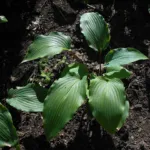 Hosta ‘Red October’Hosta 'Red October'
 Plantain lily ‘Revolution’ (Hosta ‘Revolution’)Hosta 'Revolution'
 Vascular Plants (Tracheophyta) care guideTracheophyta
 Elegans (Hosta sieboldiana ‘Elegans’)Hosta sieboldiana 'Elegans'
 Hosta ‘Regal Splendor’Hosta 'Regal Splendor'
 Hosta ‘Sum and Substance’Hosta 'Sum and Substance'