
 Source:
Elegans (Hosta sieboldiana ‘Elegans’) short overview
Hosta sieboldiana 'Elegans' is a classic large hosta valued for its broad, heart-shaped blue-green leaves, pronounced corrugation, and substantial texture. This slow-growing, clump-forming perennial performs best in partial to full shade and evenly moist, organic-rich soil. Pale flowers rise above the foliage in summer and may attract bumblebees and hummingbirds. It is a durable choice for woodland borders, shaded beds, and large containers, but ingestion can harm dogs and cats.
Taxonomic classification
Elegans (Hosta sieboldiana ‘Elegans’) care guide
Light and placement
Choose partial shade to full shade, especially with morning sun or bright filtered light and protection from intense afternoon heat. Too much direct sun can bleach or scorch the blue foliage and increase moisture stress. Too little light may produce looser growth and weaker flowering, although dense shade is tolerated if soil moisture remains steady.
Watering and humidity
Water deeply when the upper inch of soil begins to dry, keeping the root zone evenly moist rather than constantly saturated. Increase watering during hot, windy periods and reduce it after dormancy begins, while preventing prolonged winter wetness. Mulch can moderate soil temperature and evaporation, but keep it clear of the crown.
Soil and growing medium
Use moist, humus-rich loam that drains freely but does not dry rapidly. A soil pH from slightly acidic to neutral is suitable. Improve sandy ground with compost for moisture retention and break up compacted clay with organic matter and better drainage. Avoid persistently waterlogged sites, which can encourage crown and root problems.
Feeding
Apply compost or a balanced slow-release fertilizer in spring as shoots emerge. A second light feeding is usually unnecessary in fertile soil. Avoid heavy late-season nitrogen, which can produce soft growth and delay dormancy. Water fertilizer in thoroughly and keep granules away from the crown and directly against the leaf bases.
Growth and habit
This cultivar forms a broad, slowly enlarging clump from a short rhizomatous crown. It benefits from patience after planting and looks more substantial as the crown increases in divisions. The thick foliage can suppress some small weeds, but crowded, wet growth should be thinned or divided to maintain vigor and reduce disease pressure.
Planting and repotting
Plant in spring or early fall, setting the crown at soil level and spreading roots naturally. Water deeply after planting and mulch with organic material, keeping mulch away from the crown. Allow about 4 feet of horizontal space for a mature specimen where a full clump is desired; closer spacing is possible for a gradual mass planting.
Repot container-grown plants in spring as growth begins, moving up only one pot size. Divide or refresh congested root systems carefully, keeping the crown at the same depth. Use a moisture-retentive but well-drained potting mix and a heavy container that will not tip as the clump enlarges.
Propagation and pruning
Propagation
Divide established clumps in spring as shoots emerge or in early fall. Lift the crown, separate sections with healthy roots and buds, and replant promptly. Seed is possible but does not reliably reproduce the named cultivar, so division is the preferred method for maintaining 'Elegans' traits.
Pruning
Remove yellowing or frost-damaged leaves at ground level after they collapse. Cut flower scapes after flowering if seed production is not desired, or leave them temporarily for structural interest. Clear dead foliage in late fall or early spring to reduce hiding places for slugs and overwintering disease material.
Overwintering
Leave healthy foliage in place until frost or natural collapse, then remove it in late fall or early spring. Established plants are cold hardy in much of the United States and generally need no indoor protection. In containers, protect roots from repeated freeze-thaw cycles by grouping pots in a sheltered spot or insulating the container.
Uses
Use as a specimen or massed foliage perennial in shaded beds, woodland gardens, foundation plantings, and large containers. Its broad leaves provide strong contrast with ferns, heucheras, astilbes, and fine-textured grasses. It is ornamental rather than a recommended edible or medicinal plant, and should be kept away from pets because hostas are toxic when eaten.
Appearance
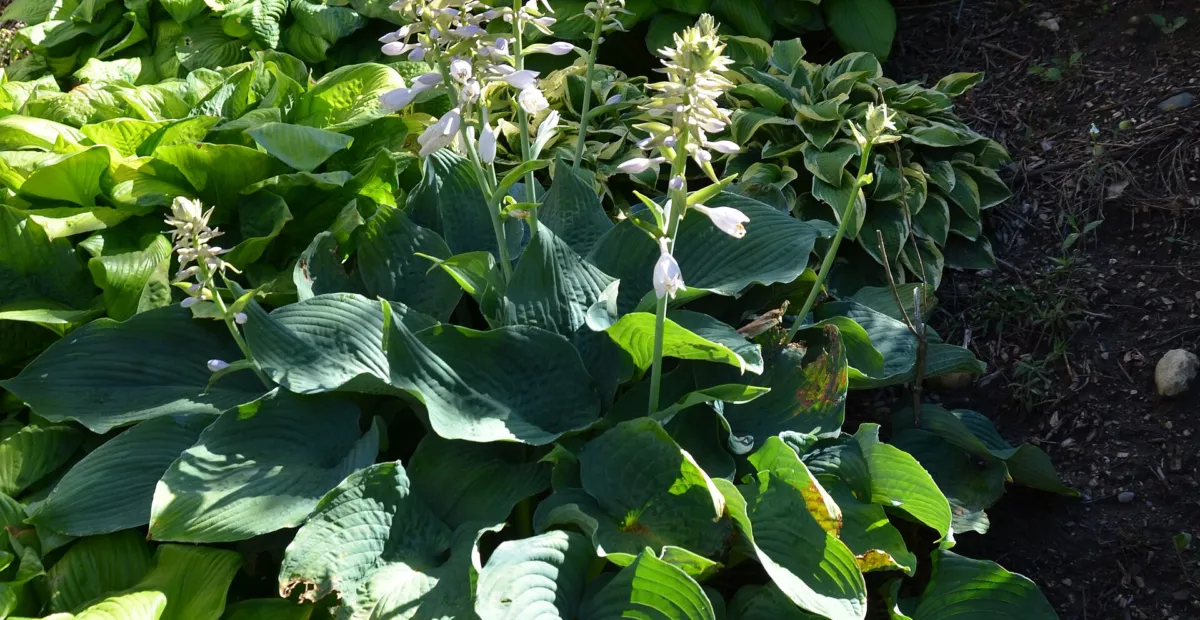
The plant is recognized by broad, heart-shaped leaves with a blue-green to blue-gray waxy surface, thick substance, deep corrugation, prominent parallel veins, and pointed tips. Leaves arise from a dense basal crown, while smooth scapes rise above the foliage and carry pale tubular flowers. Blue wax may diminish with rain, rubbing, or intense sun.
Flowering
Tall, leafless scapes carry racemes of funnel-shaped flowers that open from the lower portions upward. Flowers are generally white to pale lavender-tinged, with flowering usually occurring from late spring into summer depending on climate. The cultivar is grown mainly for its foliage rather than for a long floral display.
Pollination and visitors
The flowers are primarily visited and pollinated by bumblebees; hummingbirds may visit the upright flower scapes. Animal visitation is separate from human allergy risk, and the cultivar should not be described as allergen-free.
Hosta sieboldiana 'Elegans' photos
Click any photo for a larger view. Source, author and license are shown separately.
Diseases and pests
Diseases
Reduce crown and root disease risk with good drainage, careful watering, clean tools, and removal of decaying foliage. Watch for crown rot, petiole rot, and foliar fungal spotting. Avoid burying the crown or allowing dense mulch to stay wet against it; remove badly affected tissue and improve air movement around crowded plants.
Pests
Slugs and snails commonly rasp holes in emerging and mature leaves; deer and rabbits may also browse. Reduce sheltering debris, water early rather than late, use barriers or traps, and choose labeled controls only when needed. Avoid overhead irrigation that keeps foliage wet overnight. Regular inspection is especially useful during cool, damp spring weather.
Related diseases and pests
Only Plant Doctor profiles whose host data indicate this plant may be affected are shown here.
 DiseaseImpatiens necrotic spot virus diseaseImpatiens necrotic spot orthotospovirus
 DiseaseSouthern blightAthelia rolfsii
 PestStrawberry foliar nematodeAphelenchoides fragariae
 Environmental stressExcess light stress
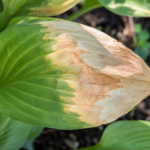 Environmental stressLeaf sunburn
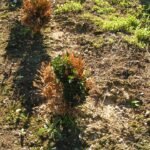 DiseasePhytophthora root and crown rotPhytophthora nicotianae
Toxicity and pollen
Hostas contain saponins and are listed by the ASPCA as toxic to dogs and cats; ingestion may cause vomiting, diarrhea, and depression. Evidence is strongest for pet exposure, while cultivar-specific human toxicity data are limited. Prevent chewing, especially by pets, and contact a veterinarian or poison service after suspected ingestion.
- Typical season
- During flowering, typically June through August in much of the United States
- Pollination / pollen
- Heavy, insect-carried pollen
Hosta flowers are insect-pollinated rather than wind-pollinated, so their relatively heavy pollen is not typically dispersed widely through the air. Direct flower contact can still expose sensitive people, and individual reactions cannot be ruled out. The plant is generally a low airborne-pollen concern in residential landscapes.
Native habitat
The species is associated with moist, shaded woodland conditions in Japan, including forest margins and humus-rich soils. Garden cultivation places it outside its native range, but its preference for filtered light, organic soil, and regular moisture reflects those woodland adaptations.
Interesting fact
The cultivar was introduced in the early twentieth century and became a benchmark for large blue-leaved hostas. Its thick, waxy foliage shows strong corrugation and prominent parallel veins. Mature clumps can take several years to reach full size. Bumblebees are documented as important flower visitors for Hosta sieboldiana.
Frequently asked questions (FAQ)
The most relevant questions about this plant, with short and direct answers.
🌱Quick care
What is Hosta sieboldiana 'Elegans' commonly called?⌄
Hosta sieboldiana 'Elegans' is commonly called giant blue hosta, although common names can vary by nursery and region.
Is Hosta sieboldiana 'Elegans' easy to grow?⌄
Yes, Hosta sieboldiana 'Elegans' is generally easy to grow when planted in partial shade, kept evenly moist, and given rich, well-drained soil.
How big does Hosta sieboldiana 'Elegans' get?⌄
Hosta sieboldiana 'Elegans' forms a large clump, commonly reaching about 20 inches tall and roughly 40 inches wide, with flower stalks that can reach 3 feet or more.
🌤️Environment and placement
Does Hosta sieboldiana 'Elegans' grow in full shade?⌄
Yes, it grows in full shade, but bright or dappled shade usually produces stronger growth and better foliage color than very dark conditions.
Can Hosta sieboldiana 'Elegans' grow in full sun?⌄
It can tolerate some morning sun if the soil stays reliably moist, but hot afternoon sun may scorch its blue leaves and is usually best avoided.
What is the best location for Hosta sieboldiana 'Elegans'?⌄
Plant it in a sheltered spot with partial shade to shade, protection from hot afternoon sun, and soil that remains evenly moist without staying waterlogged.
What soil does Hosta sieboldiana 'Elegans' need?⌄
It prefers moist, humus-rich, well-drained loam that is fertile and holds moisture without becoming soggy.
What USDA hardiness zones are suitable for Hosta sieboldiana 'Elegans'?⌄
Hosta sieboldiana 'Elegans' is generally considered hardy in USDA Zones 3 through 8, although performance can vary with local winter exposure and summer heat.
💧Care and problems
How often should I water Hosta sieboldiana 'Elegans'?⌄
Water it whenever the upper soil begins to dry, giving enough moisture to keep the root zone evenly damp during active growth and summer heat.
Why are holes appearing in my Hosta sieboldiana 'Elegans' leaves?⌄
Irregular holes are most often caused by slugs or snails, especially in cool, moist shade; inspect beneath leaves and around the crown after dark.
How do I protect Hosta sieboldiana 'Elegans' from slugs?⌄
Reduce hiding places, improve air circulation, water in the morning, and handpick or trap slugs at night; barrier products or labeled baits can provide additional control.
Why are the leaves of my Hosta sieboldiana 'Elegans' turning brown?⌄
Brown leaf edges or patches usually indicate heat, drought, excessive sun, wind exposure, or physical damage, so check moisture and provide afternoon shade.
Does Hosta sieboldiana 'Elegans' need fertilizer?⌄
It benefits from a spring application of balanced, slow-release fertilizer or compost, but excessive fertilizer can encourage soft growth and is usually unnecessary.
Should I mulch Hosta sieboldiana 'Elegans'?⌄
Yes, apply about 2 inches of organic mulch around the plant while keeping it away from the crown to conserve moisture and moderate soil temperature.
🪴Planting and repotting
When should I plant Hosta sieboldiana 'Elegans'?⌄
Plant it in spring or early fall, allowing several weeks for root establishment before extreme summer heat or hard winter conditions.
How far apart should I plant Hosta sieboldiana 'Elegans'?⌄
Allow about 3 to 4 feet of space between plants so the mature clumps can expand without crowding.
Can Hosta sieboldiana 'Elegans' grow in a container?⌄
Yes, it can grow in a large container with drainage holes, moisture-retentive potting mix, and protection from intense sun and extreme winter temperature swings.
✂️Propagation and pruning
How do I propagate Hosta sieboldiana 'Elegans'?⌄
Propagate it by division, separating sections of the crown with roots and growing points; division is most practical in spring as new growth begins.
When should I divide Hosta sieboldiana 'Elegans'?⌄
Divide it in early spring before the leaves fully expand or in early fall, avoiding periods of extreme heat or drought.
Can Hosta sieboldiana 'Elegans' be grown from seed?⌄
Yes, it can produce viable seed, but seedlings may not reproduce the parent’s exact foliage characteristics, so division is preferred for true-to-type plants.
Should I cut back Hosta sieboldiana 'Elegans' in fall?⌄
Remove collapsed or frost-damaged foliage after it dies back, usually in late fall or early winter, to keep the planting tidy and reduce overwintering debris.
Does Hosta sieboldiana 'Elegans' come back every year?⌄
Yes, it is a hardy herbaceous perennial that dies back in winter and regrows from its crown in spring.
⚠️Toxicity and safety
Is Hosta sieboldiana 'Elegans' toxic to dogs?⌄
Yes, hostas are toxic to dogs if eaten and may cause vomiting, diarrhea, or depression, so contact a veterinarian if ingestion occurs.
Is Hosta sieboldiana 'Elegans' toxic to cats?⌄
Yes, hostas are toxic to cats if ingested and can cause gastrointestinal upset, so seek veterinary advice after suspected consumption.
Is Hosta sieboldiana 'Elegans' deer resistant?⌄
No, it should not be considered reliably deer resistant because deer may browse hosta foliage, particularly where other food is limited.
🌸Flowering and special interest
When does Hosta sieboldiana 'Elegans' bloom?⌄
It usually blooms in early to midsummer, producing pale lilac to nearly white, bell-shaped flowers on tall stalks.
What do the flowers of Hosta sieboldiana 'Elegans' look like?⌄
The flowers are funnel- or bell-shaped, mostly white to pale lilac, and appear in dense clusters above the blue-gray foliage.
Should I remove the flower stalks from Hosta sieboldiana 'Elegans'?⌄
Remove the flower stalks after blooming if you prefer a foliage-focused appearance, but leaving them does not harm an otherwise healthy plant.
Why is my Hosta sieboldiana 'Elegans' not flowering?⌄
Poor flowering is commonly linked to a young or recently divided plant, insufficient light, drought, overcrowding, or excessive nitrogen fertilizer.
Similar plants
 Narrow-leaved Plantain-lily (Hosta lancifolia) care guideHosta lancifolia
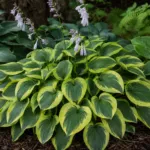 Hosta ‘Yellow Polka Dot Bikini’Hosta 'Yellow Polka Dot Bikini'
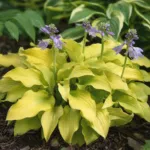 Hosta ‘Sun Mouse’Hosta 'Sun Mouse'
 Hosta ‘Victory’Hosta 'Victory'
 Hosta ‘Sum and Substance’Hosta 'Sum and Substance'
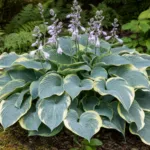 Hosta ‘Valley’s Glacier’Hosta 'Valley's Glacier'