
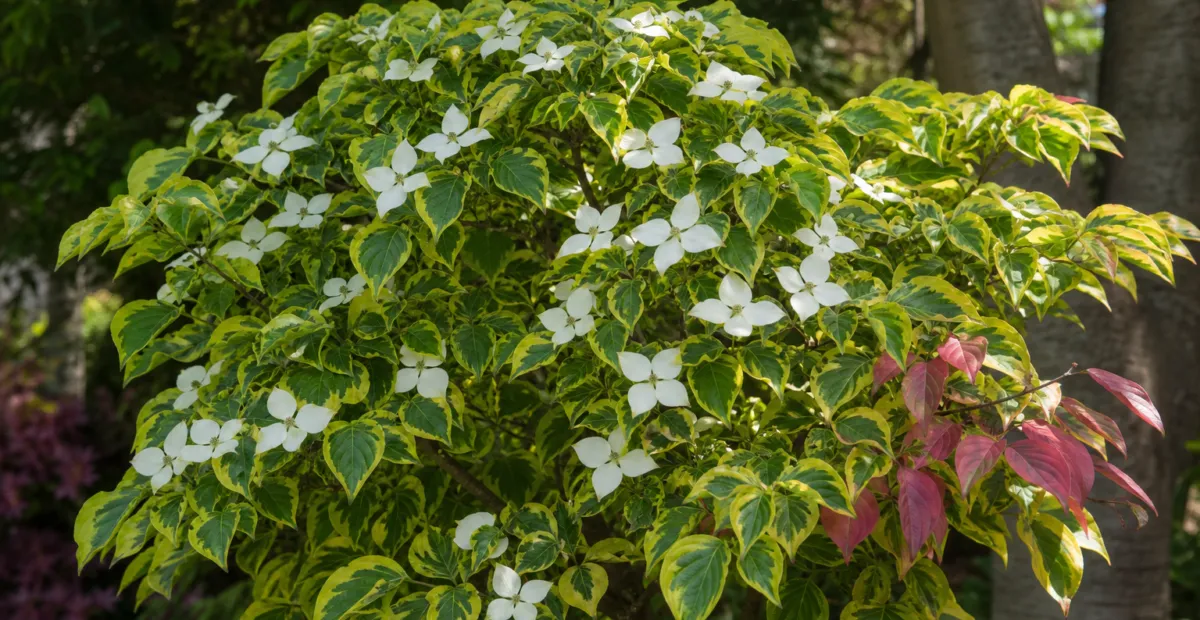
 AI-generated illustration
Cornus ‘Celestial Shadow’ short overview
Cornus 'Celestial Shadow' is a distinctive hybrid dogwood with green leaves edged broadly in golden yellow, followed by a dramatic transition to pink, burgundy, purple, and red in autumn. Large white bracts appear in late spring to early summer around the small true flowers. This deciduous tree or large shrub performs best in fertile, well-drained soil that stays moderately moist, in full sun or partial shade.
Taxonomic classification
Cornus ‘Celestial Shadow’ care guide
Light and placement
Grow in full sun to partial shade, ideally with morning or filtered light and protection from the hottest afternoon sun in hot climates. East- or west-facing exposures are suitable where soil moisture is reliable. Too much intense sun combined with drought can scorch the yellow margins; too little light may reduce vigor, flowering, and variegation contrast.
Watering and humidity
Water deeply when the upper few inches of soil begin to dry, rather than applying frequent shallow sprinklings. Keep newly planted trees evenly moist through their first growing seasons and irrigate during summer drought. Mulch the root zone to moderate temperature and evaporation, but keep mulch away from the trunk.
Soil and growing medium
Use fertile, humus-rich soil that drains freely but does not dry rapidly. Loam is ideal, though established plants can tolerate clay or sand when improved with organic matter. Soil may be acidic, neutral, or mildly alkaline; avoid chronically waterlogged sites and compacted planting holes.
Feeding
Spread compost or a slow-release balanced tree-and-shrub fertilizer in spring as growth begins, following the product label. Avoid heavy nitrogen feeding, which can produce lush, weak growth and reduce overall balance. Do not fertilize drought-stressed, newly transplanted, or seriously diseased plants until they recover.
Growth and habit
This hybrid develops as a vigorous, upright-to-spreading deciduous tree or large shrub, becoming broadly rounded with age. Give it room for mature branching and maintain a clear, uncrowded root zone. Its variegated leaves may scorch in intense heat or drought, while insufficient light can weaken color contrast.
Planting and repotting
Plant in spring or fall while temperatures are moderate. Set the root flare level with or slightly above the surrounding soil, water deeply, and mulch over the root zone without touching the trunk. Allow approximately 15–20 feet for a specimen, adjusting spacing for the intended form and site.
Best planted in the ground. If grown temporarily in a container, move it into a larger pot before roots circle densely and transplant during dormancy or mild spring weather. Protect the root ball from drying and provide excellent drainage.
Propagation and pruning
Propagation
Propagate commercially by grafting or semi-hardwood cuttings. Cultivar characteristics are not reliably preserved from seed. Semi-hardwood cuttings are generally taken in summer under controlled moisture, while grafting is best left to experienced propagators.
Pruning
Prune mainly to remove dead, damaged, crossing, or poorly positioned branches. Shape lightly after flowering or during dormancy, avoiding unnecessary removal of the developing framework. Disinfect tools between cuts when disease is suspected, and do not top the tree.
Overwintering
Established plants generally overwinter outdoors within their suitable USDA range. Water newly planted trees before the ground freezes, maintain a 2–3 inch mulch layer over the root zone, and protect young trunks from animal damage and drying winter winds. Avoid late-season nitrogen that can delay hardening.
Uses
A specimen tree or large accent shrub for beds, lawns, woodland edges, courtyards, and informal landscapes. Its strongest landscape qualities are variegated summer foliage, late-spring bracts, and multicolored autumn display. Use only as an ornamental unless fruit identity and edibility are independently confirmed.
Appearance
Leaves are medium green with a conspicuous broad golden-yellow margin during spring and summer. As temperatures fall, the variegation can shift through pink, fuchsia, purple, burgundy, and red. The tree has layered branching, a rounded mature outline, and conspicuous white bracts after leaf emergence.
Flowering
The showy display comes from four broad white bracts surrounding a central cluster of small yellow-green true flowers. Flowers appear after the foliage has emerged, generally from May into June in much of the United States. Bracts may acquire a soft pink cast as they age.
Pollination and visitors
The small central flowers are visited by insect pollinators, with nursery and garden references specifically noting bees and broader pollinator activity. The large white bracts function mainly as visual attractants around the true flowers; no single pollinator species is sufficiently documented here to name.
Diseases and pests
Diseases
Choose a site with good air circulation, avoid trunk and leaf wetting when possible, and remove fallen diseased foliage. This hybrid is described as more disease-resistant than some older flowering dogwoods, but anthracnose and other Cornus diseases can still occur under stressful, wet conditions.
Pests
Usually low-maintenance, but scale insects may occur. Inspect stems and leaf undersides, especially on stressed trees. Improve vigor with correct planting depth, mulch, irrigation during drought, and pruning of badly affected material rather than routine broad-spectrum spraying.
Related diseases and pests
Only Plant Doctor profiles whose host data indicate this plant may be affected are shown here.
 DiseasePhytophthora plurivora Root and Collar RotPhytophthora plurivora
 PestEuropean Fruit Lecanium ScaleParthenolecanium corni
 DiseaseCoral Spot CankerNectria cinnabarina
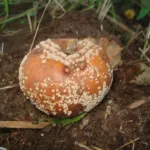 DiseaseEuropean brown rotMonilinia fructigena
 DiseasePhytophthora cactorum crown, collar, root and fruit rotPhytophthora cactorum
 Environmental stressUnderwatering
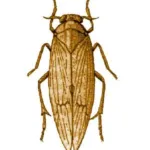 PestBrown planthopperNilaparvata lugens (Stål)
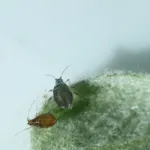 PestRosy Apple AphidDysaphis plantaginea
Toxicity and pollen
No reliable exact-cultivar toxicity assessment was located. Dogwood species and hybrids are not generally treated as major poisonous landscape plants, but plant material should not be intentionally eaten, and unidentified fruits should be kept away from children and pets. Contact a poison-control service after a suspected ingestion.
- Typical season
- May–June
- Pollination / pollen
- Insect-borne pollen
As an insect-pollinated flowering tree, its pollen is not typically dispersed in large airborne clouds like wind-pollinated trees. Individual sensitivity is still possible, and local exposure may increase during bloom, so allergy-prone gardeners should observe their own response rather than assume zero risk.
Native habitat
It is a cultivated hybrid associated with the Rutgers flowering-dogwood breeding program rather than a naturally occurring wild taxon. Its parentage is generally described as involving Cornus florida and Cornus kousa, so it combines traits from eastern North American and East Asian dogwoods. Garden performance is best in temperate climates with fertile, well-drained soil.
Interesting fact
This cultivar is described as a sport or mutation of the hybrid dogwood 'Celestial'. Its fall color can develop through pink, fuchsia, purple, burgundy, and red tones rather than a single uniform shade. The showy parts commonly called flowers are bracts; the true flowers are small and clustered at their center.
Frequently asked questions (FAQ)
The most relevant questions about this plant, with short and direct answers.
🌱Quick care
What is Cornus 'Celestial Shadow' commonly called?⌄
Cornus 'Celestial Shadow' is generally sold in the United States as Celestial Shadow Dogwood or hybrid flowering dogwood. It is a deciduous ornamental tree in the dogwood group.
How big does Cornus 'Celestial Shadow' get?⌄
Cornus 'Celestial Shadow' typically reaches about 15–20 feet tall and wide at maturity. Growth habit and final size vary with climate, rootstock, and growing conditions.
Is Celestial Shadow Dogwood deciduous?⌄
Yes, Celestial Shadow Dogwood is deciduous and drops its leaves in fall. Its spring and summer variegation is followed by pink, purple, red, or burgundy fall color.
What are the main features of Cornus 'Celestial Shadow'?⌄
Its main features are broad yellow-gold leaf margins, white spring bracts, and colorful fall foliage. The upright to rounded form also makes it useful as a specimen tree.
🌤️Environment and placement
How much sun does Cornus 'Celestial Shadow' need?⌄
Cornus 'Celestial Shadow' grows in full sun to partial shade. In hot climates, afternoon shade and consistent soil moisture can help prevent leaf-edge scorch.
Can Celestial Shadow Dogwood grow in partial shade?⌄
Yes, partial shade is suitable, especially where summers are hot. Too much shade can reduce flowering and may make the variegated foliage less vigorous.
What USDA hardiness zones are suitable for Celestial Shadow Dogwood?⌄
Published nursery information places Celestial Shadow Dogwood mainly in USDA Zones 5–8, with some sources extending it into Zone 9. Local heat, winter exposure, and moisture can affect performance at the margins.
What type of soil does Cornus 'Celestial Shadow' prefer?⌄
It prefers fertile, humus-rich, well-drained soil that stays moderately and consistently moist. Loam amended with organic matter is usually a good planting medium.
Can Cornus 'Celestial Shadow' tolerate clay soil?⌄
It can grow in clay soil if drainage is adequate and the soil is improved with organic matter. Avoid sites that remain waterlogged after rain.
Is Celestial Shadow Dogwood tolerant of heat?⌄
It has some heat tolerance but performs best with reliable moisture and protection from intense reflected afternoon heat. Mulching the root zone is especially helpful during hot, dry weather.
Where should I plant Cornus 'Celestial Shadow' in the landscape?⌄
Plant it as a specimen near a lawn, woodland edge, foundation, or mixed border where its foliage can be viewed closely. Allow roughly 15–20 feet of growing space unless you plan to prune it.
💧Care and problems
How often should I water Celestial Shadow Dogwood?⌄
Water deeply whenever the upper soil begins to dry, providing moderate, consistent moisture rather than frequent shallow watering. Newly planted trees need closer monitoring than established trees, especially during summer.
Does Cornus 'Celestial Shadow' need mulch?⌄
Yes, apply about 2–4 inches of organic mulch over the root zone to conserve moisture and moderate soil temperature. Keep mulch several inches away from the trunk.
Why are the leaves of my Celestial Shadow Dogwood turning brown?⌄
Brown leaf edges are commonly caused by drought, heat, reflected light, or inconsistent watering. Improve deep watering and mulch, and provide afternoon shade if the site is especially hot.
Is Cornus 'Celestial Shadow' disease resistant?⌄
It was developed as a disease-resistant hybrid and is generally considered more resistant than many older flowering dogwoods. However, anthracnose, powdery mildew, and other problems can still occur under stressful conditions.
What pests affect Celestial Shadow Dogwood?⌄
Celestial Shadow Dogwood is generally low-maintenance, but scale insects and other common ornamental-tree pests may occasionally appear. Inspect stems and leaf undersides before using any treatment.
Does Celestial Shadow Dogwood need fertilizer?⌄
Fertilizer is usually unnecessary when the tree grows in fertile soil and produces healthy foliage. If growth is weak, test the soil before applying a slow-release, balanced fertilizer.
🪴Planting and repotting
When is the best time to plant Cornus 'Celestial Shadow'?⌄
Plant it in spring or fall when temperatures are moderate and soil moisture is dependable. Fall planting is often useful in regions with mild autumn weather, while spring is safer in colder areas.
How far apart should Celestial Shadow Dogwoods be planted?⌄
For a specimen, allow about 15–20 feet from buildings, large trees, and other plants. Closer spacing is possible for a grouped planting, but mature crowns may eventually overlap.
Can Cornus 'Celestial Shadow' be grown in a container?⌄
It is best grown in the ground because it matures into a small tree with a substantial root system. A very large container may support a young specimen temporarily, but long-term growth and winter protection become difficult.
How do I plant a Celestial Shadow Dogwood?⌄
Dig a hole no deeper than the root ball and at least twice as wide, then set the tree with the root flare at or slightly above soil level. Backfill with native soil, water deeply, and add a mulch ring without covering the trunk.
✂️Propagation and pruning
How is Cornus 'Celestial Shadow' propagated?⌄
This cultivar is generally propagated by grafting or semi-hardwood cuttings. Seed will not reliably reproduce the distinctive cultivar characteristics.
Can I grow Celestial Shadow Dogwood from seed?⌄
Growing it from seed is not recommended for maintaining the cultivar. Seedlings can differ from the parent in foliage, form, and flowering because this is a named hybrid selection.
When should I prune Cornus 'Celestial Shadow'?⌄
Prune lightly after flowering or during the dormant season to remove dead, damaged, crossing, or poorly placed branches. Avoid heavy pruning, which can spoil the tree’s natural structure and reduce future flowering.
Does Celestial Shadow Dogwood need regular pruning?⌄
No, regular heavy pruning is not usually needed. Young trees may benefit from structural training, while mature trees generally require only occasional corrective pruning.
⚠️Toxicity and safety
Is Cornus 'Celestial Shadow' toxic to dogs or cats?⌄
A specific toxicity assessment for Cornus 'Celestial Shadow' was not located, so its exact pet-safety status is uncertain. Prevent pets and children from eating the plant or its fruit, and contact a veterinarian or poison-control service if ingestion occurs.
🌸Flowering and special interest
When does Cornus 'Celestial Shadow' bloom?⌄
It usually blooms in late spring, commonly from April through June depending on the climate. The showy white structures are bracts surrounding small central flowers.
What color are the flowers on Celestial Shadow Dogwood?⌄
The flower bracts are white to creamy white and may develop a soft pink blush as they age. Bloom intensity depends on tree maturity, light, moisture, and winter conditions.
Does Cornus 'Celestial Shadow' produce berries?⌄
Some plants produce red, berry-like fruits after flowering, although fruiting can be variable and some specimens may produce little or none. The fruits may provide seasonal interest and can attract birds.
Why is my Celestial Shadow Dogwood not blooming?⌄
A young tree, excessive shade, drought stress, poor nutrition, or unfavorable winter conditions can reduce flowering. Give it adequate light, consistent moisture, and time to mature before assuming the cultivar is failing.
What fall color does Cornus 'Celestial Shadow' have?⌄
Its green-and-yellow variegated leaves can turn pink, purple, red, burgundy, and related shades in fall. Color varies by weather, light exposure, and growing region.
Similar plants
 Azure Monkshood (Aconitum carmichaelii) care guideAconitum carmichaelii
 Monkshood (Aconitum ‘Stainless Steel’)Aconitum 'Stainless Steel'
 Monkshood (Aconitum ‘Bressingham Spire’)Aconitum 'Bressingham Spire'
 Golden full moon maple (Acer shirasawanum ‘Aureum’)Acer shirasawanum 'Aureum'
 Globosum (Acer platanoides ‘Globosum’)Acer platanoides 'Globosum'
 Striped maple (Acer pensylvanicum) care guideAcer pensylvanicum