
 Source:
 Darwin’s Barberry (Berberis darwinii) short overview
Darwin's Barberry is a dense, broadleaf evergreen shrub from Chile and Argentina, valued for glossy holly-like leaves, sharp spines, and abundant orange-yellow flowers in early spring. Arching branches create a fountain-like silhouette, while dark purple to blue-black berries follow the blooms and may feed birds. Grow it in sun or partial shade in well-drained soil, allowing room for its spreading habit and protecting it from severe winter winds.
Taxonomic classification
Darwin’s Barberry (Berberis darwinii) care guide
Light and placement
Give full sun for the densest growth and best flowering, with partial shade acceptable in hot or coastal locations. An east-, south-, or west-facing position with several hours of direct light works well. Excess shade produces a more open shrub and fewer flowers; intense reflected heat can increase drought stress and leaf scorch, especially before establishment.
Watering and humidity
Water deeply when the upper few inches of soil begin to dry during the first growing season. After establishment, allow moderate drying between waterings, but provide supplemental irrigation during prolonged heat or drought. Reduce watering in cool, wet weather and avoid saturated soil. Average outdoor humidity is adequate; misting is unnecessary.
Soil and growing medium
Use average soil that drains freely yet does not become excessively dry. Loam, sandy loam, and amended clay are suitable. A slightly acidic to neutral reaction is a good general target, although established plants tolerate a broad pH range, including alkaline soils. Avoid chronically waterlogged ground, especially in winter.
Feeding
Feed in early spring only if growth is weak or soil fertility is poor. Apply a balanced, slow-release shrub fertilizer at the label rate, or top-dress with a thin layer of mature compost. Avoid heavy nitrogen feeding, which can produce lanky shoots and reduce the naturally dense form. Do not fertilize drought-stressed or newly transplanted plants until they recover.
Growth and habit
This is a fast-growing, densely branched shrub with arching, fountain-like stems. Underground runners can produce basal shoots and gradually expand the planting into a thicket, so remove unwanted suckers if a contained specimen is desired. The natural form is attractive, while hedges tolerate regular shaping after bloom.
Planting and repotting
Plant in fall or early spring while soil moisture supports establishment. Set the root ball level with the surrounding soil, then water deeply and mulch without covering the crown. Allow about 6–12 feet of practical space for a specimen or hedge, reducing spacing only when a denser managed screen is intended.
Container-grown plants can be shifted into a pot one size larger in early spring, before strong new growth. Use a sturdy, free-draining shrub mix and ensure the container has open drainage holes. Because the species becomes large and can spread from the base, move it into the landscape rather than repeatedly maintaining it in a small pot.
Propagation and pruning
Propagation
Sow fresh or cleaned seed in containers, or take stem cuttings during the active growing season. Seedlings may vary and can require patience; semi-ripe or softwood cuttings benefit from consistent moisture and a free-draining medium. Remove unwanted basal sprouts promptly because the species can spread by underground runners.
Pruning
For a specimen, prune after flowering only to remove dead, broken, crossing, or poorly placed branches. Avoid routine hard shearing if the natural arching form is desired. For hedges, shape lightly after the main spring bloom. Cut unwanted basal shoots at ground level and use gloves because the branches and leaves are spiny.
Overwintering
In USDA Zone 7, plant in a sheltered site protected from cold, drying winter winds. Apply a loose organic mulch over the root zone after the ground cools, keeping it away from stems. Container plants are more vulnerable than in-ground specimens; move them to a protected, unheated location before severe freezes and keep the mix barely moist.
Uses
Useful as an evergreen specimen, informal hedge, clipped screen, mixed-border shrub, wooded-edge planting, or coastal-garden accent. Its spiny foliage can discourage browsing and help create a barrier, while flowers support insect visitors and berries attract birds. Use gloves around the plant and check local regulations or invasive-plant lists before planting.
Appearance
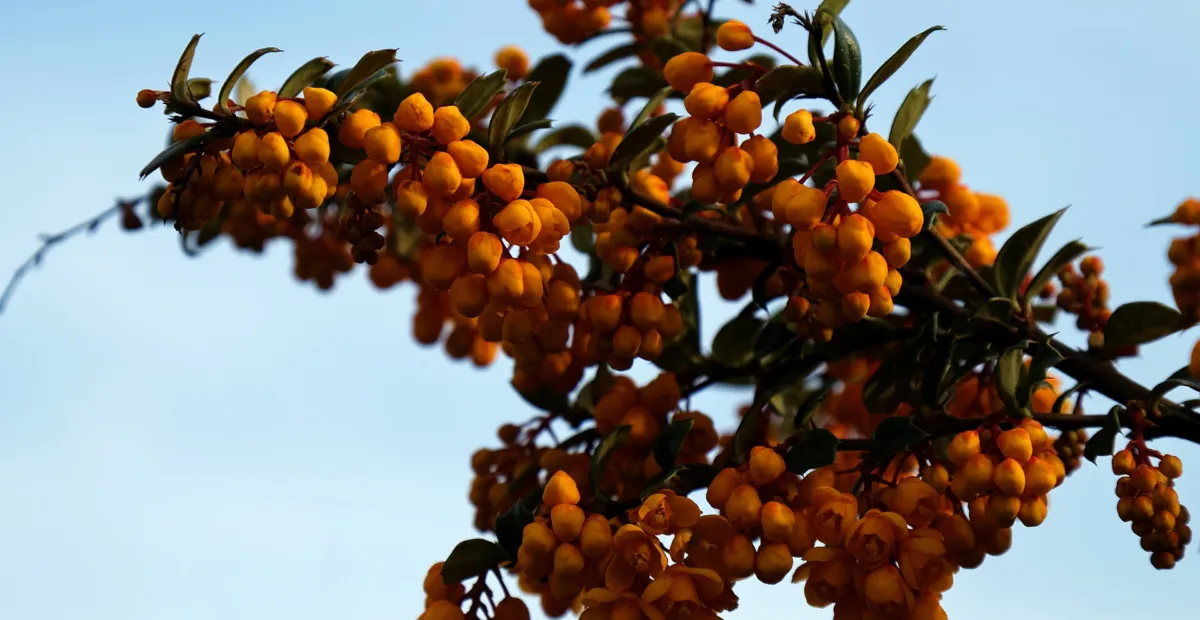
Identify the species by its glossy, leathery, dark green leaves with holly-like serrated spiny teeth, arching branches, reddish flower stalks, and dense racemes of orange-yellow flowers. The fruit is small, round, waxy, and dark blue to purple or plum-red. Stems and foliage form a strongly textured, thorny evergreen framework.
Flowering
Pendant racemes carry numerous small, bell-shaped flowers. Reddish-orange buds open to bright orange-yellow blooms in early to mid-spring, with the heaviest display typically occurring in March and April in much of the United States. Some plants may produce a lighter second flush later in the year. Shade can reduce both flowering and density.
Pollination and visitors
The flowers are visited by bees, including honey bees, and by bumblebees and butterflies according to horticultural and ecological references. Dark berries are attractive to birds, which can disperse seeds. Visitor records are stronger than evidence for any single pollinator species in all U.S. regions.
Berberis darwinii photos
Click any photo for a larger view. Source, author and license are shown separately.
Diseases and pests
Diseases
No major disease problems are consistently reported. Reduce risk by planting in well-drained soil, avoiding persistent overhead wetness, and removing badly damaged material. Investigate poor vigor for drainage, root stress, or winter injury before applying fungicides.
Pests
Usually trouble-free, but inspect dense growth for scale insects, aphids, and occasional chewing damage. Encourage airflow, avoid unnecessary nitrogen, and prune out badly infested stems. Manage problems proportionately; healthy established plants generally need little routine pest treatment.
Related diseases and pests
Only Plant Doctor profiles whose host data indicate this plant may be affected are shown here.
Toxicity and pollen
North Carolina Extension describes the species as having low-severity poison characteristics and notes that berries contain berberine, which may cause stomach upset, especially in children. Avoid intentional eating, keep harvested fruit away from children and pets, and wear gloves when handling thorny branches. Do not treat historical or regional fruit use as a guarantee of safety.
- Typical season
- Usually spring in the United States
- Pollination / pollen
- Insect-carried pollen
The species is insect-pollinated, so its pollen is not generally released in the same abundant windborne manner as grasses, many trees, or wind-pollinated weeds. However, no reliable evidence supports calling it allergen-free; sensitive people may still react to pollen or flower contact. Typical U.S. exposure is during spring bloom.
Native habitat
Native to temperate mountain regions of central and south-central Chile and southern Argentina, including Patagonian landscapes. It is adapted to cool temperate conditions, seasonal moisture, well-drained soils, and exposure ranging from open sites to woodland edges. In some introduced regions it has naturalized and can spread through bird-dispersed seed and vegetative growth.
Interesting fact
Charles Darwin encountered the plant in Chile in 1835, and the species was later named in his honor. Its small glossy leaves have holly-like spiny teeth, while underground runners can produce basal shoots and dense thickets. Birds are attracted to the waxy dark berries, aiding seed dispersal where the plant has naturalized.
Frequently asked questions (FAQ)
The most relevant questions about this plant, with short and direct answers.
🌱Quick care
How do you care for Darwin's Barberry, Berberis darwinii?⌄
Grow Darwin's Barberry in full sun to partial shade, well-drained soil, and moderate moisture while it establishes. Once established, it is relatively drought tolerant and generally needs little maintenance.
Is Darwin's Barberry evergreen?⌄
Yes, Darwin's Barberry is a broadleaf evergreen shrub in most suitable climates. Its glossy, holly-like leaves usually remain through winter, although severe cold can cause damage or leaf loss.
How big does Darwin's Barberry get?⌄
Darwin's Barberry typically grows about 5–10 feet tall and 4–7 feet wide. Its dense, arching, fountain-like form needs room to spread rather than being planted tightly against a walkway.
🌤️Environment and placement
What USDA hardiness zones are suitable for Darwin's Barberry?⌄
Darwin's Barberry is generally suited to USDA Zones 7–9, with some references extending its practical range into Zone 10. In colder areas, protect it from drying winter winds and severe freezes.
Does Darwin's Barberry grow in full shade?⌄
Darwin's Barberry can tolerate more shade than full sun, but full shade usually produces a more open plant with fewer flowers. A site receiving morning sun or bright partial shade is a better compromise.
How much sun does Darwin's Barberry need?⌄
Give Darwin's Barberry full sun for the densest growth and best flowering, although it also performs well in partial shade. In hot climates, afternoon shade can reduce heat and moisture stress.
What type of soil is best for Darwin's Barberry?⌄
Use well-drained loam, sandy soil, or clay that does not remain waterlogged. The shrub is adaptable to different soil textures, but poor drainage can lead to root problems.
💧Care and problems
Can Darwin's Barberry tolerate drought?⌄
Yes, established Darwin's Barberry can tolerate periods of drought, but it should be watered regularly during its first growing season. Mulching the root zone helps reduce moisture loss without piling mulch against the stems.
How often should you water Darwin's Barberry?⌄
Water deeply when the upper few inches of soil become dry during the establishment period. Mature shrubs usually need supplemental water only during prolonged heat or drought, provided the soil drains well.
Does Darwin's Barberry need fertilizer?⌄
Darwin's Barberry usually does not need regular fertilizer when planted in reasonably fertile soil. A thin layer of compost in spring is generally preferable to routine high-nitrogen feeding.
Why is my Darwin's Barberry not flowering?⌄
Insufficient sunlight, excessive shade, severe winter damage, or heavy pruning can reduce flowering. Move or selectively thin nearby growth only if practical, and avoid cutting away the stems that will carry the next display.
What pests and diseases affect Darwin's Barberry?⌄
Darwin's Barberry has no major pest or disease problems commonly reported in extension references. Powdery mildew or other issues may occur under stressful, poorly ventilated, or excessively wet conditions.
🪴Planting and repotting
Can Darwin's Barberry grow in clay soil?⌄
Yes, Darwin's Barberry can grow in clay soil if excess water drains away. Incorporate organic matter broadly when planting and avoid creating a water-retaining pocket around the roots.
When is the best time to plant Darwin's Barberry?⌄
Plant Darwin's Barberry in spring or fall when temperatures are moderate and the soil can be worked. In colder regions, spring planting gives the shrub more time to establish before winter.
Can Darwin's Barberry be grown in a container?⌄
Young Darwin's Barberry can be grown in a large, sturdy container with drainage holes, but its mature size and vigorous, thorny growth make permanent container culture demanding. Use a well-drained potting mix and repot when roots become crowded.
✂️Propagation and pruning
How should you prune Darwin's Barberry?⌄
Prune Darwin's Barberry mainly to remove dead, damaged, crossing, or poorly placed branches. For hedges, trim after flowering; avoid heavy pruning of specimen plants if you want to preserve their natural arching shape.
Can you prune Darwin's Barberry after flowering?⌄
Yes, pruning immediately after flowering is the usual timing for shaping Darwin's Barberry. However, cutting flowering stems can reduce the later berry crop, so prune lightly if fruit is important.
How do you propagate Darwin's Barberry?⌄
Darwin's Barberry can be propagated from seed or stem cuttings. Fresh seed may be sown promptly, while stored seed can require cold stratification; semi-ripe or mature-wood cuttings are also used under protected conditions.
Does Darwin's Barberry spread by runners?⌄
Yes, Darwin's Barberry can spread by underground runners and may form a dense thicket over time. Give it adequate space and remove unwanted shoots promptly if you want to keep the plant contained.
⚠️Toxicity and safety
Are Darwin's Barberry berries edible?⌄
The berries are a low-severity toxicity concern and may cause stomach upset if eaten, especially in quantity. Do not encourage children or pets to consume them, and avoid using them as food unless the plant and preparation have been positively verified by a reliable local source.
Is Darwin's Barberry poisonous to dogs and cats?⌄
Darwin's Barberry should be treated as potentially irritating or mildly toxic to pets because berries may upset the stomach. Contact a veterinarian or animal poison service if a pet eats a significant amount or develops vomiting, diarrhea, or unusual symptoms.
Are Darwin's Barberry thorns dangerous?⌄
Yes, Darwin's Barberry has sharp spines along its branches and leaf margins that can puncture skin. Wear gloves and protective clothing when planting or pruning, and place it away from high-traffic paths and children's play areas.
Is Darwin's Barberry deer resistant?⌄
Darwin's Barberry is generally resistant to deer browsing because of its spiny foliage and branches. Deer resistance is not absolute, particularly when other food is scarce.
🌸Flowering and special interest
When does Darwin's Barberry bloom?⌄
Darwin's Barberry usually blooms in early to mid-spring, often around March or April in climates where it is hardy. The flowers are showy orange-yellow clusters, though the exact timing varies with local weather.
What color are Darwin's Barberry flowers?⌄
The flowers are typically bright yellow to orange-yellow, sometimes with reddish tones. They hang in clusters and provide a strong spring display against the dark evergreen foliage.
Does Darwin's Barberry produce berries?⌄
Yes, Darwin's Barberry produces small, waxy berries that may appear blue, purple, or plum-red as they mature. The fruit generally follows spring flowering and can attract birds.
Why does Darwin's Barberry have no berries?⌄
A lack of berries may result from insufficient light, young plant age, poor flowering, weather during bloom, or pruning after flowering. Removing spent flowers or fruit-bearing stems can also eliminate the developing crop.
Similar plants
 Azure Monkshood (Aconitum carmichaelii) care guideAconitum carmichaelii
 Monkshood (Aconitum ‘Stainless Steel’)Aconitum 'Stainless Steel'
 Monkshood (Aconitum ‘Bressingham Spire’)Aconitum 'Bressingham Spire'
 Golden full moon maple (Acer shirasawanum ‘Aureum’)Acer shirasawanum 'Aureum'
 Globosum (Acer platanoides ‘Globosum’)Acer platanoides 'Globosum'
 Striped maple (Acer pensylvanicum) care guideAcer pensylvanicum