If you want a garden that still looks alive in November, evergreen shrubs are among the most dependable plants you can grow. Boxwood, inkberry holly, Japanese holly, American holly, juniper and arborvitae keep their leaves or needles through winter, giving beds, borders and containers a steady framework of green, blue-green or golden color.
The key is choosing the right shrub for the right conditions. Evergreens are not interchangeable: some prefer bright sun and sharply drained soil, while others stay fuller in partial shade and evenly moist ground. Before you buy, check the plant’s mature size, USDA hardiness zone, light requirements and tolerance for winter wind.
Late fall is an excellent time to assess your garden. Notice which areas look bare, where water collects after rain and which walls or fences create useful shelter. With a little planning, these six shrubs can provide structure and color in every season without demanding complicated care.
What makes an evergreen shrub successful?
Evergreen foliage loses water throughout winter, even when the ground is cold or partly frozen. That is why a shrub can suffer from browning after a dry autumn, strong wind or bright winter sun. Healthy roots and sensible placement matter just as much as the plant’s advertised hardiness.
- Match sunlight to the shrub: full sun usually means at least six hours of direct light daily; partial shade generally means about three to six hours.
- Prioritize drainage: most evergreens dislike soil that stays waterlogged around their roots.
- Water deeply, not constantly: frequent shallow watering encourages weak surface roots.
- Allow mature space: a small nursery plant may eventually become a substantial shrub.
- Protect exposed plants: a sheltered location can reduce winter wind and foliage dehydration.
In my own planting trials, the shrubs that established most evenly were not the ones watered every day. They received a thorough soaking at planting, followed by watering only when the upper few inches of soil began to dry. That approach encouraged roots to move outward instead of remaining in a permanently wet planting hole.
1. Boxwood: classic green for formal or relaxed gardens
Boxwood remains a favorite for edging, low hedges, foundation planting and containers because its small leaves create a neat, finely textured surface. Common boxwood and littleleaf boxwood offer different scales: common boxwood can become a substantial shrub, while compact littleleaf selections are better suited to narrow borders and small yards.
Best features
- Dense, year-round foliage in rich green shades
- Useful clipped into edging, balls or low hedges
- Works in full sun to light shade
- Easy to combine with flowering perennials and ornamental grasses
Choose a cultivar by mature size rather than by the height of the plant at the garden center. A compact selection may stay around 2 to 3 feet tall, while traditional forms can eventually grow much larger if left unclipped.
Boxwood prefers moist but well-drained soil. Avoid planting it where roof runoff or heavy clay leaves the roots saturated. A 2- to 3-inch layer of mulch can help moderate soil temperature, but keep mulch a few inches away from the stems.
For a tidy hedge, trim lightly after the spring flush of growth. Avoid cutting deeply into old, leafless wood unless you know the variety will produce new growth there. In exposed locations, protect boxwood from drying winter winds rather than assuming browning always means disease.
2. Inkberry holly: a native-friendly alternative with soft texture
Inkberry holly is a broadleaf evergreen native to the southeastern United States. Unlike many hollies, it has smooth, spineless leaves, making it more comfortable beside paths, patios and play areas. Its glossy foliage is usually deep green, and female plants can produce small dark berries when pollination conditions are suitable.
Best features
- Useful for informal hedges and mass plantings
- Tolerates full sun to partial shade
- Handles moist soil better than many broadleaf evergreens
- Provides shelter and seasonal food for wildlife when fruit develops
Inkberry is especially valuable in gardens with naturally acidic soil. It can tolerate occasional wetness, but that does not mean it belongs in a permanently stagnant planting hole. Improve drainage where needed, and avoid compacted areas where roots cannot breathe.
The species can become open or develop bare lower stems as it ages. Compact cultivars often make better small hedges, while taller selections suit screening or the back of a border. If your goal is berries, check whether the plant is male, female or capable of producing fruit alone; naming and fruiting behavior can vary by cultivar.
Water a newly planted inkberry when the top 2 to 3 inches of soil feel dry. In a typical home garden, that may mean roughly 5 to 10 gallons per shrub once or twice weekly during the first growing season, adjusted for rainfall, soil type and heat. Do not follow a fixed schedule if the soil is already wet.
3. Japanese holly: small leaves and a polished outline
Japanese holly offers the refined appearance of boxwood with a slightly different leaf shape and growth habit. Many cultivars stay compact, making them useful for low hedges, foundation beds and pathways. Their small, dark green leaves create a clean outline without the strongly spiny margins associated with some larger hollies.
Best features
- Excellent for low borders and geometric planting designs
- Available in rounded, upright and spreading forms
- Performs in full sun or light shade
- Tolerates regular shaping when pruned thoughtfully
Japanese holly looks best when you choose a form that naturally matches the space. A rounded cultivar may need only occasional correction, while an upright form can create a narrow vertical accent. Compare plant labels carefully: cultivars sold under similar common names can differ considerably in height and width.
Give it light, moist, well-drained soil. In deep shade, plants may become thin and less compact. In exposed winter locations, foliage can suffer from wind damage, particularly when the ground is frozen and roots cannot replace lost water.
Prune after the spring growth has extended, or trim lightly in early summer. Shearing repeatedly into the same outer layer can create a dense shell with weak interior growth, so occasionally make selective cuts to preserve a natural, healthy structure.
4. American holly: bold leaves and bright winter berries
American holly brings classic winter character to larger landscapes. Its glossy, spiny-edged leaves and red berries provide strong contrast against snow, dark mulch or evergreen conifers. It can grow as a large shrub or small tree, so it needs more room than compact hollies.
Best features
- Strong architectural form for larger properties
- Glossy foliage that remains attractive year-round
- Red berries on female plants when pollination occurs
- Useful as a specimen, screen or background planting
For dependable berry production, you generally need compatible male and female plants nearby. Garden centers often label cultivars by sex, but the exact pollination requirements can vary, so check the plant tag before planting. Remember that berry production also depends on flowering time, weather and the presence of pollinating insects.
American holly prefers deep, moist, well-drained, acidic soil. Full sun encourages a denser form, although partial shade can work, especially where winter wind is a concern. Avoid dry, exposed sites that receive reflected heat from pavement or walls.
Give this shrub enough room to develop its natural shape. Pruning can guide the outline, but forcing a large holly into a narrow space usually creates unnecessary maintenance and an uneven silhouette.
5. Juniper: blue, silver and green color for sunny, dry spots
Junipers are some of the best evergreen shrubs for sunny gardens with lean, well-drained soil. Depending on the cultivar, they may form low spreading mats, rounded mounds, upright columns or broad screening plants. Their needle-like or scale-like foliage ranges from deep green to silvery blue and can add a welcome cool note to a warm planting scheme.
Best features
- Excellent choice for full sun
- Many cultivars tolerate dry conditions once established
- Available in a wide range of shapes and mature sizes
- Useful for slopes, rock gardens, foundation beds and screens
Juniper is a good example of why drainage matters. It may tolerate drought after establishment, but it often struggles in heavy, wet soil. If water sits after rain, plant on a raised mound or choose another shrub better suited to moisture.
Space spreading cultivars according to their eventual width. A plant labeled as a 4-foot juniper may need that much room in every direction, not four plants packed into a narrow strip. Crowding reduces air movement and can leave the interior bare.
Water deeply during the first season, then gradually extend the interval between waterings. A practical test is to push a finger or soil probe 3 to 4 inches into the ground. If the soil feels cool and damp at that depth, wait; if it is dry, water slowly until the root zone is thoroughly moistened.
6. Arborvitae: dependable vertical color and privacy
Arborvitae is a familiar choice for privacy screens, windbreaks and narrow vertical accents. Its flattened sprays of foliage create a softer texture than many needle-leaved conifers, and cultivars range from compact globes to tall, columnar forms.
Best features
- Excellent for screening and living fences
- Available in compact, rounded and tall forms
- Usually happiest in full sun to partial shade
- Provides dense shelter for birds and garden wildlife
Choose the cultivar carefully. A narrow columnar type may fit beside a driveway, while a broad pyramidal type needs much more space. Planting a tall-growing arborvitae directly beneath utility lines or too close to a foundation creates problems later, even if the young plant looks perfectly proportioned.
Arborvitae prefers evenly moist, well-drained soil. Newly planted shrubs may need around 10 gallons of water once or twice a week during dry weather, but sandy soil, high temperatures and rainfall will change that estimate. Check the soil before watering rather than applying the same amount automatically.
Winter wind and bright sun can cause browning, especially on young plants or shrubs growing in exposed locations. Keep plants adequately watered through fall, but never compensate for dry conditions by leaving roots saturated. A temporary burlap windbreak can help in severe sites; leave room for air circulation and do not wrap foliage tightly in plastic.
How to combine evergreen shrubs for more color
Evergreen does not have to mean one flat shade of green. For a layered border, combine contrasting foliage shapes and colors:
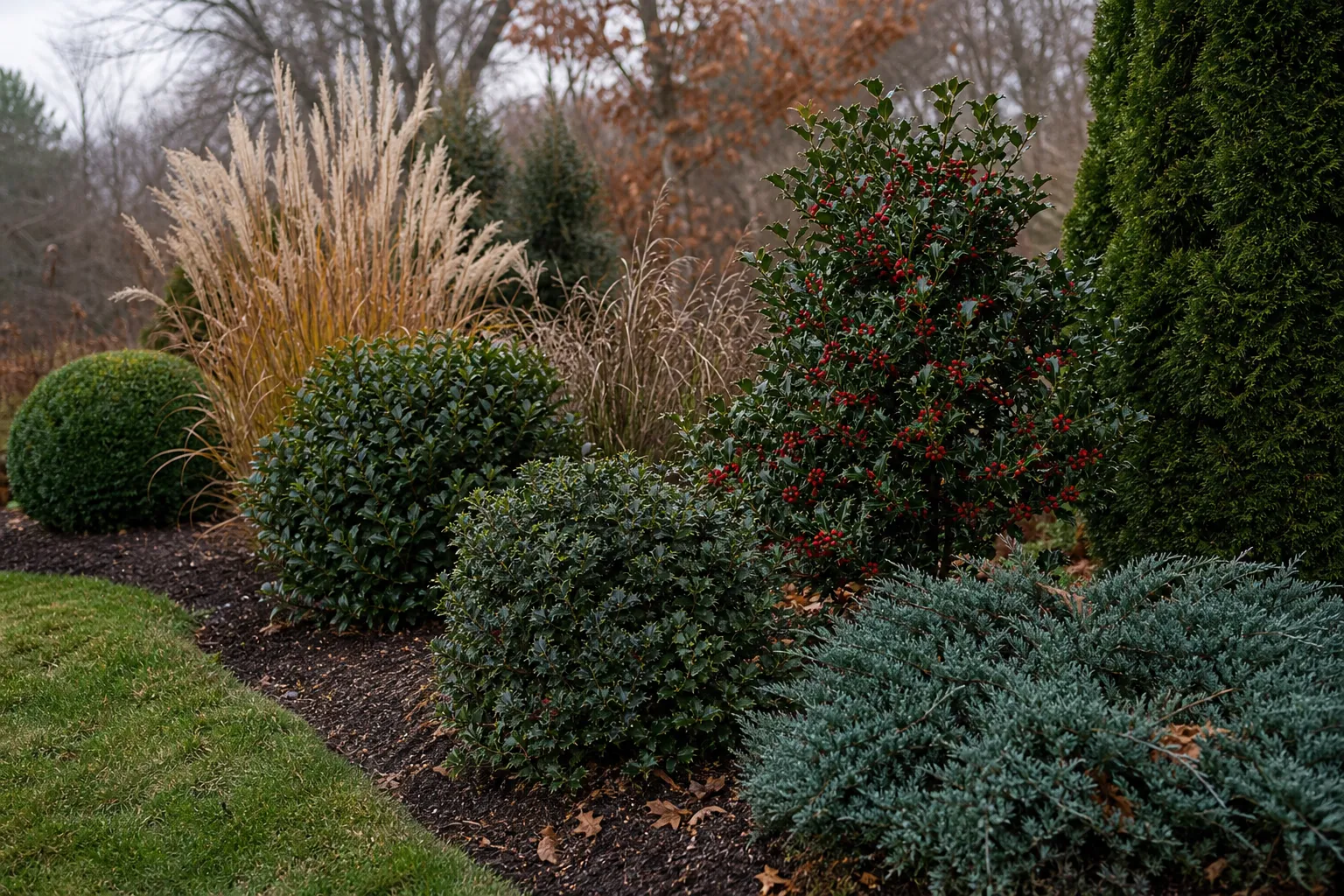
- Use blue-green juniper beside dark green boxwood.
- Place glossy inkberry in front of taller arborvitae.
- Use Japanese holly for a neat edge beneath the looser form of American holly.
- Add deciduous grasses, berries or winter-blooming perennials for seasonal movement and color.
Repeat a few shrubs rather than collecting one of everything. Repetition makes a small garden feel calmer and helps each foliage color stand out. In larger beds, arrange plants in groups of three or five, allowing enough space for mature growth.
A simple evergreen watering routine
Overwatering is one of the easiest mistakes to make with evergreen shrubs. Yellowing leaves, slow growth and root problems can occur when soil remains saturated, while winter browning may follow drought stress or drying winds.
- Check the soil 2 to 4 inches below the surface.
- Water slowly at the root zone, not over the foliage.
- Apply enough water to moisten the full planting area, not just the stem.
- Wait until the surface begins to dry before watering again.
- Reduce frequency during cool, rainy weather, but do not allow new plants to become bone-dry.
For a 5-gallon nursery shrub, a thorough watering may require approximately 5 gallons of water; larger root balls may need more. Treat this as a starting estimate, not a rule. Clay soil holds water longer than sandy soil, and mulch reduces evaporation.
Choose for your site, then enjoy the structure
The best evergreen shrub is not necessarily the rarest or most colorful one. It is the plant that fits your sunlight, soil, mature-space limits and winter exposure. Juniper excels in a sunny, dry bed; inkberry suits moist, acidic ground; boxwood and Japanese holly bring order; American holly adds berries and scale; and arborvitae creates dependable vertical cover.
Start with one well-chosen shrub, observe how it responds through the seasons and build from there. With sensible watering, good drainage and enough room to grow, these plants can keep your garden inviting long after summer flowers have faded.