
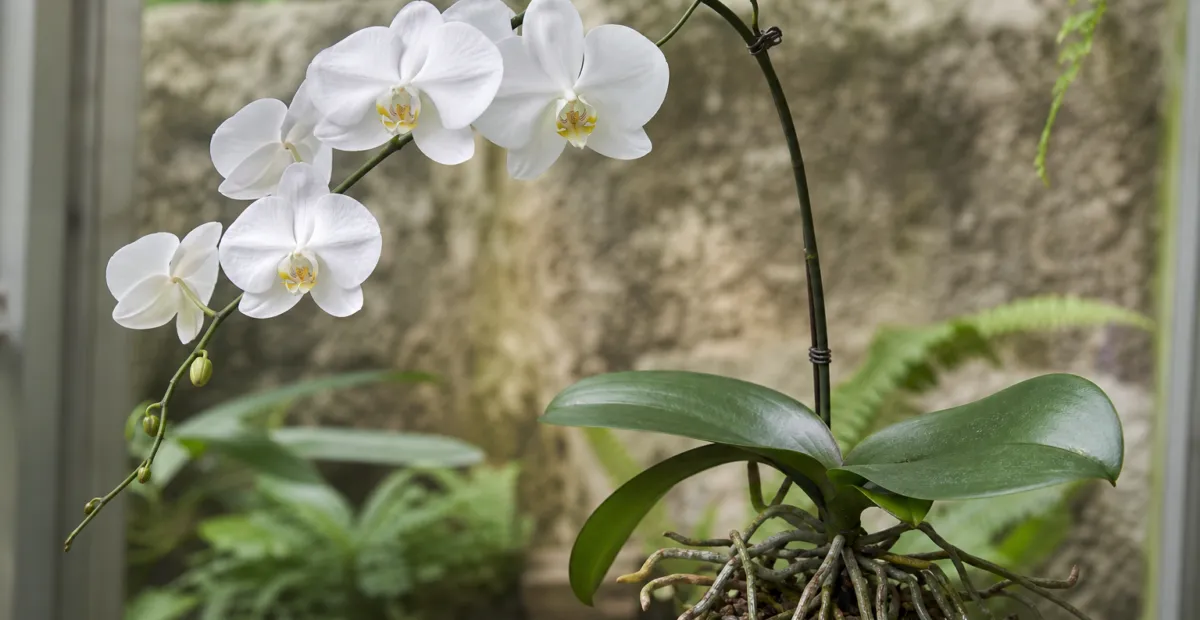
 AI-generated illustration
Moon orchid (Phalaenopsis amabilis) short overview
Phalaenopsis amabilis, commonly called moon orchid, is a tropical epiphytic orchid native to Malesia and northeastern Australia. Its thick, leathery leaves form a compact evergreen rosette, while arching, branched spikes carry long-lasting white flowers with a distinctive three-lobed lip. In the United States it is best grown indoors in bright filtered light, an airy orchid mix, warm temperatures, and moderate to high humidity.
Taxonomic classification
Moon orchid (Phalaenopsis amabilis) care guide
Light and placement
Place near an east-facing window, or several feet from a bright south- or west-facing window behind a sheer curtain. Bright filtered light supports flowering without overheating the leaves. Dark green leaves and weak flowering suggest insufficient light; yellow-green or red-tinged leaves and scorched patches indicate excessive light. Avoid hot direct afternoon sun on the foliage.
Watering and humidity
Water thoroughly with lukewarm water when the mix is approaching dryness, then let the container drain completely. A mature plant in bark often needs watering about weekly, but frequency varies with pot size, season, temperature, and humidity. Water less often in winter and never leave the crown or roots standing in water. Keep water out of the crown overnight and provide air circulation.
Soil and growing medium
Grow it in a coarse, open orchid medium based on fir bark, with optional sphagnum, perlite, or charcoal according to indoor humidity and watering habits. The roots need both moisture and rapid drainage; ordinary potting soil compacts around them and encourages rot. A slightly acidic to neutral root environment is suitable. Use a pot with ample drainage and, ideally, ventilation.
Feeding
Feed after watering with a balanced orchid fertilizer at about half the label strength, commonly three weeks out of four during active growth. Reduce to quarter strength in winter or when growth is slow. Flush the container with plain water about monthly to limit fertilizer salts. Do not fertilize a severely dehydrated, diseased, or freshly repotted plant until it has resumed normal root activity.
Growth and habit
This species is monopodial: it grows upward from a single central crown rather than forming pseudobulbs. New leaves emerge at the top while older basal leaves eventually yellow and decline. Thick aerial roots anchor the plant and absorb moisture and nutrients. Keep the crown above the medium, avoid burying living roots, and rotate the pot occasionally for balanced growth.
Planting and repotting
Use a container only slightly larger than the root mass and position the crown above the medium. Spread healthy roots naturally through the mix without forcing or tightly coiling them. Anchor newly potted plants if necessary, keep the medium evenly but lightly moist while roots re-establish, and avoid dense soil around the stem.
Repot about every two years, or sooner when bark has decomposed, drainage has slowed, or roots have outgrown the container. Repot after flowering when possible. Remove old medium, trim only dead or rotting roots with sterile tools, and use fresh coarse orchid mix. Choose a pot that fits the roots closely rather than a large container that stays wet for too long.
Propagation and pruning
Propagation
Commercial plants are usually propagated by sterile seed culture or laboratory tissue culture, because orchid seeds are dust-like and depend on specialized fungal relationships for natural germination. Home propagation from stem keikis is possible when a plant produces them, but it is not guaranteed. Divide only unusual multi-growth specimens carefully and retain sufficient roots with each section.
Pruning
After flowering, remove only dead or fully brown spikes with sterilized tools. A green spike may branch again, so it can be retained if the plant is healthy, although cutting it back to a lower node is an optional cultivation choice. Remove yellowing leaves only when they detach easily or are clearly dead; do not cut healthy roots or damage the crown.
Overwintering
Keep indoors whenever temperatures may approach 50°F, and protect the plant from frost, cold drafts, heating vents, and chilled window glass. Provide bright filtered light, reduce watering as growth slows, and maintain humidity with a pebble tray or humidifier without allowing the pot to stand in water. Avoid sudden temperature changes that can cause bud drop.
Uses
Primarily grown as an ornamental houseplant, greenhouse specimen, display orchid, and long-lasting flowering plant. The species has also been important in breeding and is recognized as a national flower of Indonesia. It is not a culinary or medicinal plant, and wild collection or international trade may be regulated under orchid conservation rules.
Appearance
Plants usually carry three to five broad, dark-green, leathery leaves arranged in two rows. Thick, fleshy roots often extend outside the pot and may appear silvery when dry and green after watering. Flower spikes arise from the leaf axils and may branch. The white flowers have rounded petals, sepals, and a conspicuous three-lobed lip with a cross-shaped central lobe and curling terminal tendrils.
Flowering
Flower spikes can branch and carry many flowers, with individual blooms lasting several weeks and sometimes longer if not pollinated. Indoor plants commonly flower in the cooler, lower-light part of the year, although timing varies with temperature, light, plant maturity, and cultural conditions. A modest autumn night-temperature drop can help initiate spikes in cultivated plants.
Pollination and visitors
Phalaenopsis orchids are insect-pollinated and produce pollinia, but a consistently documented primary pollinator for the exact species was not established in the authoritative sources reviewed. Do not assume that the common name indicates moth pollination; it refers primarily to the moth-like appearance of the flowers.
Phalaenopsis amabilis photos
Click any photo for a larger view. Source, author and license are shown separately.
Diseases and pests
Diseases
The main risks are crown rot, root rot, bacterial soft rot, and fungal leaf spotting, usually associated with excess moisture, poor airflow, or water trapped in the crown. Water in the morning, keep foliage dry overnight, use sterile tools, and discard badly rotted tissue. Isolate affected plants and improve drainage and air movement before considering a labeled treatment.
Pests
Watch for scale, mealybugs, aphids, thrips, and fungus gnats, especially where plants are crowded or media remains wet. Inspect leaf axils, roots, and flower spikes regularly. Remove small infestations with a cotton swab and appropriate cleaning solution, then repeat monitoring. Use only products labeled for orchids and follow the label; avoid spraying open flowers unnecessarily.
Related diseases and pests
Only Plant Doctor profiles whose host data indicate this plant may be affected are shown here.
 PestLong-tailed mealybugPseudococcus longispinus
 PestBrown Soft ScaleCoccus hesperidum
 DiseaseBacterial soft rotPectobacterium carotovorum
 PestCotton mealybugPhenacoccus solenopsis Tinsley
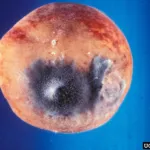 DiseaseRhizopus soft rotRhizopus stolonifer
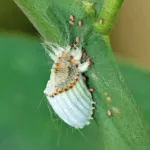 PestCottony Cushion ScaleIcerya purchasi
 DiseasePhytophthora root and crown rotPhytophthora nicotianae
 DiseaseBacterial WiltRalstonia solanacearum species complex
Toxicity and pollen
The ASPCA lists Phalaenopsis orchids as non-toxic to dogs and cats. No species-specific human poisoning concern was identified in the authoritative sources reviewed. Normal plant hygiene still applies: discourage chewing, wash hands after handling potting media, and seek medical or veterinary advice if unusual symptoms follow ingestion.
- Typical season
- During flowering
- Pollination / pollen
- Pollen is packaged in compact pollinia rather than released as a loose airborne dust.
The flowers retain pollen in pollinia, compact masses adapted for insect transfer, rather than releasing large quantities of loose airborne pollen. This suggests relatively low airborne exposure compared with wind-pollinated plants, but sensitive individuals can still react to flowers, plant debris, or potting materials. Keep good ventilation and avoid handling flowers if symptoms occur.
Native habitat
A wet-tropical epiphyte of lowland rainforest, growing on tree trunks, branches, and sometimes rocks rather than rooted in ordinary ground soil. Its exposed roots are adapted to intermittent wetting, rapid drainage, high humidity, and access to air. The native range extends across parts of Malesia, New Guinea, northeastern Australia, and the Philippines.
Interesting fact
The species was described under several earlier names before being transferred to Phalaenopsis in 1825. Its genus name refers to the moth-like appearance of some flowers. Flowers may remain open for weeks until pollination, and the species has contributed to the breeding of numerous cultivated Phalaenopsis orchids. It is officially recognized as one of Indonesia’s national flowers.
Frequently asked questions (FAQ)
The most relevant questions about this plant, with short and direct answers.
🌱Quick care
What is Phalaenopsis amabilis commonly called?⌄
Phalaenopsis amabilis is commonly called the moon orchid. It is an epiphytic orchid in the Orchidaceae family and is also related to the broader group known as moth orchids.
🌤️Environment and placement
How much light does a moon orchid need?⌄
Give a moon orchid bright, filtered light, such as near an east-facing window or behind a sheer curtain. Avoid harsh midday sun, which can scorch the leaves.
Can Phalaenopsis amabilis grow in low light?⌄
Phalaenopsis amabilis can survive in moderately bright indoor light, but very low light often produces weak growth and few flowers. If natural light is limited, a suitable LED grow light can help.
What temperature is best for Phalaenopsis amabilis?⌄
Keep Phalaenopsis amabilis warm, with indoor temperatures around 75–85°F during the day and above 60°F at night. Briefly cooler autumn nights near 55°F may help initiate flowering, but avoid cold drafts and sudden changes.
How humid should a moon orchid be?⌄
A moon orchid generally grows best at moderate to high humidity, roughly 40–70% indoors, with good air movement. Do not compensate for poor ventilation by keeping the potting mix constantly wet.
Can Phalaenopsis amabilis grow outdoors in the United States?⌄
Phalaenopsis amabilis can grow outdoors year-round only in warm, frost-free areas with filtered light and protection from heavy rain and temperature extremes. In most of the United States, grow it indoors or move it inside before temperatures approach 60°F.
Is Phalaenopsis amabilis frost-tolerant?⌄
No, Phalaenopsis amabilis is not frost-tolerant and must be protected from freezing temperatures. Cold exposure can damage leaves, roots, and flower buds even when the plant does not immediately collapse.
💧Care and problems
How often should I water Phalaenopsis amabilis?⌄
Water Phalaenopsis amabilis thoroughly when the potting mix is nearly dry, rather than following a fixed calendar. Let excess water drain completely, and adjust frequency for pot size, bark condition, temperature, and indoor humidity.
How can I tell when a moon orchid needs water?⌄
Water when the bark is nearly dry, the pot feels light, and the visible roots look silvery rather than green and plump. Clear pots make root color easier to monitor, but the mix should also be checked before watering.
Should I water a moon orchid with ice cubes?⌄
Avoid ice cubes because very cold water can stress the roots and the small dose may not evenly moisten the potting mix. Use room-temperature water and drain the pot thoroughly instead.
Should I pour water over the leaves of Phalaenopsis amabilis?⌄
Water the roots and potting medium rather than leaving water in the leaf crown. If water collects between the leaves, gently blot it away because prolonged moisture can encourage crown rot.
Why are the roots of my moon orchid turning brown or mushy?⌄
Brown, soft, or mushy roots usually indicate root rot caused by excessive moisture, poor drainage, or decomposed potting media. Remove damaged roots with sterile tools and repot the plant into fresh, airy orchid mix.
Why are the leaves of Phalaenopsis amabilis turning yellow?⌄
Yellowing leaves can result from natural aging, excessive light, overwatering, root damage, or nutrient problems. A single oldest lower leaf yellowing gradually may be normal, but rapid or widespread yellowing requires checking the roots and growing conditions.
Why are the leaves of my moon orchid wrinkled?⌄
Wrinkled leaves commonly indicate dehydration, damaged roots, or inconsistent watering rather than simply a need for more water. Check whether the roots are alive and firm before increasing watering, because rotting roots cannot absorb moisture.
What fertilizer should I use for Phalaenopsis amabilis?⌄
Use a balanced orchid fertilizer diluted to about one-quarter strength during active growth. Fertilize only when the plant and potting medium are already moist, and reduce feeding during cool, dark periods.
🪴Planting and repotting
Can Phalaenopsis amabilis grow in regular potting soil?⌄
Phalaenopsis amabilis should not be planted in ordinary potting soil because its epiphytic roots need air around them. Use a porous orchid medium based on bark, with optional coarse perlite or sphagnum moss.
What is the best pot for a moon orchid?⌄
Use a pot with ample drainage and airflow, often a clear plastic orchid pot placed inside a decorative cachepot. The container should be only slightly larger than the healthy root system, not dramatically oversized.
When should I repot Phalaenopsis amabilis?⌄
Repot Phalaenopsis amabilis after flowering or when the bark has decomposed, drainage has declined, or the roots are rotting. Healthy plants commonly need repotting about every one to three years, depending on the medium.
How do I repot a moon orchid?⌄
Remove the old medium, trim only dead or mushy roots with sterile tools, and place the healthy roots in fresh, airy orchid mix. Keep the stem base and crown above the medium, then avoid leaving the newly repotted plant waterlogged.
Can I repot Phalaenopsis amabilis while it is blooming?⌄
You can repot a blooming Phalaenopsis amabilis if the roots are rotting or the medium is failing, but otherwise it is usually less stressful to wait until flowering ends. Repotting may shorten the current display of flowers.
Should moon orchid roots be covered with potting mix?⌄
Healthy roots should be supported by the mix but not packed tightly or buried with the crown and stem. Keep the crown and the junction where leaves emerge above the medium to reduce rot risk.
✂️Propagation and pruning
How do I prune a moon orchid flower spike?⌄
After flowering, cut a completely brown or dry spike near its base with sterile scissors. If the spike remains green, you may leave it for possible side branching or cut it above a healthy node to encourage new growth.
How can I propagate Phalaenopsis amabilis?⌄
Phalaenopsis amabilis is most reliably propagated commercially from tissue culture, while home growers can sometimes separate a mature keiki after it develops several roots. Propagation from seed is slow and normally requires sterile laboratory conditions.
Can I grow a moon orchid from a leaf or root cutting?⌄
A moon orchid cannot normally be propagated from an ordinary leaf or root cutting. New plants generally arise from keikis, division of suitable mature growth, or sterile seed and tissue-culture techniques.
⚠️Toxicity and safety
Is Phalaenopsis amabilis toxic to cats and dogs?⌄
Phalaenopsis amabilis is generally considered non-toxic to cats and dogs. Pets may still experience stomach upset if they chew large amounts of plant material or potting media, so avoid allowing persistent access.
Is a moon orchid poisonous to people?⌄
A moon orchid is generally regarded as non-toxic to people. Do not eat it, however, because plants may carry pesticides, fertilizers, microbes, or potting-material contaminants.
🌸Flowering and special interest
Can Phalaenopsis amabilis rebloom from the same flower spike?⌄
A living green flower spike may produce a side branch and bloom again, although reblooming is not guaranteed. A dry brown spike will not flower again and should be removed.
How do I make Phalaenopsis amabilis bloom again?⌄
Provide bright filtered light, consistent watering, adequate nutrition, and a modest day–night temperature change in autumn. Reblooming depends on the plant’s maturity, health, light level, and seasonal conditions, so timing varies.
How long do moon orchid flowers last?⌄
Moon orchid flowers can remain attractive for several weeks, sometimes longer under stable indoor conditions. Flowers may fade sooner after pollination, dehydration, heat stress, or abrupt temperature changes.
Why is my Phalaenopsis amabilis not flowering?⌄
Insufficient light is a common reason Phalaenopsis amabilis fails to flower, although immature growth, weak roots, poor nutrition, or unsuitable temperatures can also contribute. Move it gradually to brighter filtered light and correct root or watering problems first.
Similar plants
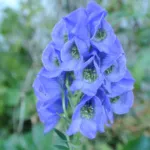 Azure Monkshood (Aconitum carmichaelii) care guideAconitum carmichaelii
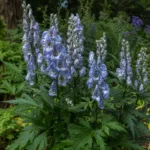 Monkshood (Aconitum ‘Stainless Steel’)Aconitum 'Stainless Steel'
 Monkshood (Aconitum ‘Bressingham Spire’)Aconitum 'Bressingham Spire'
 Golden full moon maple (Acer shirasawanum ‘Aureum’)Acer shirasawanum 'Aureum'
 Globosum (Acer platanoides ‘Globosum’)Acer platanoides 'Globosum'
 Striped maple (Acer pensylvanicum) care guideAcer pensylvanicum