Source:
 Hosta ‘Wolverine’ short overview
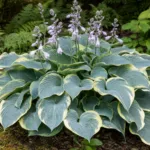
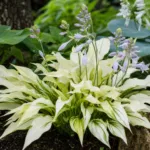
Hosta 'Wolverine' is a compact, mounded perennial grown for its narrow, slightly blue-green leaves edged in golden yellow. This registered cultivar performs best in partial to full shade with consistently moist, fertile, well-drained soil. Lavender flowers rise on summer scapes, while the foliage provides dependable texture from spring until frost. It is hardy across much of the United States, including USDA Zones 3–8.
Taxonomic classification
Hosta ‘Wolverine’ care guide
Light and placement
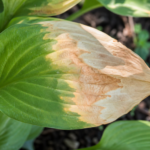
Provide morning sun or bright filtered light with afternoon shade, especially in warmer regions. Deep shade supports survival but may reduce vigor and flowering. Scorched margins, bleached leaves, or crispy tissue indicate excessive sun or drought; stretched growth and sparse flowering suggest insufficient light.
Watering and humidity
Water deeply when the top inch of soil begins to dry, keeping the root zone consistently moist rather than saturated. Increase frequency during hot or dry weather and reduce it after dormancy. Apply water at the soil line to limit leaf disease; ordinary outdoor humidity is sufficient.
Soil and growing medium
Use fertile, humus-rich soil that holds even moisture without remaining saturated. A loamy garden soil improved with compost is ideal. Hostas tolerate slightly acidic to neutral conditions, roughly pH 6.0–7.0, and perform poorly in compacted or drought-prone ground.
Feeding
Top-dress with compost in spring as shoots emerge. If the plant is pale or weak, apply a balanced slow-release fertilizer at the label rate. Avoid heavy nitrogen feeding late in the season, which can encourage soft growth and delay dormancy.
Growth and habit
Forms a symmetrical, mounded clump from a perennial crown. Growth begins in spring, expands through summer, and retreats after frost. Remove damaged leaves and spent scapes for appearance, while keeping the crown free of deep, wet mulch.
Planting and repotting
Plant in spring or early fall, setting the crown at soil level and spreading the roots outward. Water thoroughly after planting and mulch lightly, keeping mulch away from the crown. Allow room for the mature clump to broaden.
Repot container plants in early spring as growth begins, moving them into a slightly larger pot with a moisture-retentive but well-drained potting mix. Divide or refresh the root ball only when crowded.
Propagation and pruning
Propagation
Divide established clumps in early spring as shoots emerge or in early fall. Lift the crown and separate sections with viable buds and roots. Seed does not reliably reproduce the named cultivar.
Pruning
Cut flower scapes after bloom if seed formation is unwanted. Remove yellowed or frost-damaged foliage after dormancy in late fall or early spring; avoid cutting healthy leaves prematurely.
Overwintering
Leave the dormant crown outdoors in the ground in USDA Zones 3–8. After hard frost, remove collapsed foliage and maintain a light mulch layer to buffer temperature swings. Container plants are more exposed and should be protected from repeated freeze-thaw cycles.
Uses
A dependable ornamental foliage plant for shaded borders, woodland gardens, foundation beds, mass plantings, and containers. Its contrasting margins make it useful beside ferns, heucheras, astilbes, and other shade perennials. Do not use as an edible plant because hostas are toxic to dogs and cats.
Appearance
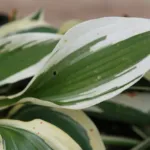
Leaves are narrow to lance-shaped, slightly blue-green, and bordered by a contrasting golden-yellow margin. The foliage forms a neat mounded rosette-like clump, while slender scapes rise above the leaves with lavender flowers. The combination of narrow blue-green blades and yellow edging is a key identification feature.
Flowering
Lavender, trumpet-shaped flowers are carried in terminal racemes on upright scapes during midsummer. Flowering is secondary to the foliage display, and removing spent scapes helps maintain a tidy appearance but is not essential.
Pollination and visitors
The Chicago Botanic Garden records wildlife interest, including attraction to birds. Specific insect pollinators for this exact cultivar were not reliably documented in the reviewed sources, so pollinator evidence is limited.
Hosta 'Wolverine' photos
Click any photo for a larger view. Source, author and license are shown separately.
Diseases and pests
Diseases
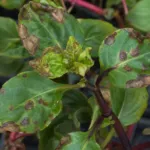
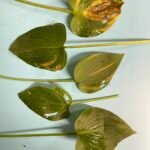
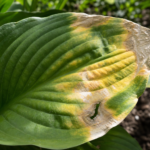
Watch for Hosta Virus X, crown and root rots, and fungal leaf spots. Buy clean stock, avoid overhead watering, improve drainage, remove diseased foliage, and sanitize tools. Do not compost plants suspected of systemic virus infection.
Pests
Slugs and snails commonly chew holes in hosta leaves, especially during cool, wet weather. Reduce hiding places, water at the soil line, hand-pick pests, and use barriers or labeled controls when necessary. Deer and rabbits may also browse the foliage.
Related diseases and pests
Only Plant Doctor profiles whose host data indicate this plant may be affected are shown here.

Toxicity and pollen
Hosta foliage, flowers, and roots contain saponins and are listed by ASPCA as toxic to dogs and cats. Ingestion may cause vomiting, diarrhea, or depression. Prevent pets from eating the plant and contact a veterinarian if ingestion is suspected. Human toxicity evidence for this cultivar is limited; avoid eating it and wash hands after handling.
- Typical season
- July–August
- Pollination / pollen
- Low-dispersal floral pollen
Hosta flowers release relatively little airborne pollen compared with wind-pollinated plants because pollen is generally associated with insect-mediated flower visits. A low allergy concern is a practical estimate rather than a cultivar-specific clinical assessment.
Native habitat
The genus Hosta is native from the Russian Far East through China, Japan, Korea, and nearby northeastern Asian regions. Wild hostas commonly occupy woodland margins, forest clearings, streamside soils, and other cool sites with seasonal moisture and filtered light.
Interesting fact
The cultivar was registered in 1995 according to the American Hosta Society classification list. Its narrow leaves contrast with the broad foliage of many classic hostas. Hosta is native to northeastern Asia, not North America. The plant dies back to the crown in winter and returns in spring.