
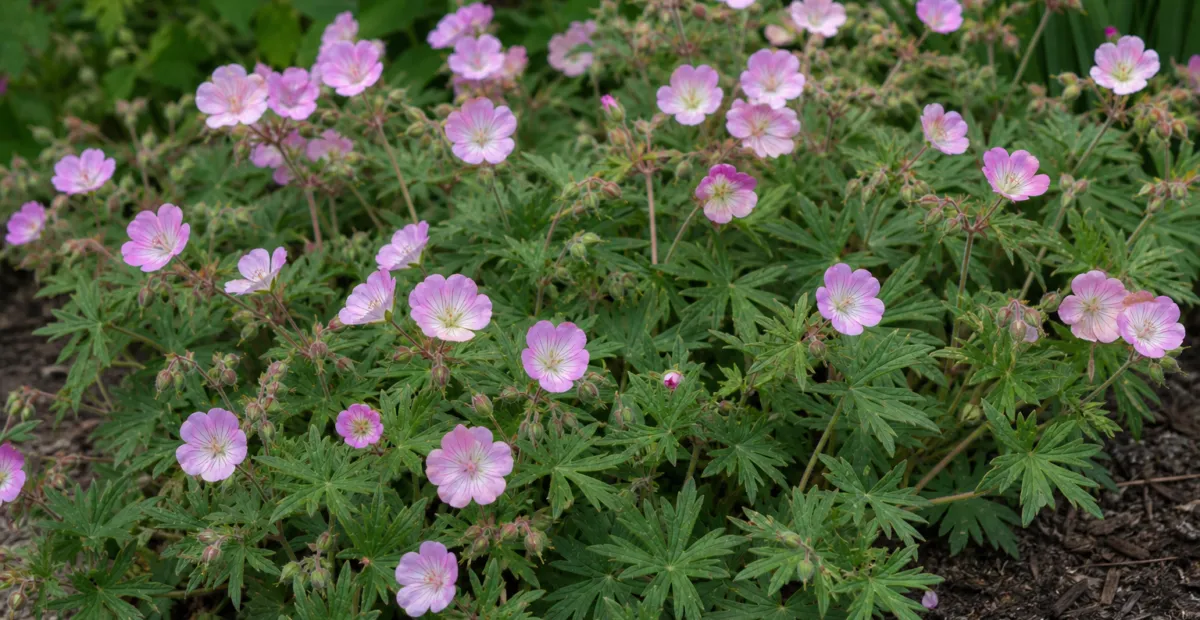
 AI-generated illustration
Cranesbill ‘Mavis Simpson’ (Geranium ‘Mavis Simpson’) short overview
Geranium 'Mavis Simpson' is a low, spreading cranesbill valued for its soft gray-green, deeply lobed foliage and shell-pink flowers marked with darker veins and pale centers. This hardy perennial forms an attractive living carpet in sunny borders, rock gardens, cottage-style plantings, and containers. It flowers over a long summer-to-fall season, tolerates a range of well-drained soils, and becomes relatively drought tolerant after establishment.
Taxonomic classification
Cranesbill ‘Mavis Simpson’ (Geranium ‘Mavis Simpson’) care guide
Light and placement
Grow in full sun to partial shade. In cooler regions, an open south- or west-facing border encourages the strongest flowering; in hot US climates, morning sun with light afternoon shade can reduce heat stress. Too little light produces lax stems and fewer flowers, while intense reflected heat combined with dry soil may cause scorch or premature summer slowdown.
Watering and humidity
Water deeply when the upper few inches of soil dry during the first growing season. Once established, allow moderate drying between waterings, but provide supplemental water during prolonged summer heat or drought, especially in containers. Water at the base rather than wetting dense foliage. Average outdoor humidity is sufficient; airflow matters more than misting.
Soil and growing medium
Use average, moderately fertile soil that drains freely but does not become excessively dry during establishment. Loam, sand, clay, chalky soils, and humus-rich garden soil can work if drainage is adequate. The cultivar tolerates acidic, neutral, and alkaline conditions, so pH adjustment is usually unnecessary unless the soil is strongly extreme.
Feeding
Apply a balanced, slow-release perennial fertilizer or a thin layer of finished compost in spring as growth begins. Avoid heavy feeding, which can produce lush foliage at the expense of sturdy growth and flowers. A second light feeding is usually unnecessary in fertile soil; do not fertilize drought-stressed, newly divided, or dormant plants.
Growth and habit
The cultivar forms a low, spreading, mat-forming plant with trailing stems that can weave between neighboring perennials. It is vigorous without requiring intensive maintenance, though it may need occasional lifting and division when the center becomes crowded. In hot climates, flowering can slow during peak summer heat before resuming in cooler weather.
Planting and repotting
Plant in spring or early fall, setting the crown level with the surrounding soil. Space plants about 18–30 inches apart according to the desired speed of cover. Firm the soil gently, water deeply after planting, and keep evenly moist during the first growing season. Avoid planting into saturated ground.
In containers, repot in spring when the root ball is crowded or the compost has become compacted. Move the plant into a slightly larger pot with a free-draining, peat-free multipurpose mix amended with grit or fine bark. Water thoroughly after repotting and give temporary shelter from hot afternoon sun while roots re-establish.
Propagation and pruning
Propagation
Divide established plants in spring or early fall, separating rooted sections with healthy crowns and roots. Basal cuttings can be taken in early to mid-spring and rooted with bottom heat. Because this is a named cultivar, vegetative propagation is preferred for maintaining its characteristics.
Pruning
Remove spent flowering stems and tired older leaves after the first flush to encourage fresh foliage and possible repeat flowering. If the plant becomes untidy or mildew affected, cut it back close to the base after flowering, then water during dry conditions to support regrowth. Remove dead foliage in late winter or early spring.
Overwintering
Leave the crown in the ground in Zones 6–8, where it is generally hardy, and apply a light mulch after the soil cools. Do not mound wet mulch against the crown. In colder or exposed sites, use winter protection and grow in a sheltered microclimate. Container plants are more vulnerable to root freezing and should be moved against a protected wall or insulated.
Uses
Useful as low ground cover, a front-of-border perennial, edging, a rock-garden plant, a cottage-garden subject, or a container spiller. Its flowers support pollinating insects, and its spreading stems can knit together open soil around shrubs and taller perennials. It is ornamental rather than a culinary or medicinal plant.
Appearance
Leaves are palmately divided and deeply lobed, with a soft downy texture and gray-green to silvery coloring. Most foliage forms a basal mound, while flowering stems carry fewer, smaller leaves. Trailing stems create a relaxed, mat-forming appearance, and the pale flowers are highlighted by darker veins.
Flowering
The flowers are five-petaled, saucer-shaped blooms held in loose cymes above the foliage. Their shell- or rose-pink petals have darker purple veining and pale pink to white centers. Flowering commonly begins in late spring or early summer and can continue into fall, although heat may reduce flowering temporarily in hot-summer regions.
Pollination and visitors
The RHS includes this cultivar among plants providing nectar and pollen for bees and other pollinating insects. Missouri Botanical Garden specifically records butterfly attraction. The available evidence supports bees and butterflies as characteristic visitors, but no particular pollinator species was sufficiently documented for this cultivar.
Diseases and pests
Diseases
Downy mildew and powdery mildew may develop where foliage is crowded, poorly ventilated, or repeatedly wet. Water at the soil line, avoid excessive nitrogen, remove heavily affected leaves, and cut back congested growth after flowering to improve air movement. Good drainage and sensible spacing are the main preventive measures.
Pests
Vine weevil, capsid bugs, and sawfly larvae may occasionally cause damage. Look for notched leaf margins, distorted young growth, or chewing on foliage. Reduce stress, inspect plants regularly, remove limited infestations by hand, and use locally appropriate controls only when damage is persistent. Avoid routine broad-spectrum insecticides while flowers are open.
Related diseases and pests
Only Plant Doctor profiles whose host data indicate this plant may be affected are shown here.
 DiseaseBacterial blight of geraniumXanthomonas hortorum pv. pelargonii
 DiseaseCucumber mosaic virusCucumber mosaic virus
 DiseaseMaple powdery mildewSawadaea bicornis
 DiseaseCucurbit Downy MildewPseudoperonospora cubensis (Berk. & M.A. Curtis) Rostovzev
 PestBlack Vine WeevilOtiorhynchus sulcatus
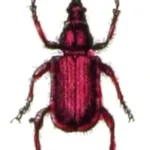 PestPeach weevilRhynchites bacchus
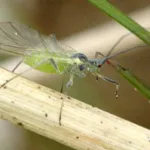 PestGreen Peach AphidMyzus persicae
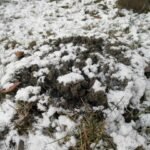 Environmental stressFrost heaving
Toxicity and pollen
Available toxicity references commonly concern Pelargonium, the tender plants also called garden geraniums, rather than true Geranium cranesbills. No cultivar-specific toxicity evidence was found for Geranium 'Mavis Simpson'. Normal garden hygiene is appropriate: do not intentionally ingest the plant, supervise children around unfamiliar plant material, and contact a medical or veterinary professional after significant ingestion or an adverse reaction.
- Typical season
- Late spring through fall during flowering
- Pollination / pollen
- Insect-associated floral pollen; not wind-dispersed in large amounts
This insect-pollinated perennial is not generally identified as a major airborne-allergy plant, but cultivar-specific pollen monitoring and allergenicity data were not found. Flowers release pollen primarily during insect visits rather than through conspicuous wind dispersal. People with strong pollen sensitivity should rely on personal response and avoid handling flowers when symptomatic.
Native habitat
This is a cultivated hybrid cranesbill rather than a wild native population, so it has no single natural habitat or native US distribution. Its parentage and horticultural background are associated with hardy Geraniums adapted to temperate garden conditions. In cultivation it performs best in open, well-drained soils with sun or light shade and moderate moisture.
Interesting fact
RHS lists Geranium 'Mavis Simpson' as an Award of Garden Merit plant. The cultivar has been associated with Geranium × riversleaianum, but RHS trial work questioned that attribution. Its gray-green foliage and extended flowering make it useful as a foliage-led ground cover as well as a flowering perennial.
Frequently asked questions (FAQ)
The most relevant questions about this plant, with short and direct answers.
🌱Quick care
What is Geranium 'Mavis Simpson' commonly called?⌄
Geranium 'Mavis Simpson' is commonly called cranesbill 'Mavis Simpson'. It is a low-growing, spreading hardy geranium grown mainly for ground cover and long-lasting pink flowers.
How big does Geranium 'Mavis Simpson' get?⌄
Geranium 'Mavis Simpson' typically grows about 8 inches tall and spreads 2 to 3 feet wide. Its lax, trailing stems make it useful at the front of borders, in rock gardens, and as a small-area ground cover.
Is Geranium 'Mavis Simpson' evergreen?⌄
Geranium 'Mavis Simpson' is semi-evergreen in mild conditions. Foliage may remain attractive through winter in warmer areas but can die back after hard freezes.
Is Geranium 'Mavis Simpson' a hardy geranium?⌄
Yes, Geranium 'Mavis Simpson' is a hardy perennial cranesbill, not the tender annual geranium commonly sold for summer bedding. Its winter performance varies with climate, exposure, drainage, and local temperatures.
🌤️Environment and placement
How much sun does Geranium 'Mavis Simpson' need?⌄
Grow Geranium 'Mavis Simpson' in full sun to partial shade. In hot regions, morning sun or light afternoon shade can help reduce heat stress while still supporting flowering.
Can Geranium 'Mavis Simpson' grow in shade?⌄
Geranium 'Mavis Simpson' tolerates partial shade but flowers best with several hours of direct light. Dense shade can produce weaker, leggier growth and fewer blooms.
What soil is best for Geranium 'Mavis Simpson'?⌄
Use moderately fertile, well-drained soil for Geranium 'Mavis Simpson'. It can grow in loam, sand, clay, chalk, or humus-rich soil as long as excess water drains away.
Can Geranium 'Mavis Simpson' tolerate clay soil?⌄
Geranium 'Mavis Simpson' can tolerate clay soil if it is improved enough to drain freely. Incorporate organic matter and avoid planting where winter or summer water remains stagnant.
Is Geranium 'Mavis Simpson' drought tolerant?⌄
Geranium 'Mavis Simpson' has some drought tolerance once established, but it performs better with moderate moisture. Water deeply during prolonged heat or drought, especially in its first growing season.
Is Geranium 'Mavis Simpson' suitable for hot, humid climates?⌄
Geranium 'Mavis Simpson' may struggle in very hot, humid summer climates, where flowering can slow and foliage may decline. Provide good air circulation, reliable drainage, and afternoon protection in the hottest locations.
💧Care and problems
How often should I water Geranium 'Mavis Simpson'?⌄
Water Geranium 'Mavis Simpson' when the soil begins to dry, keeping it moderately moist while young. Once established, reduce watering, but provide supplemental moisture during extended heat or drought.
Why is my Geranium 'Mavis Simpson' wilting in the sun?⌄
Wilting in strong sun usually indicates heat stress, inadequate root establishment, or insufficient moisture rather than a need for deep shade. Check the soil several inches down, water thoroughly when dry, and provide afternoon shade in hot weather.
How do I prune Geranium 'Mavis Simpson'?⌄
Remove spent flower stems and tired foliage to encourage fresh leaves and additional flowers. After a major flush, you can cut the plant back moderately, but avoid removing unopened buds or making a hard late-season cut.
Should I deadhead Geranium 'Mavis Simpson'?⌄
Yes, deadheading Geranium 'Mavis Simpson' can improve its appearance and encourage continued flowering. Remove faded stems back into the foliage rather than stripping away healthy leaves.
What pests affect Geranium 'Mavis Simpson'?⌄
Geranium 'Mavis Simpson' may occasionally be affected by vine weevils, capsid bugs, or sawfly larvae. Inspect foliage regularly and address chewing damage or root symptoms early.
What diseases affect Geranium 'Mavis Simpson'?⌄
Downy mildew and powdery mildew can affect Geranium 'Mavis Simpson', especially in humid, poorly ventilated conditions. Improve air circulation, avoid wetting the foliage, and remove badly affected leaves.
🪴Planting and repotting
When should I plant Geranium 'Mavis Simpson' in the United States?⌄
Plant Geranium 'Mavis Simpson' in spring after the soil can be worked or in early fall while roots can still establish. In colder areas, spring planting gives the plant more time to settle before winter.
How far apart should I plant Geranium 'Mavis Simpson'?⌄
Space Geranium 'Mavis Simpson' about 24 to 36 inches apart to allow its trailing stems to spread. Use closer spacing only when a quicker ground-cover effect is desired and airflow remains adequate.
Can Geranium 'Mavis Simpson' grow in containers?⌄
Yes, Geranium 'Mavis Simpson' grows well in a container with drainage holes and a quality, well-drained potting mix. Choose a wide container because the plant spreads more than it grows tall, and protect the roots in colder climates.
Can Geranium 'Mavis Simpson' be used as ground cover?⌄
Yes, Geranium 'Mavis Simpson' is especially useful as a low, spreading ground cover. Its gray-green foliage and sprawling flowering stems work well beneath shrubs, along paths, and at the front of borders.
Can Geranium 'Mavis Simpson' grow in a rock garden?⌄
Yes, Geranium 'Mavis Simpson' is well suited to rock gardens because it stays low and prefers well-drained soil. Position it where its stems can trail over stones without sitting in saturated soil.
✂️Propagation and pruning
How do you propagate Geranium 'Mavis Simpson'?⌄
Propagate Geranium 'Mavis Simpson' by division in spring or by basal cuttings in early to mid-spring. Cuttings generally root best with bottom heat and consistently moist, well-drained rooting media.
Can Geranium 'Mavis Simpson' be grown from seed?⌄
Seed is not usually the preferred way to reproduce Geranium 'Mavis Simpson' because named cultivars may not come true from seed. Division or basal cuttings are more reliable for producing plants matching the parent.
Does Geranium 'Mavis Simpson' spread aggressively?⌄
Geranium 'Mavis Simpson' spreads by trailing stems but is generally considered a manageable, non-invasive ground cover. Give it room to expand and trim stems that move beyond the intended area.
Should Geranium 'Mavis Simpson' be divided?⌄
Divide Geranium 'Mavis Simpson' in spring when new growth begins if the plant has become crowded or you want more plants. Replant divisions promptly and keep them evenly moist while they establish.
⚠️Toxicity and safety
Is Geranium 'Mavis Simpson' toxic to dogs or cats?⌄
No cultivar-specific toxicity classification has been established for Geranium 'Mavis Simpson'. Because plant responses can vary and the cultivar may be confused with other geraniums, prevent pets from chewing it and contact a veterinarian if ingestion causes symptoms.
Is Geranium 'Mavis Simpson' safe to plant around children?⌄
No cultivar-specific toxicity classification has been established for Geranium 'Mavis Simpson'. As with any ornamental plant, place it where young children are unlikely to chew the foliage or flowers.
🌸Flowering and special interest
When does Geranium 'Mavis Simpson' bloom?⌄
Geranium 'Mavis Simpson' generally blooms from early summer into fall, with timing varying by climate. Flowering may slow during periods of intense summer heat.
What color are the flowers of Geranium 'Mavis Simpson'?⌄
The flowers are pale shell-pink to rose-pink with darker veins and lighter centers. Individual blooms are typically about 1 to 1.5 inches across.
How can I make Geranium 'Mavis Simpson' bloom more?⌄
Provide full sun to partial shade, well-drained moderately fertile soil, and consistent moisture during establishment. Deadhead faded stems and give the plant a moderate midsummer trim if flowering stems become tired or sparse.
Does Geranium 'Mavis Simpson' attract pollinators?⌄
The open, saucer-shaped flowers of Geranium 'Mavis Simpson' can be visited by bees and other flower-seeking insects. Its long flowering period makes it a useful addition to informal and wildlife-friendly plantings.
Why is my Geranium 'Mavis Simpson' not flowering?⌄
Insufficient light, excessive heat, drought, waterlogged soil, or overly rich nitrogen fertilizer can reduce flowering. Move container plants to brighter conditions, correct drainage, and avoid heavy feeding that produces leaves at the expense of blooms.
Similar plants
 Azure Monkshood (Aconitum carmichaelii) care guideAconitum carmichaelii
 Monkshood (Aconitum ‘Stainless Steel’)Aconitum 'Stainless Steel'
 Monkshood (Aconitum ‘Bressingham Spire’)Aconitum 'Bressingham Spire'
 Golden full moon maple (Acer shirasawanum ‘Aureum’)Acer shirasawanum 'Aureum'
 Globosum (Acer platanoides ‘Globosum’)Acer platanoides 'Globosum'
 Striped maple (Acer pensylvanicum) care guideAcer pensylvanicum