
 AI-generated illustration
Dwarf Sensation (Cosmos bipinnatus ‘Dwarf Sensation’) short overview
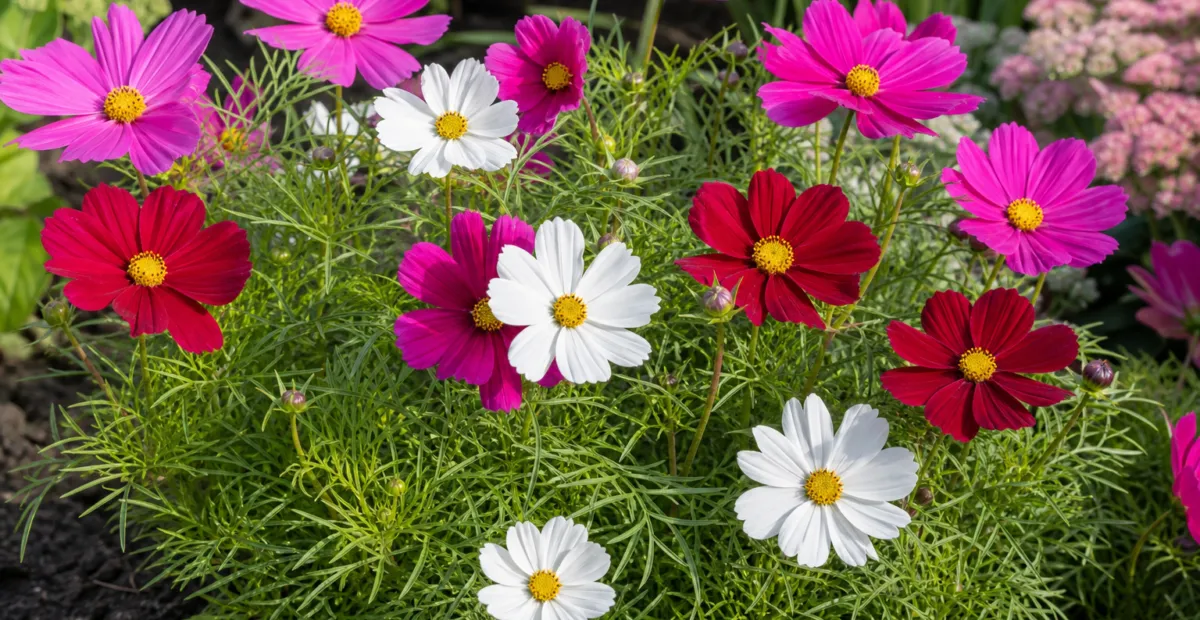
Cosmos bipinnatus 'Dwarf Sensation' is a compact annual selection bred for earlier, shorter growth than standard garden cosmos. Its finely divided foliage supports open, daisy-like flowers in pink, white, and crimson-red, each with a yellow center. Give it full sun, lean well-drained soil, and regular deadheading for a long summer display. It suits borders, containers, pollinator plantings, and informal cutting gardens.
Taxonomic classification
Dwarf Sensation (Cosmos bipinnatus ‘Dwarf Sensation’) care guide
Light and placement
Choose an open site with at least 6 hours of direct sun, preferably with southern or western exposure and protection from strong winds. Plants in too little light become stretched, lean, and flower less. In very hot regions, light afternoon shade may reduce stress, but heavy shade produces weak stems and fewer blooms.
Watering and humidity
Water deeply when the soil surface begins to dry, keeping young seedlings evenly moist for the first week or two. Once established, allow slight drying between waterings rather than keeping the soil constantly wet. Increase frequency in hot containers and during drought, and reduce it during cool or rainy periods.
Soil and growing medium
Use average to lean, loose soil that drains freely. Sandy, loamy, or moderately clayey ground can work if it does not stay saturated. Cosmos generally flowers better in soil that is not excessively rich. A neutral to slightly alkaline reaction is suitable; extreme pH is less important than good drainage and adequate structure.
Feeding
Do not overfertilize. Before planting, mix a modest amount of finished compost into poor soil if needed. In average ground, additional fertilizer is usually unnecessary; excessive nitrogen can produce leafy, weak growth and fewer flowers. Container plants may receive a dilute balanced fertilizer during active growth, but stop feeding when growth slows or flowering ends.
Growth and habit
This is a quick-growing, warm-season annual with an upright to bushy, branching habit. Its shorter selection is better suited to containers and front or middle border positions than full-sized cosmos. Pinching young plants can encourage branching, while excessive fertility or shade can make stems weak and reduce flowering.
Planting and repotting
Sow outdoors after frost danger has passed and the soil has warmed, or start indoors about 3–4 weeks before outdoor planting. Press seeds onto the surface or cover only about 1/8 inch; light and shallow coverage support germination. Thin or plant about 12 inches apart, then keep evenly moist during establishment.
Transplant young plants carefully because established roots dislike disturbance. Container-grown plants usually need no repotting during the season; sow or plant directly into the final container when practical.
Propagation and pruning
Propagation
Propagate by seed. Direct sow after the last frost or start indoors 3–4 weeks earlier. Do not bury seed deeply. Seedlings grow quickly, but harden indoor-started plants before transplanting. Allowing some flowers to mature can produce volunteer seedlings in suitable climates.
Pruning
Pinch the growing tips of young plants once they are established if a bushier form is wanted. Deadhead faded flowers regularly to encourage continued blooming. Cut stems for arrangements when the outer petals have opened. At season's end, remove diseased material; leave a few healthy seedheads only if self-sowing is desired.
Overwintering
Treat it as a seasonal annual in areas with frost. Pull plants after a killing freeze or remove them when flowering ends. In frost-free areas, plants may continue longer, but the cultivar is normally grown from fresh seed rather than overwintered indoors.
Uses
Use this compact cosmos in sunny annual borders, containers, balcony planters, cottage gardens, pollinator plantings, and informal cutting gardens. The open flower form is useful to visiting insects and provides airy color among denser plants. It is ornamental rather than a documented culinary or medicinal crop.
Appearance
The plant has slender, branching green stems and distinctive medium-green leaves divided repeatedly into very fine, threadlike segments. The airy foliage gives the plant a light texture. Flower heads sit above the foliage on relatively slender stems and show a contrasting yellow central disk surrounded by broad ray florets.
Flowering
The cultivar produces open, saucer-shaped flower heads composed of ray florets surrounding a yellow disk center. Colors are typically mixed pink, white, and crimson-red. Dwarf Sensation is marketed as earlier and shorter than standard Sensation types, with flowering continuing through summer and often until frost when spent blooms are removed.
Pollination and visitors
Open cosmos flower heads provide accessible nectar and pollen for bees, bumblebees, and butterflies. The yellow central disk is especially important because many small florets are packed together there. Avoid insecticide application while flowers are active.
Diseases and pests
Diseases
Avoid crowded, persistently wet conditions, which favor powdery mildew, gray mold, and stem problems. Improve air movement, water at the soil line, and remove badly affected material. Sanitize containers and avoid repeated overhead irrigation. Most plants have few serious disease problems when grown in full sun and well-drained soil.
Pests
Aphids, aster leafhopper, and caterpillars such as loopers may occasionally occur. Inspect new growth and leaf undersides, encourage beneficial insects, and use a strong water spray for light aphid infestations. Remove heavily damaged foliage. Avoid broad-spectrum insecticides while flowers are open and pollinators are visiting.
Related diseases and pests
Only Plant Doctor profiles whose host data indicate this plant may be affected are shown here.
 DiseaseAster yellows‘Candidatus Phytoplasma asteris’
 DiseaseSouthern blightAthelia rolfsii
 DiseaseGray MoldBotrytis cinerea
 DiseaseMaple powdery mildewSawadaea bicornis
 DiseaseCucurbit Powdery MildewPodosphaera xanthii (Castagne) U. Braun & Shishkoff
 DiseaseRose powdery mildewPodosphaera pannosa
 DiseaseApple Powdery MildewPodosphaera leucotricha
 DiseaseAsh Powdery MildewPhyllactinia fraxini (DC.) Fuss
Toxicity and pollen
No authoritative source located in this review specifically identifies Cosmos bipinnatus 'Dwarf Sensation' as toxic to people, dogs, cats, or children. Lack of a listing is not proof of complete safety. Prevent ingestion of large quantities of any ornamental plant and seek medical or veterinary advice if symptoms occur.
- Typical season
- Generally June through October in much of the United States
- Pollination / pollen
- Insect-presented pollen
Cosmos pollen is mainly presented within insect-visited flower heads rather than released from wind-pollinated cones or catkins. However, reliable cultivar-specific clinical allergy data are limited, so airborne allergy relevance is best treated as unknown rather than assumed to be zero. Sensitive gardeners should avoid handling flowers during symptoms and wash after garden work.
Native habitat
The species is native principally to Mexico and parts of the southwestern United States and grows in open, sunny habitats such as disturbed ground, fields, roadsides, and other well-drained sites. Garden forms perform best when their wild, warm-season preference is matched with sun, heat, and soil that is not overly rich.
Interesting fact
The specific epithet bipinnatus refers to the species' twice-divided foliage. The cultivar is a dwarf form of a species that commonly grows much taller. Its mixed flower colors occur around a contrasting yellow disk center. Cosmos can self-sow where seed ripens and winter conditions permit.
Frequently asked questions (FAQ)
The most relevant questions about this plant, with short and direct answers.
🌱Quick care
Is Cosmos bipinnatus 'Dwarf Sensation' an annual or perennial?⌄
Cosmos bipinnatus 'Dwarf Sensation' is a frost-tender annual in the United States. It grows, flowers, sets seed, and usually dies with the first hard frost.
How much sun does Cosmos bipinnatus 'Dwarf Sensation' need?⌄
Grow it in full sun, ideally with at least 6 hours of direct sunlight daily. More light generally produces sturdier plants and more flowers.
How tall does Cosmos bipinnatus 'Dwarf Sensation' get?⌄
This compact cosmos usually grows about 12–24 inches tall, although height varies with soil, light, and growing conditions. Some seed suppliers list plants near 20–24 inches.
How wide does Cosmos bipinnatus 'Dwarf Sensation' spread?⌄
Allow approximately 12–15 inches of growing space per plant. Giving plants adequate room improves airflow and helps maintain their compact, branching form.
Can Cosmos bipinnatus 'Dwarf Sensation' grow in containers?⌄
Yes, it grows well in containers with drainage holes and a lightweight, well-drained potting mix. Use a container at least about 10–12 inches wide for one plant.
🌤️Environment and placement
What kind of soil does Cosmos bipinnatus 'Dwarf Sensation' prefer?⌄
It prefers well-drained sandy, loamy, or moderately clayey soil. Avoid persistently wet ground, and do not enrich the soil heavily because excessive fertility can produce foliage with fewer flowers.
Can Cosmos bipinnatus 'Dwarf Sensation' tolerate poor soil?⌄
Yes, it generally performs well in moderately poor to average soil as long as drainage is good. Very rich soil may encourage lanky growth instead of abundant flowering.
Is Cosmos bipinnatus 'Dwarf Sensation' drought tolerant?⌄
Established plants tolerate short dry periods, but they flower best with moderate, consistent moisture. Water deeply when the soil begins to dry rather than keeping it constantly wet.
Where should I plant Cosmos bipinnatus 'Dwarf Sensation' in my garden?⌄
Plant it in a sunny border, bed, raised bed, or container where its compact size can be appreciated. It is especially useful at the front or middle of a planting rather than as a tall background plant.
💧Care and problems
How often should I water Cosmos bipinnatus 'Dwarf Sensation'?⌄
Water when the upper inch of soil feels dry, adjusting for heat, rainfall, and container size. Container plants may need watering more often than plants in the ground.
Does Cosmos bipinnatus 'Dwarf Sensation' need fertilizer?⌄
Usually, little or no fertilizer is needed in average soil. If growth is weak or soil is very poor, use a light application of a balanced fertilizer rather than repeated high-nitrogen feeding.
Should I deadhead Cosmos bipinnatus 'Dwarf Sensation'?⌄
Yes, remove faded flowers regularly to encourage continued blooming and keep the plant tidy. Leave a few flower heads in place if you want the plant to produce seed.
Does Cosmos bipinnatus 'Dwarf Sensation' need staking?⌄
It often stands without support because it is shorter than standard Sensation-type cosmos, but staking may help in windy locations or very fertile soil. A small, low support is usually sufficient.
Why is my Cosmos bipinnatus 'Dwarf Sensation' tall and floppy?⌄
Floppiness commonly results from insufficient sunlight, excessive fertilizer, crowded plants, or overly rich soil. Move containers to brighter light, avoid high-nitrogen feeding, and provide modest support if needed.
What problems commonly affect Cosmos bipinnatus 'Dwarf Sensation'?⌄
The main problems are usually overwatering, poor drainage, weak growth from low light, and occasional insect feeding. Good spacing, full sun, and allowing the soil to dry slightly between waterings help prevent many issues.
🪴Planting and repotting
When should I sow Cosmos bipinnatus 'Dwarf Sensation' seeds outdoors?⌄
Direct-sow seeds outdoors after the danger of frost has passed and the soil has begun to warm. In much of the United States, this is generally from spring through early summer, depending on the local climate.
How deep should I plant Cosmos bipinnatus 'Dwarf Sensation' seeds?⌄
Sow the seeds about 1/8–1/4 inch deep and cover them lightly. Cosmos seeds germinate best when they are not buried deeply.
How far apart should Cosmos bipinnatus 'Dwarf Sensation' plants be?⌄
Thin or transplant plants to about 12 inches apart, with up to 15 inches where airflow is a priority. Close spacing can increase crowding and reduce the plant's neat form.
Can I start Cosmos bipinnatus 'Dwarf Sensation' indoors?⌄
Yes, start seeds indoors about 4–5 weeks before your expected last spring frost. Transplant seedlings carefully after hardening them off and after frost danger has passed.
How long do Cosmos bipinnatus 'Dwarf Sensation' seeds take to germinate?⌄
Seeds commonly germinate in about 7–14 days under warm, evenly moist conditions. Germination may take longer if the soil is cold, too wet, or the seeds are planted too deeply.
Can Cosmos bipinnatus 'Dwarf Sensation' be transplanted?⌄
Yes, but transplant young seedlings before they become root-bound. Handle them gently, disturb the roots as little as possible, and water them in after planting.
✂️Propagation and pruning
How do I propagate Cosmos bipinnatus 'Dwarf Sensation'?⌄
Propagate it from seed, either by direct sowing or by starting seeds indoors. It is an annual cultivar, so routine propagation by cuttings is not normally necessary.
Should I pinch Cosmos bipinnatus 'Dwarf Sensation'?⌄
Pinching the growing tip once young plants are about 6–8 inches tall can encourage branching and a bushier shape. Avoid repeated hard pruning, which may delay flowering.
Will Cosmos bipinnatus 'Dwarf Sensation' self-seed?⌄
It may self-sow if flower heads are allowed to mature and drop seed. Volunteer seedlings may not reproduce the exact appearance of the named cultivar, especially if other cosmos varieties flower nearby.
⚠️Toxicity and safety
Is Cosmos bipinnatus 'Dwarf Sensation' toxic to people or pets?⌄
No specific toxicity record was found for this cultivar, but it should not be intentionally eaten. Keep seed packets and plant material away from children and pets, and contact a medical or veterinary professional if ingestion causes symptoms.
🌸Flowering and special interest
When does Cosmos bipinnatus 'Dwarf Sensation' bloom?⌄
It generally blooms from summer into early fall, with timing influenced by sowing date and local weather. Plants started indoors may flower earlier than those direct-sown outdoors.
How long does it take Cosmos bipinnatus 'Dwarf Sensation' to flower from seed?⌄
Under favorable conditions, flowering commonly begins about 8–12 weeks from sowing. Full sun, warm soil, and avoiding excessive fertilizer can help keep it on schedule.
What colors are the flowers of Cosmos bipinnatus 'Dwarf Sensation'?⌄
The mix typically produces daisy-like flowers in pink, rose, white, and crimson shades. Individual seed packets may emphasize particular colors, so the exact color balance can vary.
Is Cosmos bipinnatus 'Dwarf Sensation' good for pollinators?⌄
Yes, its open flowers can provide accessible pollen and nectar for butterflies, bees, and other beneficial insects. Single-flowered plants are generally more useful to pollinators than densely doubled flowers.
Can Cosmos bipinnatus 'Dwarf Sensation' be used as a cut flower?⌄
Yes, the flowers can be cut for informal arrangements. Harvest stems when the first flower is just opening, remove foliage below the water line, and place them in water promptly.
Similar plants
 Azure Monkshood (Aconitum carmichaelii) care guideAconitum carmichaelii
 Monkshood (Aconitum ‘Stainless Steel’)Aconitum 'Stainless Steel'
 Monkshood (Aconitum ‘Bressingham Spire’)Aconitum 'Bressingham Spire'
 Golden full moon maple (Acer shirasawanum ‘Aureum’)Acer shirasawanum 'Aureum'
 Globosum (Acer platanoides ‘Globosum’)Acer platanoides 'Globosum'
 Striped maple (Acer pensylvanicum) care guideAcer pensylvanicum