
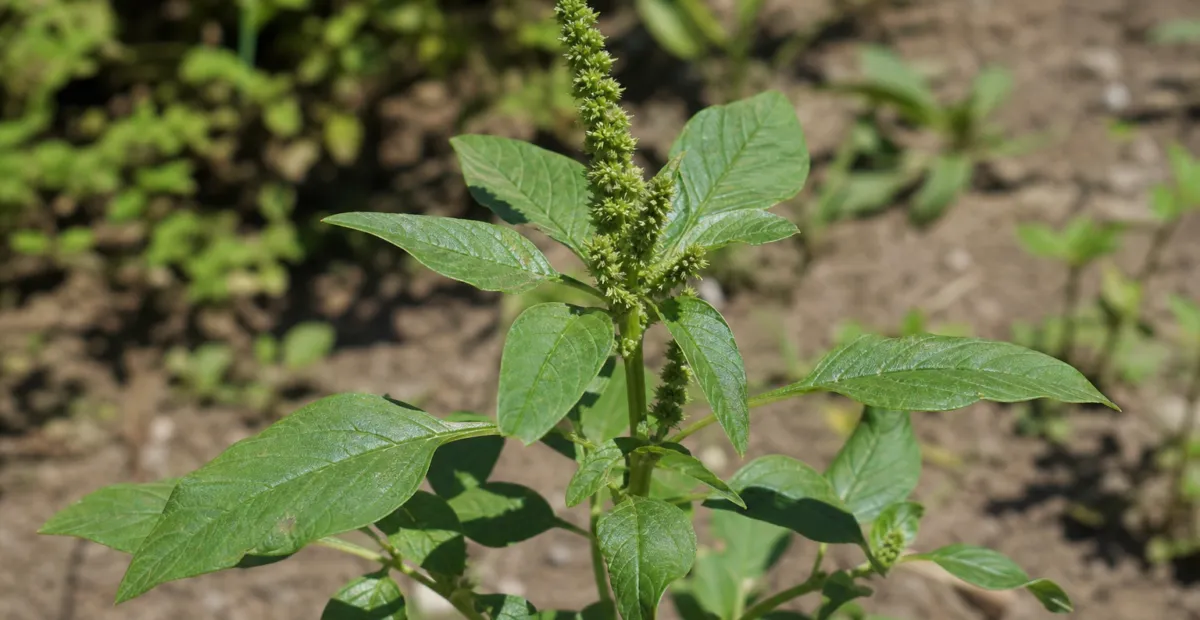
 AI-generated illustration
Smooth Pigweed (Amaranthus hybridus) short overview
Smooth Pigweed (Amaranthus hybridus) is a fast-growing warm-season annual with upright, branching stems and ovate green leaves. Its narrow terminal clusters may be green, reddish, or purplish and appear from summer into fall. Common in cultivated fields, roadsides, riverbanks, and other disturbed soils, it can provide edible young greens and seeds when accurately identified and properly prepared, but it also produces abundant wind-dispersed pollen and should be managed before heavy reseeding.
Taxonomic classification
Smooth Pigweed (Amaranthus hybridus) care guide
Light and placement
Give full sun, ideally at least 6 hours of direct light in an open bed. Southern or western exposure is suitable. Plants in insufficient light become taller and weaker, while excessive competition can reduce branching and seed production. In hot climates, reliable soil moisture is more important than afternoon shade, which is not normally required.
Watering and humidity
Water deeply when the upper 1–2 inches of soil become dry during establishment, then reduce frequency as roots develop. The plant tolerates short dry periods but grows more vigorously with even summer moisture. Avoid constant saturation, especially in containers. Humidity usually requires no special management.
Soil and growing medium
Adaptable to sandy, loamy, or clay soils, especially where disturbance has created open ground. A loose, well-drained soil supports reliable growth, although established plants tolerate some moisture retention. Soil reaction is broad, from slightly acidic through slightly alkaline. Avoid enriched beds if preventing vigorous, weedy growth is a priority.
Feeding
Normally needs little or no fertilizer. In a productive greens bed, incorporate finished compost before planting or use a balanced fertilizer at half strength only if growth is pale or weak. Avoid repeated high-nitrogen feeding, which can promote excessive foliage, nitrate accumulation, and unwanted reseeding.
Growth and habit
This annual establishes rapidly in warm weather and branches freely when growing without competition. It often behaves as a disturbance specialist, appearing wherever soil is tilled or exposed. Cut plants before seed maturation to reduce the soil seed bank; repeated cultivation can bring additional seed to the surface.
Planting and repotting
Sow outdoors after the last spring frost when soil has warmed. Press seeds onto the surface or cover with no more than 1/4 inch of fine soil; light can support germination. Thin crowded seedlings early, and water the row consistently until established.
Usually unnecessary. If grown in a container, transplant only while young and before the taproot becomes established; use a deep container with drainage and minimize root disturbance.
Propagation and pruning
Propagation
Propagate by seed. Direct-sow after soil warms, or start in small containers and transplant very young seedlings. Prevent unwanted spread by removing flowering plants before mature seed drops.
Pruning
No ornamental pruning is required. Pull or cut plants before seed heads mature if preventing spread is important. Wear gloves when handling dusty, pollen-bearing plants and remove cut stems from the site rather than composting mature seed heads.
Overwintering
Do not overwinter outdoors as a living plant; frost normally ends the annual life cycle. Allow selected plants to reseed only where that is intentional, or collect mature seed in a labeled container. Remove unwanted plants before freezing or before seed dispersal.
Uses
Young leaves may be cooked as greens, and seeds may be cooked as grain or ground into flour when the plant is accurately identified and harvested from a clean site. It is also useful as an educational or informal annual, but its aggressive seed production makes it unsuitable for many formal gardens. Avoid unsupported medicinal use claims.
Appearance
An upright, branched annual with alternate, petioled leaves that are ovate, rhombic-ovate, or lance-shaped. Stems are usually green but may be reddish or purplish and are smooth or only slightly hairy when young. The narrow terminal and axillary clusters, often green with occasional red or purple shading, help distinguish it from some related pigweeds.
Flowering
Small, inconspicuous flowers are borne in dense terminal and axillary clusters. Inflorescences are commonly green but may show reddish or purplish tones, and the terminal cluster can be slightly nodding. Flowering and fruiting generally continue from midsummer into fall in much of the United States.
Pollination and visitors
The species is primarily wind-pollinated and largely self-pollinated, so its inconspicuous flower clusters are not a dependable animal-pollinator resource. Small insects may visit inflorescences opportunistically, but documented animal attraction is limited.
Amaranthus hybridus photos
Click any photo for a larger view. Source, author and license are shown separately.
Diseases and pests
Diseases
Generally robust, but crowded or poorly drained conditions can favor damping-off, stem or root rots, and foliar leaf spots. Improve air movement, avoid chronically saturated soil, remove heavily affected plants, and rotate locations where disease recurs.
Pests
Watch for flea beetles, leaf-chewing caterpillars, aphids, tarnished plant bugs, and seedhead-feeding insects. Hand-pick small infestations, use row cover on young plants when practical, remove badly damaged plants, and avoid broad-spectrum insecticides during flowering.
Related diseases and pests
Only Plant Doctor profiles whose host data indicate this plant may be affected are shown here.
 PestTomato red spider mite (Tetranychus evansi)Tetranychus evansi Baker & Pritchard
 PestBeet ArmywormSpodoptera exigua (Hübner)
 PestChilli thripsScirtothrips dorsalis Hood
 DiseasePseudomonas viridiflava bacterial blightPseudomonas viridiflava
 DiseasePolymyxa betae — Vector of Beet RhizomaniaPolymyxa betae Keskin
 DiseaseLettuce mosaicLettuce mosaic virus
 PestBeet Cyst NematodeHeterodera schachtii
 DiseaseCucumber mosaic virusCucumber mosaic virus
Toxicity and pollen
Young leaves and seeds are reported as edible, but pigweed foliage can accumulate nitrate and contains oxalates. Cooking and draining the greens reduces oxalates and some nitrate risk. Do not harvest from chemically treated, polluted, or heavily fertilized sites, and do not rely on an identification made only from a photograph.
- Typical season
- July through October in much of the United States
- Pollination / pollen
- Abundant, fine, wind-dispersed pollen
Amaranthus pollen is small, abundant, and wind-dispersed during the flowering season. It can contribute to late-summer and early-fall airborne pollen exposure, particularly where dense stands occur. Keep plants away from windows or remove flowering stems if pollen sensitivity is a concern.
Native habitat
A pioneer of agricultural fields, fallow ground, roadsides, riverbanks, vacant lots, and other disturbed habitats. It performs best in open, warm sites with exposed mineral soil and adequate summer moisture, but established plants tolerate dry periods. The species is native to the Americas and widely introduced or naturalized elsewhere.
Interesting fact
Amaranthus hybridus is highly variable and can be confused with closely related pigweeds. It is considered one of the wild progenitors of cultivated grain amaranths. The species hybridizes readily with other Amaranthus species and can become a serious agricultural weed.
Frequently asked questions (FAQ)
The most relevant questions about this plant, with short and direct answers.
🌱Quick care
What is Smooth Pigweed?⌄
Smooth Pigweed is the annual species Amaranthus hybridus in the Amaranthaceae family. In the United States, it commonly appears as a warm-season weed in cultivated fields, gardens, disturbed soil, and other open sites.
How big does Smooth Pigweed get?⌄
Smooth Pigweed commonly grows about 2 to 7 feet tall, although size varies with moisture, fertility, and competition. Plants are upright, branched, and often develop a long fleshy taproot.
Is Smooth Pigweed an annual or perennial?⌄
Smooth Pigweed is a frost-sensitive annual. It germinates, grows, flowers, produces seed, and dies during one growing season.
How can you identify Smooth Pigweed?⌄
Look for an erect, usually hairless plant with oval, diamond-shaped, or ovate leaves, wavy margins, and green to reddish flower clusters. Unlike spiny amaranths, Smooth Pigweed has no spines; distinguishing it from similar pigweeds may require examining leaf shape, stem hairiness, and flower-head structure.
How is Smooth Pigweed different from Redroot Pigweed?⌄
Smooth Pigweed is generally hairless or much less hairy and often has more extensively branched flower heads. Redroot Pigweed typically has noticeably hairy stems and leaves, especially near the base, but young plants can be difficult to separate without close inspection.
How is Smooth Pigweed different from Palmer Amaranth?⌄
Smooth Pigweed usually has oval or diamond-shaped leaves and branched, thinner flower clusters, while Palmer Amaranth often develops longer, more prominent terminal flower spikes. Accurate identification matters because the species differ in management concerns and herbicide resistance patterns.
🌤️Environment and placement
Is Smooth Pigweed native to the United States?⌄
Smooth Pigweed is widely established in the United States and is treated as a common agricultural and garden weed. Its precise native range is complex and may vary by authority, so local occurrence does not by itself establish whether a population is native or introduced.
Where does Smooth Pigweed grow best?⌄
Smooth Pigweed grows best in warm, sunny, disturbed locations with fertile soil and adequate moisture. It is common in crop fields, vegetable gardens, roadsides, riverbanks, waste areas, and barnyards.
Does Smooth Pigweed need full sun?⌄
Smooth Pigweed grows most vigorously in full sun. It can emerge in partially shaded disturbed soil, but reduced light usually limits its growth and seed production.
What soil does Smooth Pigweed prefer?⌄
Smooth Pigweed tolerates many soil types but responds strongly to fertile, well-drained soil. It often becomes especially vigorous where soil has been disturbed or enriched with nutrients.
How much water does Smooth Pigweed need?⌄
Smooth Pigweed generally needs moderate moisture for rapid growth but can survive short dry periods once established. Waterlogged soil is less suitable than moist, well-drained ground.
What USDA growing zones support Smooth Pigweed?⌄
Smooth Pigweed can grow as a summer annual across much of the United States wherever the growing season is warm enough for germination and seed production. Frost ends the plant, so local emergence and flowering dates vary by USDA climate zone.
💧Care and problems
When does Smooth Pigweed emerge in the United States?⌄
Smooth Pigweed usually emerges after the soil warms in spring and continues germinating through much of the summer. The exact timing depends on latitude, soil temperature, rainfall, and disturbance.
How do I control Smooth Pigweed in a garden?⌄
Remove Smooth Pigweed while plants are young, preferably by hand-pulling or shallow hoeing before seed formation. Mulch and repeated removal of new seedlings help reduce emergence, while mature plants should be bagged or otherwise disposed of so seeds do not spread.
Can Smooth Pigweed survive mowing?⌄
Mowing can suppress Smooth Pigweed temporarily, but plants cut early may branch or regrow if the root crown remains. Mow or cut before flowering and combine it with follow-up removal to prevent seed production.
Is Smooth Pigweed resistant to herbicides?⌄
Some Smooth Pigweed populations in the United States have documented resistance to one or more herbicide groups. Control success varies by population, product, application timing, and label, so use integrated management and follow the product label rather than assuming one treatment will work.
🪴Planting and repotting
How deep should Smooth Pigweed seeds be planted?⌄
Smooth Pigweed seeds generally germinate best near the soil surface, and light can stimulate germination. If deliberately grown for research or edible greens, sow seeds shallowly—about one-quarter to one-third inch deep—and keep the medium evenly moist.
Can Smooth Pigweed grow in a container?⌄
Smooth Pigweed can grow in a container if it receives full sun and has fertile, well-drained potting soil. A container is useful for limiting spread, but mature plants may still produce abundant seed unless flower heads are removed.
Should I transplant Smooth Pigweed seedlings?⌄
Transplanting is possible when seedlings are small, but Smooth Pigweed is usually easier to manage by direct sowing or removal. Handle young plants carefully because the taproot develops quickly and can be damaged during transplanting.
✂️Propagation and pruning
Does Smooth Pigweed produce a lot of seeds?⌄
Yes, Smooth Pigweed can produce many small seeds during a single growing season. Preventing mature seed from falling is one of the most effective ways to reduce future plants.
How does Smooth Pigweed reproduce?⌄
Smooth Pigweed reproduces primarily by seed. Seeds can be moved by soil disturbance, equipment, water, animals, compost, or contaminated crop and garden materials.
⚠️Toxicity and safety
Are Smooth Pigweed leaves edible?⌄
Young Smooth Pigweed leaves are eaten as amaranth greens in some food traditions, but only correctly identified, uncontaminated plants should be considered for food. Avoid plants from treated soil, roadsides, manure-contaminated areas, or locations with uncertain chemical exposure.
Are Smooth Pigweed seeds edible?⌄
Smooth Pigweed seeds are reported as edible and can be used similarly to other amaranth seeds, but species identification and growing conditions must be certain. Do not consume seeds from plants exposed to herbicides, pesticides, polluted soil, or heavy roadside contamination.
Is Smooth Pigweed toxic to people or pets?⌄
Smooth Pigweed warrants moderate ingestion caution rather than being treated as universally safe. Amaranths may accumulate nitrates, and oxalates can be a concern, especially in stressed plants or when large amounts are eaten; consult a physician or veterinarian after a suspected ingestion.
Can livestock eat Smooth Pigweed?⌄
Livestock may consume Smooth Pigweed, but large amounts or plants grown under stressful conditions can pose nitrate-related concerns. Do not use it as forage without considering the animal species, plant quantity, growing conditions, and advice from a veterinarian or extension specialist.
Does Smooth Pigweed cause skin irritation?⌄
Smooth Pigweed is not generally known as a major skin-irritant plant, but handling any weed can cause irritation or allergic reactions in some people. Wear gloves when pulling it, especially if the plant is dusty, damaged, or growing among other irritating weeds.
🌸Flowering and special interest
When does Smooth Pigweed flower?⌄
Smooth Pigweed generally flowers from summer into early fall, commonly from June through October in parts of the United States. Plants may flower earlier or later depending on climate and growing conditions.
What do Smooth Pigweed flowers look like?⌄
Its flowers are very small and occur in dense, branched terminal clusters that may be greenish, reddish, or purplish. The flower heads are typically thinner and more branched than those of Redroot Pigweed.
Should I let Smooth Pigweed flower in my garden?⌄
Usually no, unless you intentionally want to collect seed or observe its flowers. Allowing Smooth Pigweed to mature can add a large seed bank and make future weed control more difficult.
Do pollinators use Smooth Pigweed flowers?⌄
Small insects can visit Smooth Pigweed flowers for pollen, but the plant is generally managed as an agricultural and garden weed rather than grown as a primary pollinator plant. If retaining it for wildlife value, prevent unwanted seed spread and avoid plants exposed to chemicals.
Similar plants
 Azure Monkshood (Aconitum carmichaelii) care guideAconitum carmichaelii
 Monkshood (Aconitum ‘Stainless Steel’)Aconitum 'Stainless Steel'
 Monkshood (Aconitum ‘Bressingham Spire’)Aconitum 'Bressingham Spire'
 Golden full moon maple (Acer shirasawanum ‘Aureum’)Acer shirasawanum 'Aureum'
 Globosum (Acer platanoides ‘Globosum’)Acer platanoides 'Globosum'
 Striped maple (Acer pensylvanicum) care guideAcer pensylvanicum