
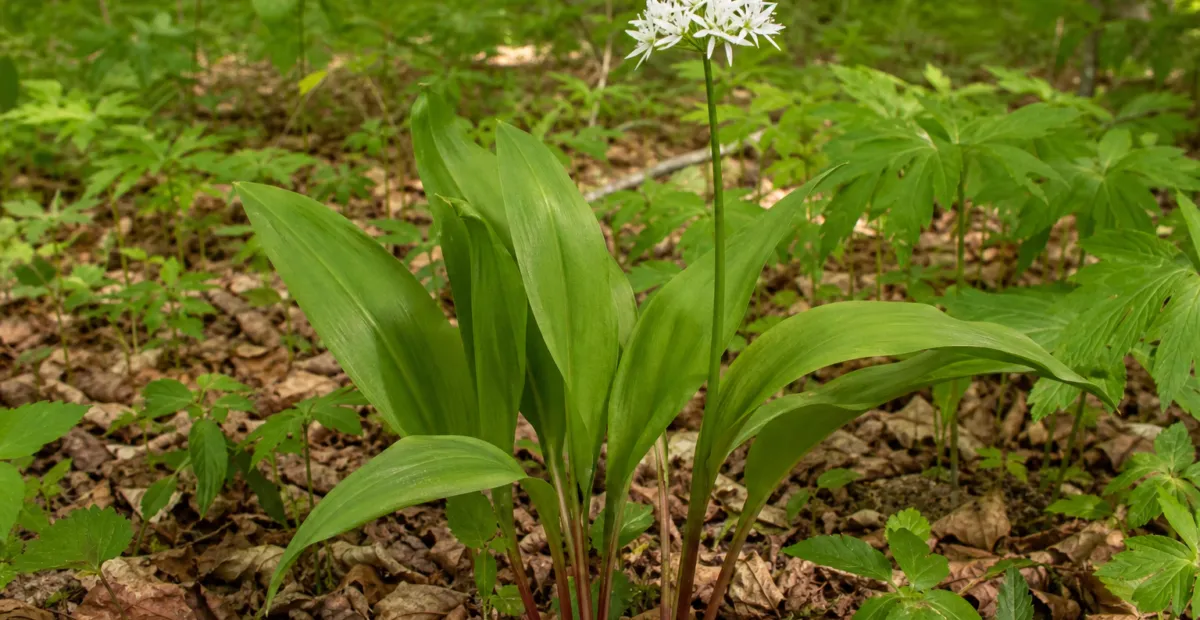
 AI-generated illustration
Ramp (Allium tricoccum) short overview
Ramp is a North American spring ephemeral native to rich, moist deciduous forests from Canada through the eastern United States. Its broad, fragrant leaves emerge before the woodland canopy closes, then fade as a leafless stalk carries a rounded cluster of small white flowers in early summer. This shade-loving bulbous perennial is valued as a native woodland plant and edible crop, but responsible harvesting is essential because wild populations recover slowly.
Taxonomic classification
Ramp (Allium tricoccum) care guide
Light and placement
Plant ramps under deciduous trees or on a north- or east-facing woodland edge where they receive bright spring light before canopy closure, followed by dappled shade or deep shade. They can tolerate more sun only when soil moisture remains dependable year-round. Weak, floppy growth may indicate excessive shade; scorched or prematurely yellowing leaves usually indicate too much sun or drying soil.
Watering and humidity
Keep the planting evenly moist through germination, establishment, and summer dormancy; do not allow the soil to dry deeply. Water slowly when the upper few inches begin to dry, especially in spring droughts and during the first several years. Good drainage is essential because saturated soil can cause bulb rot. Humidity generally requires no special management outdoors.
Soil and growing medium
Use a friable woodland soil rich in decomposed hardwood leaves, humus, and organic matter. The site should hold moisture without becoming stagnant, with good internal drainage around the bulbs. Ramps naturally occur in acidic, calcium-rich soils; avoid routine liming unless a soil test shows a need. A thick layer of hardwood leaf litter helps maintain the appropriate structure and moisture.
Feeding
Before planting, incorporate composted leaves or mature compost if the soil lacks organic matter. Annual top-dressing with leaf mold in autumn or early spring is usually sufficient. Do not push lush growth with strong nitrogen fertilizer, especially after emergence; ramp foliage is present for only a short period and the bulb must rebuild reserves before dormancy.
Growth and habit
Ramps are spring ephemerals: leaves emerge in early spring, photosynthesize briefly, and die back as temperatures rise and the canopy closes. The plant then flowers on a leafless stalk and rests underground through summer. Established plants can form dense colonies or clumps. Avoid disturbing the bulbs during dormancy and keep competing weeds controlled while new colonies establish.
Planting and repotting
Prepare a weed-free bed beneath deciduous trees or a shade structure. Rake back leaf litter, loosen the surface, and add composted leaves if needed. Set bulbs about 3 inches deep with roots covered and only the tip near the surface, then replace 2–3 inches of hardwood leaf litter. Keep the bed consistently moist and protect young seedlings from wildlife and competition.
Ramps are poorly suited to repeated container culture because they need seasonal cold, woodland moisture, organic soil, and undisturbed establishment. If grown in a container, use a deep vessel filled with moisture-retentive, well-drained leaf-based soil, keep it outdoors through winter, and transplant to a permanent woodland site as soon as practical.
Propagation and pruning
Propagation
Propagate by fresh seed or division of established clumps. Sow seed in late summer or early fall on prepared woodland soil and cover with leaf litter; warm-moist and cold periods may be needed before emergence. Division or bulb planting is faster but should use nursery-grown or legally obtained material. Seedlings are slow, and harvestable plants require several years.
Pruning
Do not routinely cut back healthy foliage while it is green; those leaves replenish the bulb before dormancy. For ethical harvesting, take only a small portion of foliage and leave the bulb and enough leaves to sustain the plant. Remove only fully dried stalks or spent foliage if desired, preferably after seed has dispersed.
Overwintering
Leave bulbs in the ground outdoors; established plants are naturally cold hardy. Maintain the hardwood leaf-litter mulch through winter, especially where snow cover is unreliable. Avoid saturated winter soil, but do not strip away the organic surface layer because it insulates bulbs and buffers moisture.
Uses
Ramps are grown in native woodland gardens, shade gardens, edible landscapes, and small-scale forest farming systems. Leaves, stems, and bulbs have a pungent onion-garlic flavor and are used sparingly in cooking. Harvesting should be conservative: leaving bulbs intact and taking only limited foliage helps preserve colonies. Never eat a wild plant unless identification is certain, because poisonous woodland look-alikes can resemble ramps.
Appearance
The plant arises from a conical bulb and usually carries one to three broad, smooth, elliptical basal leaves. Leaves are green, flat, and strongly onion-garlic scented when bruised; lower stems may be reddish or burgundy. After the leaves fade, a smooth leafless stalk bears a rounded cluster of many tiny white flowers. Black seeds develop in a capsule after flowering.
Flowering
Flowering follows foliage dieback, with a leafless stalk appearing in early summer. The rounded umbel contains many small white flowers with six tepals, six stamens, pale yellow anthers, and a single style. Each flower can develop a single black seed, and the developing seed capsules remain visible after the flowers fade.
Pollination and visitors
The small white umbels are visited by insects, and extension references identify the flowers as attractive to pollinators. The documented visitor record is broad rather than tied to one consistently reported pollinator species, so no single Latin species is assigned here.
Allium tricoccum photos
Click any photo for a larger view. Source, author and license are shown separately.
Diseases and pests
Diseases
Bulb rot is the main cultural concern and is promoted by stagnant, waterlogged soil. Improve drainage and avoid planting in compacted beds. Septoria leaf spot has been observed on wild and cultivated ramps; remove badly affected debris after dieback and improve spacing and airflow without disturbing the colony.
Pests
Bulb mites may occur, and allium leaf miner has been reported on ramps in the Northeast. Leek moth may feed on ramps when preferred allium hosts are unavailable. Inspect leaves for mines, distorted growth, or caterpillar feeding; remove heavily affected material, control weeds, and avoid unnecessary insecticide use in a native woodland planting.
Related diseases and pests
Only Plant Doctor profiles whose host data indicate this plant may be affected are shown here.
 PestAllium leafminerPhytomyza gymnostoma Loew
 DiseaseTomato spotted wilt virusOrthotospovirus tomatomaculae (tomato spotted wilt virus; TSWV)
 PestOnion thripsThrips tabaci Lindeman
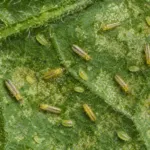 PestMelon thripsThrips palmi Karny
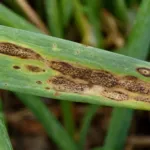 DiseaseStemphylium Leaf BlightStemphylium vesicarium (Wallr.) E.G. Simmons
 PestChilli thripsScirtothrips dorsalis Hood
 DiseaseRhizopus soft rotRhizopus stolonifer
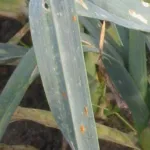 DiseaseAllium rustPuccinia allii
Toxicity and pollen
Ramps are edible to humans, but allium plants contain sulfur compounds that can cause poisoning in pets when substantial amounts are eaten. Raw, cooked, or concentrated Allium material can damage red blood cells and cause hemolytic anemia, with signs sometimes delayed for several days. Keep harvested ramps and kitchen scraps away from pets. Human consumption should be limited to correctly identified plants and normal culinary quantities.
- Typical season
- Late spring to early summer
- Pollination / pollen
- Pollen released from insect-visited flowers; airborne exposure is not well characterized.
Species-specific evidence on airborne ramp pollen and human allergy is limited. Because the flowers are insect-pollinated, exposure is likely more localized than for strongly wind-pollinated plants, but insect pollination does not prove zero allergy risk. People with known allium or pollen sensitivity should avoid handling flowers or seed heads if symptoms occur.
Native habitat
Ramps inhabit rich, moist deciduous forests, wooded slopes, ravines, and bottoms with deep leaf litter. They commonly grow beneath beech, birch, sugar maple, poplar, oak, hickory, basswood, and related eastern hardwoods. North-facing slopes are frequent because they retain moisture, although well-watered sites with other orientations can also support them.
Interesting fact
Ramps complete most of their annual photosynthesis before the forest canopy fully closes. Fresh seeds may require a warm period followed by winter chilling and can take 6–18 months to germinate. A plant may need several years from seed before leaf or bulb harvest is practical. The specific epithet tricoccum refers to its three-seeded capsules.
Frequently asked questions (FAQ)
The most relevant questions about this plant, with short and direct answers.
🌱Quick care
What is a ramp plant?⌄
Ramp is the common name for Allium tricoccum, a cold-hardy North American perennial in the Amaryllidaceae family. It is a spring ephemeral with edible leaves, stems, and bulbs when correctly identified.
How much light do ramps need?⌄
Ramps grow best in partial shade to shade, especially beneath deciduous trees. They can tolerate more spring sunlight before the canopy fills in, but harsh summer sun is usually unsuitable.
How often should I water ramps?⌄
Keep ramp soil consistently moist but never waterlogged. Water during dry periods, including after the foliage dies back, because year-round moisture supports seedling survival and bulb development.
What type of soil is best for ramps?⌄
Use rich, moist, well-drained soil high in organic matter and decomposed leaf mold. Woodland-like soil with steady moisture and, often, slightly acidic to neutral conditions is ideal.
🌤️Environment and placement
Where do ramps grow naturally in the United States?⌄
Ramps naturally grow in rich, moist deciduous forests and floodplain or drainage areas across much of the eastern and midwestern United States. North- and east-facing wooded slopes are especially typical habitats.
Can ramps grow under trees?⌄
Yes, ramps are particularly well suited to planting beneath deciduous trees such as sugar maple, beech, basswood, birch, poplar, hickory, and oak. Their spring foliage benefits from sunlight before the tree canopy fully develops.
Can ramps grow in a backyard garden?⌄
Yes, ramps can grow in a backyard garden if you provide woodland conditions: shade, rich leaf-mold soil, reliable moisture, and good drainage. They establish slowly and are better treated as a long-term perennial planting.
Can ramps grow in full sun?⌄
Ramps generally prefer shade or dappled light, but they may tolerate more sun where soil remains moist throughout the year. Full sun is most likely to cause stress if the site dries or becomes hot in summer.
What USDA hardiness zones are suitable for ramps?⌄
Ramps are cold-hardy perennials suited to much of the eastern and midwestern United States. Exact performance depends more on moisture, shade, and woodland soil than on a single hardiness-zone boundary.
💧Care and problems
Why do ramp leaves disappear in summer?⌄
Ramp leaves naturally die back in late spring or early summer because the plant is a spring ephemeral. The bulb remains underground while the plant rests through the warmer part of the year.
Do ramps need fertilizer?⌄
Ramps usually need little fertilizer when grown in rich soil amended with compost or leaf mold. A thick annual layer of decomposed leaves is generally more appropriate than heavy feeding.
Why are my ramps not coming back?⌄
Ramps may fail to return if the soil dries, drainage is poor, sunlight becomes excessive, bulbs were damaged, or the plants were harvested too heavily. Protect the planting area and maintain moisture even after the leaves disappear.
Do ramps have pests or diseases?⌄
Ramps can be affected by the same general pests and diseases as other Allium plants, but serious problems are not usually the main cultivation challenge. Poor moisture management, disturbance, and unsustainable harvesting are more common causes of decline.
How large do ramp plants get?⌄
A mature ramp commonly reaches about 6 to 12 inches tall, with a clump spreading roughly 12 to 24 inches over time. Individual size varies with soil fertility, moisture, age, and site conditions.
🪴Planting and repotting
When should I plant ramp bulbs?⌄
Plant ramp bulbs in early spring while they are dormant or just emerging, or in fall when the soil is workable. Set them in woodland-like soil at approximately 3 inches deep and keep the area consistently moist.
How deep should ramp bulbs be planted?⌄
Plant ramp bulbs about 3 inches deep, positioning them in rich, moist, well-drained soil. Cover the planting with leaf litter to help maintain the cool, organic conditions they prefer.
Can ramps be grown in containers?⌄
Ramps can be grown in a large container if it provides excellent drainage, shade, rich organic soil, and consistent moisture. Containers dry out faster than woodland soil, so they require closer monitoring.
✂️Propagation and pruning
How do you propagate ramps from seed?⌄
Sow fresh ramp seed in late summer or early fall in moist, leaf-rich soil. Seeds have complex dormancy and may take about 6 to 18 months to germinate, so do not discard the planting prematurely.
How long do ramps take to grow from seed?⌄
Ramp seeds may take 6 to 18 months to germinate, and plants typically need several years to become harvestable. Leaf harvest may take about four years, while bulb harvest can require five to seven years or longer.
Can ramps be propagated by division?⌄
Yes, ramps can be propagated by carefully dividing established bulb clumps. Division is generally faster than seed, but disturbing wild populations or removing entire clumps can damage slow-growing patches.
Should I prune ramp leaves?⌄
No routine pruning is needed because ramp foliage naturally senesces after its short spring growing season. Avoid removing more leaves than necessary, since the foliage replenishes the bulb before dormancy.
⚠️Toxicity and safety
Are ramps edible for people?⌄
Yes, the leaves, stems, and bulbs of correctly identified ramps are edible and have a strong onion-garlic flavor. Never eat a wild plant based only on appearance; ramps have dangerous look-alikes.
How can I tell ramps from poisonous look-alikes?⌄
A true ramp should have a distinct onion-or-garlic odor when a leaf is gently bruised, but smell alone should not replace expert identification. Lily-of-the-valley and false hellebore can resemble ramps and are poisonous.
Are ramps poisonous to dogs and cats?⌄
Yes, ramps contain Allium compounds that can be toxic to dogs and cats if eaten. Keep pets away from the plants and contact a veterinarian or animal poison service promptly after suspected ingestion.
How should ramps be harvested sustainably?⌄
For a lasting patch, harvest only a small portion of a population and leave most plants undisturbed. Prefer taking a leaf rather than the entire bulb, and leave at least one leaf attached so the plant can continue storing energy.
Can harvesting ramp bulbs kill the plant?⌄
Yes, removing the entire bulb can kill an individual ramp and reduce the patch’s ability to recover. Repeated bulb harvesting is especially harmful because ramps are slow-growing and may take years to reach maturity.
🌸Flowering and special interest
When do ramps flower?⌄
Ramps usually flower in June or July after their leaves have died back. Small white flowers form a rounded cluster on a leafless stalk.
How many years before ramps flower?⌄
Ramps are slow-growing and commonly require about five to seven years before flowering. The exact timing varies with habitat quality, plant age, and growing conditions.
Do ramps produce seeds?⌄
Yes, pollinated ramp flowers develop into three-lobed capsules that reveal glossy black seeds when mature. The seeds usually fall close to the parent plant, helping natural patches expand gradually.
Similar plants
 Azure Monkshood (Aconitum carmichaelii) care guideAconitum carmichaelii
 Monkshood (Aconitum ‘Stainless Steel’)Aconitum 'Stainless Steel'
 Monkshood (Aconitum ‘Bressingham Spire’)Aconitum 'Bressingham Spire'
 Golden full moon maple (Acer shirasawanum ‘Aureum’)Acer shirasawanum 'Aureum'
 Globosum (Acer platanoides ‘Globosum’)Acer platanoides 'Globosum'
 Striped maple (Acer pensylvanicum) care guideAcer pensylvanicum