
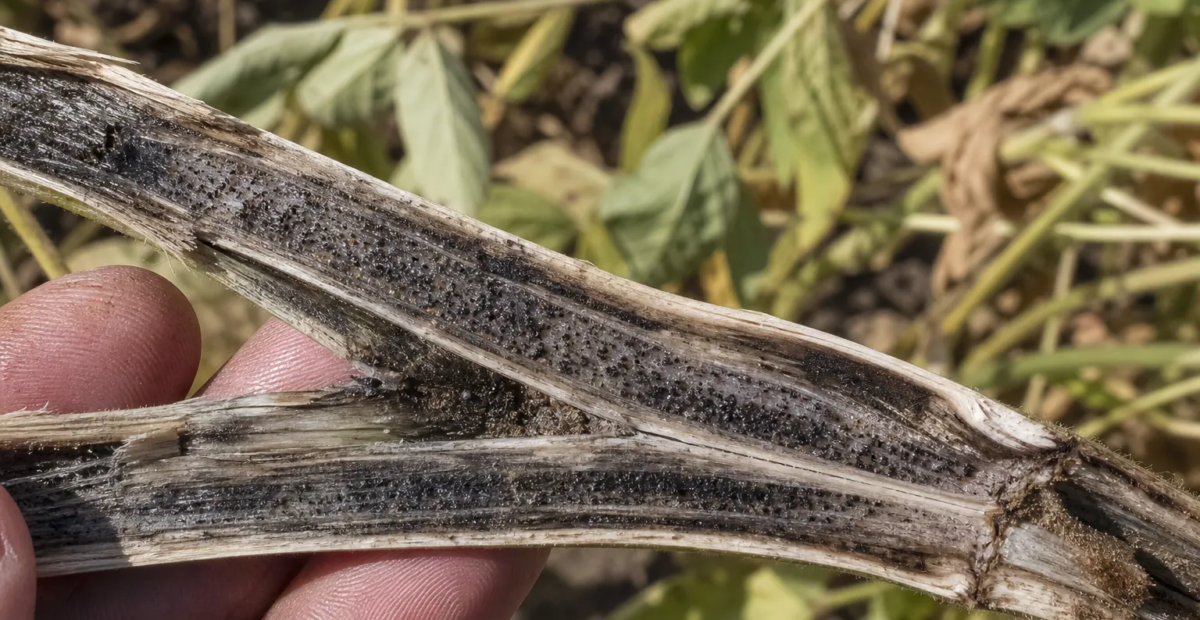
Charcoal rot
Macrophomina phaseolina (Tassi) GoidanichCharcoal rot overview
Charcoal rot is a soilborne disease caused by the fungus Macrophomina phaseolina. It attacks roots, crowns and lower stems of many crops, with severe symptoms most likely when plants face heat, drought or root injury. Wilting, premature death, dry basal rot and tiny black microsclerotia resembling charcoal dust are characteristic, but laboratory confirmation is recommended because drought and other root diseases can look similar.
Typical conditions
Overview
Charcoal rot, also called dry-weather wilt or ashy stem blight in some crop contexts, is caused by the soilborne fungus Macrophomina phaseolina. The pathogen has a very broad host range and is important in U.S. production of soybean, sunflower, corn, sorghum, dry bean, peanut, cotton, potato and strawberry, among other crops.
It infects roots and the lower stem, then can disrupt water-conducting tissues. Symptoms may remain inconspicuous until hot, dry weather or another stress causes rapid decline. Because wilting is not diagnostic by itself, compare roots and lower stems, examine internal tissues and submit representative samples to a plant diagnostic laboratory when management decisions depend on confirmation.
Symptoms and identification
- Irregular patches of wilting, yellowing, stunting and premature plant death, often becoming obvious during hot, dry weather.
- Brown to black, sunken or dry lesions on roots, crowns, hypocotyls and basal stems.
- Gray, silvery or shredded internal tissue after splitting roots or lower stems.
- Numerous tiny black microsclerotia beneath the epidermis or in pith and vascular tissues, giving affected tissue a charcoal-dusted appearance.
- Seedlings may show damping-off, dark basal lesions, poor emergence and stem breakage at the soil line.
- Depending on the host, symptoms may include stalk weakening, crown collapse, pod or seed infection, or tuber lesions.
Do not diagnose from wilt alone. Similar symptoms can result from drought, Verticillium wilt, Fusarium, Rhizoctonia, Pythium, bacterial stalk rots, nematode injury or damaged roots. Laboratory confirmation is most reliable from the margin between healthy and discolored tissue.
Causes and spread
The primary inoculum is microsclerotia and mycelium surviving in infested soil and crop debris. Spread occurs when contaminated soil is moved on tillage tools, harvest equipment, footwear, irrigation water, transplants or other planting material. Infected seed and residues can also introduce or redistribute the pathogen.
Risk increases with continuous or frequent production of susceptible crops, high temperatures, drought, root-feeding nematodes, compaction, mechanical root injury and unbalanced nutrition. The pathogen may infect young plants, but field symptoms often remain hidden until later stress exposes the damage.
Life cycle and persistence
The fungus survives between crops mainly as durable black microsclerotia in soil and infected plant residues. They can persist for years, with survival influenced by soil conditions and residue decomposition. When soil is suitably warm and moist, microsclerotia germinate and produce hyphae that infect roots or the stem base.
After infection, colonization and disease expression are accelerated when the host experiences water deficit or heat stress. In many crops, symptoms become most visible from flowering or reproductive development through late season. New microsclerotia form in dead or dying tissue and return to the soil as residues break down. Movement between fields is driven chiefly by infested soil, residues, equipment, transplants and seed rather than by ordinary long-distance airborne spread.
Treatment and control
Once plants are severely wilted, curative treatment is generally unlikely because the pathogen is established inside roots and basal stems and remains in the soil. Remove severely affected plants and roots where practical, bag or otherwise contain material from small plantings, and do not place diseased tissue in compost intended for future host crops unless the composting process is demonstrably adequate.
For remaining plants, reduce stress by supplying water appropriately, controlling weeds, correcting verified nutrient problems and avoiding additional root disturbance. In commercial fields, map affected patches, confirm the diagnosis and use the information to guide rotation and planting decisions. Crop-specific fungicide, fumigant or biological options differ substantially among U.S. crops and states; consult current university extension recommendations and the product label rather than applying an off-label program.
Low-impact and biological control
No single organic measure reliably cures established charcoal rot. Use an integrated, preventive program:
- Maintain uniform soil moisture during establishment, flowering and yield formation; avoid severe dry-down and large fluctuations where irrigation is available.
- Use healthy, high-quality seed, disease-free transplants and clean propagation media.
- Remove severely affected plants with roots where practical, and keep contaminated soil and residues out of clean beds and host-specific compost systems.
- Improve soil structure, drainage and rooting conditions without creating compaction; reduce traffic in wet soil and correct nutrient deficiencies using soil or tissue tests.
- Use anaerobic soil disinfestation, solarization or approved biological products only where they are suited to the crop, site and local production system; performance is variable and treatment is not guaranteed.
- Control weeds and plant-parasitic nematodes because they may maintain inoculum or increase root stress.
Prevention
- Start with certified or otherwise reputable seed and inspected, disease-free transplants.
- Rotate susceptible crops with less-suitable crops, especially cereals where agronomically appropriate; do not assume corn or any single rotation crop will eliminate the pathogen.
- Extend the interval between susceptible crops such as soybean, dry bean, sunflower, peanut, corn or strawberry when field history and local recommendations indicate high risk.
- Maintain adequate and even soil moisture, particularly during flowering, fruit set and grain or seed filling. Use irrigation efficiently rather than relying on emergency watering after severe stress.
- Prevent compaction and traffic-related root damage, and maintain good soil aggregation and rooting depth.
- Base fertilization on soil and tissue tests; avoid both nutrient deficiency and excessive nitrogen that promotes weak, overly dense growth.
- Manage weeds, nematodes and other root injuries that intensify plant stress.
- Remove or properly manage heavily infected residues, clean soil from equipment before moving between fields and avoid moving contaminated potting media or bed soil.
- Where available, select cultivars described by university or crop-specific programs as having improved charcoal-rot tolerance, recognizing that complete resistance is uncommon and performance is environment-dependent.
Interesting facts
- Macrophomina phaseolina is considered a broad-host-range pathogen and has been reported from hundreds of plant species, including crops, weeds and forest nursery plants.
- The name charcoal rot refers to the minute black microsclerotia that resemble charcoal dust on infected lower stems, roots or crowns.
- Infection may occur before visible symptoms, while severe wilting often appears only after heat, drought or another stress increases water demand.
- The disease is not restricted to field crops: it can also affect strawberry, potato, vegetable crops and seedlings in forest nurseries.
- A crop rotation can reduce inoculum and disease pressure, but because the host range is broad, rotation alone does not guarantee eradication.
Do not apply a fungicide solely from a visual diagnosis. In the United States, use only products currently labeled by the U.S. Environmental Protection Agency and legally authorized for the specific crop, disease and application site in your state; follow the current label exactly, including rate, timing, personal protective equipment, re-entry interval, preharvest interval and resistance-management instructions. Chemical options are crop- and state-specific and generally provide limited value once roots and basal stems are colonized.
Affected plants
The plants below are linked to this problem by structured host-plant data. The list updates automatically as new plant profiles are added.
 He tepary bea (Phaseolus acutifolius) care guidePhaseolus acutifolius
 Snap bean (Phaseolus coccineus) care guidePhaseolus coccineus
 Butter bea (Phaseolus lunatus) care guidePhaseolus lunatus
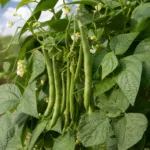 String Bean (Phaseolus vulgaris) care guidePhaseolus vulgaris
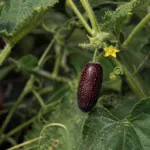 Maroon cucumbe (Cucumis anguria) care guideCucumis anguria
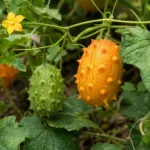 Horned Melon (Cucumis metuliferus) care guideCucumis metuliferus
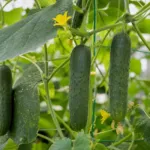 Cucumber (Cucumis sativus) care guideCucumis sativus
 Solanum aethiopicum care guideSolanum aethiopicum
 Solanum macrocarpon care guideSolanum macrocarpon
 Eggplant (Solanum melongena) care guideSolanum melongena
 Water spinach (Ipomoea aquatica) care guideIpomoea aquatica
 Garden Huckleberry (Solanum scabrum) care guideSolanum scabrum