
 Source:
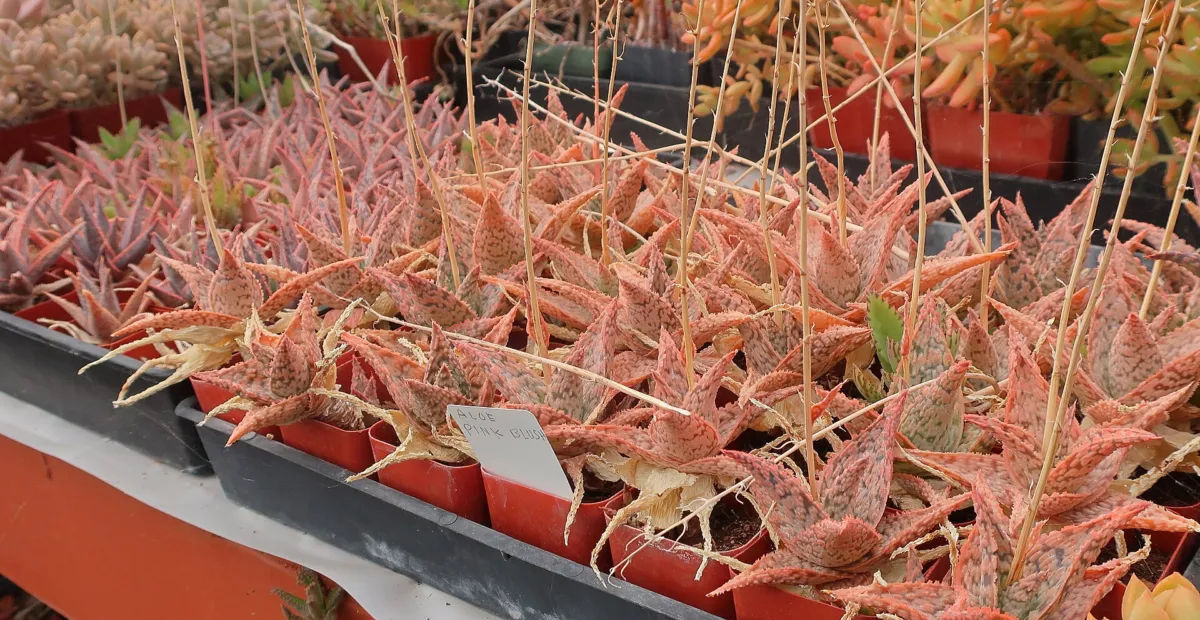
 Aloe ‘Pink Blush’ short overview
Aloe 'Pink Blush' is a compact hybrid aloe bred by Kelly Griffin and valued for its textured, mottled foliage. Its upright rosettes combine green and pale markings with raised pink accents and colorful marginal teeth. Orange to coral tubular flowers may appear from late winter into spring. In the United States, it is best grown in a sharply drained container or outdoors year-round only in frost-free climates.
Taxonomic classification
Aloe ‘Pink Blush’ care guide
Light and placement
Give bright light with several hours of direct sun, ideally near a south- or west-facing window indoors. Acclimate plants gradually when moving from shade to strong outdoor sun, especially in hot climates. Low light produces greener, looser growth and weaker coloration; excessive abrupt sun can cause bleached or scorched patches. A bright east exposure or filtered afternoon light is safer in very hot regions.
Watering and humidity
Water thoroughly only after the potting mix has dried well through much of its depth, then let excess drain completely. In spring and summer, check the mix every 2–3 weeks, adjusting for pot size, heat and airflow; water less often in fall and winter. Keep water out of the rosette when possible and never leave the container standing in a saucer. Humidity does not need to be increased.
Soil and growing medium
Use a porous cactus mix amended with extra pumice, perlite or coarse mineral grit. The container must have an unobstructed drainage hole. Avoid dense peat-heavy soil that stays wet around the roots. A slightly acidic to neutral medium is suitable; pH is less important than rapid drainage and ample air space.
Feeding
Feed in spring and summer only, using a balanced or succulent fertilizer diluted to about one-quarter to one-half the label strength every 4–6 weeks. Water first if the mix is completely dry, then fertilize lightly. Do not feed during cold, dark winter conditions, immediately after repotting, or when the plant is stressed, diseased or not actively growing.
Growth and habit
This is a compact, upright rosette-forming hybrid that can produce offsets from the base and gradually form a small clump. Growth is usually strongest in warm, bright conditions. Remove dead lower leaves and separate offsets when they crowd the container; avoid frequent disturbance because the fleshy leaves can be brittle.
Planting and repotting
Choose a raised, rocky or sharply drained position in frost-free regions. Set the root ball level with the surrounding soil and keep leaves from resting on wet soil. Water once after planting, then allow the mix to dry substantially before watering again. In colder parts of the United States, grow it in a container so it can be moved under cover.
Repot in spring or early summer when roots fill the container or offsets become crowded. Choose a pot only slightly larger than the root system and use a drainage hole with a gritty succulent mix. Handle the leaves carefully because they can snap. After repotting, wait several days before watering if roots were disturbed, then resume a conservative dry-down cycle.
Propagation and pruning
Propagation
The most practical method is division of rooted offsets. Separate offsets when they have formed their own roots, allow damaged surfaces to dry briefly, and pot them into a gritty mix. Seed or laboratory micropropagation may be used by breeders, but seed-grown plants will not necessarily reproduce the named cultivar accurately.
Pruning
Pruning is limited to removing completely dry lower leaves and spent flower stalks. Use clean, sharp tools and cut the stalk near its base after flowering has finished. Avoid trimming healthy leaf tips or removing green tissue unnecessarily, because aloe leaves heal slowly and damaged surfaces can become entry points for rot.
Overwintering
Bring containers indoors before frost and place them in the brightest available window. Keep the plant cool but above freezing, reduce watering sharply, and ensure strong air circulation. In USDA Zone 9 areas, outdoor plants need a rain-sheltered microclimate and frost protection; prolonged cold or wet winter soil can cause irreversible rot.
Uses
Use as a specimen succulent in containers, sunny window gardens, succulent displays, rock gardens and water-wise plantings where winters are frost-free. It is especially useful for small spaces because of its compact form and ornamental foliage. Do not use this cultivar for food or home remedies; its exact hybrid chemistry and safety have not been established.
Appearance
The plant forms stemless to very short-stemmed upright rosettes of fleshy, lance-shaped leaves. Green blades show pale green or whitish patterning, raised bumps or ridges, and pink to coral teeth along the margins. Color intensity can vary with light, temperature and watering, making the pink blush more pronounced under bright conditions.
Flowering
Flowering is seasonal and is most often reported from late winter into spring, although timing shifts with climate and indoor conditions. The flowers are tubular and borne on short upright inflorescences, with orange to coral coloration. Plants need adequate light and mature size before flowering reliably; container-grown specimens may bloom irregularly.
Pollination and visitors
Aloe flowers are commonly visited by hummingbirds and other nectar-feeding animals, and aloe hybrids with orange or coral tubular flowers can provide nectar in the cooler part of the United States growing season. Bees may also visit and collect pollen, but exact visitor records for this named cultivar are limited.
Aloe 'Pink Blush' photos
Click any photo for a larger view. Source, author and license are shown separately.
Diseases and pests
Diseases
The main disease risk is root or crown rot caused by overwatering, poor drainage or cold wet soil. Use a porous mix, containers with drainage holes and a dry interval between waterings. Remove rotted tissue with sterile tools and repot only healthy portions into fresh, dry medium. Good airflow helps reduce fungal spotting and soft-rot problems.
Pests
Scale and mealybugs are the main reported pests, especially on indoor plants. Inspect leaf bases, margins and the center of the rosette regularly. Remove small infestations with a cotton swab dipped in rubbing alcohol, avoiding prolonged wetting of the foliage. For larger infestations, isolate the plant and use a labeled succulent-safe treatment according to its instructions.
Related diseases and pests
Only Plant Doctor profiles whose host data indicate this plant may be affected are shown here.
 Environmental stressOverwatering
 PestCotton mealybugPhenacoccus solenopsis Tinsley
 Environmental stressPoor drainage stress (waterlogging)
 DiseaseRhizopus soft rotRhizopus stolonifer
 DiseaseBacterial soft rotPectobacterium carotovorum
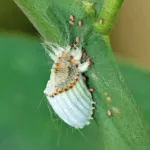 PestCottony Cushion ScaleIcerya purchasi
 DiseasePhytophthora root and crown rotPhytophthora nicotianae
 Environmental stressWaterlogging
Toxicity and pollen
Exact toxicity studies for Aloe 'Pink Blush' are not well documented, but aloe plants are treated as unsafe for pets by veterinary poison-control references because sap components such as saponins and anthraquinone-related compounds can cause gastrointestinal upset. Keep leaves and fallen pieces away from chewing animals and children. Seek medical or veterinary advice after ingestion, especially if vomiting, diarrhea or lethargy develops.
- Typical season
- Usually late winter to spring when flowering
- Pollination / pollen
- Heavy, animal-transferred floral pollen rather than wind-dispersed pollen
The flowers produce pollen, but aloe flowers are generally adapted to animal transfer rather than wind dispersal. This suggests relatively low airborne pollen exposure compared with wind-pollinated plants, not zero risk. Sensitive people should avoid handling flowers closely if they notice symptoms, and keep indoor plants clean of fallen floral material.
Native habitat
This cultivar has no wild habitat because it is a cultivated hybrid. Its parentage belongs to Aloe, a genus associated mainly with warm, seasonally dry regions of Africa, the Arabian Peninsula and nearby areas. In cultivation, it performs best in mineral, fast-draining substrates, bright light and climates without freezing weather.
Interesting fact
The cultivar was created by aloe hybridizer Kelly Griffin. Its pink coloration is concentrated in raised marginal teeth and textured leaf surfaces rather than being a uniform leaf pigment. It is sold in the United States as both a specialty succulent and a seasonal container plant. The cultivar name is horticultural and does not indicate a botanical species.
Frequently asked questions (FAQ)
The most relevant questions about this plant, with short and direct answers.
🌱Quick care
How do you care for Aloe 'Pink Blush'?⌄
Give Aloe 'Pink Blush' full sun to partial shade, plant it in sharply draining soil, and water only after the soil has dried completely. Protect it from freezing temperatures and avoid leaving the roots in wet soil.
How large does Aloe 'Pink Blush' get?⌄
Aloe 'Pink Blush' is a compact hybrid that typically grows to about 12 inches tall and can spread to roughly 12 inches wide. It may gradually form a wider clump as offsets develop.
🌤️Environment and placement
Is Aloe 'Pink Blush' an indoor or outdoor plant?⌄
Aloe 'Pink Blush' can grow indoors as a sunny-window houseplant or outdoors in warm, dry climates. In the United States, move it indoors or under protection before freezing weather because it is frost tender.
How much light does Aloe 'Pink Blush' need?⌄
Provide Aloe 'Pink Blush' with several hours of bright light daily, from full sun to partial shade. Increase direct sun gradually to reduce leaf scorch and to encourage its characteristic pink coloration.
Can Aloe 'Pink Blush' grow in full sun?⌄
Yes, Aloe 'Pink Blush' can grow in full sun if it is acclimated gradually. Very intense afternoon sun, especially after an indoor period, can scorch the leaves, so partial shade may be preferable in hot climates.
Is Aloe 'Pink Blush' frost hardy?⌄
No, Aloe 'Pink Blush' is frost tender and should be protected before temperatures reach 32°F. Keep it in a sheltered, dry location during freezing weather because cold combined with moisture increases damage risk.
Can Aloe 'Pink Blush' stay outside year-round?⌄
It can stay outside year-round only in reliably frost-free parts of USDA Zones 9–11 with suitable drainage and protection from prolonged wet conditions. Elsewhere, grow it in a container that can be moved indoors for winter.
💧Care and problems
Why is my Aloe 'Pink Blush' losing its pink color?⌄
Reduced light is a common reason Aloe 'Pink Blush' becomes greener or less vividly blushed. Move it gradually toward a brighter location, while avoiding sudden exposure to intense outdoor sun.
How often should you water Aloe 'Pink Blush'?⌄
Water Aloe 'Pink Blush' thoroughly only when the potting mix is completely dry, then let excess water drain away. The interval may be every couple of weeks during active growth but can be much longer in winter or low light.
Should Aloe 'Pink Blush' be watered from the top or bottom?⌄
Either method can work, but thorough watering at the soil surface is simplest for Aloe 'Pink Blush' as long as water drains freely from the pot. Keep water from pooling in the rosette because persistent moisture can encourage rot.
What does an overwatered Aloe 'Pink Blush' look like?⌄
An overwatered Aloe 'Pink Blush' may develop soft, translucent, yellowing, or collapsing leaves and a mushy stem base. Stop watering, inspect the roots, remove rotten tissue, and replant healthy portions in dry, fast-draining mix.
Why are the leaves of my Aloe 'Pink Blush' turning brown?⌄
Brown leaves can result from sun scorch, prolonged drought, cold damage, or root problems. Check whether the damage is on the sun-facing side, whether the soil stays wet, and whether the plant has been exposed to temperatures near freezing.
Why is my Aloe 'Pink Blush' becoming stretched or leaning?⌄
Stretching and leaning usually indicate insufficient light. Move the plant gradually to a brighter window or outdoor location and rotate the pot periodically so growth remains more even.
Does Aloe 'Pink Blush' need humidity?⌄
Aloe 'Pink Blush' does not require high humidity and generally performs well in average indoor conditions. Good air circulation and dry foliage are more important than misting.
What pests affect Aloe 'Pink Blush'?⌄
Mealybugs and scale can affect Aloe 'Pink Blush', particularly when it is grown indoors. Inspect leaf bases and crevices regularly, isolate affected plants, and use a treatment labeled for succulents according to its instructions.
🪴Planting and repotting
What soil is best for Aloe 'Pink Blush'?⌄
Use a sharp-draining cactus and succulent mix for Aloe 'Pink Blush', ideally in a container with a drainage hole. A gritty, mineral-heavy mix is safer than dense potting soil because it dries quickly around the roots.
What type of pot is best for Aloe 'Pink Blush'?⌄
Choose a pot with a drainage hole that is only slightly larger than the root ball. Terracotta can be helpful because it allows the mix to dry faster, but any well-drained container can work with careful watering.
When should Aloe 'Pink Blush' be repotted?⌄
Repot Aloe 'Pink Blush' when roots fill the container, offsets crowd the pot, or the soil no longer drains well. Refresh the mix every few years if needed, and avoid moving it into an excessively large pot.
How do you repot Aloe 'Pink Blush'?⌄
Remove the plant, check the roots for rot, and place it at the same depth in fresh, fast-draining succulent mix. After repotting, wait several days before watering so disturbed roots can dry and heal.
✂️Propagation and pruning
Does Aloe 'Pink Blush' produce offsets?⌄
Yes, Aloe 'Pink Blush' commonly forms offsets around the mother rosette and can become a small clumping plant. These offsets are the most practical way to propagate an established specimen.
How do you propagate Aloe 'Pink Blush' from offsets?⌄
Separate a rooted offset from the mother plant with a clean knife or by gently pulling it apart, then let any wounds dry before planting it in gritty succulent mix. Water sparingly until roots are established.
Can you propagate Aloe 'Pink Blush' from a leaf?⌄
Leaf propagation is generally unreliable for Aloe 'Pink Blush' because a detached leaf may rot or fail to produce a new rosette. Division of rooted offsets is the preferred method.
Should you prune Aloe 'Pink Blush'?⌄
Routine pruning is not necessary for Aloe 'Pink Blush'. Remove dead or damaged leaves close to the base with clean tools, but do not cut healthy leaves simply to change the rosette’s shape.
⚠️Toxicity and safety
Is Aloe 'Pink Blush' toxic to cats and dogs?⌄
Aloe 'Pink Blush' should be treated as potentially toxic if eaten. Keep it away from children and pets, and contact a veterinarian or poison-control service if ingestion occurs.
Can you use Aloe 'Pink Blush' gel on skin?⌄
No, Aloe 'Pink Blush' should not be treated as a source of medicinal aloe gel. It is an ornamental hybrid, and its plant material should not be eaten or applied to skin without qualified professional guidance.
🌸Flowering and special interest
Does Aloe 'Pink Blush' flower?⌄
Yes, mature Aloe 'Pink Blush' can produce an upright flower stalk with clusters of tubular orange blooms. Flowering is seasonal and is more likely when the plant receives strong light and has reached sufficient maturity.
When does Aloe 'Pink Blush' bloom?⌄
Aloe 'Pink Blush' is a seasonal bloomer, but the timing can vary with climate, indoor conditions, plant age, and light exposure. Outdoor plants in warm climates may flower more reliably than young indoor specimens.
Why is my Aloe 'Pink Blush' not flowering?⌄
A young plant, inadequate light, or unsuitable seasonal conditions can prevent Aloe 'Pink Blush' from flowering. Give it bright light, maintain excellent drainage, and allow it to mature rather than forcing bloom with extra water or fertilizer.
Similar plants
 Azure Monkshood (Aconitum carmichaelii) care guideAconitum carmichaelii
 Monkshood (Aconitum ‘Stainless Steel’)Aconitum 'Stainless Steel'
 Monkshood (Aconitum ‘Bressingham Spire’)Aconitum 'Bressingham Spire'
 Golden full moon maple (Acer shirasawanum ‘Aureum’)Acer shirasawanum 'Aureum'
 Globosum (Acer platanoides ‘Globosum’)Acer platanoides 'Globosum'
 Striped maple (Acer pensylvanicum) care guideAcer pensylvanicum