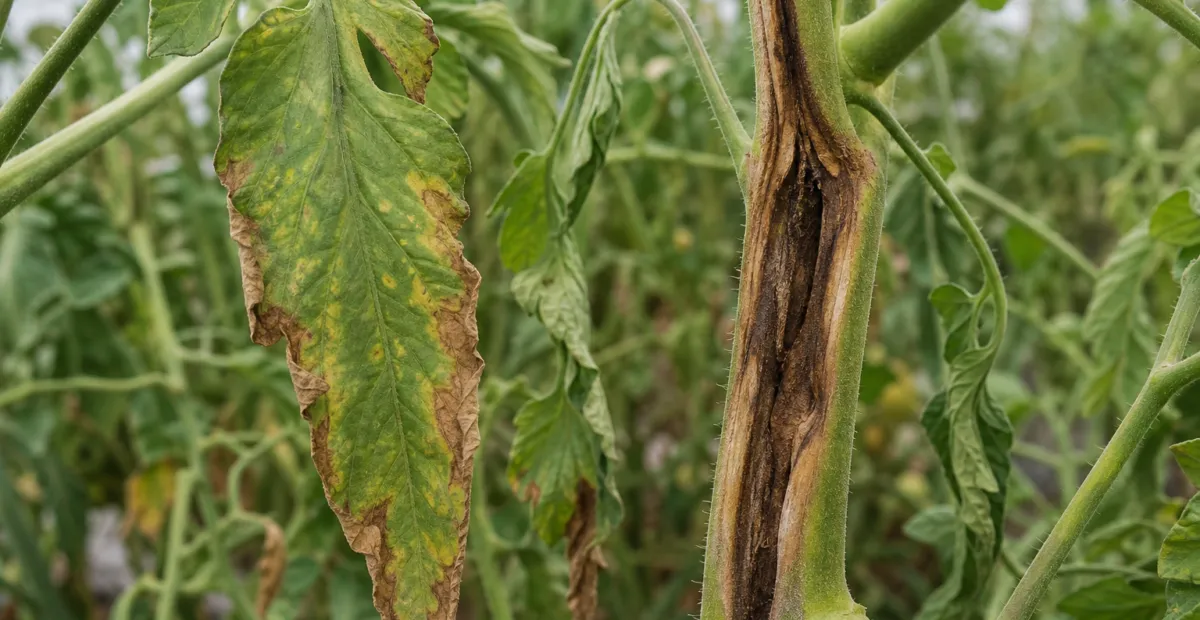
Tomato bacterial canker
Clavibacter michiganensis subsp. michiganensisTomato bacterial canker overview
Tomato bacterial canker is a serious, seedborne bacterial disease caused primarily by Clavibacter michiganensis subsp. michiganensis. It can move systemically through tomato vascular tissue, causing one-sided wilt, leaf firing, stem cankers, vascular browning, plant collapse and characteristic bird’s-eye spots on fruit. Infected seed, transplants, tools, water splash and greenhouse handling can spread it rapidly.
Typical conditions
Overview
Tomato bacterial canker is caused primarily by the gram-positive, xylem-colonizing bacterium Clavibacter michiganensis subsp. michiganensis. It occurs in field-grown, high-tunnel and greenhouse tomatoes and may remain inconspicuous in young transplants before developing after plants are established or begin flowering.
The disease has both systemic and local phases. Systemic infections move through vascular tissue and produce wilt, leaf firing, stem discoloration and plant death. Local infections produce leaf, petiole, stem and fruit lesions without necessarily killing the entire plant.
A laboratory diagnosis is recommended because bacterial canker can resemble bacterial wilt, Fusarium wilt, Verticillium wilt, foliar bacterial diseases, herbicide injury and abiotic stress.
Symptoms and identification
- Lower leaves may yellow, curl, wilt, dry and turn brown; often only one side of a leaflet or plant is affected.
- Leaf margins may develop brown necrosis with a yellow border, commonly called firing.
- Petiole and leaf veins can become dark, sunken or streaked, although this symptom is not always present.
- Stems may show narrow brown streaks, longitudinal splits and sunken cankers. Cutting the stem can reveal yellow, tan or reddish-brown vascular discoloration and a mealy or partly hollow pith.
- Small raised white spots with tan or brown centers may form on fruit. These characteristic bird’s-eye spots are more common on green fruit and may have a persistent pale halo.
- Severely affected plants can become stunted, wilt progressively and collapse or die.
Causes and spread
The pathogen is commonly introduced on infected or contaminated seed and symptomless transplants. It can survive in infected plant debris and may spread between plants in greenhouse production through handling, pruning, grafting, splashing water, contaminated trays, stakes, benches, clothing and tools.
Entry is favored by wounds and natural openings such as hydathodes. Overhead irrigation, rain, high humidity, dense plant canopies and frequent handling increase local spread. Seedborne infections are especially important because a small contaminated lot can distribute the pathogen widely before symptoms are obvious.
Life cycle and persistence
Clavibacter michiganensis subsp. michiganensis may persist on or in infected tomato seed, transplants, crop residues and contaminated production materials. After entering a plant, it can multiply in xylem vessels and move systemically, while also colonizing wounded leaves, stems and fruit surfaces.
Warm conditions, approximately 75–90°F, combined with free moisture or high relative humidity favor symptom development and spread. The time from infection to visible symptoms varies with inoculum level, cultivar, plant age, temperature, humidity and whether infection is systemic or local. Symptomless transplants can still carry substantial bacterial populations.
Treatment and control
There is no dependable curative treatment once a tomato plant has a systemic infection. Mark suspect plants, confirm the diagnosis through a plant diagnostic laboratory when practical, and remove severely affected plants with surrounding debris. Avoid shaking plants or moving through clean areas after handling them.
In greenhouses and high tunnels, sanitation and stopping spread are more valuable than attempting to rescue infected plants. Remove crop residues promptly after harvest, clean structures and equipment, control volunteer tomatoes, and replace contaminated propagation materials. In fields, harvest healthy areas first when possible and avoid working or irrigating through wet foliage.
When an outbreak is suspected in commercial production, retain seed-lot, transplant and sanitation records and contact the state plant-health authority or extension diagnostician for testing and site-specific guidance.
Low-impact and biological control
Organic and low-input management relies mainly on exclusion and sanitation rather than eradication. Use organically produced, disease-tested seed and clean transplants; disinfect tools and hard surfaces with a product permitted for the production system; remove infected plants and debris; use drip irrigation; improve ventilation; and avoid pruning or tying plants while wet.
Some biological seed treatments, microbial products and plant-defense activators have been studied, but performance is inconsistent and product availability, organic certification and crop labeling vary. Use them only when they are legally registered and permitted for tomatoes in the United States, and treat them as preventive components of an IPM program rather than cures.
Prevention
- Start with certified, disease-tested tomato seed and reputable, inspected transplants.
- Quarantine and monitor incoming plants; do not mix suspect lots with clean production.
- Use clean trays, stakes, benches, grafting supplies and irrigation equipment. Disinfect reusable materials according to the product label and discard porous materials that cannot be reliably sanitized.
- Keep foliage dry when practical. Prefer drip or subirrigation over overhead watering and improve air movement.
- Do not work plants when they are wet. Wash hands and sanitize knives, pruners and other tools between lots and whenever suspicious plants are encountered.
- Remove symptomatic plants and nearby plants during transplant production. Bag and remove them from the growing area; do not compost diseased tomato debris unless a validated high-temperature process is used.
- Rotate away from tomato and avoid replanting contaminated greenhouse beds when practical. Remove volunteer tomatoes and solanaceous weeds that may maintain inoculum.
- Choose cultivars described by regional extension or seed suppliers as having improved bacterial-canker tolerance, recognizing that complete resistance is not generally available.
Interesting facts
- The disease was first described in Michigan in 1910, which is reflected in the pathogen name.
- The pathogen is an actinobacterium that invades tomato xylem rather than behaving like a typical leaf-surface bacterial pathogen.
- Bird’s-eye fruit spots are distinctive but are not present in every outbreak or on every cultivar.
- Young transplants may appear healthy while carrying enough bacteria to spread disease after transplanting.
- Hydathodes, the water-excreting openings at leaf margins, can serve as efficient infection courts.
- The name Clavibacter michiganensis is used in modern taxonomy, while older references may use forms such as Corynebacterium michiganense or Clavibacter michiganensis pv. michiganensis.
Chemical products provide limited and mainly preventive suppression; they do not reliably cure systemically infected plants. Use only products legally authorized and currently labeled in the United States for tomato bacterial diseases and the intended production site, crop and use pattern. Follow the current label exactly, including personal protective equipment, reentry interval, preharvest interval, application rate and resistance-management directions. Check state registration and consult current university extension recommendations before use.
Affected plants
The plants below are linked to this problem by structured host-plant data. The list updates automatically as new plant profiles are added.