
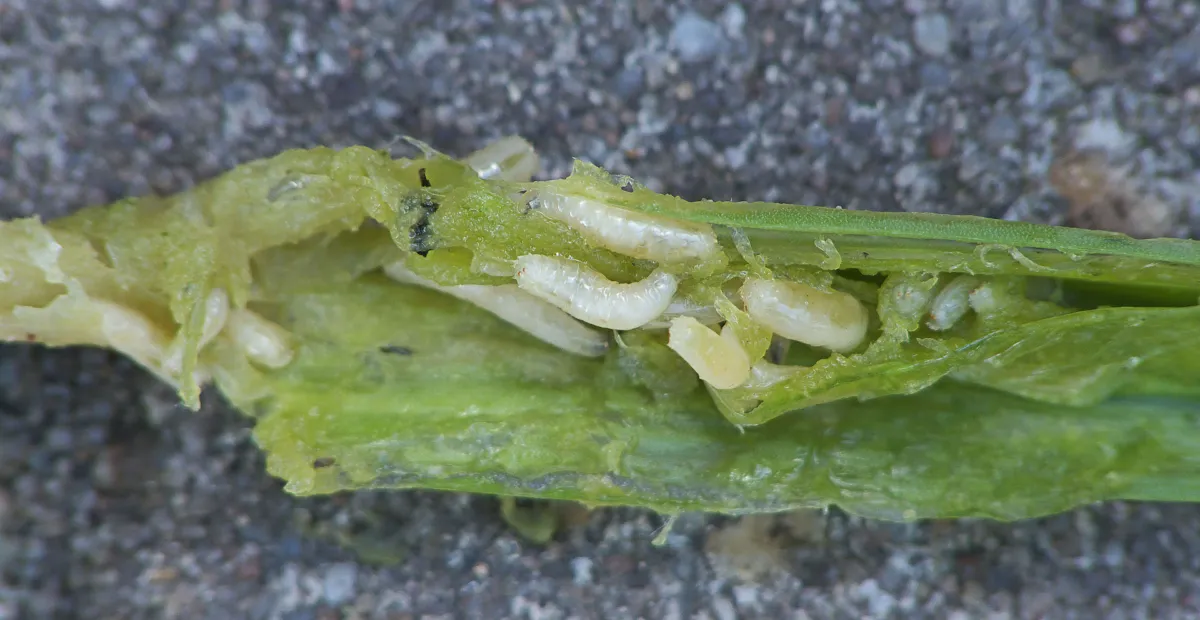
Onion Maggot
Delia antiquaOnion Maggot overview
The onion maggot, Delia antiqua, is a soil-dwelling fly pest of onions and other Allium crops. Its creamy-white larvae tunnel into seedlings, basal stems and developing bulbs, causing wilting, yellowing, stunting, plant death and bulb decay. Risk is highest in cool, wet springs, repeatedly planted beds and fields containing damaged or leftover onion tissue.
Typical conditions
Overview
Onion maggot is the larval stage of a small gray anthomyiid fly. Adults resemble small houseflies, while the larvae are creamy-white, legless maggots about 0.4 inch long. Females lay elongated white eggs in or on the soil near the base of susceptible plants.
The larvae enter roots, the basal stem or the developing bulb. Young plants may wilt, yellow, become stunted or die; older bulbs may show internal tunnels, cavities, soft decay and poor storage quality. The pest is most consistently important on onions, although related Allium crops can also be attacked.
Identification can be difficult because onion maggot resembles other Delia root maggots. A reliable diagnosis should consider the host, feeding location, season and larval or adult characteristics; microscopic examination may be needed for species-level confirmation.
Symptoms and identification
- Poor or uneven stands of onion seedlings.
- Wilting, yellowing, stunting or sudden collapse despite adequate moisture.
- Roots, the basal plate and underground stem tunneled or shredded.
- Creamy-white maggots inside bulbs or at the stem base.
- Bulb cavities, soft rot and secondary decay.
- Damage often appears in patches, especially where onions were previously grown or plant tissue was injured.
Causes and spread
Delia antiqua overwinters mainly as a puparium in soil near previously infested Allium crops. Adults emerge during spring, and females lay eggs near suitable host plants. Larvae move into the plant soon after hatching. Repeated onion production in the same bed, discarded bulbs, volunteer onions and cull piles allow local populations to build.
Cool, moist soil and high organic matter can favor survival and movement of maggots. Plant wounds caused by cultivation, disease, insects or mechanical injury may increase attractiveness to egg-laying females. Flies can disperse from nearby infested beds, so rotation works best when the new planting is well separated from old Allium ground.
Life cycle and persistence
The pest has four stages: egg, larva, puparium and adult fly. Eggs are laid near the soil surface at the base of onion-family plants. Larvae hatch in roughly 4–10 days under favorable conditions and immediately burrow toward roots, basal stems or bulbs. Larval feeding lasts several weeks, depending on temperature and host condition.
Mature larvae leave the plant and form brown, hardened puparia in the soil. Adults emerge after development is complete, mate and lay eggs for another generation. Several generations may occur in a season in temperate U.S. production areas, with the first spring generation often causing the greatest injury because seedlings are small and vulnerable.
Treatment and control
There is no reliable curative treatment once larvae are established inside a seedling or bulb. Remove and dispose of severely infested plants, including surrounding soil where practical, and do not compost them in a cool backyard pile. Replanting with onions in the same infested bed may prolong the problem.
For remaining plants, correct avoidable stress, maintain even moisture without prolonged saturation, and protect new plantings with row cover where feasible. In commercial production, preventive seed treatments, transplant treatments or in-furrow measures may be used only when justified by local monitoring and according to the current product label. Foliar sprays aimed at adults are generally unreliable because the flies are mobile and spend limited time exposed on foliage.
Low-impact and biological control
- Use tightly secured floating row covers over newly seeded or transplanted onions, garlic and related crops.
- Practice rigorous sanitation and rotate Allium crops away from infested soil.
- Consider commercially available entomopathogenic nematodes such as Steinernema feltiae or Heterorhabditis bacteriophora where their label, environmental requirements and local performance are appropriate.
- Maintain habitat for ground beetles and rove beetles, which can prey on eggs and larvae, although they are generalist predators and are not a dependable stand-alone control.
- Some entomopathogenic fungi, including Beauveria bassiana and Metarhizium species, have activity against Delia pests, but effectiveness depends on formulation, timing, soil conditions and label authorization.
- Do not apply beneficial nematodes or fungi together with products that may harm them unless compatibility is documented.
Prevention
- Rotate onions and other susceptible Alliums to a different planting area; greater separation from last year’s crop improves effectiveness.
- Remove and destroy cull bulbs, dead plants, volunteer onions and harvest debris promptly.
- Do not leave piles of discarded onions or garlic beside the garden.
- Avoid unnecessary injury during planting and cultivation, and control diseases that damage the basal stem.
- Use healthy transplants or pregerminated seed where appropriate to shorten the most vulnerable seedling stage.
- Install insect-proof row cover immediately after planting and seal the edges; remove it only when pollination is not relevant and adult egg-laying risk has passed.
- Avoid incorporating fresh manure, green manure or heavy undecomposed organic residues immediately before planting susceptible crops.
- Monitor for wilted plants and inspect roots and bulbs rather than relying on adult-fly sightings alone.
Interesting facts
- The damaging stage is the larva, not the adult fly.
- Onion maggot adults are difficult to distinguish visually from related Delia flies; host and feeding evidence are important for diagnosis.
- First-generation larvae often cause the most severe losses because young onion seedlings have limited roots and small bulbs.
- Onion maggot is primarily associated with Allium crops, whereas the similar seedcorn maggot has a much broader host range.
- Degree-day models exist for estimating development, but models developed elsewhere should be validated locally before being used for precise timing.
Use only pesticide products legally authorized in the United States for the specific crop and onion maggot problem. Product registrations, active ingredients, application sites, preharvest intervals and user restrictions can change; read and follow the current label exactly. Do not infer legality or efficacy from a product listed for another Delia species, crop or state. Prioritize sanitation, exclusion, rotation, monitoring and other IPM measures, and consult your state extension service or local crop advisor for current recommendations.
Affected plants
The plants below are linked to this problem by structured host-plant data. The list updates automatically as new plant profiles are added.
 Onion (Allium cepa) care guideAllium cepa
 Allium christophii care guideAllium christophii
 Bunching onion (Allium fistulosum) care guideAllium fistulosum
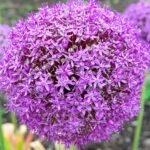 Giant Allium (Allium giganteum) care guideAllium giganteum
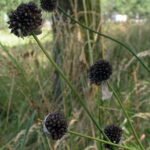 Ornamental onion (Allium) care guideAllium
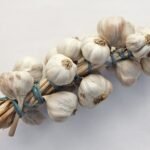 Garlic (Allium sativum) care guideAllium sativum
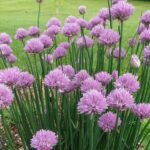 Chives (Allium schoenoprasum) care guideAllium schoenoprasum
 Ransoms (Allium ursinum) care guideAllium ursinum
 Wild leek or broadleaf wild leek (Allium ampeloprasum) care guideAllium ampeloprasum
 Shallot (Allium cepa Aggregatum Group)Allium cepa Aggregatum Group
 Cepa Group (Allium cepa Group)Allium cepa Cepa Group
 Rakkyo (Allium chinense) care guideAllium chinense