
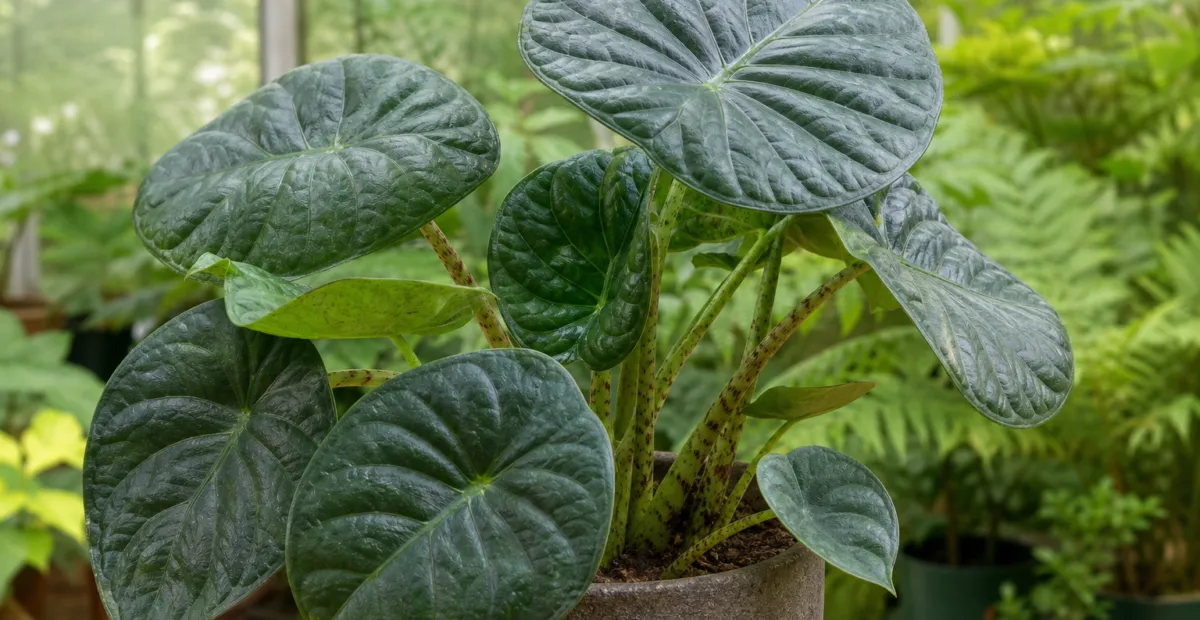
 AI-generated illustration
Alocasia melo short overview
Alocasia melo is a compact, rare elephant ear from Sabah, Malaysian Borneo, where it grows in warm wet tropical forest on ultramafic soils. Its thick, nearly round leaves are blue-green, leathery, and deeply bullate, creating a striking melon-skin texture. In the United States it is best grown indoors or in a protected warm greenhouse, with bright filtered light, high humidity, excellent drainage, and steady warmth.
Taxonomic classification
Alocasia melo care guide
Light and placement
Place in bright filtered or dappled light, such as near an east-facing window or several feet back from a bright south- or west-facing window behind a sheer curtain. Gentle morning sun may be tolerated, but strong midday rays can bleach or scorch the thick leaves. Too little light causes slower growth and smaller, weaker leaves; excessive light may produce pale patches, crisp edges, or curling.
Watering and humidity
Water thoroughly when the upper 1–2 inches of the mix feel partly dry, allowing excess water to drain fully before returning the pot to its saucer. Keep the root zone evenly moist during active growth but never constantly saturated. Water less often in cool or dark winter conditions. High humidity helps reduce leaf-edge browning, but airflow is essential to prevent fungal and bacterial problems.
Soil and growing medium
Use a loose, airy aroid mix that retains some moisture without becoming saturated. A practical blend can combine fine or medium orchid bark, coco coir or peat-free potting mix, perlite, and a small amount of compost or worm castings. Slightly acidic to neutral conditions are appropriate. Avoid dense garden soil and containers that drain slowly, because rhizome and root rot develop readily in stagnant media.
Feeding
Feed during active growth with a complete balanced houseplant fertilizer diluted to half the label strength about every 3–4 weeks. Apply to already-moist soil to reduce root stress. Reduce or stop feeding when growth slows in winter, after repotting, or when the plant is stressed, chilled, or recently treated for root problems.
Growth and habit
This is a compact, clumping herbaceous perennial with a short stem and leaves arising in a tight group. Growth is generally slow to moderate, especially after shipping, root disturbance, or cool temperatures. Stable warmth, strong indirect light, and an airy root zone support steady leaf production; sudden leaf loss often signals cold, drought, overwatering, or acclimation stress.
Planting and repotting
For outdoor summer display, plant only after nights remain reliably warm and the danger of frost has passed. Set the root system at its previous depth and space plants about 12–18 inches apart for airflow and clump development. In most US climates, container culture is safer than permanent outdoor planting.
Repot in spring or early summer only when roots have filled the container or the mix has broken down. Move up one pot size, preserve the existing planting depth, and use a container with generous drainage holes. After repotting, keep the plant warm and evenly but lightly moist while roots re-establish.
Propagation and pruning
Propagation
Propagation is normally by separating offsets or dividing a mature rhizomatous clump during active growth. Small corms may also be started in warm, humid conditions, but establishment can be slow. Use clean tools, avoid burying propagules too deeply, and keep the medium lightly moist rather than wet.
Pruning
Remove yellowing, diseased, or badly damaged leaves at the base with sterilized shears. Do not routinely cut healthy leaves, since the plant benefits from retaining functional foliage. Wipe tools with disinfectant between plants when disease is suspected, and allow cut surfaces to remain dry rather than sealing them.
Overwintering
Bring containers indoors before temperatures approach 55°F, and protect the plant from drafts, cold windows, and heating vents. Maintain bright filtered light and reduce watering as growth slows, while keeping the rhizome from becoming completely desiccated. Outdoor plants in colder USDA zones should be container-grown rather than left in the ground.
Uses
Primarily valued as a collectible indoor foliage plant, greenhouse specimen, or sheltered tropical container accent. Its compact stature and heavily textured leaves suit curated aroid collections. It has no supported culinary or medicinal use in the evidence reviewed. Because it is toxic if chewed, do not place it where children or pets can access the foliage.
Appearance
Leaves are thick, leathery, peltate, and ovate to nearly circular, with a deeply wrinkled or bullate surface and strongly impressed veins. The upper surface is dark bluish green, while the underside is paler. Short, erect growth and overlapping leaf bases create a dense jewel-plant appearance. Petioles are pale green and may show sparse burgundy spotting near the lower portion.
Flowering
As an aroid, it produces a spathe and spadix rather than a showy solitary flower. Flowering is uncommon in ordinary indoor culture and is not usually the plant’s primary ornamental feature. Reliable US flowering months for this species are not documented.
Pollination and visitors
Species-specific pollinator records were not located in the authoritative sources reviewed. Like other aroids, its inflorescence is biologically adapted for animal visitation, but a particular visitor group should not be assigned without direct documentation.
Diseases and pests
Diseases
The main risks are root or rhizome rot from waterlogged media and bacterial or fungal leaf spotting under wet, stagnant conditions. Use a fast-draining mix, water at the root zone, provide gentle air movement, and remove badly damaged leaves with sterilized tools. Isolate plants showing spreading lesions or sudden collapse.
Pests
Spider mites, thrips, mealybugs, and scale may attack stressed plants, especially in dry indoor air. Inspect leaf undersides, petiole bases, and tight stem crevices regularly. Quarantine new plants, wash foliage when practical, and treat early infestations with repeated applications of insecticidal soap or horticultural oil according to the product label.
Related diseases and pests
Only Plant Doctor profiles whose host data indicate this plant may be affected are shown here.
 DiseaseRhizopus soft rotRhizopus stolonifer
 DiseaseBacterial soft rotPectobacterium carotovorum
 DiseaseRhizoctonia DiseasesRhizoctonia solani Kühn
 Environmental stressWaterlogging
 Environmental stressUnderwatering
 PestOnion thripsThrips tabaci Lindeman
 PestMelon thripsThrips palmi Karny
 PestChilli thripsScirtothrips dorsalis Hood
Toxicity and pollen
Alocasia species contain insoluble calcium oxalate crystals that can cause burning and irritation of the mouth, throat, skin, and eyes if chewed or handled with sap exposure. Keep all plant parts away from children and animals, wear gloves when dividing or pruning, and seek poison-control or veterinary advice after ingestion.
- Pollination / pollen
- Typically enclosed within the spadix and associated with insect pollination
This is an insect-pollinated flowering aroid, so pollen is produced inside the spadix rather than released as a large airborne cloud. Species-specific allergy studies are lacking; avoid claiming zero risk. Airborne exposure is likely limited compared with wind-pollinated plants, but sensitive people should avoid contact with sap and flowering structures.
Native habitat
The species is endemic to Sabah, Malaysian Borneo, and occurs in wet tropical environments associated with ultramafic substrates. Reported habitat descriptions place it on thin soils and steep streamside banks in warm lowland rainforest. These conditions explain its preference for warmth, humidity, moisture-retentive but sharply draining media, and protection from harsh direct sun.
Interesting fact
The specific epithet melo refers to the leaves’ resemblance to the textured skin of a melon. The species is endemic to Sabah on Malaysian Borneo and is associated with ultramafic substrates. Its thick, leathery, strongly bullate leaves are unusually robust for a small Alocasia. Plants in trade may be mislabeled as Alocasia rugosa.
Frequently asked questions (FAQ)
The most relevant questions about this plant, with short and direct answers.
🌱Quick care
How do you care for Alocasia melo indoors?⌄
Give Alocasia melo bright filtered light, an airy moisture-retentive aroid mix, steady warmth, and evenly moist soil that never stays waterlogged. Protect it from cold drafts, direct afternoon sun, and prolonged drying.
Is Alocasia melo a good houseplant for beginners?⌄
Alocasia melo can be grown indoors by beginners who can provide consistent moisture, warmth, humidity, and good drainage. It is less forgiving of root rot, dry air, and sudden environmental changes than many common houseplants.
How much light does Alocasia melo need?⌄
Alocasia melo needs bright filtered or indirect light for healthy, compact growth. A bright window with a sheer curtain or a suitable grow light is usually safer than strong direct midday or afternoon sun.
🌤️Environment and placement
Can Alocasia melo grow in low light?⌄
Alocasia melo may survive in moderate indirect light, but low light commonly produces slower growth and smaller leaves. Move it closer to a bright filtered window or add a grow light if growth becomes weak.
Can Alocasia melo tolerate direct sunlight?⌄
Alocasia melo should generally be protected from intense direct sunlight because its leaves can scorch or bleach. Gentle early-morning sun may be tolerated when introduced gradually, but filtered light is the safer default.
What temperature is best for Alocasia melo?⌄
Keep Alocasia melo warm, ideally around 65–80°F during active growth. Avoid cold windows, drafts, and temperatures near 50°F, which can cause stress, dormancy, or lasting damage.
What humidity does Alocasia melo need?⌄
Alocasia melo generally performs best at about 60–80% relative humidity, especially while producing new leaves. A humidifier or well-ventilated cabinet is more reliable than occasional misting.
Can Alocasia melo grow in a bathroom?⌄
Alocasia melo can grow well in a warm, bright bathroom if it receives strong filtered light and adequate airflow. A dark bathroom or one exposed to cold drafts is not suitable.
Is Alocasia melo safe to grow outdoors in the United States?⌄
Alocasia melo can be grown outdoors in warm, frost-free conditions with bright filtered light, but it is frost tender. In most of the United States, move it indoors before cold weather and never expose it to freezing temperatures.
💧Care and problems
How often should you water Alocasia melo?⌄
Water Alocasia melo when the upper portion of the mix has begun to dry, then water thoroughly until excess drains away. The schedule varies with light, temperature, humidity, and pot size, so check the soil rather than following a fixed calendar.
Should Alocasia melo dry out between waterings?⌄
Alocasia melo should not be allowed to dry completely for extended periods, but the mix should not remain saturated. Let the surface and some of the upper mix dry before watering again.
Why is my Alocasia melo drooping?⌄
Drooping can result from underwatering, overwatering, cold stress, low humidity, root damage, or a recent change in conditions. Check the moisture level and roots first, then correct the underlying environmental problem rather than watering automatically.
Why are Alocasia melo leaves turning yellow?⌄
Yellow leaves on Alocasia melo are often linked to overwatering, poor drainage, root damage, or normal aging of an older leaf. If several leaves yellow at once, inspect the roots and allow excess water to drain freely.
Why are the leaves of my Alocasia melo turning brown?⌄
Brown edges or patches usually indicate dry soil, low humidity, salt buildup, cold stress, or sun scorch. Check the roots and watering pattern, increase humidity gradually, and shield the plant from harsh direct light.
Why is my Alocasia melo losing leaves?⌄
Alocasia melo may lose leaves after cold exposure, low humidity, root rot, a move, or a seasonal slowdown. If the corm is firm and healthy, correct the conditions and wait for recovery rather than assuming the plant is dead.
Why is my Alocasia melo not growing?⌄
Slow growth is normal for Alocasia melo, but very limited growth can indicate insufficient light, cool temperatures, low humidity, root problems, or inadequate nutrition. Provide stable warmth and bright filtered light before increasing fertilizer.
Why are new Alocasia melo leaves stuck or not unfurling?⌄
New leaves may stall because of low humidity, cool conditions, root stress, inconsistent watering, or insufficient energy reserves. Keep the plant warm and evenly moist, and avoid forcing the leaf open because it can be damaged easily.
Does Alocasia melo go dormant?⌄
Alocasia melo can slow down or enter dormancy when light, temperature, or seasonal conditions decline. During dormancy, reduce watering while keeping the corm from becoming completely dry, and resume more active care when new growth appears.
Should you fertilize Alocasia melo?⌄
Fertilize Alocasia melo lightly during active growth with a balanced houseplant fertilizer diluted according to its label. Do not fertilize stressed, newly repotted, dormant, or root-damaged plants until they show healthy recovery.
How do you prevent spider mites on Alocasia melo?⌄
Prevent spider mites by maintaining suitable humidity, avoiding severe drought stress, and checking the leaf undersides and petioles regularly. Isolate new plants and treat an infestation promptly with a product labeled for indoor plants.
🪴Planting and repotting
What soil is best for Alocasia melo?⌄
Use an airy, moisture-retentive aroid mix containing ingredients such as bark, perlite, and coco coir or another suitable organic component. The mix should hold some moisture while draining quickly and leaving plenty of air around the roots.
What type of pot does Alocasia melo need?⌄
Plant Alocasia melo in a pot with drainage holes that is only slightly larger than its root system. An oversized pot stays wet longer and increases the risk of root rot.
When should you repot Alocasia melo?⌄
Repot Alocasia melo when roots substantially fill the container, the mix has broken down, or drainage has become poor. Repotting is usually best during active growth, using a fresh airy mix and a modestly larger pot.
How do you repot Alocasia melo without causing root rot?⌄
To reduce root-rot risk, use fresh porous mix, a pot with drainage holes, and do not bury the corm or crown deeply. Remove only clearly dead roots, water lightly after repotting, and keep the plant warm while it re-establishes.
Can Alocasia melo grow in LECA or another semi-hydroponic medium?⌄
Alocasia melo can be grown in LECA or another semi-hydroponic medium, but it must be transitioned carefully and kept warm with adequate humidity. Monitor the roots closely because a plant moved from soil can initially react poorly to constant moisture.
✂️Propagation and pruning
How do you propagate Alocasia melo?⌄
Alocasia melo is commonly propagated from offsets or corms produced around the mother plant rather than from leaf cuttings. Separate viable offsets carefully, keep them warm and humid, and use a lightly moist, airy medium until roots and shoots develop.
Can you propagate Alocasia melo from a leaf cutting?⌄
A leaf cutting alone cannot reliably produce a new Alocasia melo because new plants require viable stem or corm tissue. Propagation should use a corm, offset, or division that includes the necessary growth point.
Can you prune Alocasia melo?⌄
Prune Alocasia melo only to remove fully yellow, dead, or badly damaged leaves, using clean scissors at the base of the petiole. Healthy green leaves should be retained because the plant needs them to store energy.
⚠️Toxicity and safety
Is Alocasia melo toxic to cats and dogs?⌄
Alocasia melo is toxic if chewed or ingested by cats, dogs, or people. Keep it away from pets and children, and contact a medical or veterinary professional promptly if ingestion occurs.
Can touching Alocasia melo irritate your skin?⌄
The sap of Alocasia melo may irritate sensitive skin, so wear gloves when cutting or repotting it and wash your hands afterward. Keep plant debris away from children and pets.
🌸Flowering and special interest
Does Alocasia melo flower indoors?⌄
Alocasia melo can flower, but indoor flowering is uncommon and usually occurs only on a mature, well-established plant. A flower is not necessarily a problem, although some growers remove it when they want the plant to direct more energy toward foliage.
Similar plants
 Azure Monkshood (Aconitum carmichaelii) care guideAconitum carmichaelii
 Monkshood (Aconitum ‘Stainless Steel’)Aconitum 'Stainless Steel'
 Monkshood (Aconitum ‘Bressingham Spire’)Aconitum 'Bressingham Spire'
 Golden full moon maple (Acer shirasawanum ‘Aureum’)Acer shirasawanum 'Aureum'
 Globosum (Acer platanoides ‘Globosum’)Acer platanoides 'Globosum'
 Striped maple (Acer pensylvanicum) care guideAcer pensylvanicum