
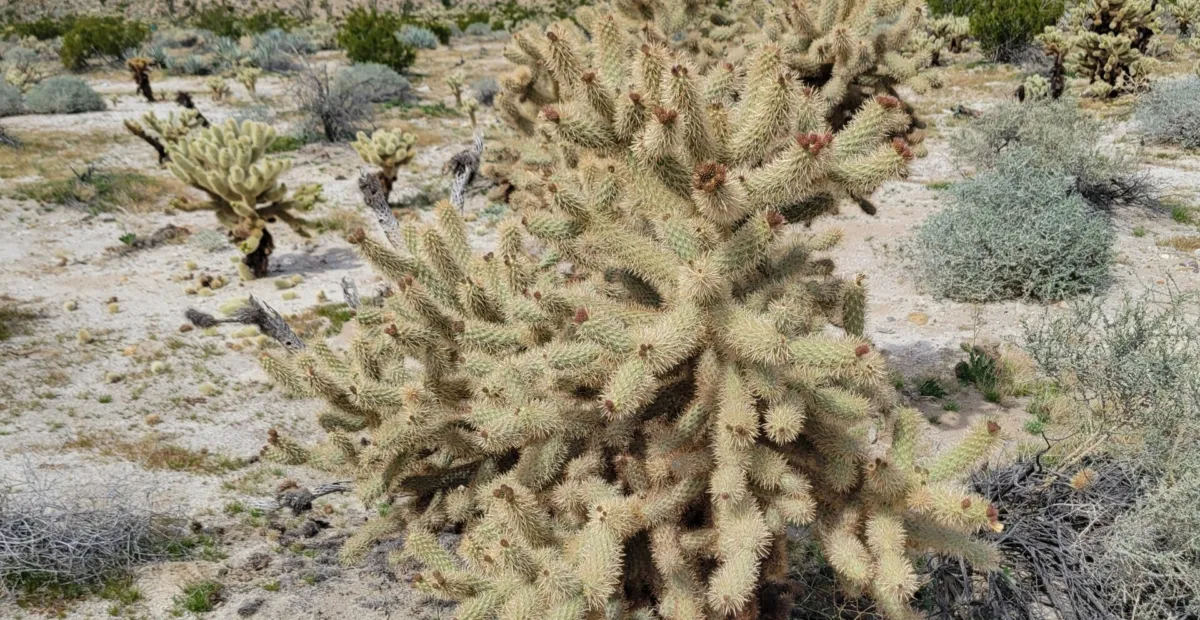
 Source:
 Cylindropuntia fosbergii short overview
Cylindropuntia fosbergii is a rare cholla native to a very small area of southeastern California, especially the Anza-Borrego region. This perennial stem succulent forms a tree-like, branching plant with easily detached cylindrical joints covered in pinkish spines. Its spring flowers range from pink to bronze, while its dry to leathery fruits are often sterile. Grow it only where intense sun, sharply drained soil, and careful handling are practical.
Taxonomic classification
Cylindropuntia fosbergii care guide
Light and placement
Provide unobstructed full sun, ideally with a south- or west-facing exposure and excellent air circulation. Strong light supports compact, well-colored joints and flowering. Insufficient light can cause weak, elongated growth and reduced blooming; excessive heat is usually less concerning than wet roots, though newly moved container plants should be acclimated gradually.
Watering and humidity
Water thoroughly, then allow the substrate to dry completely before watering again. During hot active growth, the interval may be several weeks depending on container size and soil; reduce sharply in fall and keep nearly dry in cool winter conditions. Never leave the pot standing in water, and do not combine frequent irrigation with low temperatures.
Soil and growing medium
Use a very sharply drained mineral substrate composed mainly of coarse sand, pumice, gravel, or similar materials. In containers, a commercial cactus mix amended with extra grit is appropriate. Avoid heavy clay and water-retentive organic soils. A neutral to slightly alkaline reaction is compatible with its desert habitat.
Feeding
Feed only during active warm-season growth, using a diluted cactus fertilizer with relatively low nitrogen once or twice in spring and early summer. Do not fertilize newly rooted cuttings, drought-stressed plants, dormant plants, or specimens in cold, wet soil. Excess nutrition can produce weak, overly lush growth.
Growth and habit
The plant develops a tree-like, branching architecture from cylindrical stem joints that can detach with little force. Detached joints may root or contribute to local clonal persistence. Because branches are armed and brittle, place the plant where routine access, pruning, and fallen joints can be managed safely.
Planting and repotting
Plant in spring after cold, wet weather has passed, using a shallow hole just large enough for the root system. Keep the crown at its original soil level and do not bury stem joints. Space generously for branching and establish with only occasional deep watering once the root system begins growing.
Repot only when the container is crowded or the substrate has degraded. Wear thick gloves, use tongs or cardboard to handle the plant, and allow any damaged cutting surfaces to dry before replanting. Choose a stable, heavy pot with a drainage hole.
Propagation and pruning
Propagation
Stem-joint cuttings are the most practical method because joints detach readily and the taxon is reported to rely heavily on clonal reproduction. Let cut surfaces callus in a dry, shaded place, then set the base into a gritty, barely moist medium during warm weather. Seed propagation is possible but may be unreliable because fruits are generally described as sterile.
Pruning
Prune only to remove damaged, dead, or dangerously positioned joints. Use long-handled tools, thick gloves, eye protection, and tongs; never handle detached joints bare-handed. Make clean cuts during warm, dry weather and allow wounds to dry. Avoid unnecessary shaping, since the natural branching habit is a key identification feature.
Overwintering
Keep protected from frost and prolonged winter rain. In colder regions, move container plants to a bright, cool, dry location before freezing weather. Water sparingly or not at all while dormant, and return plants outdoors gradually in spring to prevent sun scorch.
Uses
A specialist ornamental for dry gardens, desert collections, cactus beds, and large containers where its unusual pinkish, teddy-bear-like appearance can be viewed from a safe distance. It is not recommended beside paths or in areas used by children or pets because joints and spines detach readily. No culinary or medicinal use is supported here.
Appearance
This cholla forms upright, tree-like branches made of cylindrical joints approximately 1.6–7.1 inches long and 0.8–2.2 inches wide. The joints have a distinctive pinkish, orange, reddish, or brownish cast and dense spines, contrasting with the whiter appearance of teddy-bear cholla. Joints detach exceptionally easily.
Flowering
Flowers are open, bisexual cactus flowers with green outer tepals or filaments and inner tepals described as pink, bronze, reddish, or magenta-tinged. Bloom is reported mainly from March through May in its native southeastern California range. Flowers are daytime-opening; exact flowering intensity varies with seasonal conditions.
Pollination and visitors
Day-opening cholla flowers are reported as bee-pollinated, but a species-specific pollinator inventory for Cylindropuntia fosbergii is limited. Treat bee visitation as documented but not exclusive, and avoid presenting a single pollinator species as certain.
Cylindropuntia fosbergii photos
Click any photo for a larger view. Source, author and license are shown separately.
Diseases and pests
Diseases
The main risk is root or stem rot caused by persistently wet soil, especially in containers or cool weather. Use a porous substrate, avoid overhead irrigation, and remove soft, darkened tissue promptly with a sterile tool. Provide strong airflow and do not rewater until the medium is fully dry.
Pests
Watch for scale insects, mealybugs, and cochineal-like sap-feeders, particularly on stressed container plants. Inspect joints and crevices regularly. Remove small infestations mechanically or with a targeted treatment labeled for cacti; avoid excessive wetting and correct weak light or poor drainage that encourages decline.
Related diseases and pests
Only Plant Doctor profiles whose host data indicate this plant may be affected are shown here.
Toxicity and pollen
No reliable species-specific toxicology record was located. The principal documented hazard is mechanical injury from dense spines and detachable joints, including glochids that can penetrate skin. Keep away from paths, play areas, and pets, and handle with tools and protective gloves. Do not infer edibility or safety from the absence of a toxicity listing.
- Typical season
- Spring flowering season; species-specific allergy timing is not documented
- Pollination / pollen
- Insect-associated pollen; airborne relevance not documented
This is a flowering cactus, so it produces pollen, but reliable species-specific measurements of airborne pollen abundance or human allergy risk were not located. Insect visitation may limit airborne dispersal compared with strongly wind-pollinated plants, but that does not establish zero allergy risk. Avoid handling flowers during bloom if symptoms are a concern.
Native habitat
Native to a very limited area of southeastern California in the western Sonoran Desert, where it occurs on flats and hillsides in dry Sonoran desert scrub. Reported elevations range roughly from 85 to 850 meters (about 280 to 2,790 feet). It is adapted to intense sun, seasonal dryness, mineral soils, and rapid drainage.
Interesting fact
This species is restricted to a very small area of southeastern California. Its joints detach readily, aiding clonal spread but creating a handling hazard. The taxon has undergone several name and rank changes, including historical placement in Opuntia. Fruits are generally dry to leathery and often sterile.
Frequently asked questions (FAQ)
The most relevant questions about this plant, with short and direct answers.
🌱Quick care
What is Cylindropuntia fosbergii?⌄
Cylindropuntia fosbergii is a rare cholla cactus in the Cactaceae family, native to southeastern California. It is a perennial, branching stem succulent associated with dry Sonoran Desert scrub.
Does Cylindropuntia fosbergii have a common name?⌄
Documented English sources use names including pink teddy-bear cholla, Hoffmann’s teddy-bear cholla, and Mason Valley cholla. Because common-name usage varies, Cylindropuntia fosbergii is the clearest identification.
How much light does Cylindropuntia fosbergii need?⌄
Cylindropuntia fosbergii needs full sun, ideally with at least 6 hours of direct light daily. Strong light helps maintain compact, sturdy growth.
How often should I water Cylindropuntia fosbergii?⌄
Water Cylindropuntia fosbergii only after its soil has dried completely, then soak the root zone and let excess water drain. Established plants need little supplemental water, especially outdoors in humid or rainy climates.
Is Cylindropuntia fosbergii cold hardy?⌄
Cylindropuntia fosbergii should be protected from frost and prolonged cold, wet conditions. Keep it nearly dry during cold weather because low temperatures combined with wet roots can cause rot.
🌤️Environment and placement
Where does Cylindropuntia fosbergii grow naturally?⌄
Cylindropuntia fosbergii is endemic to a limited area of southeastern California, particularly the Anza-Borrego Desert region. It grows in dry Sonoran Desert scrub at roughly 279 to 2,789 feet in elevation.
Can Cylindropuntia fosbergii grow outdoors in the United States?⌄
Cylindropuntia fosbergii is best suited to outdoor culture in warm, dry regions of the Southwest. In colder, wetter, or humid parts of the United States, grow it in a container that can be moved under cover.
Can Cylindropuntia fosbergii grow indoors?⌄
Cylindropuntia fosbergii can be grown indoors only in a very bright, sunny location with excellent airflow. A south-facing window or strong grow light is usually necessary, and watering must remain sparse.
What soil is best for Cylindropuntia fosbergii?⌄
Use sandy, rocky, sharply drained cactus soil for Cylindropuntia fosbergii. The container or planting site must drain freely because compacted or water-retentive soil greatly increases the risk of root rot.
What USDA zone is suitable for Cylindropuntia fosbergii?⌄
A precise USDA hardiness range is not well established for this uncommon species. Treat it as a warm-desert cactus and protect it from freezing temperatures, prolonged cold, and winter moisture.
💧Care and problems
Why is my Cylindropuntia fosbergii turning soft or dark?⌄
Soft, dark, or collapsing stems usually indicate excess moisture, poor drainage, cold injury, or rot. Move the plant to a dry, bright location, inspect the roots, and remove diseased tissue with sterilized tools if necessary.
Why is my Cylindropuntia fosbergii growing thin or weak?⌄
Thin or weak growth usually results from insufficient direct light. Move the plant gradually into stronger sun to reduce sunburn risk, and avoid frequent watering while it is adapting.
How can I prevent root rot in Cylindropuntia fosbergii?⌄
Prevent root rot by using porous cactus soil, a drainage hole, and a container that is not oversized. Let the soil dry fully between waterings and keep the plant drier during cool or cloudy weather.
Should I fertilize Cylindropuntia fosbergii?⌄
Fertilizer is optional and should be used sparingly during active growth. If the plant is growing well, a diluted, low-nitrogen cactus fertilizer once in spring is generally sufficient.
🪴Planting and repotting
How do I plant Cylindropuntia fosbergii in the ground?⌄
Plant Cylindropuntia fosbergii in full sun on a raised or naturally fast-draining site with sandy or rocky soil. Set it at the same depth as it was growing and avoid irrigating heavily until the roots have settled.
Can Cylindropuntia fosbergii grow in a container?⌄
Yes, Cylindropuntia fosbergii can grow in a container with a drainage hole and very porous cactus mix. Choose a heavy pot for stability and leave enough room around the plant to handle it safely.
When should I repot Cylindropuntia fosbergii?⌄
Repot Cylindropuntia fosbergii during warm, active growth when the soil is dry. Repot only when the roots are crowded or the mix has degraded, and allow damaged roots to dry before watering again.
✂️Propagation and pruning
How is Cylindropuntia fosbergii propagated?⌄
Cylindropuntia fosbergii is most practically propagated from stem segments, because this taxon is associated with clonal reproduction and its fruits and seeds may be sterile or irregular. Allow a detached segment to callus before placing it in dry, gritty soil.
Can Cylindropuntia fosbergii be grown from seed?⌄
Seed propagation may be unreliable for Cylindropuntia fosbergii because available botanical accounts describe its fruits as generally sterile and its seeds as absent or irregular. Cuttings are the more dependable method when legally and ethically sourced.
How do I root a Cylindropuntia fosbergii cutting?⌄
Let a healthy stem segment dry and callus for several days, then set the cut end shallowly into dry, sharply drained cactus mix. Keep it warm and bright, and begin light watering only after roots have begun to form.
Can I prune Cylindropuntia fosbergii?⌄
Prune Cylindropuntia fosbergii only to remove damaged, diseased, or dangerously placed segments. Wear thick gloves, use long-handled tools, and let cut surfaces dry before exposing the plant to moisture.
⚠️Toxicity and safety
Is Cylindropuntia fosbergii poisonous?⌄
Species-specific toxicity information for Cylindropuntia fosbergii is not well established. Treat it as a hazardous cactus because its spines and detachable joints can cause painful injuries, even when toxicity is unknown.
Are the spines of Cylindropuntia fosbergii dangerous?⌄
Yes, the spines are a significant physical hazard and can penetrate skin or clothing. Keep the plant away from walkways, children, and pets, and use long tools and sturdy gloves when handling it.
How should I handle Cylindropuntia fosbergii safely?⌄
Handle Cylindropuntia fosbergii with thick leather gloves, long sleeves, eye protection, and long-handled tools. Do not grab fallen joints with bare hands, and remove glochids or spines promptly if contact occurs.
Is Cylindropuntia fosbergii safe around pets?⌄
Cylindropuntia fosbergii is not considered safe around pets because its spines and easily detached segments can injure mouths, paws, and fur. Keep it physically inaccessible, even though species-specific poisoning data are limited.
🌸Flowering and special interest
When does Cylindropuntia fosbergii bloom?⌄
Cylindropuntia fosbergii is reported to bloom mainly from March through May. Flowering is most likely when the plant receives strong sunlight, a dry winter rest, and warm spring conditions.
What color are Cylindropuntia fosbergii flowers?⌄
The flowers of Cylindropuntia fosbergii are described as pink to bronze or yellowish flowers with reddish to purple tones. Color can vary with the plant and the stage of flowering.
Does Cylindropuntia fosbergii produce fruit or viable seeds?⌄
Cylindropuntia fosbergii can produce small, dry to leathery fruits, but botanical sources describe them as generally sterile or containing absent and irregular seeds. This is why vegetative propagation is usually more practical than sowing seed.
Similar plants
 Azure Monkshood (Aconitum carmichaelii) care guideAconitum carmichaelii
 Monkshood (Aconitum ‘Stainless Steel’)Aconitum 'Stainless Steel'
 Monkshood (Aconitum ‘Bressingham Spire’)Aconitum 'Bressingham Spire'
 Golden full moon maple (Acer shirasawanum ‘Aureum’)Acer shirasawanum 'Aureum'
 Globosum (Acer platanoides ‘Globosum’)Acer platanoides 'Globosum'
 Striped maple (Acer pensylvanicum) care guideAcer pensylvanicum