
 Source:
 Sweet Pepperbush (Clethra alnifolia) short overview
Sweet Pepperbush is a deciduous North American shrub valued for fragrant white flower spikes that brighten gardens in mid to late summer. It grows best in consistently moist, acidic, organic-rich soil and adapts from full sun to partial shade, although afternoon protection is helpful in hot, dry sites. This native shrub supports a diverse range of bees and other flower-visiting insects and is especially useful beside ponds, rain gardens, woodland edges, and naturalistic borders.
Taxonomic classification
Sweet Pepperbush (Clethra alnifolia) care guide
Light and placement
Grow in full sun to partial shade; light shade is useful in hot southern climates, while more sun encourages denser growth and heavier flowering. An east-facing or morning-sun location is a good compromise in warm regions. Sparse flowering and stretched stems can indicate insufficient light. Bleached leaves, scorched margins, and rapid wilting suggest excessive heat or sun combined with drought.
Watering and humidity
Keep the root zone consistently moist, especially during the first two growing seasons and while flower buds are forming. Water deeply when the upper 1–2 inches of soil begins to dry, then apply mulch to reduce evaporation. Established plants tolerate brief flooding and short dry periods, but prolonged drought can cause leaf scorch, premature leaf drop, and poor flowering. Humidity is usually not a concern when outdoor soil moisture is adequate.
Soil and growing medium
Use a moisture-retentive but aerated soil amended with leaf mold, compost, or other stable organic matter. Acidic loam, sandy loam, and peaty woodland soils are suitable. Avoid compacted sites where water remains stagnant around the crown, even though the species tolerates wet conditions. Do not heavily lime the planting area; alkaline soil may reduce nutrient availability and cause weak, chlorotic growth.
Feeding
Feed in early spring only if growth is weak or the soil is poor. A thin compost top-dressing or a slow-release fertilizer formulated for acid-loving shrubs is usually sufficient. Avoid heavy nitrogen applications, which can produce lush foliage at the expense of flowers and may increase soft, winter-prone growth. Do not fertilize drought-stressed, newly transplanted, or dormant plants.
Growth and habit
This multi-stemmed shrub forms a rounded to upright clump and may spread gradually by suckering from the base or nearby roots. It is generally manageable in a mixed border but can form a small colony in favorable moist soil. Allow room for natural suckering, or remove unwanted shoots while young. Flowering occurs on new-season growth, so routine maintenance is best timed after blooming or during late winter before spring growth begins.
Planting and repotting
Plant in spring or fall when soil is workable, positioning the root ball level with the surrounding soil. Water thoroughly after planting and maintain a 2–3-inch organic mulch layer without piling mulch against stems. Keep the site evenly moist during establishment. In heavy clay, improve structure broadly across the planting area rather than placing rich amendments in a narrow hole.
Grow container plants in a large pot with drainage holes and an acidic, moisture-retentive shrub mix. Repot in early spring before active growth, moving up only one container size. Refresh the upper layer of mix annually if the plant remains in the same pot. Container plants dry out faster than those in the ground and need closer monitoring during summer.
Propagation and pruning
Propagation
Propagate from seed, softwood cuttings, or division of established suckering clumps. Sow cleaned seed in containers or prepared beds and provide the moisture and seasonal conditions needed for germination; seedlings may vary in uniformity. Softwood cuttings are best taken during active early-summer growth and rooted under high humidity. Division or separation of young suckers is practical when the plant is dormant.
Pruning
Prune lightly in late winter or immediately after flowering. Remove dead, damaged, crossing, or weak stems at ground level, and thin older stems to maintain an open clump. Because flowers form on new growth, avoid severe late-spring pruning, which can remove developing shoots and reduce that season’s bloom. Remove unwanted suckers while young if colony spread is not desired.
Overwintering
Plants grown in the ground generally need no special winter protection within their hardiness range. Apply a consistent mulch layer over the root zone after the soil cools, especially for newly planted shrubs and plants in colder climates. Protect container-grown specimens by moving them to an unheated sheltered location or insulating the pot, since roots in containers experience colder temperature swings than roots in the ground.
Uses
Use Sweet Pepperbush in rain gardens, pond margins, moist shrub borders, woodland edges, foundation plantings, and native pollinator gardens. Its late-summer fragrance and shade tolerance make it useful near patios and walkways. The fruits are consumed by wildlife, but the plant should not be promoted as a human food or medicinal plant without crop-specific evidence.
Appearance
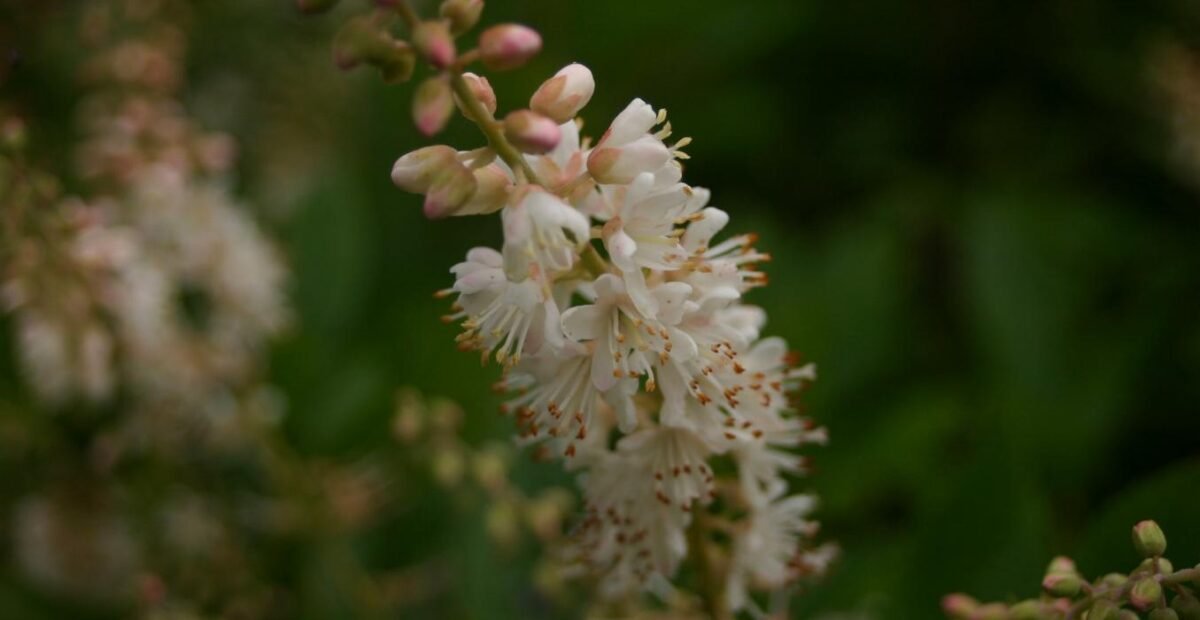
Leaves are alternate, oval to obovate, medium to dark green, and distinctly serrated toward the upper margins, giving the foliage an alder-like appearance. Young stems are green to reddish brown and mature stems become gray-brown. Narrow, bottlebrush-like spikes rise from the branch tips and carry many small, star-shaped flowers. Dry brown capsules may persist after flowering and contribute winter texture.
Flowering
Flower spikes are produced at the ends of new shoots from mid-summer into late summer. Individual flowers are small, white to pink, and arranged densely along upright racemes. The sweet fragrance is most noticeable in warm weather and can be appreciated from nearby paths or windows. Removing faded spikes is optional and mainly improves appearance; it is not required for continued health.
Pollination and visitors
The flowers provide nectar and pollen for a diverse insect community. Documented visitors include bumblebees, honey bees and other bees, butterflies, moths, flies including hoverflies, beetles, and wasps. Bumblebees have been identified as important pollinators in detailed flower-visitor observations, while beetles and many other insects also contribute to the plant’s broad ecological value.
Clethra alnifolia photos
Click any photo for a larger view. Source, author and license are shown separately.
Diseases and pests
Diseases
Serious disease problems are uncommon when the plant is grown in suitable moist but well-aerated soil. Prevent leaf spotting and root problems by avoiding overhead irrigation late in the day, improving crowded airflow, and correcting chronic crown saturation. Remove heavily spotted foliage after leaf fall and sanitize pruning tools when cutting diseased tissue. Persistent decline is more often associated with drought, alkaline soil, or root stress than with a major pathogen.
Pests
Sweet Pepperbush is generally resistant to major insect problems, though occasional chewing insects, scale, or sap-feeding pests may occur. Inspect new growth and leaf undersides before treating. Encourage beneficial insects, rinse light infestations with water, and prune out badly affected stems when practical. Avoid routine broad-spectrum insecticides during bloom because the flowers attract many beneficial visitors.
Toxicity and pollen
Authoritative plant-safety sources do not provide a sufficiently clear, species-specific toxicology profile for Clethra alnifolia. Do not assume that undocumented toxicity means proven safety. Prevent children and pets from chewing ornamental plant material, and contact a medical professional or veterinarian if a substantial amount is eaten or symptoms develop.
- Typical season
- Typically July–August in much of the United States
- Pollination / pollen
- Insect-dispersed pollen; not normally released in large airborne clouds
Sweet Pepperbush is insect-pollinated, so its pollen is primarily transferred by flower visitors rather than released as a large airborne cloud. That does not prove zero allergy risk: individual sensitivity, close contact with flowers, and local conditions can still matter. Reliable species-specific clinical allergy data are limited, so the overall airborne-allergy level is left unknown rather than assigned a precise low rating.
Native habitat
In its native range, Sweet Pepperbush occurs in swamps, wet thickets, floodplains, pond edges, coastal wetlands, and moist or sandy woods. It favors acidic substrates with dependable moisture and organic matter, often growing where seasonal flooding alternates with periods of better drainage. The species is especially well adapted to the humid eastern United States but can be cultivated more broadly where summer moisture is maintained.
Interesting fact
The species epithet alnifolia means “alder-leaved,” referring to the serrated leaves. Its common name reflects both the sweet fragrance of the flowers and the pepper-like appearance of the seed capsules. The shrub can flower in partial shade during the part of summer when many woodland plants have finished blooming. It is also notable for tolerating short periods of flooding while remaining unsuitable for persistently stagnant, oxygen-poor soil.
Frequently asked questions (FAQ)
The most relevant questions about this plant, with short and direct answers.
🌱Quick care
What is Sweet Pepperbush?⌄
Sweet Pepperbush is the deciduous native shrub Clethra alnifolia, valued for its fragrant summer flowers and usefulness in moist, partly shaded landscapes.
How much sunlight does Sweet Pepperbush need?⌄
Sweet Pepperbush grows in full sun to shade, but partial shade is often best in hot climates. More sunlight generally produces heavier flowering when the soil remains consistently moist.
How often should I water Sweet Pepperbush?⌄
Water Sweet Pepperbush regularly enough to keep the soil consistently moist, especially during its first growing season and periods of drought. Established plants tolerate brief dry periods but perform poorly in hot, dry sites.
Is Sweet Pepperbush cold hardy?⌄
Sweet Pepperbush is cold hardy across much of the United States, with commonly listed hardiness extending from USDA Zones 3 through 9. Winter protection is usually unnecessary for established plants in suitable zones.
How large does Sweet Pepperbush get?⌄
Sweet Pepperbush commonly grows about 5 to 10 feet tall and 4 to 6 feet wide, although cultivars may be substantially smaller. The shrub can spread gradually by underground stolons and form a small colony.
🌤️Environment and placement
What kind of soil does Sweet Pepperbush prefer?⌄
Sweet Pepperbush prefers moist, organic-rich, acidic soil with reliable drainage. It tolerates clay, loam, sand, occasional wetness, and short periods of flooding once established, but not persistently hot, dry soil.
Can Sweet Pepperbush grow in wet soil?⌄
Sweet Pepperbush can grow in moist or occasionally wet soil and is well suited to pond margins, rain gardens, swales, and damp woodland edges. It still benefits from drainage that prevents prolonged stagnant conditions around the roots.
Can Sweet Pepperbush grow in shade?⌄
Sweet Pepperbush can grow and flower in partial shade and even relatively shady locations. Heavy shade may reduce flowering and make the foliage less vigorous or less colorful.
Is Sweet Pepperbush suitable for a rain garden?⌄
Sweet Pepperbush is suitable for rain gardens and other moist sites because it tolerates wet soil and occasional flooding. Choose a location where water does not remain stagnant indefinitely and allow enough room for its mature spread.
Is Sweet Pepperbush native to the United States?⌄
Sweet Pepperbush is native to the eastern United States, ranging naturally from Maine south to Florida and west to Texas. It is commonly used in native, pollinator, and wetland-style gardens.
Can Sweet Pepperbush tolerate salt spray?⌄
Sweet Pepperbush has useful tolerance of salt spray and is considered suitable for some coastal landscapes. Salt tolerance does not eliminate the need for adequate soil moisture, organic matter, and protection from hot, drying conditions.
💧Care and problems
Does Sweet Pepperbush need fertilizer?⌄
Sweet Pepperbush usually needs little fertilizer when planted in fertile, organic-rich soil. If growth is weak, test the soil first and correct pH or nutrient deficiencies rather than applying fertilizer routinely.
Why are the leaves on my Sweet Pepperbush turning brown?⌄
Brown leaves on Sweet Pepperbush are commonly associated with drought, heat, or hot exposed conditions. Keep the root zone evenly moist, apply mulch, and provide afternoon shade if the site becomes excessively hot.
What pests affect Sweet Pepperbush?⌄
Sweet Pepperbush is generally resistant to serious insect and disease problems, but spider mites can cause significant damage in hot, dry locations. Improve moisture and reduce plant stress before considering treatment.
Is Sweet Pepperbush deer resistant?⌄
Sweet Pepperbush is often described as deer resistant, although deer may browse it when preferred food is scarce. Protection is still advisable for newly planted shrubs in areas with heavy deer pressure.
Does Sweet Pepperbush spread aggressively?⌄
Sweet Pepperbush can spread by stolons and may form small thickets when growing in favorable moist conditions. It is usually manageable, but remove unwanted suckers or install it where natural spreading is acceptable.
🪴Planting and repotting
When is the best time to plant Sweet Pepperbush?⌄
The best time to plant Sweet Pepperbush is during spring or fall when temperatures are moderate and soil moisture is dependable. Water thoroughly after planting and maintain consistent moisture while roots establish.
How far apart should I plant Sweet Pepperbush?⌄
Space Sweet Pepperbush according to its mature size, generally about 4 to 6 feet apart for a natural grouping. Use closer spacing only when a faster screen or massed planting is desired and some later thinning is acceptable.
Can Sweet Pepperbush be grown in a container?⌄
Sweet Pepperbush can be grown in a large container for a time, especially when using a compact cultivar. The container must have drainage, the potting mix should retain moisture without staying saturated, and the plant will need regular watering.
Can Sweet Pepperbush grow in clay soil?⌄
Sweet Pepperbush can tolerate clay soil if it remains moist and drains adequately. Incorporating organic matter into the planting area and applying mulch can improve root conditions, but avoid creating a permanently waterlogged basin.
✂️Propagation and pruning
How do you propagate Sweet Pepperbush?⌄
Sweet Pepperbush can be propagated by seed, summer stem cuttings, or division of suckers. Division and cuttings are usually more practical for preserving the characteristics of a selected cultivar.
Can Sweet Pepperbush be grown from seed?⌄
Sweet Pepperbush can be grown from seed, but the seeds generally benefit from about 30 days of cold stratification before spring germination. Seed-grown plants may differ from named cultivars.
Can you propagate Sweet Pepperbush from cuttings?⌄
Sweet Pepperbush can be propagated from softwood cuttings taken in late May or early June in much of the United States. Rooting is more reliable in a clean, well-drained medium with high humidity and consistent moisture.
When should Sweet Pepperbush be pruned?⌄
Prune Sweet Pepperbush in late winter or early spring before new growth begins. Because it flowers on new wood, pruning during this period generally preserves the summer flower display.
How do you prune an overgrown Sweet Pepperbush?⌄
Renew an overgrown Sweet Pepperbush by removing some of the oldest stems at ground level and shortening excessively long new growth in late winter or early spring. Avoid removing all stems at once unless severe rejuvenation is necessary.
Should I remove Sweet Pepperbush suckers?⌄
Remove Sweet Pepperbush suckers if you want to maintain a single planting or a defined boundary. Leave them in place when creating a naturalized screen, colony, or informal mass planting.
⚠️Toxicity and safety
Is Sweet Pepperbush toxic to people or pets?⌄
The toxicity of Sweet Pepperbush to people and pets is not well established, so avoid treating the plant as confirmed edible or safe to consume. Keep children and animals from eating the leaves, flowers, or fruit, and consult a veterinarian or poison-control service if ingestion occurs.
🌸Flowering and special interest
When does Sweet Pepperbush bloom?⌄
Sweet Pepperbush usually blooms from July into August, with fragrant white flower spikes appearing in late summer. Bloom timing varies somewhat with climate, cultivar, and growing conditions.
Are Sweet Pepperbush flowers fragrant?⌄
Sweet Pepperbush flowers are strongly and pleasantly fragrant, often described as spicy or sweet. The scent is especially noticeable when the shrub is planted near a walkway, patio, or frequently used garden area.
Why is my Sweet Pepperbush not flowering?⌄
Poor flowering in Sweet Pepperbush is most often linked to excessive shade, drought stress, immature growth, or pruning at the wrong time. Provide dependable moisture and avoid cutting the shrub after spring growth has begun.
Does Sweet Pepperbush attract pollinators?⌄
Sweet Pepperbush attracts bees, butterflies, hummingbirds, and other pollinators with its fragrant nectar- and pollen-rich flowers. It is particularly useful because it blooms in late summer, when fewer shade-tolerant shrubs are flowering.
Does Sweet Pepperbush have attractive fall or winter features?⌄
Sweet Pepperbush develops brown capsules in fall that can persist into winter and provide food for birds and small mammals. Its deciduous foliage may turn pale yellow to golden brown before dropping.
Similar plants
 Azure Monkshood (Aconitum carmichaelii) care guideAconitum carmichaelii
 Monkshood (Aconitum ‘Stainless Steel’)Aconitum 'Stainless Steel'
 Monkshood (Aconitum ‘Bressingham Spire’)Aconitum 'Bressingham Spire'
 Golden full moon maple (Acer shirasawanum ‘Aureum’)Acer shirasawanum 'Aureum'
 Globosum (Acer platanoides ‘Globosum’)Acer platanoides 'Globosum'
 Striped maple (Acer pensylvanicum) care guideAcer pensylvanicum