
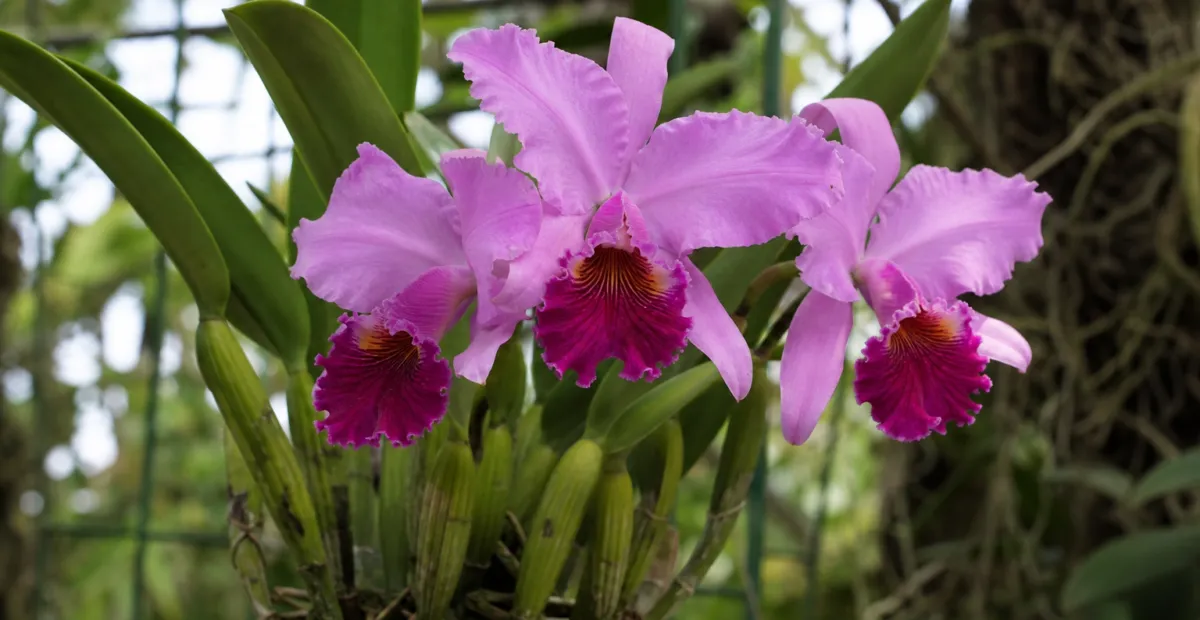
 AI-generated illustration
He crimson cattleya or ruby-lipped cattleya (Cattleya labiata) short overview
Cattleya labiata, known in the United States as the crimson cattleya or ruby-lipped cattleya, is a spectacular Brazilian orchid with thick pseudobulbs, leathery leaves, and large, often fragrant blooms. It grows as an epiphyte or lithophyte and performs best in bright filtered light, an airy orchid mix, thorough watering followed by partial drying, and a distinct drier rest as new growths mature. Cattleya labiata is a sympodial, unifoliate Brazilian orchid with thick pseudobulbs and large rose-lilac flowers centered by a crimson-purple lip with yellow markings.
Taxonomic classification
He crimson cattleya or ruby-lipped cattleya (Cattleya labiata) care guide
Light and placement
Provide very bright filtered light, such as an east window or a south-facing window softened by sheer material. Gentle morning sun is useful, but acclimate carefully to stronger exposure. Dark green, elongated growth with few flowers often indicates insufficient light; yellow-green leaves, bleached patches, or scorch indicate excessive intensity or heat.
Watering and humidity
Water thoroughly when the upper mix is nearly dry, then let excess drain completely. During active growth, water more regularly because new roots and pseudobulbs are developing; after the pseudobulb matures, allow a longer dry interval but do not leave roots desiccated for extended periods. Maintain humidity with ventilation rather than constantly wet roots.
Soil and growing medium
Use a coarse, airy orchid substrate such as medium-grade fir bark with perlite, lava rock, or another open component. The mix must drain quickly while retaining modest moisture around active roots. A slightly acidic to near-neutral root environment is suitable; avoid compact garden soil and containers that remain waterlogged.
Feeding
Feed during active pseudobulb growth with a complete orchid fertilizer at the label’s dilute rate, generally every two to four waterings. Reduce or stop feeding when growth has fully matured and the plant enters its drier rest. Water with plain water periodically to flush fertilizer salts, especially in bark mixes.
Growth and habit
A sympodial orchid that advances along a rhizome, producing successive thickened pseudobulbs, each normally bearing one leathery leaf. New growths store water and carbohydrates and often determine the following flowering display, so avoid removing healthy older pseudobulbs unless they are diseased.
Planting and repotting
Grow in a pot or basket rather than outdoors in ordinary soil. Set the rhizome horizontally with older pseudobulbs toward the pot edge and keep pseudobulbs and the crown above the mix. Establish after new root tips appear; allow room for the plant to advance across the container.
Repot when the medium decomposes, usually every 2–3 years, preferably just as new roots begin to emerge. Move only one pot size larger and keep the rhizome near the surface rather than burying the pseudobulbs. Secure the plant firmly so newly emerging roots are not damaged by movement.
Propagation and pruning
Propagation
Divide established plants when there are enough mature pseudobulbs to support each section; three to five pseudobulbs per division is a practical minimum for reducing setback. Seed propagation requires sterile flask culture because orchid seeds lack substantial reserves and normally depend on specialized germination conditions.
Pruning
Remove only dead, diseased, or completely desiccated pseudobulbs and roots. After flowering, cut the spent inflorescence near its base once it has dried. Do not cut healthy green pseudobulbs or leaves, which continue to support the developing plant.
Overwintering
Protect from temperatures below about 55°F at night and keep it indoors or in a heated greenhouse in most of the United States. Provide bright light, airflow, and reduced watering during the winter rest, while avoiding prolonged cold, wet conditions around the roots.
Uses
Primarily grown as a specimen orchid, greenhouse collection plant, indoor flowering display, or cut-flower subject. Its large, durable blooms are valuable ornamentally, but wild-collected plants should be avoided; purchase nursery-propagated material from reputable sellers and follow applicable orchid trade rules.
Appearance
The plant forms clustered, thickened green pseudobulbs along a creeping rhizome. Each mature pseudobulb generally carries one leathery, elliptical leaf, giving the species the classic unifoliate Cattleya appearance. Flower stems emerge from a sheath at the top of a mature pseudobulb and carry several large blooms.
Flowering
This unifoliate Cattleya produces a terminal sheath and typically opens two to five large flowers after the current pseudobulb has matured. In its native cycle it is associated with late spring through summer flowering, though greenhouse photoperiod and temperature can shift the date. Strong light is important for reliable blooming, but hot direct midday sun can scorch leaves.
Pollination and visitors
Reliable species-specific pollinator records were not confirmed in the reviewed sources. Cattleya flowers have specialized pollinia and a fused reproductive column, but the available evidence here does not justify assigning a specific visitor group to Cattleya labiata.
Cattleya labiata photos
Click any photo for a larger view. Source, author and license are shown separately.
Diseases and pests
Diseases
Prevent bacterial and fungal problems with excellent airflow, clean tools, rapid drainage, and dry foliage before night. Soft, dark, spreading lesions or foul odors suggest rot; isolate affected plants, remove compromised tissue with sterilized tools, and correct excessive moisture. Avoid repeated overhead watering in stagnant conditions.
Pests
Watch for scale, mealybugs, thrips, and spider mites, especially on stressed or dry plants. Inspect leaf undersides, pseudobulb bases, and new growth regularly. Remove small infestations with a cotton swab or appropriate labeled treatment; improve airflow and quarantine new orchids before placing them with a collection.
Related diseases and pests
Only Plant Doctor profiles whose host data indicate this plant may be affected are shown here.
 DiseaseBacterial soft rotPectobacterium carotovorum
 PestCotton mealybugPhenacoccus solenopsis Tinsley
 DiseaseRhizopus soft rotRhizopus stolonifer
 PestCottony Cushion ScaleIcerya purchasi
 PestOnion thripsThrips tabaci Lindeman
 PestMelon thripsThrips palmi Karny
 DiseaseBacterial WiltRalstonia solanacearum species complex
 DiseaseBacterial Fruit BlotchAcidovorax citrulli
Toxicity and pollen
ASPCA lists Cattleya labiata as non-toxic to dogs and cats. Normal handling is not considered hazardous, but plant material should not be intentionally eaten, and any unusual gastrointestinal reaction warrants veterinary or medical advice.
- Typical season
- Not typically a significant seasonal airborne-pollen source in the United States
- Pollination / pollen
- Cohesive pollinia; not freely wind-dispersed
The pollen is packaged into cohesive pollinia rather than released as a loose airborne cloud. This suggests low routine airborne exposure compared with wind-pollinated plants, although sensitive people may still react to plant debris, greenhouse dust, or incidental floral material.
Native habitat
Native to Brazil, where it occurs as an epiphyte or lithophyte in seasonally dry tropical environments. Plants attach to trees or rocky surfaces, receiving abundant air movement, intermittent rainfall, rapid drainage, and a noticeable contrast between wetter growth periods and drier rest.
Interesting fact
Cattleya labiata was among the earliest large-flowered cattleyas to become important in orchid horticulture. Its flowers may reach roughly 5–6 inches across, and the species helped establish the classic large-flowered Cattleya ideal. In nature it can grow on trees or rocks rather than in soil.
Frequently asked questions (FAQ)
The most relevant questions about this plant, with short and direct answers.
🌱Quick care
What is the crimson cattleya or ruby-lipped cattleya?⌄
The crimson cattleya or ruby-lipped cattleya is the orchid species Cattleya labiata in the family Orchidaceae. It is a pseudobulb-forming epiphyte or lithophyte native to Brazil.
Is Cattleya labiata easy to grow indoors?⌄
Cattleya labiata can grow well indoors when it receives strong filtered light, good air circulation, and a fast-draining orchid mix. It is less forgiving of low light and constantly wet roots than many beginner orchids.
How much light does Cattleya labiata need?⌄
Cattleya labiata needs bright filtered light and generally more light than a typical low-light houseplant. Indoors, a bright south-, east-, or west-facing window can work, but harsh midday sun should be filtered while the plant acclimates.
How often should I water Cattleya labiata?⌄
Water Cattleya labiata thoroughly when its open orchid mix is nearly dry, then let excess water drain completely. The plant should dry slightly between waterings, but it should not remain dry for prolonged periods during active growth.
What potting mix is best for Cattleya labiata?⌄
Use an open, coarse orchid mix that drains quickly, such as orchid bark combined with perlite or another airy component. The mix should retain some moisture without staying soggy around the roots.
🌤️Environment and placement
What temperature does Cattleya labiata prefer?⌄
Cattleya labiata generally prefers warm days around 70–85°F and cooler nights around 55–72°F. A day-to-night drop of about 10–15°F can support healthy growth and flowering.
Can Cattleya labiata grow outside in the United States?⌄
Cattleya labiata can grow outdoors in frost-free parts of the United States if it is protected from harsh direct sun, cold rain, and temperature extremes. In most other areas, bring it indoors before nighttime temperatures approach the low 50s°F.
Is Cattleya labiata frost-tolerant?⌄
No, Cattleya labiata is frost-tender and should not be exposed to freezing temperatures. Move it indoors or into a protected heated growing space before frost is expected.
What humidity does Cattleya labiata need?⌄
Cattleya labiata usually grows well at about 40–70% relative humidity when watering and air movement are appropriate. Higher humidity should be paired with good ventilation to reduce the risk of fungal and bacterial problems.
Can Cattleya labiata tolerate direct sunlight?⌄
Cattleya labiata may tolerate some gentle morning or late-afternoon sun after gradual acclimation, but intense midday sunlight can scorch the leaves. Filter strong sun with a sheer curtain or shade cloth.
💧Care and problems
Why are my Cattleya labiata leaves dark green?⌄
Dark green leaves often indicate that Cattleya labiata is receiving too little light for reliable flowering. Increase light gradually while avoiding sudden exposure to hot, direct midday sun.
Why are Cattleya labiata leaves yellowing?⌄
Yellowing leaves can result from excessive light, aging foliage, overwatering, or root damage. Check the roots and potting mix first, then adjust light and watering rather than assuming one cause.
Why are the pseudobulbs on my Cattleya labiata wrinkled?⌄
Wrinkled pseudobulbs usually indicate dehydration, insufficient roots, or watering that is too infrequent for the growing conditions. Water thoroughly when the mix is nearly dry and inspect for dead or rotted roots if the problem continues.
How should I fertilize Cattleya labiata?⌄
Feed Cattleya labiata with a balanced orchid fertilizer at one-quarter to one-half strength during active growth. Reduce or stop feeding when growth slows, and water regularly with plain water to limit fertilizer-salt buildup.
Can I use tap water for Cattleya labiata?⌄
Cattleya labiata may tolerate tap water if it is not excessively hard or softened with sodium chloride. Use lukewarm water, and consider rainwater, filtered water, or low-mineral water if leaf or root problems develop.
How much air circulation does Cattleya labiata need?⌄
Cattleya labiata benefits from gentle, continuous air movement around its leaves and roots. Good circulation is especially important when humidity is high or the plant has recently been watered.
What pests commonly affect Cattleya labiata?⌄
Common orchid pests such as scale, mealybugs, aphids, and spider mites can affect Cattleya labiata. Inspect leaf undersides, pseudobulbs, and new growth regularly, and isolate an infested plant before treatment.
🪴Planting and repotting
When should I repot Cattleya labiata?⌄
Repot Cattleya labiata when the potting medium has broken down, drainage has declined, or new roots and shoots are beginning to grow. If those signs are absent, wait until after flowering to minimize stress.
What size pot does Cattleya labiata need?⌄
Choose a pot that accommodates about two years of growth without leaving a large volume of unused wet mix. A pot only 2–3 inches wider than the current root mass is usually sufficient.
Should Cattleya labiata be planted in soil?⌄
No, Cattleya labiata should not be planted in ordinary garden soil or dense houseplant potting soil. Its roots need an airy orchid medium that drains rapidly and allows oxygen around the roots.
✂️Propagation and pruning
How do I propagate Cattleya labiata?⌄
The practical home-propagation method is division of a mature plant into sections containing at least three to five healthy pseudobulbs. Divide when new roots or shoots are starting, because small divisions may take longer to flower.
Can Cattleya labiata be propagated from leaf cuttings?⌄
No, ordinary leaf cuttings do not produce new Cattleya labiata plants. Propagation is normally done by dividing the rhizome or through specialized laboratory seed or tissue-culture methods.
Should I prune Cattleya labiata after flowering?⌄
Remove only the spent flower spike or dead, damaged, or diseased tissue from Cattleya labiata. Do not cut healthy pseudobulbs or leaves, because they store energy for future growth and flowering.
⚠️Toxicity and safety
Is Cattleya labiata toxic to dogs and cats?⌄
Cattleya labiata is listed as non-toxic to dogs and cats. Even non-toxic plants can cause mild stomach upset if eaten, so contact a veterinarian if a pet consumes a large amount or develops symptoms.
🌸Flowering and special interest
How often does Cattleya labiata bloom?⌄
Cattleya labiata typically blooms once a year, although the timing can vary by clone and growing conditions. Mature, well-lit plants usually flower from the newest completed growth.
When does Cattleya labiata bloom?⌄
Cattleya labiata is generally an autumn-blooming orchid, but flowering time can vary among plants and may be influenced by light and temperature. A healthy mature pseudobulb should produce a protective sheath and flower spike when conditions are favorable.
Why is my Cattleya labiata not blooming?⌄
Insufficient light is one of the most common reasons Cattleya labiata fails to bloom. Other possibilities include an immature plant, disrupted growth, excessive nitrogen, root problems, or the absence of a useful day-to-night temperature change.
Are Cattleya labiata flowers fragrant?⌄
Many Cattleya labiata plants produce fragrant flowers, but fragrance intensity can vary with the individual plant, time of day, and growing conditions. Lack of fragrance does not necessarily indicate a health problem.
How can I encourage Cattleya labiata to flower?⌄
Provide strong filtered light, steady active-season growth, careful drying between waterings, and cooler nights than days. Avoid moving or repotting the plant while a developing bud is close to opening.
Similar plants
 Azure Monkshood (Aconitum carmichaelii) care guideAconitum carmichaelii
 Monkshood (Aconitum ‘Stainless Steel’)Aconitum 'Stainless Steel'
 Monkshood (Aconitum ‘Bressingham Spire’)Aconitum 'Bressingham Spire'
 Golden full moon maple (Acer shirasawanum ‘Aureum’)Acer shirasawanum 'Aureum'
 Globosum (Acer platanoides ‘Globosum’)Acer platanoides 'Globosum'
 Striped maple (Acer pensylvanicum) care guideAcer pensylvanicum