
 Source:
 He silver banksia (Banksia marginata) short overview
He silver banksia (Banksia marginata) is a highly variable evergreen shrub or small tree from southeastern Australia. Its narrow leaves have dark green upper surfaces and silvery, hairy undersides, while pale yellow cylindrical flower spikes provide nectar for honeyeaters and other wildlife. In cultivation, it performs best in sun, sharply drained acidic soil, and a climate with mild winters. Established plants tolerate dry periods, but wet, poorly drained soil is a more serious risk than short-term drought.
Taxonomic classification
He silver banksia (Banksia marginata) care guide
Light and placement
Give full sun for the densest habit and best flowering; light partial shade is tolerated, especially in hot inland climates. An east-, south-, or west-facing position with several hours of direct light is suitable, while deep shade can produce sparse, leggy growth and fewer spikes. Bleached foliage or scorched margins suggest excessive reflected heat or drought combined with intense exposure.
Watering and humidity
Water deeply and thoroughly when the upper several inches of soil begin to dry during establishment, then allow excess water to drain fully. Reduce frequency in cool weather and during winter, and increase only during prolonged heat or drought. Avoid frequent shallow watering and never leave the root zone saturated; ordinary household humidity is not required.
Soil and growing medium
Use a sharply drained, low-phosphorus soil or native-plant mix based on coarse sand, loam, or fine gravel. Slightly acidic to neutral conditions are suitable. Avoid heavy clay, waterlogging, fresh manure, and phosphorus-rich fertilizers, because Banksias are adapted to nutrient-poor soils and Proteaceae can be sensitive to phosphorus excess.
Feeding
Feed sparingly in spring with a fertilizer formulated for Australian natives and low in phosphorus, using the label's lightest rate. A thin top-dressing of mature, low-phosphorus compost is safer than rich manure. Do not fertilize drought-stressed, newly transplanted, or declining plants until roots have recovered.
Growth and habit
This species ranges from compact shrubs to small trees, with habit strongly influenced by provenance, exposure, soil, and fire history. It generally forms a stable, well-branched framework and needs little shaping once established. Growth may become open or leggy in shade, and summer humidity can reduce performance in forms adapted to drier climates.
Planting and repotting
Plant in spring after the danger of hard frost has passed, or in fall where winters are mild. Set the root crown level with the surrounding soil, never deeply buried. Allow about 6–10 feet between standard garden plants; use wider spacing for tree-form selections. Water deeply during the first growing season while keeping the root zone well drained.
Repot only when necessary, preferably in late winter or early spring. Use a deep container with excellent drainage and a low-phosphorus native-plant mix. Disturb the root ball as little as possible, and move plants into progressively larger pots rather than an oversized wet container.
Propagation and pruning
Propagation
Sow fresh seed just beneath the surface from late winter through spring. Germination commonly takes about 4–8 weeks. Cuttings can be taken from firm young growth in late summer to early fall, but success varies with material and technique. Some subalpine provenances may require cold stratification.
Pruning
Prune lightly after flowering to maintain shape and remove damaged wood. Lignotuberous forms can tolerate harder renovation pruning, but non-lignotuberous plants should not be cut back severely. Avoid removing large amounts of old wood unless the plant's resprouting habit is known.
Overwintering
In USDA Zone 8 or exposed locations, protect young plants from hard freezes with a sheltered site, temporary frost cloth, and dry winter soil. Container plants can be moved to a bright, cool, frost-free location during severe weather. Do not keep them in warm, dim indoor rooms for long periods.
Uses
Use as an evergreen specimen, informal screen, windbreak, wildlife plant, or large-container subject in mild climates. Flower spikes provide nectar for birds and insects, and persistent follicles add structural interest. Indigenous Australian communities used the flower spikes to make a sweet drink; this historical use should not be treated as a recommendation for home consumption.
Appearance
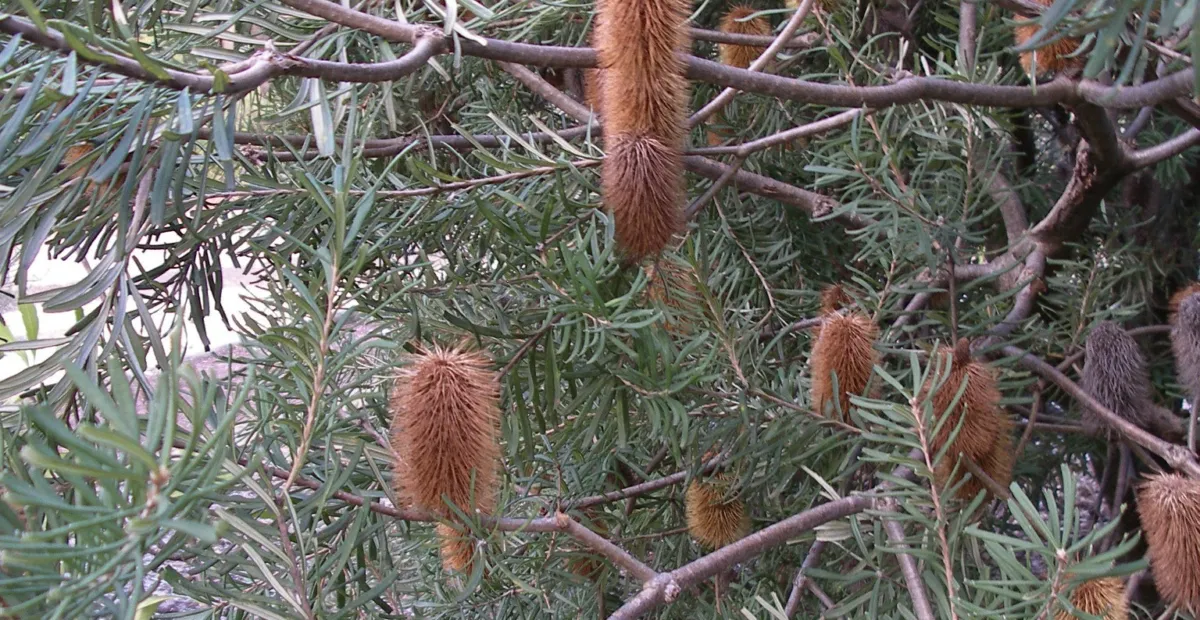
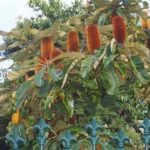
Leaves are narrow and leathery, with dark green upper surfaces and pale, hairy undersides that flash silver in moving air. Small serrations may occur near the tips or margins. The bark and branching structure become more substantial with age, while old flower spikes mature into dark, woody, cone-like follicle clusters that are valuable for identification.
Flowering
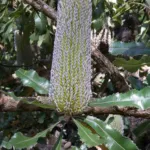
Dense cylindrical spikes are composed of many small flowers arranged around a central axis. The pale yellow spikes may appear from late winter or spring through autumn, with the strongest display varying among provenances and climates. Older flower spikes develop persistent woody follicles that may remain on the plant for years.
Pollination and visitors
The most characteristic visitors are nectar-feeding birds, especially honeyeaters such as the New Holland honeyeater. Bees and other insects also visit the nectar-rich spikes, and small mammals have been recorded among visitors to Banksia flowers. Visitor communities vary with habitat and season.
Banksia marginata photos
Click any photo for a larger view. Source, author and license are shown separately.
Diseases and pests
Diseases
Prevent root and collar diseases by using free-draining soil, avoiding standing water, and keeping mulch away from the stem. Watch for decline, dieback, or yellowing in persistently wet conditions; remove badly affected material and improve drainage rather than relying on routine fungicide.
Pests
Inspect new growth and flower spikes for scale, mealybugs, aphids, and caterpillar damage. Improve airflow, avoid excess nitrogen, and remove heavily infested material. Use horticultural oil or insecticidal soap only when the plant is actively growing and label directions allow; avoid spraying open flowers when pollinators are present.
Toxicity and pollen
No authoritative source located in this review documents species-specific poisoning of people, dogs, cats, or children by Banksia marginata. That absence is not proof of edibility or guaranteed safety. Prevent chewing of leaves, flowers, and follicles, and contact Poison Control or a veterinarian after a substantial ingestion or concerning symptoms.
- Typical season
- Typically late winter through autumn in the United States when cultivated; local timing depends on climate.
- Pollination / pollen
- Mostly pollen carried by flower visitors; limited airborne dispersal
Banksia marginata is primarily animal-pollinated, so its pollen is not released in the same wind-borne manner as many allergenic grasses and trees. However, flower handling can expose people to pollen, and published species-specific U.S. aerobiology and clinical allergy data are sparse; sensitive individuals should avoid direct contact during bloom.
Native habitat
Native to southeastern Australia, including New South Wales, Victoria, Tasmania, and South Australia. It occurs in woodland, forest, shrubland, coastal dunes, heath, and sometimes swamp margins, across sandy, rocky, and seasonally moist sites. Natural populations experience nutrient-poor soils, periodic fire, and variable rainfall.
Interesting fact
The species is exceptionally variable, ranging from low shrubs to trees around 12 m tall. Some populations form a lignotuber that can resprout after fire, while others rely more heavily on canopy-stored seed. The name marginata refers to rolled-under leaf margins in some forms. Its follicles can remain conspicuous long after flowering.
Frequently asked questions (FAQ)
The most relevant questions about this plant, with short and direct answers.
🌱Quick care
What is he silver banksia?⌄
He silver banksia is Banksia marginata, an evergreen Australian shrub or small tree in the Proteaceae family. It has narrow leaves with silvery undersides, pale yellow cylindrical flower spikes, and woody cone-like fruits.
How large does he silver banksia get?⌄
He silver banksia is highly variable, ranging from a spreading shrub to a small tree. In cultivation, many plants reach roughly 5 to 8 feet tall and wide, but some forms can become substantially larger.
Are Banksia marginata leaves supposed to look silver?⌄
Yes, the silvery appearance is characteristic of Banksia marginata. The upper leaf surfaces are generally green, while the undersides are pale or white and become especially noticeable when wind turns the foliage.
How long does he silver banksia live?⌄
He silver banksia can be a long-lived woody plant when grown in suitable conditions, but no single lifespan applies to all forms. Drainage, climate, fire history, disease pressure, and pruning practices strongly affect longevity.
🌤️Environment and placement
How much sunlight does he silver banksia need?⌄
Grow he silver banksia in full sun for the strongest growth and best flowering. It can tolerate light partial shade, but too much shade may produce a thinner plant and fewer flowers.
How cold hardy is Banksia marginata?⌄
Established Banksia marginata can tolerate temperatures around 14°F when planted in a sheltered, well-drained location. Young plants and those exposed to wind, wet roots, or repeated freezes are more vulnerable.
Can I grow he silver banksia in the United States?⌄
He silver banksia can be grown in parts of the United States with mild winters, excellent drainage, and low-phosphorus soil. In colder areas, grow it in a container or provide protected placement and winter protection.
What USDA hardiness zone is Banksia marginata?⌄
Banksia marginata is best suited to mild climates, with established plants tolerating about 14°F under favorable conditions. Exact performance varies by plant origin, exposure, drainage, and whether the plant is young or mature.
Is he silver banksia wind tolerant?⌄
He silver banksia can tolerate exposed conditions once established, but sheltered placement is preferable in areas with strong winds, freezing temperatures, or salt spray. Young plants benefit from temporary protection while developing their root systems.
Can he silver banksia be used as a screen plant?⌄
Yes, dense forms of he silver banksia can work as informal screen plants. Choose a form suited to the available space, provide strong light and drainage, and allow for its potentially larger mature size.
💧Care and problems
How often should I water Banksia marginata?⌄
Water Banksia marginata moderately while it establishes, allowing the soil to dry somewhat between waterings. Once established, it generally needs little supplemental water except during prolonged heat or drought.
Should I fertilize Banksia marginata?⌄
Usually, Banksia marginata needs little or no fertilizer once established. If feeding is necessary, use a product specifically formulated for Australian native plants and low in phosphorus, following the label rate carefully.
Why are the leaves of he silver banksia turning brown?⌄
Brown leaves may result from drought, root damage, poor drainage, frost, salt exposure, or transplant stress. Check soil moisture and drainage first, and avoid correcting the problem with high-phosphorus fertilizer.
Can overwatering kill Banksia marginata?⌄
Yes, prolonged wet soil can damage or kill Banksia marginata by causing root problems. Water only when needed after establishment, and correct drainage before increasing irrigation or applying treatments.
🪴Planting and repotting
What type of soil is best for he silver banksia?⌄
Use sandy or loamy soil that drains sharply and contains little available phosphorus. Avoid heavy, poorly drained soil and phosphorus-rich fertilizers, which can damage banksias and other Proteaceae.
Can he silver banksia grow in clay soil?⌄
He silver banksia may tolerate some heavier soil in naturally suitable populations, but garden clay should be improved only enough to increase drainage. Planting on a raised mound is safer than adding rich compost or fertilizer.
Can Banksia marginata be grown in a pot?⌄
Banksia marginata can be grown in a large container while young or where winters are too cold for outdoor planting. Use a sharply draining, low-phosphorus potting mix, avoid standing water, and repot only when necessary.
How do I plant he silver banksia?⌄
Plant he silver banksia in a sunny, well-drained site with the root crown at its original soil level. Water thoroughly after planting, then reduce irrigation gradually as roots establish, and do not add phosphorus-rich amendments.
How far apart should I plant Banksia marginata?⌄
Space Banksia marginata according to the mature form, generally allowing about 5 to 8 feet between typical shrub-sized plants. Larger or tree-form selections need more room for their eventual height, spread, and root-zone access.
✂️Propagation and pruning
How do I prune he silver banksia?⌄
Prune he silver banksia lightly to shape it and remove dead, damaged, or crossing branches. Avoid cutting deeply into old, leafless wood because banksias may respond poorly when there are no active buds below the cut.
Can I grow Banksia marginata from seed?⌄
Yes, Banksia marginata is commonly propagated from seed. Sow fresh or properly stored seed in a sterile, sharply draining medium and keep it lightly moist; germination time can vary with seed quality and conditions.
Can he silver banksia be propagated from cuttings?⌄
Cuttings may be possible, but success can be less consistent than seed propagation and may depend on the plant’s form and timing. Use healthy semi-mature material and a very free-draining propagation medium.
Does Banksia marginata need fire to reproduce?⌄
Not every Banksia marginata population depends on fire in the same way. Some plants can regenerate from a woody lignotuber after fire, while others rely mainly on seed, so fire response varies among populations and forms.
⚠️Toxicity and safety
Is he silver banksia toxic to people or pets?⌄
No documented species-specific toxicity classification was located for he silver banksia. Even so, prevent children and pets from chewing unfamiliar plant material, and seek professional medical or veterinary advice if ingestion causes symptoms.
🌸Flowering and special interest
When does he silver banksia bloom?⌄
He silver banksia can flower from spring into autumn, with timing varying by climate and local form. The flowers are usually pale yellow and arranged in upright cylindrical spikes up to about 4 inches long.
Why is my Banksia marginata not flowering?⌄
Insufficient light, excessive nitrogen or phosphorus, young age, drought stress, and excessive pruning can reduce flowering in Banksia marginata. Give it strong light, sharp drainage, appropriate watering, and time to mature.
Does he silver banksia attract pollinators?⌄
He silver banksia flowers provide nectar and are visited by pollinating birds, insects, and other nectar-feeding animals in suitable regions. Flowering activity is usually greatest when the plant receives adequate sunlight and is not overfertilized.
Similar plants
 Banksia ericifolia care guideBanksia ericifolia
 He coast banksia (Banksia integrifolia) care guideBanksia integrifolia
 He showy banksia (Banksia speciosa) care guideBanksia speciosa
 Acorn banksia or orange banksia (Banksia prionotes) care guideBanksia prionotes
 He saw banksia (Banksia serrata) care guideBanksia serrata
 Swamp Banksia (Banksia robur) care guideBanksia robur