
 Source:
 Desert rose (Adenium obesum) short overview
Adenium obesum, commonly called desert rose, is a striking succulent shrub prized for its swollen, sculptural caudex and showy trumpet-shaped flowers. In the United States it is usually grown in a container or as a houseplant because it cannot tolerate freezing temperatures. Give it intense light, a porous soil mix, and thorough watering only after the substrate has dried. Plants may rest and shed leaves during cool, dry winters.
Taxonomic classification
Desert rose (Adenium obesum) care guide
Light and placement
Provide the brightest practical exposure, ideally several hours of direct sun through a south- or west-facing window or outdoors in full sun. Acclimate gradually when moving from indoor light to outdoor sun to prevent scorch. Sparse growth, long weak stems, and poor flowering indicate insufficient light; pale or scorched patches suggest abrupt excessive sun or heat stress.
Watering and humidity
Water thoroughly only when the substrate has dried substantially, then let excess drain completely. During warm active growth, check the mix regularly but do not keep it continuously damp. Reduce watering sharply in cool, low-light conditions and during leafless dormancy; withholding water is safer than repeated small drinks when temperatures are low. Humidity is not a primary requirement.
Soil and growing medium
Use a porous cactus or succulent mix amended with coarse mineral material such as pumice, perlite, or grit. Drainage is more important than richness because the swollen caudex and roots are highly vulnerable to rot in stagnant, wet soil. A near-neutral to slightly alkaline medium is suitable; avoid compacted clay and water-retentive garden soil in containers.
Feeding
Fertilize only during active growth, from spring through summer, using a balanced or bloom-supporting liquid fertilizer at half strength about every 2–4 weeks, following the product label. Water first if the mix is very dry. Stop feeding during cool-season dormancy or when the plant is leafless, and flush the container occasionally to reduce salt buildup.
Growth and habit
This long-lived succulent shrub develops a thickened basal caudex and branching stems, often becoming increasingly sculptural with age. Growth is fastest in warm weather with strong light and slows markedly during cool or dry dormancy. Container specimens remain smaller than plants grown in suitable frost-free ground, and pruning can encourage branching.
Planting and repotting
Plant outdoors only where freezing weather is absent, generally in USDA Zones 10b–12. Set the root system at its previous depth; do not bury the swollen caudex deeply if it is being displayed. Space landscape specimens about 3–5 feet apart where their mature form can develop. Establish with light, infrequent watering, allowing the soil to dry between applications.
Repot in spring or early summer when active growth resumes. Choose a container with generous drainage holes and only a modest increase in diameter. Handle the caudex carefully, remove damaged roots, and allow any cuts to dry before planting into dry mix. Keep the plant relatively dry for several days after repotting, then resume cautious watering.
Propagation and pruning
Propagation
Sow fresh seed in warm, sterile, sharply drained mix during the active growing season; seedlings usually develop the most characteristic caudex. Stem cuttings root in warm conditions after the cut surface has dried. Grafting is widely used for selected flowering forms. Keep new propagules warm and avoid excess moisture while roots establish.
Pruning
Prune in spring or early summer as growth resumes. Remove dead, damaged, crossing, or weak shoots with sterilized tools, and shorten long branches to encourage a fuller framework. Wear gloves because the cut surfaces release poisonous latex. Let cuts dry and keep rain or irrigation off fresh wounds until they seal.
Overwintering
Bring containers indoors before temperatures fall below about 50–55°F, placing them in the brightest cool location available. Reduce watering as growth slows and withhold it during a leafless rest unless the caudex begins to shrivel severely. Never expose the plant to frost or freezing temperatures. Resume watering and feeding gradually when warmth and new growth return.
Uses
Primarily used as a container ornamental, houseplant, patio specimen, rock-garden accent in frost-free climates, or bonsai subject. Its caudex and flowers provide strong sculptural and seasonal interest. It is not an edible plant, and traditional medicinal or hunting uses should not be treated as safe home remedies because the latex is poisonous.
Appearance
The most distinctive feature is a broad, swollen caudex that may be partly above the soil, supporting crooked gray-green to brown branches. Fleshy, leathery, oval to lance-shaped leaves cluster toward shoot tips. The sparse branching habit and exposed caudex create a miniature-tree or bonsai-like appearance, while terminal flower clusters provide the principal ornamental display.
Flowering
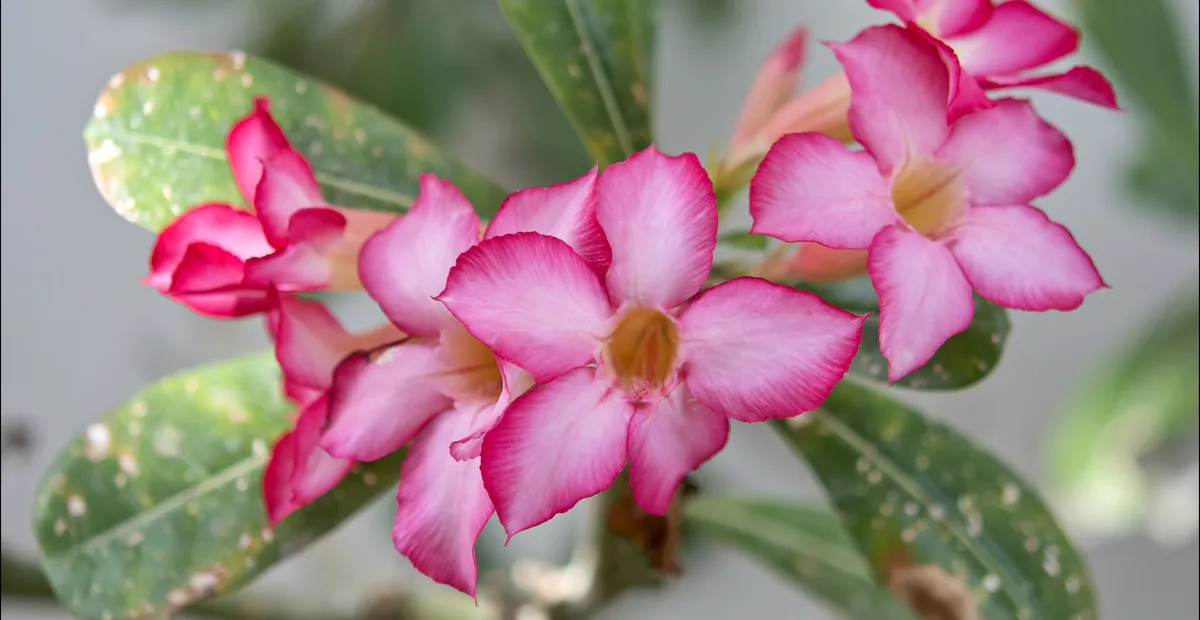
Flowers are borne in terminal clusters near the ends of branches. Each bloom is trumpet- or salverform, with five spreading lobes and protruding stamens. Flowering is strongest during warm, bright conditions; outdoor plants commonly bloom in summer, while indoor plants may flower irregularly when light and warmth are adequate.
Pollination and visitors
Showy tubular flowers are documented as attractive to butterflies and hummingbirds in horticultural settings. Bees and other insects may also visit, but the exact visitor community depends on region and access to outdoor flowers. Visitor attraction should not be confused with the plant’s toxic sap or with human pollen allergy risk.
Adenium obesum photos
Click any photo for a larger view. Source, author and license are shown separately.
Diseases and pests
Diseases
The main disease risk is root or caudex rot caused by persistently wet substrate, especially in cool weather. Use clean tools, sharply drained mix, and careful watering. Fungal leaf spots may occur; remove affected leaves, improve airflow, keep foliage drier, and avoid overhead irrigation. Severe rot requires removal of damaged tissue and re-rooting only after wounds have dried.
Pests
Inspect new growth and leaf undersides for mealybugs, scale, aphids, and spider mites. Isolate affected containers, remove small infestations with a cotton swab or water spray, and use a labeled treatment when needed. Avoid chronic overwatering, which weakens roots and increases decline from rot.
Related diseases and pests
Only Plant Doctor profiles whose host data indicate this plant may be affected are shown here.
 PestCotton mealybugPhenacoccus solenopsis Tinsley
 PestCottony Cushion ScaleIcerya purchasi
 PestMealy Plum AphidHyalopterus pruni (Geoffroy, 1762)
 PestMelon aphid (cotton aphid)Aphis gossypii Glover
 DiseaseAlternaria leaf spot and fruit rotAlternaria alternata
 PestObscure mealybugPseudococcus viburni
 PestCitrus mealybugPlanococcus citri
Toxicity and pollen
The plant produces toxic milky latex containing cardiac glycosides. All parts should be treated as poisonous if chewed or swallowed, with particular caution around sap from wounded stems, roots, and leaves. Wear gloves when pruning, wash skin after contact, and keep plant material away from children and animals. Seek urgent medical or veterinary advice after ingestion.
- Typical season
- No well-established U.S. airborne pollen season documented; exposure would mainly coincide with flowering
- Pollination / pollen
- Insect-dispersed pollen; not typically wind-borne
Adenium obesum is an insect-pollinated flowering plant, and no strong U.S. evidence was found establishing it as a major airborne allergy source. Pollen exposure is therefore expected to be limited compared with wind-pollinated plants, but a low-risk classification is not a guarantee for every sensitive person. Avoid handling sap and wash hands after plant contact.
Native habitat
Native populations occur across semi-arid parts of sub-Saharan Africa and the Arabian Peninsula, including regions with pronounced dry seasons. Plants occupy hot, seasonally dry habitats and tolerate drought through water-storing swollen stems. Natural soils are generally mineral, porous, and rapidly drained rather than persistently wet.
Interesting fact
Its swollen caudex stores water and gives mature plants a bonsai-like silhouette. The species can lose its leaves during cool or dry periods without necessarily being unhealthy. Toxic latex from Adenium species has a documented history of use in African arrow poisons. The epithet obesum refers to the plant’s stout, swollen form.
Frequently asked questions (FAQ)
The most relevant questions about this plant, with short and direct answers.
🌱Quick care
What is Adenium obesum commonly called?⌄
Adenium obesum is commonly called desert rose. It is a succulent shrub in the Apocynaceae family, valued for its swollen caudex, glossy leaves, and trumpet-shaped flowers.
How much light does a desert rose need?⌄
A desert rose needs full sun or very bright filtered light, ideally at least 6 hours of strong light daily. Increase direct exposure gradually to prevent leaf or stem sunburn.
How often should I water Adenium obesum?⌄
Water Adenium obesum thoroughly only after the potting mix has dried. Empty excess water from the saucer, and water less often during cool, dark, or dormant periods.
What is the best soil for a desert rose?⌄
Use a porous, sharply drained cactus or succulent mix for a desert rose. The container must have drainage holes because constantly wet soil can quickly cause root and caudex rot.
Can desert rose grow indoors?⌄
Yes, desert rose can grow indoors beside the brightest sunny window available. It generally performs best outdoors during warm weather, but it must be brought inside before cold or frost.
🌤️Environment and placement
Can Adenium obesum grow outside in the United States?⌄
Adenium obesum can grow outdoors year-round only in warm, frost-free parts of the United States, generally USDA Zones 10b–12. In colder areas, grow it in a container and overwinter it indoors.
When should I bring my desert rose indoors?⌄
Bring desert rose indoors when nighttime temperatures regularly approach 50–55°F. Keep it in bright light, reduce watering, and protect it from cold drafts, winter rain, and all freezing temperatures.
Can desert rose survive frost or a freeze?⌄
No, desert rose is frost tender and should never be exposed to freezing temperatures. Even brief cold can cause leaf drop, stem damage, or fatal rot, especially when the soil is wet.
Is desert rose tolerant of low humidity?⌄
Yes, desert rose generally tolerates ordinary indoor humidity and does not require misting. Good light, warm temperatures, and fast-draining soil are more important than increasing humidity.
Can a desert rose stay outside in full summer sun?⌄
Yes, an established desert rose can grow in full summer sun and usually flowers best there. Acclimate plants moved from indoors or shade over several days to reduce the risk of sunburn.
💧Care and problems
Why are my desert rose leaves turning yellow and falling off?⌄
Yellow leaves and leaf drop can result from seasonal dormancy, cool temperatures, low light, drought stress, or overly wet soil. Check the roots and caudex for softness, and reduce watering during cool conditions.
Why is my Adenium obesum losing leaves in winter?⌄
Winter leaf loss is often a normal dormancy response in Adenium obesum, especially after temperatures or light levels decline. Keep the plant warm and bright, and water sparingly until active growth resumes.
How can I tell if a desert rose has root rot?⌄
Root or caudex rot is indicated by a soft, dark, collapsing area, a foul smell, or roots that are brown and mushy rather than firm. Remove affected tissue, let cuts dry, and repot into dry, porous mix.
Why is my desert rose stem soft?⌄
A soft desert rose stem usually signals rot, often caused by cold, wet soil, poor drainage, or damaged tissue. Stop watering, inspect the plant promptly, and remove any clearly decayed tissue with a sterile tool.
Should I fertilize Adenium obesum?⌄
Fertilize Adenium obesum lightly during active spring and summer growth with a balanced or flowering-plant fertilizer. Do not fertilize a dormant, cold, recently stressed, or severely root-damaged plant.
What pests commonly affect desert rose?⌄
Desert rose may be affected by mealybugs, aphids, and mites. Inspect leaf undersides, stems, and new growth regularly, and isolate infested plants before treating them with a product labeled for the pest and plant.
🪴Planting and repotting
What type of pot is best for a desert rose?⌄
Use a pot with generous drainage holes and choose a size only slightly larger than the root system. Unglazed clay can help the mix dry faster, while shallow or broad containers can suit plants with prominent caudices.
When should I repot Adenium obesum?⌄
Repot Adenium obesum during warm, active growth, preferably in spring or early summer. Repot when roots fill the container, drainage slows, or the mix has broken down, and avoid combining major root work with cold-season dormancy.
Should the swollen caudex of a desert rose be buried?⌄
The caudex should be planted securely but not kept in constantly wet soil or buried deeper than necessary. Some growers gradually expose more of the swollen base during repotting, but this should be done conservatively to avoid stress and damage.
Can I plant a desert rose directly in the ground?⌄
You can plant desert rose in the ground only where temperatures remain frost-free and the soil drains very quickly. In most of the United States, container growing is safer because plants can be moved indoors for winter.
✂️Propagation and pruning
How do you propagate Adenium obesum from seed?⌄
Sow fresh Adenium obesum seeds in a warm, sterile, sharply drained medium and keep them lightly moist, never waterlogged. Seed-grown plants can vary in flower color and form, so they may not reproduce a named cultivar exactly.
Can desert rose grow from cuttings?⌄
Yes, desert rose can grow from stem cuttings. Let the cut end callus, place it in a very well-drained medium, and keep moisture limited until roots begin developing; cutting-grown plants may form a less prominent caudex than seedlings.
Can I propagate a desert rose from a leaf?⌄
A desert rose leaf generally will not produce a complete new plant. Propagation is normally done from seed, stem cuttings, or grafting rather than from individual leaves.
When should I prune Adenium obesum?⌄
Prune Adenium obesum during warm, active growth when it can recover quickly. Pruning can shorten leggy branches and encourage branching, but avoid severe cuts on a weak, dormant, recently repotted, or cold-stressed plant.
How do I make a desert rose branch more?⌄
To encourage branching, prune a healthy, actively growing stem just above a node with a sterile tool. Provide strong light afterward and keep the wound dry until it has sealed.
⚠️Toxicity and safety
Is Adenium obesum poisonous to people?⌄
Yes, Adenium obesum is highly toxic if ingested and produces poisonous milky latex. Keep it away from children and pets, avoid contact with eyes or mouth, and wear gloves when pruning or taking cuttings.
What should I do if desert rose sap gets on my skin?⌄
If desert rose sap gets on your skin, wash the area promptly with soap and plenty of water. Avoid touching your eyes or mouth, and seek medical or poison-control advice if irritation or ingestion occurs.
Is desert rose safe for dogs and cats?⌄
No, desert rose is not considered safe for dogs or cats because its leaves, stems, flowers, and sap can be poisonous if eaten. Keep the plant inaccessible and contact a veterinarian promptly after suspected ingestion.
🌸Flowering and special interest
Why is my desert rose not flowering?⌄
Insufficient light is a common reason a desert rose does not flower. Give it strong light, maintain active warm-season growth, avoid excessive watering, and allow time after winter dormancy or major pruning for new flowering growth.
When does Adenium obesum usually bloom?⌄
Adenium obesum usually blooms during warm, bright growing conditions, often from spring through summer. Flowering may pause during winter dormancy, after relocation, or when light, warmth, or root health is inadequate.
How long do desert rose flowers last?⌄
Individual desert rose flowers commonly remain attractive for several days, while a healthy plant can continue producing successive blooms for weeks or longer. Duration varies with cultivar, temperature, light, and plant condition.
Does desert rose need a dormant period to bloom?⌄
A desert rose does not always require dormancy to bloom, but many plants naturally slow down or lose leaves during cooler, darker months. Strong light and warm temperatures can support continued growth, while dormancy is safer when indoor conditions are cool.
Similar plants
 Azure Monkshood (Aconitum carmichaelii) care guideAconitum carmichaelii
 Monkshood (Aconitum ‘Stainless Steel’)Aconitum 'Stainless Steel'
 Monkshood (Aconitum ‘Bressingham Spire’)Aconitum 'Bressingham Spire'
 Golden full moon maple (Acer shirasawanum ‘Aureum’)Acer shirasawanum 'Aureum'
 Globosum (Acer platanoides ‘Globosum’)Acer platanoides 'Globosum'
 Striped maple (Acer pensylvanicum) care guideAcer pensylvanicum