
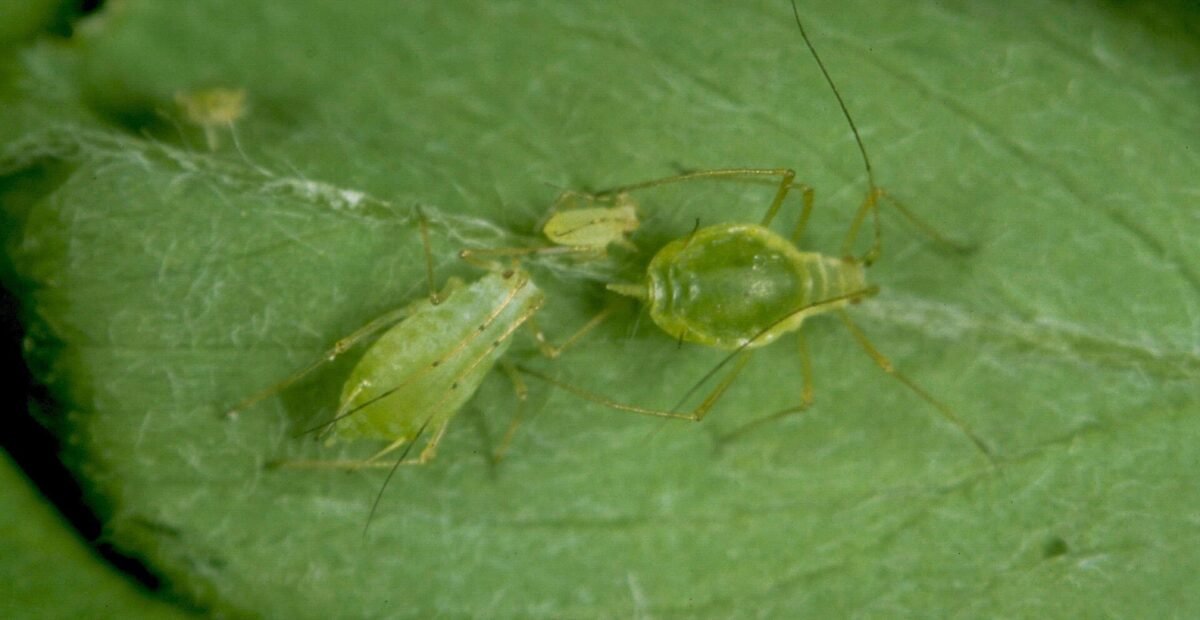
Borsó-levéltetű
Acyrthosiphon pisumBorsó-levéltetű overview
A borsó-levéltetű (Acyrthosiphon pisum) főként borsón, lucernán, bükkönyön, lóbabon és más pillangósokon táplálkozó, szívó szájszervű kártevő. A fiatal hajtásokon és a virágzás–hüvelyképződés időszakában telepei növekedési visszaesést, levélcsavarodást, mézharmatot és termésminőség-romlást okozhatnak. A korai felderítés és a természetes ellenségek védelme általában kulcsfontosságú.
Typical conditions
Overview
The pea aphid is a sap-feeding insect in the family Aphididae. Adults are relatively large aphids, commonly about 1/8 to 1/4 inch long, with long legs, long antennae and prominent cornicles. Most individuals are wingless, but winged forms develop when colonies become crowded, host quality declines or dispersal is favored.
On peas, colonies concentrate on shoot tips, young leaves, flowers and developing pods. Feeding removes plant sap and may reduce vigor, seed filling and pod quality. Heavy infestations also produce honeydew, on which dark sooty molds may grow. Identification should be confirmed carefully because the pea aphid resembles the blue alfalfa aphid and other large green aphids.
Symptoms and identification
- Clusters of green or pink aphids and pale cast skins on young shoots, leaf undersides, flowers or developing pods.
- Leaf curling, puckering, yellowing, wilting or shortened shoot growth when colonies are dense.
- Sticky honeydew on foliage, stems or pods; dark superficial sooty mold may develop afterward.
- Reduced flower retention, incomplete seed fill, smaller pods or general loss of plant vigor.
- On alfalfa, heavy populations may discolor or stunt new growth and reduce forage quality.
- Virus symptoms can occur indirectly after aphid feeding, but they cannot be diagnosed from aphid presence alone.
To separate pea aphids from the similar blue alfalfa aphid, examine the antennae and other diagnostic characters with a hand lens or obtain expert confirmation.
Causes and spread
Damage results from piercing-sucking feeding by adults and nymphs. Populations can increase rapidly because most spring and summer females give birth to live young without mating. Winged females disperse on air currents and may move from perennial legumes, feral vetch or weedy hosts into peas and other crops.
Spread is favored by nearby infested alfalfa, clover, vetch or legume weeds; dense, succulent plant growth; drought stress; and disruption of predators and parasitoids by broad-spectrum insecticides. Aphids may also contribute to the spread of certain legume viruses, although vector efficiency depends on the virus, aphid population and timing of acquisition and transmission.
Life cycle and persistence
In colder parts of the United States, pea aphids commonly overwinter as fertilized eggs attached to stems or other tissues of perennial legumes such as alfalfa and clover. In milder regions, some active aphids may survive winter. Eggs hatch in spring into females that reproduce parthenogenetically and give birth to live nymphs.
Nymphs pass through several molts before becoming adults. Most generations are wingless and remain on suitable legumes, but winged females appear when colonies are crowded, plants deteriorate or seasonal dispersal is triggered. As day length shortens in fall, males and egg-laying females are produced; after mating, females deposit overwintering eggs. Development is favored by cool to mild conditions, with rapid population growth often occurring in spring rather than during extreme summer heat.
Treatment and control
Begin with confirmation and monitoring rather than calendar spraying. On garden peas, knock small colonies from foliage with a firm stream of water, prune and discard badly infested tender tips when practical, and remove harvested crop residues that still carry live colonies. Avoid excessive nitrogen and water stress.
In alfalfa or larger plantings, base treatment on crop stage, aphid density, plant vigor and natural-enemy abundance. Pea aphid populations are often suppressed by predators, parasitoids and aphid-pathogenic fungi, and treatment may be unnecessary when beneficial insects are abundant. If colonies are increasing rapidly near flowering or pod set, consult the crop-specific recommendations of the relevant state Extension service and use a targeted, legally registered product only when justified by the local threshold and label.
Low-impact and biological control
- Conserve lady beetles, lacewings, syrphid fly larvae, predatory midges, damsel bugs and parasitoid wasps such as Aphidius ervi by avoiding unnecessary broad-spectrum sprays.
- Rinse aphids from small plants with water, repeating as needed because protected colonies can remain in curled foliage.
- Use insecticidal soap or horticultural oil only when the product label permits the intended crop and site; thorough contact coverage is essential and repeat applications may be needed.
- Commercial parasitoids or predators can be useful in protected culture, but releases work best when introduced early and when ants, incompatible pesticides and excessive pest density are managed.
- Entomopathogenic fungi may contribute to control during humid or wet conditions, but performance is variable and should not be treated as guaranteed.
Prevention
- Inspect peas and other legumes at least weekly from emergence through flowering and early pod development, concentrating on shoot tips and leaf undersides.
- Use a hand lens to verify identity when large green aphids occur on alfalfa or peas; do not assume every green aphid is A. pisum.
- Remove or mow heavily infested volunteer legumes and legume weeds near valuable plantings before winged aphids disperse, while avoiding actions that unnecessarily destroy beneficial insect habitat.
- Maintain even soil moisture and good plant vigor, but avoid excessive nitrogen that produces unusually lush, aphid-attractive growth.
- Choose locally adapted or less susceptible pea and alfalfa cultivars where dependable resistance is available.
- Scout before spraying and record aphid density, plant stage and the number of lady beetles, lacewings, syrphid larvae and parasitized aphid mummies.
Interesting facts
Pea aphids occur in green and pink forms; color alone is not a reliable identification character. The species is monoecious, meaning its documented life cycle occurs on legume hosts rather than requiring a separate non-legume primary host. Most of the growing season may be dominated by live-bearing females, allowing populations to build quickly. Pea aphids are also a major model organism in aphid biology and genomics, including research on wing formation, host adaptation and symbiosis.
Use only insecticides legally authorized in the United States for the specific crop, site and pea aphid problem. Follow the current product label exactly, including crop restrictions, preharvest interval, reentry interval, personal protective equipment, pollinator precautions and resistance-management directions. Do not infer legality or suitability from a product registered on another crop or in another state.
Affected plants
The plants below are linked to this problem by structured host-plant data. The list updates automatically as new plant profiles are added.
 False Acacia (Robinia pseudoacacia) care guideRobinia pseudoacacia
 Broad Bean (Vicia faba) care guideVicia faba
 Chickpea (Cicer arietinum) care guideCicer arietinum
 Lentil (Vicia lens) care guideVicia lens
 Garden Peony (Paeonia officinalis) care guidePaeonia officinalis
 False goatsbeard (Astilbe × arendsii ‘Fanal’)Astilbe × arendsii 'Fanal'