
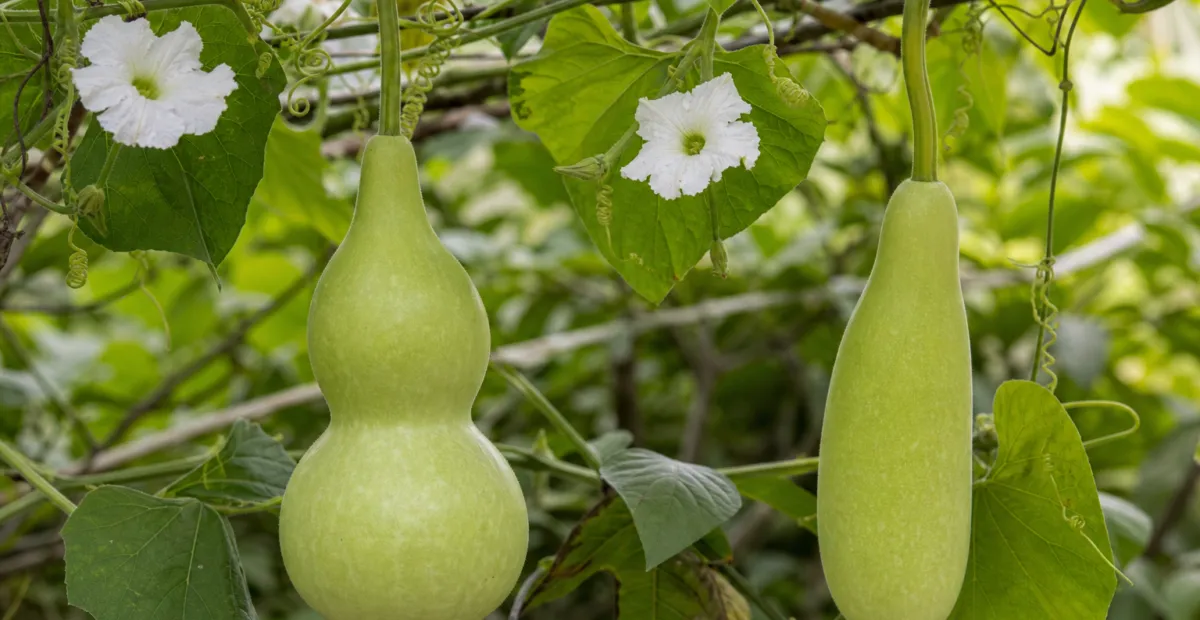
 AI-generated illustration
Calabash (Lagenaria siceraria) short overview
Calabash is a vigorous, warm-season annual vine in the cucumber family, grown for its striking white evening flowers and highly variable gourds. Depending on the cultivar, fruits may be bottle-shaped, round, elongated, or twisted, and mature shells can be dried for practical or decorative uses. Give it full sun, fertile well-drained soil, steady moisture, and a sturdy trellis or ample ground space. Never eat fruit that tastes bitter.
Taxonomic classification
Calabash (Lagenaria siceraria) care guide
Light and placement
Plant in the sunniest available location, ideally with 8 or more hours of direct light and a south- or west-facing exposure. A little afternoon shade can help in very hot climates, but persistent shade produces weak stems, fewer female flowers, and poor fruiting. Pale, stretched growth indicates insufficient light; scorched leaves or severe midday wilt suggest excessive heat, drought, or root stress rather than a need for deep shade.
Watering and humidity
Water deeply when the top inch of soil begins to dry, keeping the root zone evenly moist while avoiding constantly saturated soil. Large vines and developing gourds may need several waterings per week during hot, dry weather. Apply water at the soil surface to keep foliage dry and mulch lightly to reduce evaporation. Reduce watering after frost kills the vine; container plants dry faster than in-ground plants.
Soil and growing medium
Use fertile soil with abundant organic matter but dependable drainage. Loam or amended sandy loam supports rapid vine growth while preventing stagnant conditions around the roots. Heavy clay should be improved with compost and grown on a raised mound or bed. A slightly acidic to neutral reaction is suitable; avoid fresh manure in direct contact with roots because it can encourage excessive vegetative growth or root injury.
Feeding
Incorporate finished compost before planting, then feed after vines begin active growth with a balanced vegetable fertilizer at the product’s label rate. A second light application when flowering begins can support fruit production in poor soil. Avoid repeated high-nitrogen feeding once vines are vigorous, because it may favor leaves and stems over female flowers and fruit. Do not fertilize drought-stressed, waterlogged, or frost-damaged plants.
Growth and habit
This fast-growing vine produces long, branching stems with tendrils that climb supports or spread across soil. Provide a trellis strong enough for mature gourds, especially large-fruited cultivars. Direct young shoots early, support heavy fruits with slings when needed, and remove damaged leaves promptly. Fruit shape and final size vary greatly among cultivars, so allow more room than a compact summer squash.
Planting and repotting
Sow two or three seeds in a warm planting pocket, then thin to the strongest seedling. In short-season areas, transplant carefully because cucurbit roots dislike disturbance. Set plants out only after cold nights have passed and provide the trellis before vines begin running. Keep the seedbed evenly moist until emergence, then mulch after the soil has warmed.
Container-grown plants need a large pot with drainage and a trellis installed before the vine becomes crowded. Transplant seedlings while small and disturb the root ball as little as possible. Repot only when roots fill the container, moving one pot size larger. Because mature vines are vigorous, in-ground planting or a very large container is usually more practical than repeated repotting.
Propagation and pruning
Propagation
Propagate from seed. Sow fresh, fully mature seed in warm soil or start it indoors in individual pots 3–4 weeks before outdoor planting. Scarification or a short soak can improve emergence when seed coats are especially hard, but avoid prolonged soaking that encourages decay. Save seed only from fully mature, dry fruit and expect cross-pollinated plants to vary.
Pruning
Prune only to guide vines, remove damaged growth, or limit crowding. Train the main stems onto the support while young. Once fruiting is established, excess side shoots may be shortened if space is limited, but heavy pruning can reduce leaf area and fruit development. Remove spent or diseased foliage with clean tools and avoid cutting during wet conditions.
Overwintering
This is a frost-tender annual. Harvest usable fruits before the first freeze, then remove and compost the dead vine unless disease is suspected. Dried mature gourds can be cured indoors in a warm, dry, well-ventilated place. Overwintering the plant itself is generally impractical; preserve mature seed instead.
Uses
Immature fruits of suitable cultivars are used as a cooked vegetable, while fully mature shells are dried for containers, vessels, utensils, musical instruments, birdhouses, and decorative crafts. Some forms are selected mainly for ornament or traditional utilitarian use. Edibility depends on cultivar and fruit condition; never consume a fruit or juice that tastes distinctly bitter.
Appearance
The plant has soft, rounded to shallowly lobed leaves, tendrils, succulent ridged stems, and separate male and female flowers on the same vine. Its white flowers are conspicuous at dusk. Fruits range from bottle and club shapes to spherical, long, curved, or highly ornamental forms; mature shells become firm and often tan or brown as they dry.
Flowering
Calabash is monoecious, producing separate staminate and pistillate flowers on one plant. Flowers commonly begin anthesis around dusk and can remain functional through the night and early morning. Male flowers are usually more numerous than female flowers. Female flowers have a distinct inferior ovary beneath the corolla, which enlarges into the gourd after successful pollination.
Pollination and visitors
Research documents hawkmoths and other moths as important visitors, with honey bees, butterflies, and beetles also recorded in some regions. The large pale flowers, evening opening, and nectar availability are consistent with nocturnal visitation. Visitor communities vary with geography, cultivar, and local insect abundance, so a single universal pollinator cannot be assigned confidently.
Lagenaria siceraria photos
Click any photo for a larger view. Source, author and license are shown separately.
Diseases and pests
Diseases
Common problems include powdery mildew, downy mildew, anthracnose, angular leaf spot, and damping-off. Use clean seed, rotate cucurbit crops, provide good spacing and airflow, water at the base, and remove badly infected leaves. Avoid working among wet vines. Management should follow local extension recommendations because disease pressure and approved products vary by state.
Pests
Watch for cucumber beetles, squash bugs, aphids, whiteflies, spider mites, and vine-feeding pests. Inspect undersides of leaves and young stems frequently, remove small infestations by hand or with a water spray, and protect seedlings with row cover until flowering. Use insecticides only when necessary and avoid spraying open flowers, especially during evening pollinator activity.
Related diseases and pests
Only Plant Doctor profiles whose host data indicate this plant may be affected are shown here.
 DiseaseCucurbit Downy MildewPseudoperonospora cubensis (Berk. & M.A. Curtis) Rostovzev
 DiseaseCucurbit Powdery MildewPodosphaera xanthii (Castagne) U. Braun & Shishkoff
 DiseaseBacterial Fruit BlotchAcidovorax citrulli
 DiseaseCucurbit AnthracnoseColletotrichum orbiculare
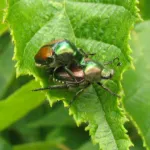 PestJapanese beetlePopillia japonica
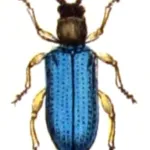 PestCereal leaf beetleOulema melanopus
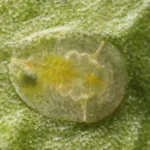 PestCitrus whiteflyDialeurodes citri
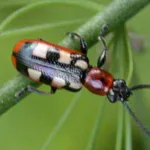 PestAsparagus BeetleCrioceris asparagi
Toxicity and pollen
Edible forms are generally used as a cooked vegetable when young, but bitter fruit or juice can contain high levels of cucurbitacins and has caused severe gastrointestinal illness, including vomiting, bleeding, low blood pressure, and shock. Taste a tiny raw piece before cooking; if it is noticeably bitter, spit it out and discard the entire fruit. Do not try to remove toxicity by cooking or dilution.
- Typical season
- Summer to early fall during flowering
- Pollination / pollen
- Heavy, insect-carried pollen released from anthers
The flowers produce pollen, but pollen is primarily transferred by visiting insects rather than released for wind dispersal. Airborne exposure is therefore expected to be limited compared with wind-pollinated plants, although sensitive people may still encounter pollen while handling flowers or working close to flowering vines. This rating does not address fruit toxicity.
Native habitat
The species is associated with seasonally dry tropical and subtropical environments and grows in open, sunny sites with seasonal moisture. In cultivation it performs best in warm soils, long frost-free periods, fertile ground, and regular water. It is not a cold-climate perennial; in the United States it is normally grown as a summer annual.
Interesting fact
Calabash fruits may mature into hard, durable shells that remain useful long after the vine dies. The species has extraordinary fruit-shape diversity, including bottle, club, spherical, long, and serpentine forms. Its evening flowers make it an important example of a crop with substantial nighttime pollination. Archaeological and ethnobotanical evidence supports a long history of human transport and cultivation.
Frequently asked questions (FAQ)
The most relevant questions about this plant, with short and direct answers.
🌱Quick care
What is Calabash (Lagenaria siceraria)?⌄
Calabash is a frost-tender annual vine in the Cucurbitaceae family, grown for its edible young fruits and hard-shelled mature gourds. It is also commonly sold in the United States as bottle gourd or birdhouse gourd.
Can mature Calabash gourds be used for crafts?⌄
Yes, fully mature and properly dried Calabash gourds can be used for containers, decorations, utensils, and birdhouses. The shell must be completely dry before cutting, sanding, or sealing it.
How long does Calabash take to mature?⌄
Calabash usually needs a long, hot growing season, with many types requiring roughly 90–120 days or longer to produce mature dried gourds. Harvest timing varies substantially by cultivar and whether the fruit is intended for food or crafting.
🌤️Environment and placement
How much sun does Calabash need?⌄
Calabash needs full sun, ideally at least 6–8 hours of direct sunlight daily. Strong light and a long, warm season help the vigorous vine flower and mature its fruits.
What soil is best for Calabash?⌄
Plant Calabash in fertile, well-drained loam enriched with compost. The soil should hold consistent moisture without remaining waterlogged, because saturated roots can decline quickly.
Is Calabash frost hardy?⌄
No, Calabash is frost-tender and is usually grown as a warm-season annual in the United States. Wait until frost has passed and the soil has warmed before planting outdoors.
How large does a Calabash vine get?⌄
A Calabash vine can grow several feet long and may spread rapidly across beds, fences, or trellises. Provide ample room and guide new growth early before the tendrils become difficult to reposition.
💧Care and problems
How often should I water Calabash?⌄
Water Calabash regularly to keep the soil consistently moist, especially during flowering and fruit development. Avoid repeated drought followed by heavy watering, which can stress the plant and reduce production.
What fertilizer does Calabash need?⌄
Calabash generally performs best in fertile soil amended with compost and does not require heavy feeding when soil fertility is adequate. Avoid excessive nitrogen, which can produce abundant leaves and vines with fewer flowers and fruits.
When should I harvest Calabash for eating?⌄
Harvest Calabash for eating while the fruits are young, tender, and still soft-skinned, often when they are roughly 6–12 inches long depending on the variety. Pick promptly because mature fruits become fibrous and develop hard shells.
How do I know when Calabash is mature for drying?⌄
Leave Calabash fruits on the vine until the skin hardens and the stem begins to dry, provided frost does not threaten. Mature fruits should feel firm and develop a lightweight, hollow character as they cure.
How do I dry and cure Calabash gourds?⌄
Cure mature Calabash in a warm, dry, well-ventilated place with space between fruits for air circulation. Rotate them periodically and discard any fruit that becomes soft or severely moldy; complete curing can take several months.
What pests commonly affect Calabash?⌄
Calabash may be attacked by common cucurbit pests such as squash bugs, cucumber beetles, aphids, and vine borers. Inspect leaves and stems frequently, remove pests early, and use physical controls or locally approved treatments when needed.
Why are Calabash leaves turning yellow?⌄
Yellow leaves can result from overwatering, poor drainage, nutrient deficiency, drought stress, or insect damage. Check soil moisture, inspect the leaf undersides and stems, and correct the underlying problem rather than automatically adding fertilizer.
Why are my Calabash leaves wilting?⌄
Wilting usually indicates drought, root stress, heat stress, or damage from pests such as squash vine borers. Water deeply when the soil is dry, but inspect the lower stems and roots if wilting persists despite adequate moisture.
🪴Planting and repotting
When should I plant Calabash outdoors?⌄
Sow Calabash outdoors after the danger of frost has passed and soil temperatures reach about 70°F. In shorter-season areas, start seeds indoors several weeks early, but handle the roots carefully because cucurbits dislike transplant disturbance.
How far apart should Calabash plants be?⌄
Space Calabash about 3 feet apart when growing it on a sturdy trellis, or 4–6 feet apart when allowing the vines to trail on the ground. Give extra room if growing unusually vigorous varieties.
Does Calabash need a trellis?⌄
Calabash does not require a trellis, but strong support is useful because its vines are vigorous and can occupy substantial ground space. A sturdy trellis also keeps fruits cleaner and improves air circulation, though heavy fruits may need individual support.
Can Calabash grow in a container?⌄
Calabash can grow in a very large container if it has fertile, well-drained soil, consistent moisture, and strong support for the vine. Containers dry out quickly, so monitor watering more closely than with plants grown in the ground.
✂️Propagation and pruning
How do I grow Calabash from seed?⌄
Sow Calabash seeds about 1 inch deep in warm soil, using hills or mounds with good drainage. Germination is fastest in warm conditions, and soaking seed for several hours before sowing may help soften its hard coat.
Can I start Calabash seeds indoors?⌄
Yes, you can start Calabash indoors about 3–4 weeks before outdoor planting, preferably in biodegradable pots. Transplant only after the weather is reliably warm and disturb the root ball as little as possible.
Should I prune Calabash vines?⌄
You can prune or pinch Calabash to control excessive growth and encourage lateral shoots, which may bear additional flowers. Avoid removing large amounts of healthy foliage because the leaves support fruit development.
⚠️Toxicity and safety
Can you eat Calabash?⌄
Yes, young Calabash fruits are commonly cooked as a vegetable, and young shoots, leaves, and flowers may also be edible when properly identified and prepared. Fully mature dried gourds are generally grown for crafts rather than food.
Is Calabash toxic?⌄
Calabash can be toxic when the fruit tastes distinctly bitter because bitter fruits may contain dangerous levels of cucurbitacins. Do not eat or cook a bitter fruit, and never use bitter Calabash juice as a home remedy.
What should I do if Calabash tastes bitter?⌄
Spit out any bitter Calabash immediately and discard the entire fruit without cooking it. Cucurbitacins are not reliably neutralized by heat, and symptoms such as vomiting, diarrhea, severe abdominal pain, dizziness, or bleeding require urgent medical advice or poison-control guidance.
Why did my Calabash fruit turn bitter?⌄
Bitterness can occur when Calabash produces elevated cucurbitacins, although the exact cause is not always predictable. Heat, drought, plant stress, genetics, or accidental cross-pollination may contribute, so taste-test only a tiny raw piece and discard anything noticeably bitter.
🌸Flowering and special interest
Why is my Calabash not producing fruit?⌄
Poor fruit set is often caused by inadequate pollination, especially because Calabash flowers open at night. Heat stress, drought, excessive nitrogen, or a plant that is still producing mainly male flowers can also delay fruit production.
How do I hand-pollinate Calabash flowers?⌄
Hand-pollinate Calabash at night or early the next morning by transferring pollen from a freshly opened male flower to the center of a female flower. A small paintbrush or the male flower itself works well, and pollination is most effective while both flowers are open.
What do Calabash flowers look like?⌄
Calabash produces large, white, fragrant flowers that generally open at night. The female flowers have a small immature gourd behind the bloom, while male flowers grow on slender stalks without that swelling.
Why are my Calabash female flowers falling off?⌄
Female Calabash flowers commonly drop when they are not pollinated, and drought or other stress can worsen the problem. Hand-pollinate newly opened flowers and maintain steady moisture during bloom.
Similar plants
 Azure Monkshood (Aconitum carmichaelii) care guideAconitum carmichaelii
 Monkshood (Aconitum ‘Stainless Steel’)Aconitum 'Stainless Steel'
 Monkshood (Aconitum ‘Bressingham Spire’)Aconitum 'Bressingham Spire'
 Golden full moon maple (Acer shirasawanum ‘Aureum’)Acer shirasawanum 'Aureum'
 Globosum (Acer platanoides ‘Globosum’)Acer platanoides 'Globosum'
 Striped maple (Acer pensylvanicum) care guideAcer pensylvanicum