
 Source:
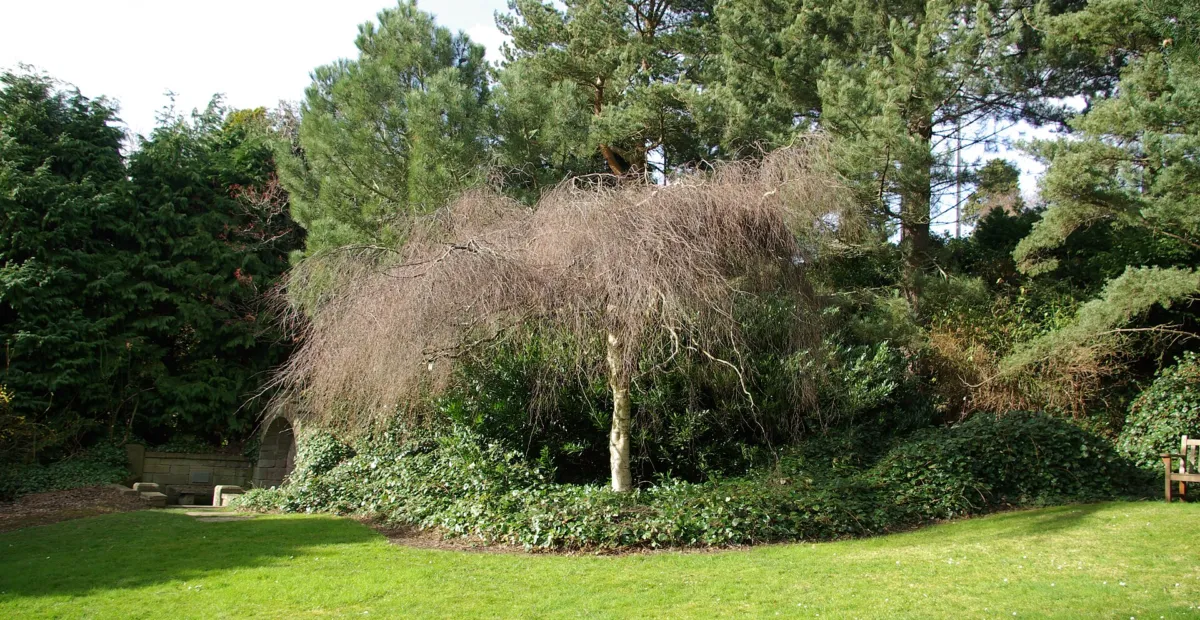
 Youngii (Betula pendula ‘Youngii’) short overview
Betula pendula 'Youngii' is a graceful weeping cultivar of silver birch, valued for its cascading branchlets, pale peeling bark and clear yellow autumn foliage. Usually grafted onto a standard trunk, it forms a dome or umbrella-like crown whose final height depends partly on the grafting height and training. Plant it as a cool-climate specimen in full sun or light shade, with dependable moisture but soil that drains freely.
Taxonomic classification
Youngii (Betula pendula ‘Youngii’) care guide
Light and placement
Give full sun for the strongest growth and best crown development; light partial shade is tolerated, especially in hot regions. An east- or north-facing exposure can reduce afternoon heat stress. Too little light may produce sparse foliage and weaker form, while intense reflected heat combined with dry soil can cause scorch, premature yellowing and decline.
Watering and humidity
Water slowly and deeply when the upper few inches of soil begin to dry, keeping the root zone consistently moist rather than saturated. Newly planted trees may need weekly irrigation during dry weather; established trees still benefit from summer watering during drought. A 2–3 inch organic mulch layer helps moderate soil moisture, but keep it off the trunk.
Soil and growing medium
Use a moisture-retentive but well-drained loam, sandy loam or clay loam. The cultivar tolerates a broad pH range from acidic through alkaline, but compacted, waterlogged ground and drought-prone sites are poor choices. Mulch the root zone with organic matter while keeping mulch away from the trunk.
Feeding
Feed only if growth or soil testing indicates a need. Apply a thin layer of compost or a balanced, slow-release tree fertilizer in early spring, following the product label. Do not heavily fertilize drought-stressed, newly planted or late-season trees, since soft late growth can increase stress and winter injury.
Growth and habit
This cultivar has a strongly pendulous, twiggy habit and usually lacks a naturally upright central leader. Grafted plants form a crown at the graft height, while lower-trained plants can develop a dome with curtains of hanging branches. Remove rootstock shoots and maintain clearance where branches reach paths or lawns.
Planting and repotting
Plant in spring or fall when the soil is workable. Set the root flare level with, or slightly above, the surrounding soil; do not bury the graft union. Water deeply after planting and maintain even moisture through the first two growing seasons. Allow generous clearance for the weeping crown and keep turf competition away from the trunk.
Container culture is possible only while the tree remains manageable. Transplant or shift a container-grown specimen in early spring before leaf expansion, preserving the root ball. Because birches establish roots quickly and dislike prolonged root disturbance, choose the final site early and avoid repeated repotting.
Propagation and pruning
Propagation
Commercially, this cultivar is maintained by grafting or budding scion wood onto compatible birch rootstock. Softwood cuttings are reported, but reliable true-to-type production is more difficult than grafting. Seed will not reliably reproduce the cultivar.
Pruning
Prune during the dormant season to remove dead, damaged, crossing or poorly positioned growth and to maintain clearance. Do not routinely shorten every hanging branch, because this destroys the characteristic form. On grafted trees, remove vigorous shoots arising below the graft union. Avoid unnecessary pruning in late winter when birches may bleed sap heavily.
Overwintering
Outdoor hardy in cold regions, but young trees benefit from deep watering before the ground freezes and a loose mulch layer over the root zone. Protect the trunk from mechanical injury and rodent damage where needed. Avoid wrapping tightly or creating a damp shelter around the crown.
Uses
Best used as an ornamental specimen, focal-point tree or architectural accent in lawns and spacious mixed borders. Its bark, pendulous form and autumn foliage provide multi-season interest. It is not a culinary crop, and the cultivar should not be promoted for medicinal use.
Appearance
Look for a pale trunk with peeling bark, slender drooping branchlets and simple ovate to diamond-shaped leaves with coarsely double-serrated margins. The cultivar’s defining feature is its strongly cascading crown, often forming an umbrella or dome above a straight grafted stem. Fall foliage turns bright yellow.
Flowering
This monoecious birch bears separate male and female catkins on the same tree. Slender brownish-yellow male catkins develop from the previous season and release pollen as spring growth begins; smaller female catkins appear with the leaves and later mature into cylindrical fruiting catkins.
Pollination and visitors
The reproductive structures are adapted to wind rather than animal pollination, so the cultivar should not be marketed as a nectar-rich pollinator plant. Birch trees can nevertheless contribute food and habitat to specialist insects and other wildlife through foliage, catkins and seeds.
Betula pendula 'Youngii' photos
Click any photo for a larger view. Source, author and license are shown separately.
Diseases and pests
Diseases
Possible problems include powdery mildew, rust and honey fungus. Reduce stress with correct planting, consistent moisture and good air movement. Remove badly affected material when practical and seek local diagnostic advice before using a fungicide; avoid routine preventive spraying without identification.
Pests
Watch for bronze birch borer, other birch borers, aphids and leaf-mining sawflies. Keep the tree vigorous with adequate moisture, avoid trunk injury and inspect stressed trees for canopy thinning, exit holes or D-shaped adult emergence holes. Remove and replace severely declining trees when treatment is not practical.
Related diseases and pests
Only Plant Doctor profiles whose host data indicate this plant may be affected are shown here.
Toxicity and pollen
No major toxic effect is established for ordinary garden contact with this cultivar. Birch sap, bark and foliage can irritate sensitive people, and ingestion of plant material may cause minor gastrointestinal upset. Prevent children and pets from chewing plant parts and consult a poison service if a substantial amount is eaten or symptoms occur.
- Typical season
- Typically April–May in much of the United States; timing varies by region
- Pollination / pollen
- Abundant, lightweight, wind-dispersed pollen
Birch releases abundant, lightweight airborne pollen from male catkins during spring. It is a recognized seasonal allergy concern, especially for people sensitized to birch pollen or related cross-reactive foods. Local pollen counts and season dates vary across the United States.
Native habitat
The species is native across much of Europe and into parts of Asia, where it commonly occupies cool temperate, boreal and open pioneer habitats. It favors light-demanding sites and a range of reasonably drained soils, often establishing on sandy or disturbed ground, but cultivated trees perform best with reliable summer moisture.
Interesting fact
The cultivar originated as a chance seedling with unusually trailing growth. Its crown height is often determined by the height of the graft. The species produces winged nutlets in mature female catkins. Silver birch bark becomes darker and more fissured on older trunks.
Frequently asked questions (FAQ)
The most relevant questions about this plant, with short and direct answers.
🌱Quick care
What is Betula pendula 'Youngii' commonly called?⌄
Betula pendula 'Youngii' is commonly called Young's weeping birch. It is a compact, ornamental cultivar of European white birch with strongly pendulous branches.
How big does Betula pendula 'Youngii' get?⌄
Betula pendula 'Youngii' commonly reaches about 10–12 feet tall and wide, although graft height and training can produce larger specimens. Nursery plants may be listed anywhere from roughly 4 to 25 feet depending on the rootstock and form.
Is Betula pendula 'Youngii' evergreen or deciduous?⌄
Betula pendula 'Youngii' is deciduous and drops its leaves in fall. Its white, peeling bark and weeping branch structure provide winter interest after leaf fall.
How fast does Betula pendula 'Youngii' grow?⌄
Betula pendula 'Youngii' has a moderate to fairly fast growth rate when young, but its compact mature size makes it slower to establish than many large shade trees. Growth is strongest with adequate moisture and good drainage.
🌤️Environment and placement
Where should I plant Betula pendula 'Youngii'?⌄
Plant Betula pendula 'Youngii' as a specimen tree in an open area with full sun to partial shade and enough room for its cascading branches. Avoid sites that become hot, dry, or poorly drained.
What USDA hardiness zones are suitable for Betula pendula 'Youngii'?⌄
Betula pendula 'Youngii' is generally suited to cold climates, commonly listed around USDA Zones 2–6 and sometimes into Zone 7 depending on local conditions. Heat and drought are usually greater limitations than winter cold.
Can Betula pendula 'Youngii' grow in partial shade?⌄
Yes, Betula pendula 'Youngii' can grow in partial shade, but full sun usually produces denser foliage and a better-defined weeping form. Provide morning or afternoon sun where possible.
What type of soil does Betula pendula 'Youngii' need?⌄
Betula pendula 'Youngii' grows best in moist, well-drained loam but can tolerate sandy or clay soil if drainage is adequate. Do not plant it in persistently waterlogged ground.
Does Betula pendula 'Youngii' tolerate heat and drought?⌄
Betula pendula 'Youngii' does not perform reliably in prolonged heat or drought. Keep the root zone evenly moist, mulch it to reduce soil temperature, and give supplemental water during dry spells.
💧Care and problems
How often should I water Betula pendula 'Youngii'?⌄
Water Betula pendula 'Youngii' whenever the upper few inches of soil begin to dry, supplying a deep soaking rather than frequent light watering. Newly planted trees need more consistent irrigation during their first growing seasons.
Should I mulch around Betula pendula 'Youngii'?⌄
Yes, apply a 2–3-inch layer of organic mulch over the root zone to conserve moisture and moderate soil temperature. Keep mulch several inches away from the trunk to prevent bark and crown problems.
Why are the leaves of Betula pendula 'Youngii' turning yellow?⌄
Yellow leaves may result from normal fall color, drought stress, poor drainage, nutrient limitations, or pest damage. Check soil moisture and drainage first, then inspect leaves and branches for insects or dieback.
What pests affect Betula pendula 'Youngii'?⌄
Betula pendula 'Youngii' can be affected by aphids, leaf miners, birch leafminer, and bronze birch borer. Trees weakened by heat, drought, or poor placement are more vulnerable, so consistent moisture and a cool root zone are important.
Is Betula pendula 'Youngii' susceptible to bronze birch borer?⌄
Yes, Betula pendula 'Youngii' can be vulnerable to bronze birch borer, especially when stressed by drought or heat. Regular watering and avoiding hot, exposed sites help reduce risk but do not guarantee protection.
🪴Planting and repotting
When is the best time to plant Betula pendula 'Youngii'?⌄
Plant Betula pendula 'Youngii' in spring or fall, when temperatures are moderate and soil moisture is easier to maintain. Fall planting is suitable where the ground is workable and winter arrives gradually.
How should I plant a grafted Betula pendula 'Youngii'?⌄
Plant a grafted Betula pendula 'Youngii' with the graft union several inches above the soil line and never bury the trunk flare. Remove competing shoots that emerge from below the graft, because they belong to the rootstock.
Can Betula pendula 'Youngii' be grown in a container?⌄
Betula pendula 'Youngii' can be grown temporarily in a large container, but it is ultimately better planted in the ground. Container roots dry and freeze more quickly, and the tree may become unstable as the canopy develops.
✂️Propagation and pruning
Can I grow Betula pendula 'Youngii' from seed?⌄
Seed is not a reliable way to reproduce Betula pendula 'Youngii' because named cultivars do not come true from seed. The cultivar is normally propagated by grafting onto a suitable birch rootstock.
Does Betula pendula 'Youngii' need pruning?⌄
Betula pendula 'Youngii' often benefits from formative pruning to remove crowded, crossing, dead, or poorly positioned branches. Pruning is especially useful for shaping grafted trees and maintaining clearance beneath the weeping canopy.
When should I prune Betula pendula 'Youngii'?⌄
Prune Betula pendula 'Youngii' in summer or fall rather than in late winter or early spring. Birch trees may bleed sap heavily from cuts made as sap begins to rise.
Can I train the branches of Betula pendula 'Youngii'?⌄
Yes, young branches can be selectively trained to create a cleaner dome or improve clearance, but permanent staking or rigid tying should be avoided. Remove supports before they constrict growing branches.
⚠️Toxicity and safety
Is Betula pendula 'Youngii' toxic to dogs, cats, or people?⌄
Betula pendula 'Youngii' is generally considered a low-concern ornamental tree, but plant material should not be intentionally eaten. Keep fallen leaves, catkins, and twigs away from pets and children if ingestion is a concern.
Are the roots of Betula pendula 'Youngii' invasive?⌄
Betula pendula 'Youngii' is not generally classified as having invasive roots, but birches form many shallow, spreading feeder roots. Keep turf and competing plants from drying the root zone, and avoid planting directly beside foundations or hardscape.
🌸Flowering and special interest
Does Betula pendula 'Youngii' flower?⌄
Yes, Betula pendula 'Youngii' produces inconspicuous birch catkins in spring, often around the time the leaves emerge. The catkins are ornamental only at close range and are not the cultivar's main feature.
What does Betula pendula 'Youngii' look like in fall?⌄
Betula pendula 'Youngii' usually develops yellow fall foliage before shedding its leaves. Its pale exfoliating bark and strongly drooping twigs remain visible through winter.
Similar plants
 Azure Monkshood (Aconitum carmichaelii) care guideAconitum carmichaelii
 Monkshood (Aconitum ‘Stainless Steel’)Aconitum 'Stainless Steel'
 Monkshood (Aconitum ‘Bressingham Spire’)Aconitum 'Bressingham Spire'
 Golden full moon maple (Acer shirasawanum ‘Aureum’)Acer shirasawanum 'Aureum'
 Globosum (Acer platanoides ‘Globosum’)Acer platanoides 'Globosum'
 Striped maple (Acer pensylvanicum) care guideAcer pensylvanicum