
 Source:
 Cutleaf European White Birch (Betula pendula ‘Laciniata’) short overview
Betula pendula 'Laciniata' is a graceful deciduous birch selected for deeply cut leaves, pendulous branchlets, white bark, and yellow fall color. This uncommon cultivar performs best in full sun to partial shade with consistently moist, well-drained soil. It is often confused in commerce with 'Dalecarlica' or 'Crispa', so authenticated nursery stock is important. An uncommon cutleaf cultivar of silver birch with pendulous branchlets, white bark, and finely divided foliage.
Taxonomic classification
Cutleaf European White Birch (Betula pendula ‘Laciniata’) care guide
Light and placement
Plant in full sun for the strongest growth and best crown density; light partial shade is tolerated, especially in hot climates. An east-, north-, or west-facing position can work where soil stays cool, while intense reflected heat and deep shade are poor choices. Sparse, stretched growth suggests insufficient light; scorched margins and premature yellowing may indicate heat or drought stress.
Watering and humidity
Water slowly and deeply when the upper few inches of soil begin to dry, keeping the root zone evenly moist rather than alternating drought and saturation. Young trees need regular irrigation through the first two summers; established trees still benefit from watering during prolonged heat or drought. Mulch helps conserve moisture and moderate root temperature.
Soil and growing medium
Use moderately fertile, moisture-retentive but well-drained soil. Loam, clay, or sand can work if drainage and moisture are balanced. A slightly acidic to neutral soil is suitable, though the species tolerates a broad pH range, including mildly alkaline conditions. Mulch over the root zone without covering the trunk.
Feeding
Usually needs little fertilizer in adequately fertile soil. Apply compost or a light, slow-release tree fertilizer in early spring only when soil tests or weak growth indicate a need. Avoid high-nitrogen feeding during drought, late summer, or after midsummer, because it can encourage soft growth and increase stress.
Growth and habit
This is a slender, open-growing tree with gracefully pendulous branchlets and a generally upright framework. Growth is typically medium to fast when roots remain cool and moist. The cultivar may be sold under inaccurate names, so maintenance and expected form should be judged from authenticated plants rather than nursery labels alone.
Planting and repotting
Plant in spring or fall while the soil is workable. Set the root flare level with or slightly above surrounding soil, never bury the trunk. Provide ample room for the eventual crown and keep a broad mulch ring. Water deeply during the first two growing seasons, especially in hot, dry weather.
Best grown in the ground. Young container trees should be shifted into a larger container only when roots fill the existing pot; transplant in early spring or fall, preserve the root ball, and avoid prolonged container culture because birch roots dry quickly.
Propagation and pruning
Propagation
Named plants are normally propagated by grafting or selected softwood cuttings. Grafting onto compatible Betula rootstock is the more dependable commercial method. Seed will not reproduce the cultivar faithfully.
Pruning
Prune only when necessary to remove dead, damaged, crossing, or poorly placed branches. Make cuts after the tree is fully leafed out, generally in summer, because spring pruning can produce heavy sap flow. Avoid topping and large branch removal, which damage the natural form and increase decay risk.
Overwintering
Outdoor winter protection is normally unnecessary in suitable USDA Zones 2–7. Protect young trunks from rodents and mechanical injury, maintain mulch over the root zone without touching the bark, and water before the ground freezes if autumn has been dry. In regions with heavy wet snow or ice, avoid planting where falling branches could cause damage.
Uses
A specimen or accent tree for spacious lawns, woodland margins, informal gardens, and wildlife-oriented plantings. The finely divided foliage and white bark provide strong seasonal structure. It is generally unsuitable beneath utility lines or in compact, drought-prone planting strips.
Appearance
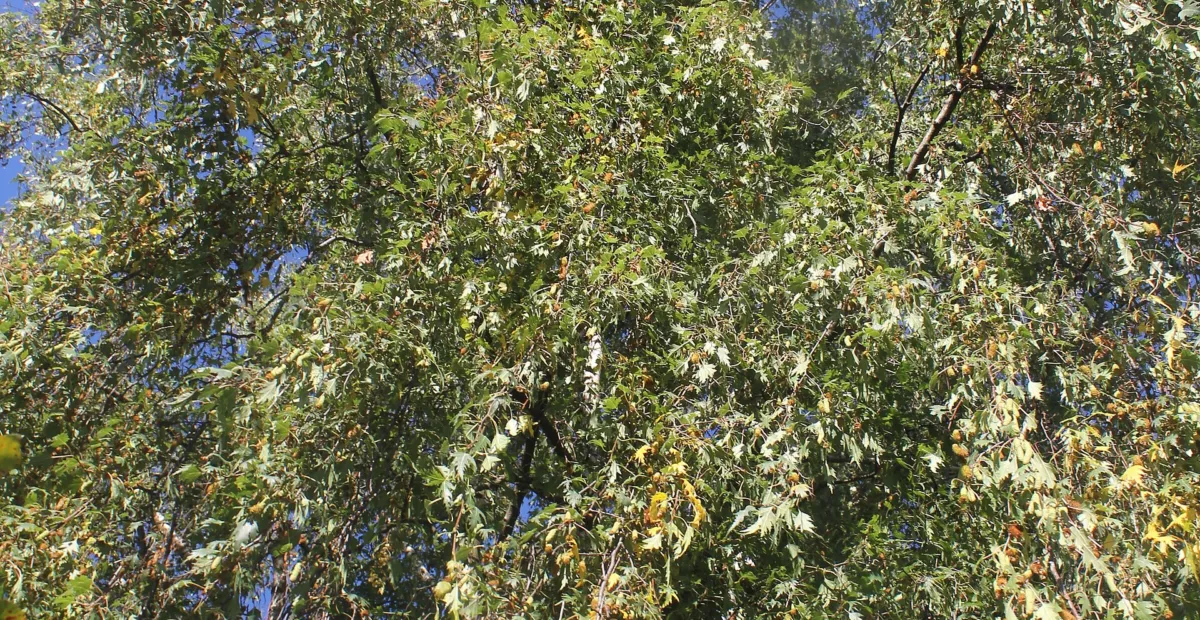
The most distinctive features are deeply cut, narrow-lobed leaves, long drooping branchlets, and pale bark that becomes whiter with age while developing darker rugged texture near the base. Leaves turn yellow in fall and may drop earlier than those of the species. Compared with commonly confused 'Dalecarlica', 'Laciniata' is generally described as less deeply dissected and smaller-leaved.
Flowering
The cultivar bears separate male and female catkins on the same tree. Male catkins develop before winter and elongate as leaves emerge; smaller female catkins appear in spring and later mature into seed-bearing structures. The catkins are inconspicuous and are not showy flowers in the usual garden sense.
Pollination and visitors
Pollination is by wind rather than animal visitors. The tree can still contribute seeds and structural habitat to temperate garden and woodland systems, but its catkins should not be presented as nectar-rich pollinator flowers.
Betula pendula 'Laciniata' photos
Click any photo for a larger view. Source, author and license are shown separately.
Diseases and pests
Diseases
Possible problems include powdery mildew, rust, and honey fungus. Improve air circulation, avoid chronic root saturation, remove badly affected debris, and prune out dead wood with clean tools. Declining vigor may also reflect drought stress or unsuitable heat rather than disease.
Pests
Birch leaf miners, aphids, and bronze birch borer may occur. Maintain steady moisture and avoid trunk injury; monitor for premature browning, canopy thinning, D-shaped exit holes, or galleries. Stressed trees are more vulnerable, and severe borer damage may be fatal.
Related diseases and pests
Only Plant Doctor profiles whose host data indicate this plant may be affected are shown here.
Toxicity and pollen
No specific toxic effect is established for this cultivar in the reviewed horticultural sources. Normal tree-plant precautions still apply: do not ingest plant material, sap, or large quantities of seeds, and prevent children or pets from chewing branches or foliage. Birch pollen can cause allergic symptoms in sensitized people.
- Typical season
- Primarily April–May in much of the United States, varying by region and spring temperatures
- Pollination / pollen
- Light, abundant, wind-dispersed pollen
Birch releases abundant, lightweight airborne pollen when male catkins open in spring. Betula pollen is a recognized seasonal aeroallergen, and sensitive people may experience symptoms during local birch-pollen periods. Keep this consideration in mind when siting the tree near frequently used outdoor areas.
Native habitat
The species is native across much of Europe and into northern Asia, where it commonly occupies open woodland, forest edges, heath, disturbed ground, and other bright sites. It is a light-demanding pioneer associated with cool temperate climates and soils ranging from sandy to loamy, provided drainage and moisture are balanced.
Interesting fact
The cultivar name is often misapplied to other cutleaf birches in commerce. Compared with 'Dalecarlica', 'Laciniata' is generally described as having smaller, less deeply incised leaves. Pointed winter vegetative buds are another reported distinguishing feature, although identification can be difficult without authenticated material.
Frequently asked questions (FAQ)
The most relevant questions about this plant, with short and direct answers.
🌱Quick care
What is Betula pendula 'Laciniata' commonly called?⌄
Betula pendula 'Laciniata' is commonly called cutleaf European white birch, cutleaf weeping birch, or Swedish birch. Nursery names can vary, so confirm the cultivar name on the plant label.
How fast does Betula pendula 'Laciniata' grow?⌄
Betula pendula 'Laciniata' grows at a moderate to fast rate when planted in suitable conditions. Growth slows substantially if the roots experience drought, heat, compaction, or poor drainage.
How big does cutleaf European white birch get?⌄
Cutleaf European white birch can mature into a large tree, commonly reaching about 40–50 feet tall and 20–25 feet wide. Allow room for its spreading crown and strongly pendulous side branches.
🌤️Environment and placement
Does Betula pendula 'Laciniata' grow in full sun or shade?⌄
Plant Betula pendula 'Laciniata' in full sun to partial shade, with the best foliage and form usually developing in bright light. Protect the root zone from excessive heat and drying.
What USDA hardiness zones are suitable for cutleaf European white birch?⌄
Betula pendula 'Laciniata' is very cold hardy and is generally suitable for much of USDA Zones 2–7, depending on the source and local conditions. Hot, drought-prone areas are more limiting than winter cold.
What soil is best for Betula pendula 'Laciniata'?⌄
Use moist, well-drained loam, clay, or sandy soil for Betula pendula 'Laciniata'. It tolerates a broad soil pH range, but standing water and persistently dry soil can both cause problems.
Can cutleaf European white birch tolerate wet soil?⌄
Cutleaf European white birch prefers consistent moisture but does not tolerate waterlogged soil well. Improve drainage before planting rather than placing the tree where water remains after rain.
Can Betula pendula 'Laciniata' handle drought?⌄
Betula pendula 'Laciniata' should not be allowed to dry out, especially during establishment and hot weather. Mature trees may tolerate short dry periods, but prolonged drought increases stress and pest risk.
Is cutleaf European white birch a good tree for a small yard?⌄
Cutleaf European white birch is usually better suited to a large yard, park, or spacious landscape because it can become roughly 40–50 feet tall. A smaller birch cultivar is generally a better choice where overhead and lateral space are limited.
💧Care and problems
How often should I water Betula pendula 'Laciniata'?⌄
Water deeply whenever the upper several inches of soil begin to dry, keeping the root zone evenly moist but not saturated. Newly planted trees may need supplemental water one to two times weekly during dry weather.
Why are the leaves of my cutleaf European white birch turning yellow?⌄
Yellow leaves may result from normal fall color, drought stress, waterlogged roots, nutrient limitations, or insect damage. Check soil moisture and drainage first, then inspect the foliage and branches for pests.
What pests attack Betula pendula 'Laciniata'?⌄
Birch leafminer and bronze birch borer can damage or kill stressed Betula pendula trees, including 'Laciniata'. Maintaining adequate moisture and avoiding trunk injuries are important preventive measures.
Why is my cutleaf European white birch losing small branches?⌄
Betula pendula can shed small twigs, particularly after strong winds or during drought stress. Remove broken branches cleanly and have an arborist assess larger limbs, cracks, or signs of decline.
Should I mulch around Betula pendula 'Laciniata'?⌄
Yes, apply a 2–4 inch layer of organic mulch over the root zone to conserve moisture and reduce weed competition. Keep mulch several inches away from the trunk to prevent bark and disease problems.
🪴Planting and repotting
When is the best time to plant Betula pendula 'Laciniata'?⌄
Plant Betula pendula 'Laciniata' in early spring or fall when temperatures are mild and soil moisture is reliable. Water thoroughly after planting and maintain even moisture through the first growing season.
How far from a house should I plant cutleaf European white birch?⌄
Plant cutleaf European white birch well away from buildings, paved surfaces, utilities, and septic systems because it develops a large crown and shallow, spreading roots. A site at least 20 feet from structures is a practical starting point, with more space preferred for mature specimens.
Can Betula pendula 'Laciniata' be grown in a container?⌄
Betula pendula 'Laciniata' is not a good long-term container tree because it becomes large and develops an extensive root system. It may be kept temporarily in a large nursery container, but permanent landscape planting is preferable.
Does cutleaf European white birch transplant well?⌄
Betula pendula generally transplants relatively easily when moved while dormant or in early spring. Preserve as much of the root ball as possible and keep the tree well watered after transplanting.
✂️Propagation and pruning
How is Betula pendula 'Laciniata' propagated?⌄
Betula pendula 'Laciniata' is usually propagated by specialized nursery methods rather than by seed so the cutleaf cultivar is preserved. Seed-grown offspring may not reproduce the parent’s exact foliage or weeping form.
Can I grow cutleaf European white birch from seeds?⌄
You can raise Betula pendula from seed, but seedlings are not guaranteed to be true to 'Laciniata'. Collect mature seed in fall and provide the cold, moist conditions birch seed commonly needs for germination.
When should I prune Betula pendula 'Laciniata'?⌄
Prune Betula pendula 'Laciniata' in summer or fall, preferably when it is in full leaf, to reduce sap bleeding. Remove dead, damaged, crossing, or poorly attached branches rather than making heavy routine cuts.
How do I prune a cutleaf weeping birch?⌄
Prune to preserve one strong central leader and remove competing or rubbing branches as needed. Do not top the tree or remove large amounts of live wood, because that can weaken its structure and encourage decay.
⚠️Toxicity and safety
Is Betula pendula 'Laciniata' poisonous to dogs or cats?⌄
No specific toxicity is firmly established for Betula pendula 'Laciniata', but plant material should not be intentionally eaten by pets or people. Contact a veterinarian or poison-control service if a large amount is ingested or symptoms develop.
Does cutleaf European white birch cause allergies?⌄
Yes, Betula pendula releases abundant pollen and may aggravate birch-pollen allergies during its flowering period. Avoid placing it near frequently used outdoor seating if household members are sensitive to birch pollen.
Are the roots of Betula pendula 'Laciniata' invasive?⌄
The roots of Betula pendula 'Laciniata' are generally shallow and spreading rather than invasive in the legal or ecological sense. They can interfere with turf, paving, or poorly prepared planting areas, so provide adequate soil volume.
🌸Flowering and special interest
Does Betula pendula 'Laciniata' flower?⌄
Yes, Betula pendula 'Laciniata' produces inconspicuous brown catkins, with male and female catkins appearing during spring. The catkins are ornamental but less prominent than the tree’s white bark and finely cut leaves.
When does cutleaf European white birch get catkins?⌄
Cutleaf European white birch develops catkins in spring, with the hanging fruiting structures becoming more noticeable later in the season. Local timing varies with climate and spring temperatures.
What color does Betula pendula 'Laciniata' turn in fall?⌄
The deeply cut green leaves of Betula pendula 'Laciniata' usually turn yellow in fall before dropping. Color is strongest when the tree receives adequate sunlight and moisture without severe summer stress.
Why is my Betula pendula 'Laciniata' not developing white bark?⌄
Young Betula pendula 'Laciniata' may have less strongly developed white bark than mature trees. Bark color and texture become more distinctive with age, while the lower trunk may eventually develop darker, rougher patches.
Similar plants
 Azure Monkshood (Aconitum carmichaelii) care guideAconitum carmichaelii
 Monkshood (Aconitum ‘Stainless Steel’)Aconitum 'Stainless Steel'
 Monkshood (Aconitum ‘Bressingham Spire’)Aconitum 'Bressingham Spire'
 Golden full moon maple (Acer shirasawanum ‘Aureum’)Acer shirasawanum 'Aureum'
 Globosum (Acer platanoides ‘Globosum’)Acer platanoides 'Globosum'
 Striped maple (Acer pensylvanicum) care guideAcer pensylvanicum