
 Source:
 Swamp Banksia (Banksia robur) short overview
Swamp Banksia is a striking evergreen shrub from wet coastal heaths and swamps of eastern Australia. Its broad, sharply toothed leaves create a bold silhouette, while cylindrical flower spikes open from bluish-green buds into yellow-green brushes that age toward brown. Give it full sun, reliable moisture, and sharply drained soil. In the United States, it is best suited to mild, frost-light regions or container culture with winter protection.
Taxonomic classification
Swamp Banksia (Banksia robur) care guide
Light and placement
Provide full sun, ideally with at least 6 hours of direct light and an open eastern, southern, or western exposure. Sun supports stronger flowering and a sturdier habit. Insufficient light may produce sparse growth and few flower spikes; severe reflected heat combined with drought can scorch leaf margins, so maintain moisture during hot weather.
Watering and humidity
Water deeply and consistently while establishing, then irrigate whenever the upper soil begins to dry rather than allowing prolonged drought. This species appreciates more moisture than many banksias, particularly during active growth and dry spells, but the root zone must still drain freely. Reduce irrigation in cool weather while preventing the container or bed from becoming bone-dry.
Soil and growing medium
Use a free-draining, acidic to neutral mix based on sandy loam, bark, or other low-phosphorus materials. Although this species naturally occupies wet sites, its roots should not remain stagnant in oxygen-poor water. Avoid heavy applications of manure, lime, and phosphorus-rich fertilizers. In clay, plant on a raised mound or improve drainage rather than creating a permanently saturated pocket.
Feeding
Feed sparingly during active spring and summer growth with a fertilizer specifically formulated for Australian natives and low in phosphorus. Apply at label strength or weaker, and water afterward. Do not heavily enrich the soil with manure or high-phosphorus products. Avoid feeding drought-stressed, newly transplanted, or dormant plants.
Growth and habit
This is an open, multi-stemmed shrub that commonly forms a broad, bold outline. It can grow quickly in warm conditions with dependable moisture and may flower relatively young. Maintain a clear, uncrowded position so the heavy foliage and flower spikes develop well; avoid repeated severe disturbance of the root system.
Planting and repotting
Plant in spring after the risk of hard frost has passed, or in fall where winters are mild. Set the root ball at the same depth as in its nursery container; do not bury the stem flare. Allow roughly 6–8 feet between plants for a specimen-sized shrub, with more space where a larger cultivated form is expected. Water deeply during establishment and mulch lightly without touching the stem.
Repot container plants only when roots have filled the container, preferably in spring or early summer. Disturb the root ball as little as possible, move into a fast-draining low-phosphorus mix, and water carefully while the plant re-establishes. A deep container is preferable because Banksia seedlings develop a substantial root system.
Propagation and pruning
Propagation
Seed is the most dependable method. Sow fresh, viable seed in a sterile, sharply drained low-phosphorus mix and keep it evenly moist; germination is commonly reported within about 3–5 weeks. Transplant seedlings carefully at the cotyledon stage. Cuttings are possible but less consistent, especially with large-leaved material.
Pruning
Prune after flowering to improve branching or tighten the outline. Remove damaged or weak stems first and avoid indiscriminate cutting into old, leafless wood unless regrowth is known to be available. Light formative pruning is usually sufficient for garden plants.
Overwintering
In USDA Zones 8 and colder, grow in a large container or provide a bright, sheltered winter position. Protect young plants from hard freezes, cold drying winds, and saturated winter soil. Container plants can be moved into a cool, bright greenhouse or conservatory; avoid warm, dim indoor conditions that encourage weak growth.
Uses
Use as a bold evergreen specimen, informal screen, moisture-garden shrub, wildlife plant, or source of long-lasting dried flower spikes. Its nectar-rich inflorescences can support nectar-feeding birds and insects. It is not presented here as an edible or medicinal plant, and harvested material should not be consumed without specialist identification and safety guidance.
Appearance
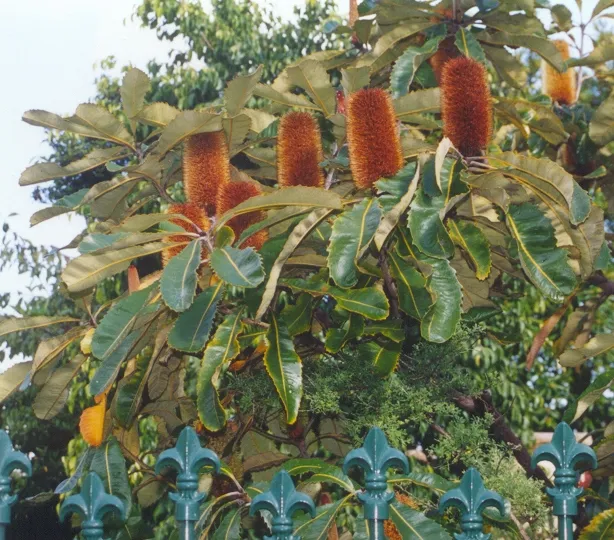
Identification is aided by the very large, rigid, sharply serrated leaves, which may approach 16 inches long and 5 inches wide. Upper leaf surfaces are green, while the undersides are pale and softly textured. Young stems and veins often carry rusty-brown hairs. The shrub has an open, architectural outline and conspicuous cylindrical spikes that age into persistent woody structures.
Flowering
The inflorescences are dense cylindrical Banksia flower spikes, usually emerging from branch junctions or older stems. Buds are bluish green and may show rusty or reddish tones before opening; mature flowers are yellow-green and gradually darken to orange-brown. Flower spikes can remain attractive after drying and may persist for months or years. Flowering is strongest in bright sun, with occasional off-season spikes possible.
Pollination and visitors
The flower spikes are visited by a mixture of insects and nectar-feeding birds. Documented visitor groups associated with this species or its well-supported ecological profile include native bees, honey bees, butterflies, moths, beetles, wasps, honeyeaters, friarbirds, and other nectar-feeding birds. Flower opening and pollen presentation can be triggered by contact from larger visitors.
Banksia robur photos
Click any photo for a larger view. Source, author and license are shown separately.
Diseases and pests
Diseases
Generally resilient in suitable conditions, but root-rot problems can develop where drainage is poor or roots remain waterlogged. Use clean containers, avoid chronic saturation, and remove declining plants or contaminated media. Maintain good air movement and avoid unnecessary overhead irrigation.
Pests
Occasional chewing insects may damage leaves or flower structures. Inspect new growth and developing spikes, remove minor infestations by hand or with a water spray, and use targeted controls only when damage is significant. Poor drainage and root stress are more serious risks than routine insect attack.
Related diseases and pests
Only Plant Doctor profiles whose host data indicate this plant may be affected are shown here.

Toxicity and pollen
No authoritative species-specific evidence confirming toxicity to people or pets was located. This should not be treated as proof of safety: prevent ingestion of leaves, flowers, and woody fruits, and seek professional advice after a significant exposure. Handling the foliage may cause minor mechanical irritation because the leaves are stiff and toothed.
- Typical season
- Typically autumn through winter in the native range; US exposure timing is not well documented.
- Pollination / pollen
- Pollen presented within insect- and bird-visited flower spikes
Banksia robur is insect- and bird-visited, so pollen is often presented within the flower spike rather than freely released like wind-borne grass pollen. However, insect pollination does not establish zero allergy risk, and reliable species-specific airborne-pollen data for US gardens were not located.
Native habitat
Native to coastal New South Wales and Queensland, where it occurs in swamps, wet heath, sandy lowlands, and nearby plateaus. It tolerates poor soils and seasonal wetness better than many banksias, but natural drainage and oxygenated soil remain important. The species is adapted to warm, frost-light climates and responds to fire through its woody underground storage structure.
Interesting fact
The species can produce flower spikes along older stems, sometimes close to ground level. Its woody follicles may remain attached for a long time after flowering. Australian National Botanic Gardens observations recorded plants reaching about 5 ft in three years and flowering at that age. The name robur refers to strength or robustness.
Frequently asked questions (FAQ)
The most relevant questions about this plant, with short and direct answers.
🌱Quick care
What is Swamp Banksia?⌄
Swamp Banksia is the common name for Banksia robur, a bold evergreen shrub in the Proteaceae family. It typically grows about 3–6 feet tall and wide in cultivation, with large serrated leaves and yellow-green flower spikes.
How much sun does Swamp Banksia need?⌄
Swamp Banksia grows best in full sun, which also encourages the strongest flowering. It may tolerate some light shade, but reduced light can produce a looser plant with fewer flowers.
How often should I water Swamp Banksia?⌄
Water Swamp Banksia regularly, especially while it is establishing and during hot or dry weather. Although it naturally grows in damp habitats, it still needs well-drained soil rather than stagnant water around its roots.
How big does Swamp Banksia get?⌄
Swamp Banksia commonly reaches about 3–6 feet tall and around 6 feet wide in cultivation, although size varies with climate and growing conditions. It may become larger in especially favorable gardens.
Is Swamp Banksia evergreen?⌄
Yes, Swamp Banksia is generally evergreen and retains its large leathery leaves year-round. New growth may have a noticeable rusty-brown covering on the stems and leaf veins.
🌤️Environment and placement
Where should I plant Swamp Banksia?⌄
Plant Swamp Banksia in a sunny location with sandy, well-drained soil that can remain moderately moist. A rain garden edge, damp border, or irrigated sandy bed can work well if water does not remain stagnant.
Can Swamp Banksia grow in wet soil?⌄
Swamp Banksia can handle reliably moist soil better than many banksias, but the soil should still drain freely. Avoid sites that stay waterlogged around the root crown for long periods.
Can Swamp Banksia tolerate drought?⌄
Swamp Banksia is not a strong drought-tolerant choice and performs best with regular moisture. Established plants may tolerate short dry periods, but prolonged drought can reduce growth and flowering.
What type of soil does Swamp Banksia prefer?⌄
Use sandy, acidic to neutral, well-drained soil that retains some moisture when irrigated. Avoid heavy, poorly drained or strongly alkaline soil, and do not use rich phosphorus-heavy amendments.
Can I grow Swamp Banksia in a container?⌄
Swamp Banksia can be grown in a large container when supplied with excellent drainage and consistent moisture. Choose a deep, free-draining native-plant mix and expect to water more often than an in-ground plant.
Is Swamp Banksia suitable for a small garden?⌄
Swamp Banksia can suit a small garden if its mature width of roughly 6 feet or more is allowed for. Regular pruning after flowering can help maintain a denser, more compact shape.
Is Swamp Banksia frost hardy?⌄
Swamp Banksia is frost-tolerant once established, but young plants may need protection during their first winter. Cover small plants during severe freezes and keep the root zone evenly moist but well drained.
💧Care and problems
How do I care for Swamp Banksia after planting?⌄
Keep the root zone consistently watered during establishment, maintain full sun, and avoid disturbing the roots unnecessarily. Once established, continue irrigation during extended dry weather and keep competing weeds away.
Does Swamp Banksia need fertilizer?⌄
Swamp Banksia usually needs little fertilizer when planted in suitable soil. If feeding is necessary, use a low-phosphorus product formulated for Australian native plants and follow the label rate.
Why are the leaves on my Swamp Banksia turning brown?⌄
Brown leaves can result from drought, root damage, salt buildup, extreme heat, or poor drainage. Check soil moisture and drainage first, and avoid heavy fertilizer or phosphorus-rich products while the plant recovers.
Why is my Swamp Banksia wilting even though the soil is wet?⌄
Wilting in wet soil can indicate oxygen-starved roots or root disease rather than a lack of water. Improve drainage if possible, avoid repeated saturation, and inspect the roots or lower stems for dark, decayed tissue.
What pests affect Swamp Banksia?⌄
Swamp Banksia is generally fairly pest-resistant, although occasional chewing insects may damage leaves or developing growth. Inspect the undersides of leaves and new shoots, and address only a confirmed pest problem.
Is Swamp Banksia susceptible to root rot?⌄
Swamp Banksia appears relatively resistant to root-rot problems, but it can still suffer in persistently waterlogged or contaminated soil. Good drainage, careful watering, and clean planting material are the main preventive measures.
🪴Planting and repotting
When is the best time to plant Swamp Banksia?⌄
Plant Swamp Banksia during mild weather, preferably in fall or spring when the soil is workable and extreme heat or freezing is less likely. In frost-prone areas, give young plants time to establish before winter.
How should I plant Swamp Banksia in clay soil?⌄
Do not place Swamp Banksia in a compacted, poorly drained clay bed without improving drainage. A raised mound or well-drained planting area is safer than enriching the hole with phosphorus-rich soil amendments.
How far apart should Swamp Banksia plants be planted?⌄
Space Swamp Banksia plants about 6 feet apart for a natural mature spread, or farther apart for stronger airflow and an open form. Allow additional clearance from paths, structures, and other shrubs.
Should I mulch around Swamp Banksia?⌄
Yes, apply a thin layer of organic mulch to conserve moisture and moderate soil temperature. Keep mulch several inches away from the trunk and root crown so the lower stem stays dry and ventilated.
✂️Propagation and pruning
How do I propagate Swamp Banksia from seed?⌄
Propagate Swamp Banksia from seed by sowing fresh, viable seed in a clean, free-draining mix and keeping it lightly moist. Germination commonly takes about three to five weeks, after which seedlings should be handled carefully.
How long does Swamp Banksia take to flower from seed?⌄
Swamp Banksia may begin flowering at roughly three years under favorable conditions, but timing varies with climate, plant size, and care. Plants grown in low light or stressed by drought may take longer.
Can Swamp Banksia be grown from cuttings?⌄
Seed is the most established propagation method for Swamp Banksia, while cutting success may be less predictable. If attempting cuttings, use fresh semi-hardwood material and a sterile, sharply draining medium.
When should I prune Swamp Banksia?⌄
Prune Swamp Banksia after flowering to encourage branching and maintain a tighter shape. Remove dead or damaged growth first, and avoid severe cuts into old, leafless wood because regrowth may be limited.
Can I cut Swamp Banksia flowers for arrangements?⌄
Yes, the long-lasting yellow-green flower spikes can be cut for arrangements and may retain interest as they dry. Use clean pruners and avoid removing too many flowering stems from a young or stressed plant.
⚠️Toxicity and safety
Is Swamp Banksia poisonous to people or pets?⌄
Species-specific toxicity information for Swamp Banksia is not well established, so treat the plant as unverified rather than confirmed safe. Prevent children and pets from chewing plant parts, and contact a poison-control or veterinary service if ingestion occurs.
🌸Flowering and special interest
When does Swamp Banksia bloom?⌄
Swamp Banksia usually blooms from fall through winter, with flowering reported across a broader seasonal window in some locations. Individual plants may produce occasional flower spikes outside the main season.
What color are Swamp Banksia flowers?⌄
Swamp Banksia flower spikes begin bluish-green in bud and turn yellow-green as they open. The spikes gradually darken with age and can remain attractive after drying.
Why is my Swamp Banksia not flowering?⌄
Insufficient sunlight is a common reason Swamp Banksia fails to flower, while drought, excessive fertilizer, young age, and unsuitable soil can also contribute. Move or prune nearby shade if possible and maintain steady moisture without waterlogging.
Do Swamp Banksia flowers attract birds and insects?⌄
Yes, the flower spikes can provide food for nectar-feeding birds and insects. The plant is particularly useful in wildlife-friendly landscapes when grown in a sunny position with suitable moisture.
Similar plants
 Azure Monkshood (Aconitum carmichaelii) care guideAconitum carmichaelii
 Monkshood (Aconitum ‘Stainless Steel’)Aconitum 'Stainless Steel'
 Monkshood (Aconitum ‘Bressingham Spire’)Aconitum 'Bressingham Spire'
 Golden full moon maple (Acer shirasawanum ‘Aureum’)Acer shirasawanum 'Aureum'
 Globosum (Acer platanoides ‘Globosum’)Acer platanoides 'Globosum'
 Striped maple (Acer pensylvanicum) care guideAcer pensylvanicum