
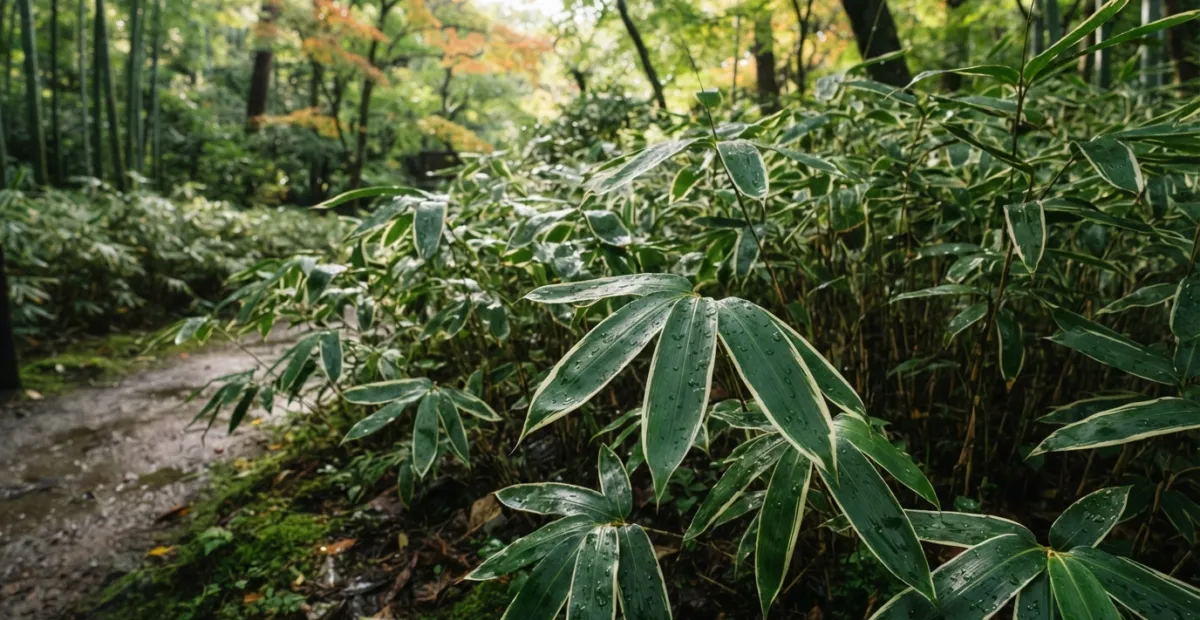
Veitch’s Bamboo (Sasa veitchii) short overview
Veitch's bamboo is a broad-leaved, evergreen running bamboo from Japan and Sakhalin, valued for its dark green foliage and distinctive pale margins that develop after cold weather. It forms spreading stands suited to woodland gardens, slopes, screens, and large containers, but its vigorous rhizomes require a root barrier or other containment. Grow it in moist, fertile, well-drained soil from sun to shade.
Taxonomic classification
Veitch’s Bamboo (Sasa veitchii) care guide
Light and placement
Grow in bright open shade, dappled woodland light, or partial sun; it also tolerates full sun when soil stays consistently moist. An east- or north-facing position is often easiest, while afternoon shade helps in hot climates. Bleached, scorched margins and curled leaves suggest excessive sun or drought; weak, elongated growth can indicate insufficient light.
Watering and humidity
Keep the root zone evenly moist, especially during establishment and summer heat. Water deeply when the surface begins to dry rather than giving frequent shallow irrigation. Increase watering during prolonged dry weather and reduce it in cool, wet seasons, while avoiding standing water. Mulch helps stabilize moisture and protects shallow rhizomes.
Soil and growing medium
Use fertile, humus-rich soil that drains freely but retains steady moisture. Loam amended with compost is ideal; clay and sand are acceptable if improved with organic matter and drainage management. The species tolerates acidic, neutral, and alkaline conditions, but compacted, waterlogged ground increases stress and winter damage.
Feeding
Apply compost or a balanced slow-release fertilizer in spring as new culms begin to emerge. A second light feeding in early summer can support dense foliage in poor soil. Do not overfeed late in the season or fertilize drought-stressed, newly transplanted, or waterlogged plants; excessive vigor can make containment more difficult.
Growth and habit
This is a running bamboo with elongated rhizomes that can spread well beyond the original planting area. It forms dense, arching to erect stands and may behave aggressively in fertile, moist soil. Install a robust rhizome barrier before planting or grow it in a large container. Periodic edge-cutting and removal of unwanted shoots are part of normal maintenance.
Planting and repotting
Plant after the soil can be worked in spring or in early fall while temperatures remain moderate. Set the root ball level with the surrounding soil and water thoroughly. Space plants according to the intended effect, but plan for lateral spread. Install a sturdy rhizome barrier before backfilling, or use a large container with drainage holes for easier control.
Grow in a substantial container with drainage and a moisture-retentive but open mix. Repot or divide when the root mass becomes crowded, preferably in spring before vigorous shoot emergence. Inspect for circling rhizomes and remove excess material; do not allow rhizomes to escape through drainage openings into surrounding soil.
Propagation and pruning
Propagation
Propagate by dividing established plants or taking young rhizome cuttings in spring. Seed propagation is possible but less practical because flowering and seed production are irregular. Keep divisions evenly moist while they establish and contain new rhizome growth from the outset.
Pruning
Thin weak, dead, damaged, or spindly culms in spring. Remove unwanted shoots at ground level and cut back edges that cross the containment line. If a lower groundcover effect is desired, cut the stand to the ground after the spring flush or just before new growth begins. Remove flowering shoots promptly when practical.
Overwintering
Established plants are cold hardy in much of USDA Zone 6 and warmer, though exposed sites may suffer leaf browning or culm injury. Apply a winter mulch over the root zone, protect from drying winds, and water before the ground freezes if autumn is dry. Container plants are more vulnerable and should be sheltered from prolonged hard freezes.
Uses
Use as an evergreen groundcover, mass planting, woodland accent, slope planting, informal screen, hedge, or specimen in a large container. Its winter-paled leaf margins are especially effective in Japanese-style and shade gardens. Because it is a running bamboo, avoid planting near property lines, drains, paving, or natural areas unless spread is physically contained.
Appearance
The plant has slender woody culms and broad, lance-shaped evergreen leaves, generally dark green through the growing season. After exposure to cold, the leaf margins develop a distinctive pale cream, tan, or whitish appearance while the centers remain green. The combination of broad leaves, spreading habit, and winter-edged foliage helps distinguish it from finer-leaved bamboos.
Flowering
Like other bamboos, it produces small, inconspicuous flowers in branched grass inflorescences rather than showy blooms. Flowering is not a dependable seasonal ornamental feature, and the timing is not reliably documented for United States gardens. Remove flowering shoots if maintaining a leafy display, particularly when flowering appears to trigger decline or additional flowering.
Pollination and visitors
The inconspicuous bamboo flowers are wind-pollinated rather than adapted to attract animal visitors. No specific insect, bird, or other animal pollinator is reliably documented as characteristic for this species.
Diseases and pests
Diseases
The species is generally considered disease-resistant, but poor drainage can cause root decline. Prevent problems with well-drained soil, moderate fertility, clean pruning tools, and adequate spacing. Remove damaged tissue and correct waterlogging rather than relying on routine fungicide applications.
Pests
Slugs may chew young foliage, especially in damp shade. Inspect new growth, reduce hiding places, and use proportionate controls where necessary. Monitor stressed plants for general bamboo pests, but avoid treating unless a pest is identified and causing meaningful damage.
Toxicity and pollen
Reliable veterinary and human toxicology information specific to Sasa veitchii is limited. Do not assume that the plant is edible or harmless because it is a grass. Prevent children and pets from chewing ornamental plants, and seek professional medical or veterinary advice after significant ingestion or if symptoms occur.
- Typical season
- Irregular; no dependable U.S. season documented
- Pollination / pollen
- Light, wind-dispersed grass pollen
Bamboo pollen is released from inconspicuous flowers and is dispersed by wind, but flowering in Sasa veitchii is irregular and species-specific airborne-allergy data are limited. People with grass-pollen sensitivity should avoid handling flowering material during active pollen release and monitor local symptoms.
Native habitat
Its native range extends from Sakhalin to Japan, where it occurs in temperate environments. In cultivation it performs best in fertile, humus-rich, moisture-retentive but well-drained soil, especially in partial shade or woodland-like conditions. Its elongated rhizomes support rapid lateral spread and dense groundcover formation.
Interesting fact
Cold weather causes the leaf margins to become pale through localized tissue damage, creating a regular ornamental winter effect. The species is evergreen but can be cut back to ground level and regrown as a lower groundcover. Its broad leaves give it a lush appearance uncommon among many temperate bamboos. Rhizome growth is vigorous enough to make containment essential in small gardens.
Frequently asked questions (FAQ)
The most relevant questions about this plant, with short and direct answers.
🌱Quick care
What is Veitch's Bamboo?⌄
Veitch's Bamboo is the accepted common name for Sasa veitchii, a spreading, woody bamboo in the grass family Poaceae. It is grown mainly for its broad evergreen leaves and ornamental groundcover habit.
Is Veitch's Bamboo evergreen?⌄
Veitch's Bamboo is broadly evergreen in mild climates, but foliage can become cream-edged, papery, or brown after winter exposure. Cold, wind, and severe freezes may cause leaf damage even when the rhizomes survive.
How tall does Veitch's Bamboo get?⌄
Veitch's Bamboo commonly reaches about 2 to 8 feet tall, depending on the climate, cultivar, soil, and management. It can be maintained as a low groundcover by cutting it back.
🌤️Environment and placement
How much sun does Veitch's Bamboo need?⌄
Veitch's Bamboo grows in full sun, partial shade, or shade. It generally develops cleaner foliage and needs less irrigation in bright shade or filtered light, especially in hot U.S. climates.
How cold hardy is Sasa veitchii?⌄
Sasa veitchii is hardy to about 0°F, although exact performance depends on winter wind, snow cover, soil moisture, and plant establishment. Protect young plants from drying winter winds.
What USDA hardiness zones can grow Veitch's Bamboo?⌄
Veitch's Bamboo is commonly grown in USDA Zones 6 through 9, with the best foliage typically in areas where summers are not excessively hot and dry. In colder areas, expect some winter leaf injury.
How fast does Veitch's Bamboo spread?⌄
Veitch's Bamboo spreads rapidly through elongated rhizomes and can form a broad colony. Give it ample space or install a reliable root barrier before planting near lawns, paths, foundations, or neighboring properties.
Is Veitch's Bamboo good ground cover?⌄
Veitch's Bamboo can make an effective broad-leaved groundcover for woodland gardens, slopes, banks, and shaded areas. Its spreading rhizomes make containment essential where a permanent, controlled planting is required.
Can Veitch's Bamboo grow in full shade?⌄
Veitch's Bamboo can grow in full shade, although growth may be less dense and slower than in filtered light or partial shade. Consistently moist, fertile soil helps compensate for lower light.
Can Veitch's Bamboo grow in full sun?⌄
Veitch's Bamboo can grow in full sun when the soil remains evenly moist and well drained. Afternoon shade is preferable in hot, dry regions because intense sun and wind can scorch the leaf margins.
💧Care and problems
Is Veitch's Bamboo invasive or aggressive?⌄
Veitch's Bamboo can be aggressive in gardens because its rhizomes spread beyond the original planting area. Treat it as a running bamboo and contain it with a properly installed barrier or grow it in a large container.
How often should I water Veitch's Bamboo?⌄
Water Veitch's Bamboo whenever the soil surface begins to dry, keeping the root zone consistently moist during establishment and summer drought. Do not leave the plant in saturated soil.
Why are the leaf edges of my Veitch's Bamboo turning white or cream?⌄
Cream or pale leaf margins are a characteristic ornamental feature of Veitch's Bamboo, often becoming more pronounced as leaves mature or overwinter. Crispy brown margins instead usually indicate drought, wind, cold, or root stress.
Why is my Veitch's Bamboo turning brown?⌄
Brown foliage on Veitch's Bamboo is commonly caused by winter burn, drought, hot wind, or root damage. Remove fully dead leaves or stems, correct moisture problems, and wait for new growth before judging the plant's recovery.
Can I mow Veitch's Bamboo?⌄
Established Veitch's Bamboo can usually be cut close to the ground with a mower or brush cutter if the area is accessible. Repeated cutting controls height but may not stop rhizomes from spreading underground.
How do I control Veitch's Bamboo from spreading?⌄
Control Veitch's Bamboo by installing a strong rhizome barrier, cutting and removing escaping rhizomes, or growing it in a contained planter. Inspect the perimeter at least once each growing season because rhizomes can travel beyond the visible clump.
Should I fertilize Veitch's Bamboo?⌄
Fertilize Veitch's Bamboo in spring with a balanced, slow-release fertilizer if growth is weak or the soil is poor. Avoid excessive nitrogen, which can produce lush growth and increase maintenance without solving drainage or moisture problems.
🪴Planting and repotting
Can Veitch's Bamboo grow in containers?⌄
Veitch's Bamboo can grow in containers, but the pot must be large, have drainage holes, and be monitored for rhizomes escaping through openings. Divide or repot when the root mass becomes crowded.
What soil is best for Veitch's Bamboo?⌄
Plant Veitch's Bamboo in fertile, humus-rich soil that retains moisture without staying waterlogged. It tolerates clay, loam, and sandy soils when drainage and organic matter are adequate.
How far apart should I plant Veitch's Bamboo?⌄
Spacing depends on whether you want a colony or individual specimens, but allow several feet between plants because Veitch's Bamboo spreads by rhizomes. Use a root barrier rather than relying on close spacing to limit expansion.
How do I plant Veitch's Bamboo?⌄
Plant Veitch's Bamboo at the same depth it was growing in its nursery container, backfill with fertile soil, and water thoroughly. Mulch the root zone without covering the canes, and keep it consistently moist during the first growing season.
Does Veitch's Bamboo need a root barrier?⌄
A root barrier is strongly recommended for Veitch's Bamboo in most home landscapes because it is a spreading bamboo. Install the barrier before planting and extend it deeply enough to intercept rhizomes, with the top edge remaining slightly above soil level.
✂️Propagation and pruning
When should Veitch's Bamboo be cut back?⌄
Cut Veitch's Bamboo to the ground in late winter or early spring before new growth for a short, refreshed planting. Cutting it after the spring flush can also produce a low groundcover effect.
How do I propagate Veitch's Bamboo?⌄
The most practical way to propagate Veitch's Bamboo is by division, separating rooted rhizome sections with viable shoots. Seed and root cuttings are possible in principle but are less convenient for most home gardeners.
When is the best time to divide Veitch's Bamboo?⌄
Divide Veitch's Bamboo in early spring as new growth begins or in early fall where winters are mild. Keep divisions moist and replant them promptly so the rhizomes and roots do not dry out.
⚠️Toxicity and safety
Is Veitch's Bamboo toxic to dogs, cats, or people?⌄
Species-specific toxicity evidence for Veitch's Bamboo is insufficient, so it should not be assumed safe to eat. Prevent pets and children from chewing the plant, and contact a veterinarian or poison-control service if plant material is ingested.
Can people eat Veitch's Bamboo leaves?⌄
Veitch's Bamboo leaves have traditional culinary and folk uses in parts of Japan, but those uses do not establish safety for modern home consumption or medicinal use. Do not use the leaves as food or medicine without reliable species-specific guidance.
Is Veitch's Bamboo deer resistant?⌄
Veitch's Bamboo is not reliably deer-proof. Deer pressure varies by location and available forage, so protect new plantings with fencing or repellents if browsing is common in your area.
Can Veitch's Bamboo damage foundations or paving?⌄
Veitch's Bamboo is unlikely to crack a sound foundation directly, but its spreading rhizomes can invade planting beds, lift edging, and emerge beneath or around paving. Plant it well away from structures and contain the rhizomes.
🌸Flowering and special interest
Does Veitch's Bamboo flower?⌄
Veitch's Bamboo can flower, but its flowers are small and insignificant compared with its foliage. Bamboo flowering is uncommon and difficult to predict, so it is not normally grown for blooms.
Does Veitch's Bamboo die after flowering?⌄
Some bamboo species decline or die after flowering, but species-specific flowering behavior for Sasa veitchii is not sufficiently documented to state that every flowering plant will die. Treat unusual flowering as a reason to monitor the colony and preserve healthy divisions.
Similar plants
 Alphonse Karr Bamboo (Bambusa multiplex) care guideBambusa multiplex
  Black bamboo or purple bamboo (Chinese: 紫竹) (Phyllostachys nigra) care guidePhyllostachys nigra
  Chusquea culeou care guideChusquea culeou
  Giant Timber Bamboo (Phyllostachys reticulata) care guidePhyllostachys reticulata
  Palmate Bamboo (Sasa palmata) care guideSasa palmata
  Bissett’s bamboo (Phyllostachys bissetii) care guidePhyllostachys bissetii