
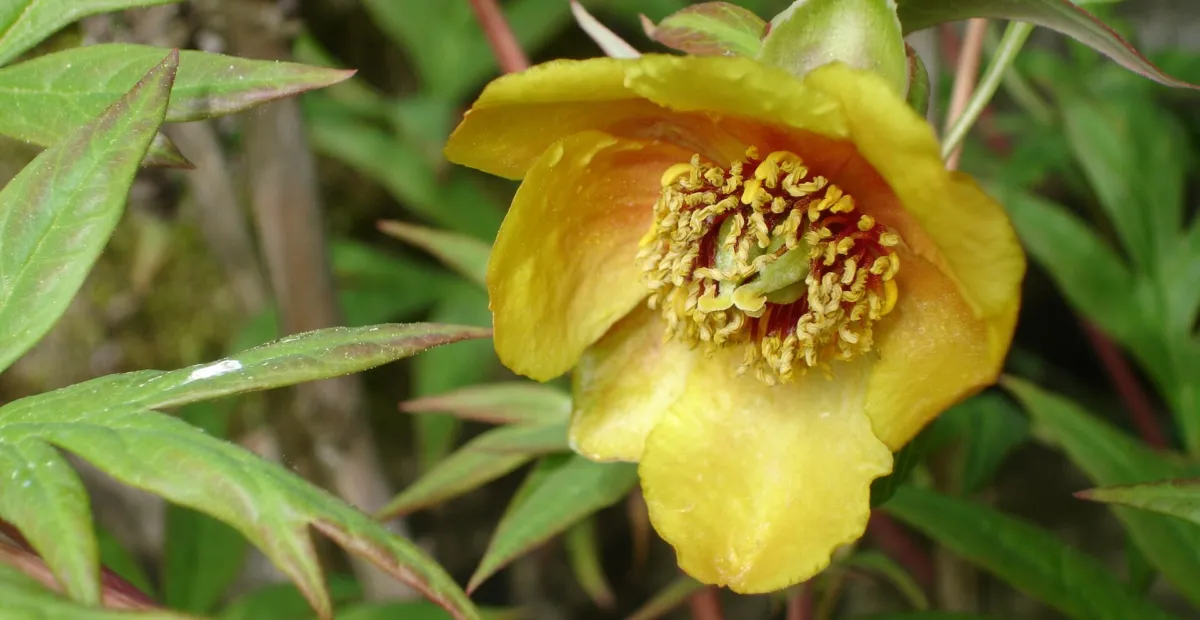
 Source:
 Delavay’s tree peony (Paeonia delavayi) short overview
Delavay's tree peony is a long-lived, deciduous shrub native to high-elevation woodlands and thickets in southwestern China. Its deeply divided leaves frame saucer-shaped flowers that vary widely in color, from deep maroon and red to yellow, orange, purple, greenish or white. In U.S. gardens, it prefers fertile, well-drained soil, sun or light shade, steady moisture during establishment, and shelter from strong winds.
Taxonomic classification
Delavay’s tree peony (Paeonia delavayi) care guide
Light and placement
Give full sun to partial shade, with morning sun or light afternoon shade especially useful in hot or windy sites. East- and west-facing positions are suitable; shelter from strong wind protects tall stems, young foliage, and flowers. Excess shade produces weak, open growth and fewer flowers, while intense heat and reflected afternoon sun can scorch foliage and shorten flower life.
Watering and humidity
Water deeply and slowly when the upper few inches of soil begin to dry, especially during the first two growing seasons. Maintain even moderate moisture while buds and new shoots develop, then reduce supplemental watering after establishment unless drought is prolonged. Keep foliage dry when possible and never leave the root zone saturated. Average outdoor humidity is adequate.
Soil and growing medium
Use a deep, fertile, humus-rich soil that drains freely while holding moderate moisture. Loam amended with compost is suitable; avoid persistently waterlogged ground. The plant tolerates acidic, neutral, and alkaline soils, but neutral to slightly alkaline conditions are commonly recommended. Limestone-derived or rocky mountain soils occur in its native range.
Feeding
In early spring, top-dress with compost or apply a balanced slow-release fertilizer at label strength as growth begins. Keep fertilizer away from the stems and water it in. Avoid heavy nitrogen feeding, which can produce soft growth and fewer flowers. Do not fertilize drought-stressed, newly transplanted, or dormant plants.
Growth and habit
This is a long-lived, multi-stemmed shrub with permanent woody shoots and an upright, somewhat open habit. It can take several years to settle after planting and dislikes repeated disturbance. Once established, it generally needs little shaping beyond removal of dead wood, suckers, and spent flowers.
Planting and repotting
Plant bare-root or container plants during dormancy, preferably in fall or early spring. Set the root crown at the nursery soil level and avoid burying woody stems. Allow about 4–6 feet between plants, enrich the planting area with compost, water thoroughly, and mulch without touching the stems. Shelter young plants from drying winds.
Avoid routine repotting because mature roots are deep and transplanting can be difficult. If container-grown, move it while dormant into a deep, sturdy pot with excellent drainage, disturbing the root ball as little as possible. Plant out after establishment rather than keeping a large specimen containerized.
Propagation and pruning
Propagation
Seed is the most characteristic method for the species but is slow and may require alternating warm and cold periods before germination. Sow fresh seed as soon as ripe or use a properly managed double-dormancy treatment. Semi-hardwood cuttings are documented, but rooting is more demanding than seed propagation. Cultivars and hybrids may not come true from seed.
Pruning
Little pruning is normally needed. In early spring, remove dead, damaged, crossing, or weak wood and any unwanted suckers. Do not cut the shrub to the ground after frost because its woody stems carry future growth. Light shaping after flowering is possible, but hard pruning can reduce the next display.
Overwintering
Leave the woody framework intact through winter. In colder regions, apply a light mulch over the root zone after the ground cools, keeping it away from stems. Protect young plants from drying winter wind and abrupt temperature swings. Avoid warm indoor overwintering; the species needs a genuine cool dormant period and winter chill.
Uses
Use as a specimen shrub, back-of-border accent, woodland-edge planting, informal hedge, or seasonal cut flower. Its persistent woody framework and attractive divided foliage provide value beyond bloom. Flowers may be visited by several insects, but the species should not be promoted as edible or medicinal without separate verified guidance.
Appearance
The shrub has persistent woody stems and an upright, open to vase-shaped outline. Large leaves are deeply divided into many lance-shaped to oval leaflets, giving the plant a finely textured appearance. Foliage is dark green on top and noticeably blue-green underneath. Conspicuous leafy bracts surround the flowers, and pod-like fruits follow successful pollination.
Flowering
Flowers are usually saucer-shaped and borne singly or in small terminal groups, with conspicuous bracts and numerous yellow stamens. Color is highly variable across the species, including maroon, red, yellow, orange, purple, greenish, and white forms. In U.S. temperate gardens, flowering is generally in May; wild populations may flower from mid-May into late June. Individual flowers can remain open for roughly 6–9 days.
Pollination and visitors
Field research recorded bees, beetles, syrphid flies, ants, and butterflies visiting the flowers. Bees were the most effective pollinators in the study, while beetles and ants contributed inconsistently; syrphid flies and butterflies were frequent or observed visitors but had low pollination efficiency. The species was largely dependent on insect-assisted cross-pollination.
Paeonia delavayi photos
Click any photo for a larger view. Source, author and license are shown separately.
Diseases and pests
Diseases
Usually trouble-free, but watch for peony leaf blotch, peony wilt, Verticillium wilt, honey fungus, canker, and stem diseases. Improve air circulation, avoid overhead irrigation, remove diseased foliage, and cut out infected wood with sterilized tools. Do not compost badly diseased material.
Pests
Generally relatively pest-free. Monitor for scale, peony leaf and bud eelworms, and soil-dwelling moth larvae. Ants around buds are common and normally harmless. Use sanitation, good spacing, and targeted treatment only when damage is significant.
Toxicity and pollen
Peony plants contain paeonol and are recognized by veterinary poison-control references as capable of causing gastrointestinal upset in pets if eaten. Evidence specific to P. delavayi is limited, so treat the species conservatively: discourage chewing, remove fallen plant material, and seek veterinary advice after significant ingestion. Human exposure information for this exact species is limited; do not consume it.
- Typical season
- Late spring to early summer during flowering
- Pollination / pollen
- Mostly insect-carried pollen; limited wind contribution
The flowers produce abundant pollen for insect visitors, but pollen is not primarily dispersed by wind. No reliable U.S. clinical allergy profile specific to P. delavayi was found, so a low airborne-allergy rating is a cautious horticultural assessment rather than a medical guarantee. Sensitive people should avoid handling flowers during peak pollen release.
Native habitat
In the wild, it occurs in southwestern China, including Yunnan, Sichuan, and southeastern Tibet. It is associated with mountain forest edges, secondary woodland, shrubland, glades, and open grassy places at roughly 6,200–13,100 feet. Native sites have temperate highland conditions, seasonal moisture, strong light, and often rocky or limestone-influenced soils.
Interesting fact
The species is highly variable in flower color, leaf division, and flower size across its native range. It is a woody shrub, so its stems persist through winter unlike herbaceous peonies. The epithet delavayi honors Father Jean Marie Delavay, a French missionary and plant collector in China. It has contributed to the breeding of modern lutea tree-peony hybrids.
Frequently asked questions (FAQ)
The most relevant questions about this plant, with short and direct answers.
🌱Quick care
What is Delavay's tree peony?⌄
Delavay's tree peony is a deciduous, woody peony shrub scientifically known as Paeonia delavayi. It is valued for its finely divided foliage, suckering habit, and outward-facing flowers in shades that may include red, yellow, purple-red, orange, white, or greenish yellow.
How much sunlight does Delavay's tree peony need?⌄
Delavay's tree peony grows best in full sun to partial shade, with some protection from intense afternoon heat in hot climates. A lightly shaded site can help flowers last longer, but dense shade may reduce flowering.
How often should I water Delavay's tree peony?⌄
Water Delavay's tree peony moderately, keeping the soil evenly moist while the plant establishes and during prolonged dry spells. Allow excess water to drain freely because constantly soggy roots can cause decline.
Is Delavay's tree peony easy to grow?⌄
Yes, Delavay's tree peony is generally an adaptable, long-lived shrub when planted in deep, fertile, well-drained soil. Its main requirements are adequate drainage, moderate moisture, sunlight, and shelter from strong winds.
🌤️Environment and placement
What USDA hardiness zones are suitable for Paeonia delavayi?⌄
Paeonia delavayi is generally grown in USDA Zones 5 through 9, although hardiness can vary with the plant's source and local exposure. Protect young growth from severe cold and drying winter winds where necessary.
Where should I plant Delavay's tree peony?⌄
Plant it in a sheltered border, woodland edge, or shrub bed with full sun to partial shade and deep, humus-rich, well-drained soil. Avoid exposed locations where strong winds may break woody stems or damage flower buds.
Can Delavay's tree peony grow in clay soil?⌄
Delavay's tree peony can tolerate clay if it is fertile and drains well, but heavy, waterlogged clay should be improved before planting. Incorporate organic matter and consider a raised planting area where drainage is poor.
Does Delavay's tree peony tolerate summer heat?⌄
Established plants can tolerate summer heat if they receive adequate moisture and are protected from severe afternoon sun. In hot regions, partial shade and a mulch layer can reduce heat and moisture stress.
Does Delavay's tree peony need winter chill?⌄
Yes, Delavay's tree peony is a cold-hardy, deciduous shrub that benefits from a normal winter dormancy and winter chill. It is not suited to warm climates that lack a meaningful cool season.
💧Care and problems
How do I fertilize Delavay's tree peony?⌄
Apply compost or another well-rotted organic mulch in spring as growth begins, keeping it away from the crown. If growth is weak, a balanced, general-purpose fertilizer can be used according to its label directions.
Why is my Delavay's tree peony not flowering?⌄
Poor flowering is commonly linked to insufficient light, excessive nitrogen, root disturbance, drought, or a young plant that has not matured. Give it time, avoid moving it unnecessarily, and provide fertile soil with consistent but not excessive moisture.
Why are the leaves of my Delavay's tree peony wilting?⌄
Wilting may result from drought, root damage, waterlogged soil, or fungal problems such as peony wilt. Remove affected growth, improve air circulation and drainage, and avoid overhead watering; persistent or spreading symptoms warrant local diagnosis.
What diseases affect Delavay's tree peony?⌄
Delavay's tree peony may be affected by peony wilt, gray mold, Verticillium wilt, and other problems favored by wet conditions. Good drainage, clean-up of diseased foliage, and careful watering help reduce disease pressure.
Should I mulch around Delavay's tree peony?⌄
Yes, apply a moderate layer of organic mulch to conserve moisture and improve soil quality. Keep mulch away from the plant's crown and woody stems because excessive moisture around the base can encourage rot.
🪴Planting and repotting
When is the best time to plant Delavay's tree peony?⌄
Plant Delavay's tree peony in fall or early spring, with fall usually preferred where the ground is workable. Planting during dormancy gives the roots time to establish before the following growing season.
How do I plant Delavay's tree peony?⌄
Plant it in a wide, deep hole with fertile, well-drained soil, setting the root system at the same general depth at which it was growing in its container. Water thoroughly after planting and maintain moderate moisture while it establishes.
Can Delavay's tree peony be grown in a container?⌄
It can be grown temporarily in a large container, but its woody growth, vigorous roots, and eventual size make in-ground planting preferable. Use a deep container with drainage holes and a fertile, well-drained potting mix.
How much space does Delavay's tree peony need?⌄
Allow approximately 3 to 5 feet of height and at least 3 to 4 feet of width, with additional room if the plant produces suckers. Good spacing improves air circulation and makes long-term maintenance easier.
✂️Propagation and pruning
How do I propagate Delavay's tree peony?⌄
Delavay's tree peony can be propagated from seed or by dividing established suckering clumps. Division produces plants more quickly, while seed can be slow and may require alternating warm and cold periods before germination.
Can I grow Delavay's tree peony from seed?⌄
Yes, the species can be grown from seed, but germination may take more than one season because the seeds commonly require a warm period followed by chilling. Seed-grown plants may take several years to reach flowering size.
Can Delavay's tree peony be divided?⌄
Yes, established, strongly suckering plants can often be divided during dormancy. Each division should include healthy roots and shoots, and newly divided sections may take time to regain vigor.
When should I prune Delavay's tree peony?⌄
Prune lightly after flowering or during dormancy to remove dead, damaged, weak, or overcrowded stems. Unlike herbaceous peonies, its woody stems should not automatically be cut to the ground after frost.
How do I prune an overgrown Delavay's tree peony?⌄
Thin a proportion of the oldest stems at ground level during dormancy to reduce crowding and rejuvenate the shrub. Avoid removing too much growth at once, especially if the plant is mature and flowering well.
⚠️Toxicity and safety
Is Delavay's tree peony toxic to pets?⌄
Delavay's tree peony may be toxic if eaten by pets, so prevent dogs, cats, and other animals from ingesting its roots, stems, leaves, flowers, or seeds. Contact a veterinarian or pet poison service if ingestion occurs.
Can people eat Delavay's tree peony?⌄
No, Delavay's tree peony should not be eaten or used as a home remedy without professional guidance. Keep plant material away from children and avoid ingesting any part of the plant.
🌸Flowering and special interest
When does Delavay's tree peony bloom?⌄
Delavay's tree peony generally blooms in late spring to early summer, with timing varying by climate and spring temperatures. Flowers are often smaller and more outward-facing than those of many cultivated tree peony hybrids.
What colors are Delavay's tree peony flowers?⌄
Flowers may be red, yellow, orange, purple-red, white, greenish yellow, or intermediate shades. Color varies considerably among plants, especially when they are grown from seed.
Why are Delavay's tree peony flowers hidden by the leaves?⌄
The species naturally produces outward-facing flowers that may sit within or behind its finely divided foliage. This growth habit makes Delavay's tree peony especially valuable as a foliage shrub rather than only as a large-flowered specimen.
Should I deadhead Delavay's tree peony?⌄
Deadhead after flowering if you want the plant to look tidy and to conserve some energy. Leave developing seed capsules in place if you plan to collect seed, remembering that seedlings may vary from the parent plant.
Similar plants
 Balkan Peony (Paeonia peregrina) care guidePaeonia peregrina
 Woodland peony (Paeonia obovata) care guidePaeonia obovata
 Garden Peony (Paeonia officinalis) care guidePaeonia officinalis
 Paeonia anomala veitchii care guidePaeonia anomala veitchii
 Common Garden Peony (Paeonia lactiflora) care guidePaeonia lactiflora
 Wild Peony (Paeonia mascula) care guidePaeonia mascula