
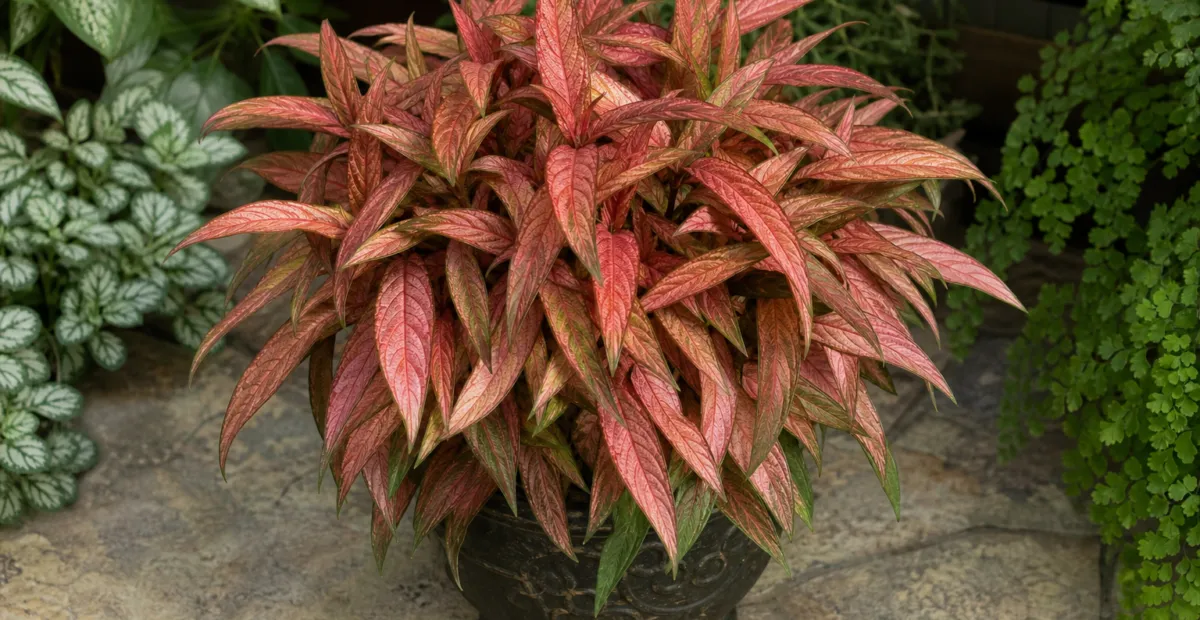
 AI-generated illustration
Caladium ‘Desert Sunset’ short overview
Caladium ‘Desert Sunset’ is a patented strap-leaf caladium prized for its unusual salmon-pink to bronze foliage and darker copper-colored veins. Its upright, evenly mounding habit works especially well in shaded beds, patio containers, hanging baskets, and seasonal displays. Grow it in warm, organically enriched soil that stays evenly moist but drains freely. In most of the United States, lift and store the tubers before frost.
Taxonomic classification
Caladium ‘Desert Sunset’ care guide
Light and placement
Give bright filtered light or partial shade, ideally with gentle morning sun and protection from intense afternoon rays. ‘Desert Sunset’ can tolerate more sun when moisture is ample, but harsh all-day sun may scorch leaves and fade coloration. Too little light can produce weaker growth and less vivid color; excessive shade may make stems stretch.
Watering and humidity
Keep the root zone consistently moist during active growth, watering when the surface begins to dry but before the plant wilts. Containers may need frequent checking in hot weather. Reduce watering gradually as leaves yellow in fall, then keep dormant tubers comparatively dry. Good drainage is critical because saturated soil promotes rot.
Soil and growing medium
Use a loose, organically enriched medium that holds moisture without becoming waterlogged. A peat-based or coir-based potting mix amended with compost and perlite works well in containers. Garden soil should be fertile, humus-rich, and freely draining. Caladiums generally tolerate acidic to near-neutral conditions; avoid compacted soil and prolonged saturation, which increase the risk of tuber rot.
Feeding
Feed during active growth with a balanced liquid fertilizer diluted according to the product label, or use a controlled-release fertilizer incorporated into the growing medium. Begin after shoots are established and stop as foliage declines in late season. Do not fertilize dormant tubers or plants suffering from cold, drought, or waterlogged roots.
Growth and habit
This is a vigorous, rapid-growing strap-leaf caladium with an upright, uniformly mounding habit. It develops a seasonal canopy from tubers and reaches display size during one warm growing season. Its narrow leaves suit borders, baskets, and containers where a finer texture is preferred than that of broad fancy-leaf caladiums.
Planting and repotting
Plant outdoors only after frost danger has passed and soil temperatures are consistently about 60–70°F. Set dormant tubers with the puckered, bud-bearing side upward, generally about 2 inches deep; container culture may use roughly 1–2 inches of cover. Space plants 8–12 inches apart for a dense display, or farther apart for individually defined plants. Water thoroughly after planting and mulch after foliage emerges.
Repot or transplant after the danger of frost has passed and the growing medium is warm. Handle the tuber and emerging shoots gently, and choose a container with drainage holes. A 6-inch pot is commonly suitable for one large tuber, while wider containers allow several smaller tubers to create a fuller display.
Propagation and pruning
Propagation
Commercial propagation is by division or chipping of tubers, with each section retaining a viable bud. Divide dormant tubers in late winter or spring before planting, allowing cut surfaces to dry briefly before planting. The cultivar is patented, and commercial propagation restrictions apply; seed does not preserve the cultivar reliably.
Pruning
Little pruning is needed. Remove yellowing, damaged, or diseased leaves at the base with clean shears. As the plant enters seasonal dormancy, allow foliage to yellow naturally before cutting it back and reducing water. Do not cut healthy leaves merely to reshape the plant.
Overwintering
In USDA Zones 8b–11, tubers may survive in suitable warm, well-drained sites, though protection from wet winter soil improves reliability. In colder areas, stop watering as foliage declines, lift tubers after dormancy, dry them in a shaded ventilated place, and store them in dry vermiculite or similar material at roughly 60°F or above. Replant only after spring soil has warmed.
Uses
Use ‘Desert Sunset’ as a foliage accent in shaded beds, borders, patio pots, hanging baskets, and mixed tropical-style containers. Its strap leaves provide color and texture where many flowering annuals struggle. It is strictly ornamental and should not be eaten; wear gloves when handling tubers if skin or oral exposure is a concern.
Appearance
The cultivar has narrow lance-shaped strap leaves rather than broad heart-shaped leaves. Leaves combine salmon pink and bronze tones with darker copper-colored venation, and coloration can shift with light intensity, nutrition, and maturity. Petioles rise from the tuber to form a neat, upright mound with a relatively fine-textured tropical appearance.
Flowering
This cultivar is grown primarily for foliage, but caladiums can occasionally produce a small arum-type inflorescence consisting of a spathe surrounding a short spadix. Flowering is sporadic and not the main ornamental feature. Reliable cultivar-specific flowering months are not documented.
Pollination and visitors
No reliable cultivar-specific pollinator or animal-visitor record was found. The occasional inflorescences are inconspicuous and the plant is cultivated primarily for foliage, so pollinator value should be treated as undocumented rather than assumed.
Diseases and pests
Diseases
The main risk is tuber rot, especially in cool, wet, poorly drained soil. Plant only in warm media, avoid standing water, and provide airflow around containers. Remove collapsing or foul-smelling tubers promptly. Leaf spots may occur under prolonged wetness; improve spacing, water at the soil surface, and remove badly affected foliage rather than applying routine fungicides.
Pests
Watch for aphids, mealybugs, spider mites, thrips, caterpillars, slugs, and snails. Inspect new growth and leaf undersides, remove pests by hand or with a water spray, and use a labeled insecticidal soap only when needed. Avoid keeping foliage continually wet and correct stressed growing conditions, which can worsen pest problems.
Related diseases and pests
Only Plant Doctor profiles whose host data indicate this plant may be affected are shown here.
 Environmental stressLeaf sunburn
 PestMealy Plum AphidHyalopterus pruni (Geoffroy, 1762)
 DiseaseAlternaria leaf spot and fruit rotAlternaria alternata
 Environmental stressUnderwatering
 PestOnion thripsThrips tabaci Lindeman
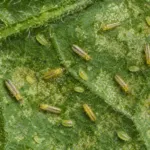 PestMelon thripsThrips palmi Karny
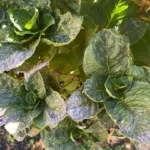 PestChilli thripsScirtothrips dorsalis Hood
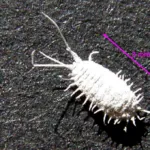 PestObscure mealybugPseudococcus viburni
Toxicity and pollen
Caladiums contain insoluble calcium oxalate crystals. Chewing or swallowing leaves, petioles, or tubers can cause immediate mouth pain, burning, swelling, drooling, vomiting, or difficulty swallowing. Keep the plant and stored tubers away from children and pets; seek medical or veterinary advice after ingestion, particularly if swelling or breathing difficulty occurs.
- Pollination / pollen
- Not well documented; pollen is not a prominent ornamental feature
Caladium pollen and airborne-allergy behavior are not well documented for this exact cultivar. Because flowering is occasional and inconspicuous, exposure is likely limited in ordinary cultivation, but a zero-allergy claim is not justified. Remove inflorescences if desired and avoid handling plant material near the face if irritation occurs.
Native habitat
The hybrid caladium background comes from tropical and subtropical American plants associated with warm, humid climates, filtered light, and moisture-retentive but drained soils. Cultivated plants perform best when root-zone temperatures remain warm and decline into dormancy as temperatures fall.
Interesting fact
‘Desert Sunset’ was bred in Florida from a cross involving ‘White Wonder’ and ‘Twist and Shout’. It was selected in 2008 and patented as PP25,421. The cultivar is classified as a strap-leaf type and is noted for rapid growth and distinctive bronze-salmon foliage.
Frequently asked questions (FAQ)
The most relevant questions about this plant, with short and direct answers.
🌱Quick care
What is Caladium 'Desert Sunset'?⌄
Caladium 'Desert Sunset' is a strap-leaved caladium with salmon-pink to bronze foliage and darker copper-colored veins. It forms an upright, mounding plant suited to borders, containers, hanging baskets, and shaded landscapes.
How much light does Caladium 'Desert Sunset' need?⌄
Give Caladium 'Desert Sunset' bright filtered light to partial shade. Gentle morning sun can be suitable, but intense afternoon sun may scorch the leaves unless soil moisture is kept consistently high.
How often should I water Caladium 'Desert Sunset'?⌄
Water when the soil surface begins to feel slightly dry, keeping the mix evenly moist but never soggy. Containers may need more frequent watering during hot weather, while poor drainage increases the risk of tuber rot.
Is Caladium 'Desert Sunset' easy to grow?⌄
Caladium 'Desert Sunset' is fairly easy to grow when provided with warmth, filtered light, moisture-retentive soil, and protection from frost. Its main challenges are cold damage, drought stress, and overwatering.
🌤️Environment and placement
Can Caladium 'Desert Sunset' grow indoors?⌄
Yes, Caladium 'Desert Sunset' can grow indoors in a warm room with bright, indirect light and evenly moist soil. Keep it away from cold drafts, heating vents, and harsh direct sunlight through glass.
Can Caladium 'Desert Sunset' grow in full sun?⌄
Caladium 'Desert Sunset' performs best in shade to partial shade rather than full sun. Some cultivars tolerate more sun with ample moisture, but strong afternoon exposure can cause leaf scorch and fading.
What temperature is best for Caladium 'Desert Sunset'?⌄
Warm conditions are best, with soil temperatures preferably above about 60–70°F when planting tubers. Protect the plant from frost and prolonged temperatures in the mid-60s°F or lower, which can trigger decline.
Is Caladium 'Desert Sunset' hardy in the United States?⌄
Caladium 'Desert Sunset' is frost-tender and is generally grown as a warm-season plant across much of the United States. In USDA Zones 8b–11, tubers may overwinter in protected soil, but colder or wet winter conditions can cause losses.
Can I grow Caladium 'Desert Sunset' in a container?⌄
Yes, Caladium 'Desert Sunset' grows well in containers, patio pots, and hanging baskets. Use a pot with drainage holes and a rich, peat-based mix that holds moisture without staying waterlogged.
💧Care and problems
Why are the leaves on my Caladium 'Desert Sunset' wilting?⌄
Wilting usually means the plant is too dry, overheated, or suffering from root or tuber damage. Check the soil moisture and drainage, then move the plant from harsh sun while avoiding repeated saturation.
Why are Caladium 'Desert Sunset' leaves turning yellow?⌄
Yellow leaves can result from natural seasonal dormancy, overwatering, cold exposure, or insufficient light. If the soil is wet and the stems or tuber feel soft, suspect rot rather than simply adding more water.
Why is my Caladium 'Desert Sunset' not growing?⌄
Slow growth is commonly caused by cool soil, low light, a dry root zone, or a dormant tuber. Keep the plant warm and evenly moist, and do not plant dormant tubers outdoors until the soil has warmed.
Should I fertilize Caladium 'Desert Sunset'?⌄
Yes, light feeding during active growth can support healthy foliage, especially in containers. Use a balanced fertilizer according to the product label and avoid heavy applications, which can damage roots or produce weak growth.
How do I prevent root or tuber rot in Caladium 'Desert Sunset'?⌄
Prevent rot by using well-drained soil, a container with drainage holes, and careful watering. Keep the soil evenly moist but never saturated, particularly when temperatures are cool or the plant is dormant.
🪴Planting and repotting
When should I plant Caladium 'Desert Sunset' tubers?⌄
Plant Caladium 'Desert Sunset' tubers in spring after frost danger has passed and the soil has warmed to at least about 60–70°F. Planting in cold, wet soil can delay sprouting and encourage rot.
How deep should I plant Caladium 'Desert Sunset' tubers?⌄
Plant the tubers about 2 inches deep in loose, moisture-retentive soil, with the puckered or knobby growing side facing upward. Space plants roughly 8–12 inches apart for a fuller display.
What soil is best for Caladium 'Desert Sunset'?⌄
Use rich, organic, moisture-retentive soil that drains freely. A peat-based container mix amended with compost is suitable, but avoid heavy compacted soil that remains saturated after watering.
Should I repot Caladium 'Desert Sunset' after buying it?⌄
Repot only when the current container is poorly drained, severely root-bound, or filled with unsuitable soil. Choose a pot just one size larger and disturb the roots as little as possible during active growth.
✂️Propagation and pruning
How do I propagate Caladium 'Desert Sunset'?⌄
Caladium 'Desert Sunset' is propagated from its underground tubers, usually by planting whole tubers or carefully dividing large, healthy tubers with visible buds. Each division must retain at least one viable growing point and should be kept warm and only lightly moist until growth begins.
Can I save Caladium 'Desert Sunset' tubers for next year?⌄
Yes, in climates with freezing winters, lift the tubers after foliage declines or frost damages the leaves. Let them dry briefly, remove loose soil, and store them in a ventilated, dry location above about 60°F in peat, vermiculite, or another low-moisture medium.
Should I cut back Caladium 'Desert Sunset' leaves?⌄
Remove damaged or yellowing leaves at the base with clean scissors, but avoid cutting healthy foliage unnecessarily. Healthy leaves help the tuber store energy before seasonal dormancy.
⚠️Toxicity and safety
Is Caladium 'Desert Sunset' poisonous to cats and dogs?⌄
Yes, Caladium 'Desert Sunset' should be treated as toxic to cats, dogs, horses, and people if ingested. Its insoluble calcium oxalates can cause mouth irritation, drooling, swelling, vomiting, and difficulty swallowing.
What should I do if a pet eats Caladium 'Desert Sunset'?⌄
Remove access to the plant and contact a veterinarian or animal poison-control service promptly if a pet chews or swallows it. Do not induce vomiting unless a veterinary professional specifically instructs you to do so.
🌸Flowering and special interest
Does Caladium 'Desert Sunset' produce flowers?⌄
Yes, Caladium 'Desert Sunset' can produce small, inconspicuous arum-family flowers, but it is grown primarily for its colorful leaves. Flowering is usually much less ornamental than the foliage.
Should I remove flowers from Caladium 'Desert Sunset'?⌄
Removing flower spathes as they appear can help keep the plant focused on foliage production. This is optional, but it may be useful when the goal is a fuller, longer-lasting leaf display.
Similar plants
 Yellow lantern chili (Capsicum chinense) care guideCapsicum chinense
 Capsicum baccatum care guideCapsicum baccatum
 Serrano (Capsicum annuum ‘Serrano’)Capsicum annuum 'Serrano'
 Purple Beauty (Capsicum annuum ‘Purple Beauty’)Capsicum annuum 'Purple Beauty'
 Numex Twilight (Capsicum annuum ‘Numex Twilight’)Capsicum annuum 'Numex Twilight'
 Explosive Ember Chili Pepper (Capsicum annuum ‘Explosive Ember’)Capsicum annuum 'Explosive Ember'