
 Source:
 Hairpin Banksia (Banksia spinulosa) short overview
Hairpin Banksia is an evergreen Australian shrub or small tree valued for its narrow, prickly-edged leaves and upright, bottlebrush-like flower spikes. The accepted species is native to eastern Australia, especially New South Wales and Queensland, with related forms extending into Victoria. In cultivation it needs full sun, sharply drained acidic soil and restrained feeding, particularly low-phosphorus fertilizer. It is best suited to mild climates or protected containers in the United States.
Taxonomic classification
Hairpin Banksia (Banksia spinulosa) care guide
Light and placement
Give Hairpin Banksia full sun, ideally with at least 6 hours of direct light and good air movement. A south- or west-facing position is suitable in much of the United States, while hot inland sites may benefit from light afternoon protection during extreme heat. Sparse growth and weak flowering suggest insufficient light; bleached foliage, scorched margins or sudden wilt can indicate excessive reflected heat or root stress rather than simple sun intolerance.
Watering and humidity
Water deeply when the upper few inches of soil have begun to dry, then allow excess water to drain completely. Keep newly planted specimens evenly moist through their first growing season, reducing frequency after roots establish. Water less in cool winter weather and more during prolonged summer heat, but never leave the root zone saturated. Humidity is usually not a special requirement; drainage and ventilation matter more.
Soil and growing medium
Use a porous, sharply drained medium based on sand, fine bark and loam, or plant in naturally free-draining acidic ground. Heavy clay should be amended broadly or avoided because prolonged wetness can damage roots. Keep pH slightly acidic to neutral and avoid alkaline rubble, fresh manure and high-phosphorus products. A raised bed or sloping site is useful where winter rainfall is heavy.
Feeding
Feed sparingly in spring with a fertilizer formulated for Australian natives or another low-phosphorus product, using a conservative rate. A thin layer of mature, low-phosphorus organic mulch is safer than rich manure. Do not fertilize drought-stressed, newly transplanted or dormant plants, and avoid routine high-phosphorus fertilizers because Proteaceae can be sensitive to phosphorus excess.
Growth and habit
The species is variable, ranging from a compact shrub to a larger, multi-stemmed plant. It develops a lignotuber in some forms, allowing recovery after fire or severe disturbance. Maintain an open canopy by avoiding constant overwatering and excessive nitrogen, and leave room for the plant to broaden naturally rather than relying on repeated hard pruning.
Planting and repotting
Plant after severe frost risk has passed, or in fall where winters are mild and drainage is excellent. Set the root ball level with the surrounding soil and avoid disturbing the roots more than necessary. Water thoroughly at planting, apply a light, low-nutrient mulch away from the stem, and irrigate consistently while the root system establishes. Choose a permanent site because mature banksias dislike repeated root disturbance.
Grow in a tall, well-drained container only while the plant is young or where climate requires protection. Repot in spring before vigorous growth, moving up one pot size and disturbing roots as little as possible. Use an acidic, low-phosphorus native-plant mix with excellent drainage. Do not allow the pot to stand in a saucer of water.
Propagation and pruning
Propagation
Propagation is most reliably done from fresh seed, which is released from woody follicles after opening or treatment. Sow in a free-draining, low-nutrient medium and keep evenly moist but never waterlogged. Seed-grown plants can vary in habit and flower traits. Cuttings may be possible for selected forms, but success is less dependable and cultivar-specific.
Pruning
Prune lightly after flowering to remove spent heads, dead wood or weakly placed branches. Young plants can be tip-pruned to encourage branching, but avoid repeatedly cutting into old, leafless wood because banksias may not reliably reshoot there. Sterilize tools and make clean cuts; severe rejuvenation pruning is riskier than gradual shaping.
Overwintering
In USDA Zone 9a or colder, protect plants from hard freezes, cold drying winds and saturated winter soil. Container specimens can be moved to a bright, cool, frost-free location, but should not be kept in dim, heated rooms. Reduce watering during cool weather while maintaining enough moisture to prevent complete root-ball desiccation.
Uses
Use as an evergreen specimen, informal screen, wildlife planting or container plant in mild U.S. climates. Its flower spikes can support cut-flower and dried-flower displays, but stems should be harvested sustainably and local regulations respected. It is especially useful in water-wise Australian-style gardens when drainage and climate are suitable. Do not treat the plant as a medicinal or food crop without species-specific professional guidance.
Appearance
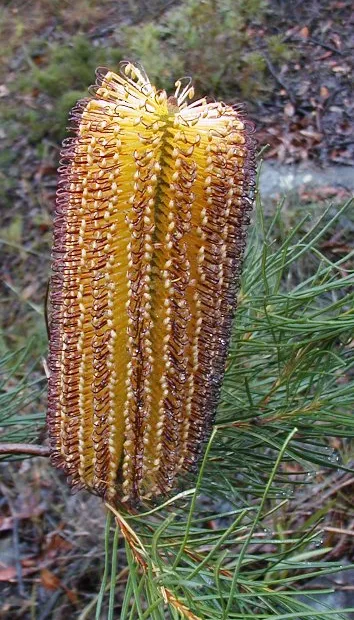
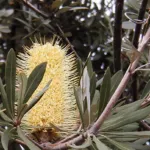
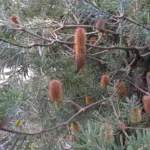
Leaves are narrow and linear, often crowded along the stems, with margins that may curve backward and feel prickly. Upright cylindrical flower spikes resemble stiff bottlebrushes and are followed by woody follicles embedded in a cone-like infructescence. Flower spikes may show golden or yellow bracts with contrasting dark red, brown or purple styles, depending on the form.
Flowering
The showy spikes are dense inflorescences made from many small flowers rather than a single large bloom. Flowering is commonly concentrated from late autumn into winter in southeastern Australia, although cultivated plants can shift season with climate and variety. Styles extend prominently from the spike and may change appearance as flowers mature.
Pollination and visitors
The dense flower spikes are visited by nectar-feeding birds and a range of insects. Australian studies have documented bird and insect visitation, with honeyeater-type birds important in native habitats; bees and other insects may also forage on flowering plants. Visitor abundance depends on local fauna, season and the presence of other nectar plants.
Banksia spinulosa photos
Click any photo for a larger view. Source, author and license are shown separately.
Diseases and pests
Diseases
The main preventive measure is excellent drainage, since root and collar rots become more likely in persistently wet soil. Avoid burying the stem base, overwatering or planting into compacted clay. Watch for dieback, cankers or sudden wilt and remove affected material promptly. Improve airflow and sanitation, and seek a local diagnosis before applying fungicides.
Pests
Inspect new growth and flower spikes for scale, aphids, mealybugs and occasional caterpillar feeding. Use a strong water spray for light infestations, prune out heavily affected tips and encourage natural predators. Avoid broad-spectrum insecticides during bloom because they can harm flower visitors. Treat only when damage is sustained and identify the pest first.
Toxicity and pollen
Reliable sources do not establish Hairpin Banksia as a known poisonous plant for people or pets, but absence of evidence is not proof of edibility or complete safety. Avoid ingesting leaves, flowers, seeds or plant material, supervise children and pets around unfamiliar plants, and contact poison-control or a veterinarian if ingestion causes symptoms.
- Typical season
- Typically late fall through winter in the United States when flowering occurs
- Pollination / pollen
- Heavy pollen presented within dense flower spikes; mainly animal-transferred.
Hairpin Banksia is primarily adapted for animal-assisted pollen transfer, but its abundant flowers can still release pollen during handling, harvesting or close exposure. People with pollen sensitivity should avoid rubbing flower spikes, consider gloves when pruning and keep flowering stems away from indoor air. Species-specific clinical allergy data are limited.
Native habitat
Hairpin Banksia occurs in eastern Australian open forests, woodlands and heath-like communities from coastal areas into uplands. It grows in climates ranging from temperate to warm subtropical, often on nutrient-poor, well-drained sands or other freely draining soils. Natural populations experience periodic fire, and some plants can resprout from a lignotuber after disturbance.
Interesting fact
The species is highly variable, and recognized forms differ in size, leaf shape and style color. Its apparent flower spikes are compound inflorescences containing many individual flowers. Some plants retain woody fruiting structures after flowering, creating a durable architectural feature. The name spinulosa refers to its spiny or prickly character.
Frequently asked questions (FAQ)
The most relevant questions about this plant, with short and direct answers.
🌱Quick care
What is Hairpin Banksia?⌄
Hairpin Banksia is the common name for Banksia spinulosa, an evergreen Australian shrub in the Proteaceae family. It is grown for its cylindrical yellow-to-orange flower spikes and wildlife value.
How large does Hairpin Banksia get?⌄
Hairpin Banksia commonly grows about 6 to 10 feet tall and wide, although forms and varieties vary considerably. Compact cultivars can remain much smaller and are better suited to containers or small gardens.
🌤️Environment and placement
How much sun does Hairpin Banksia need?⌄
Hairpin Banksia grows best in full sun, ideally with at least 6 hours of direct light daily. Too much shade can produce open, weak growth and fewer flowers.
What USDA hardiness zone is Hairpin Banksia?⌄
Hairpin Banksia is best treated as a mild-winter plant in the United States, with hardiness depending on its variety and local provenance. Grow it outdoors where winters are moderate, and protect it from hard freezes.
Can Hairpin Banksia survive frost?⌄
Hairpin Banksia can tolerate light frost, and some southern forms are notably frost hardy, but hard freezes can damage or kill it. Protect young plants and container specimens during severe cold.
💧Care and problems
How often should I water Hairpin Banksia?⌄
Water Hairpin Banksia regularly while it establishes, then reduce watering because mature plants are drought tolerant. Water deeply when the soil has dried several inches below the surface, but never keep the roots soggy.
Is Hairpin Banksia drought tolerant?⌄
Established Hairpin Banksia is drought tolerant and usually needs only occasional deep watering. Young plants require consistent moisture until their root systems develop.
How do I fertilize Hairpin Banksia?⌄
Fertilize Hairpin Banksia sparingly, if at all, and use a fertilizer specifically labeled low in phosphorus. High-phosphorus fertilizers can injure banksias because Proteaceae are adapted to nutrient-poor soils.
Why are the leaves on my Hairpin Banksia turning yellow?⌄
Yellow leaves may result from poor drainage, excessive phosphorus, root stress, or soil conditions that are too alkaline. Check drainage and fertilizer history before increasing watering or feeding.
Does Hairpin Banksia have serious pest problems?⌄
Hairpin Banksia is generally considered relatively trouble-free, with few major pests reported. Stress from poor drainage, unsuitable fertilizer, or insufficient light is often more important than insect damage.
🪴Planting and repotting
What type of soil is best for Hairpin Banksia?⌄
Use well-drained sandy or loamy soil for Hairpin Banksia. Avoid poorly drained or heavily alkaline soils, which can contribute to weak growth and yellowing foliage.
Can Hairpin Banksia grow in clay soil?⌄
Hairpin Banksia can tolerate some heavier soil only when drainage is reliable. Improve compacted clay with raised planting areas or another drainage solution rather than adding large amounts of rich compost to the planting hole.
Can Hairpin Banksia grow in a container?⌄
Hairpin Banksia can grow in a large container if it receives full sun and has exceptionally well-drained, low-phosphorus potting media. Choose a stable pot with drainage holes and avoid letting the plant sit in water.
✂️Propagation and pruning
Does Hairpin Banksia need pruning?⌄
Hairpin Banksia generally needs little pruning when it has enough space to develop naturally. Lightly trim after flowering to maintain shape, but avoid cutting far back into old, leafless wood unless the plant has a reliable lignotuber.
How do I prune Hairpin Banksia after flowering?⌄
Remove spent flower heads and lightly shorten overly long shoots after flowering. Make cuts just above healthy foliage and avoid removing large amounts of old wood at once.
How do I grow Hairpin Banksia from seed?⌄
Sow Hairpin Banksia seed in a very free-draining, clean seed-starting mix and keep it lightly moist. Germination commonly takes about 2 to 5 weeks, while seedlings may need several years to reach flowering size.
Can Hairpin Banksia be grown from cuttings?⌄
Yes, Hairpin Banksia can be propagated from cuttings, especially when you want to preserve a particular flower color or compact form. Take healthy semi-mature cuttings in late spring and use a sterile, sharply draining medium.
⚠️Toxicity and safety
Is Hairpin Banksia toxic to dogs and cats?⌄
There is no well-established species-specific toxicity classification for Hairpin Banksia, but ingestion of any ornamental plant can cause stomach upset or present a choking risk. Contact a veterinarian or poison service if a pet eats a substantial amount or develops symptoms.
Is Hairpin Banksia safe for people?⌄
Hairpin Banksia has no well-established species-specific toxicity classification for humans. Do not eat its leaves, flowers, or seed structures, and use normal caution when handling woody flower heads or plants with sharp foliage.
🌸Flowering and special interest
When does Hairpin Banksia bloom?⌄
Hairpin Banksia usually blooms from fall through winter and may continue into spring, depending on the climate and form. In the United States, flowering time can shift with local temperatures and daylight.
What color are Hairpin Banksia flowers?⌄
Hairpin Banksia flower spikes are typically yellow or golden, with styles that may be yellow, orange, red, or maroon. Color varies among natural forms and horticultural selections.
Does Hairpin Banksia attract bees and birds?⌄
Yes, Hairpin Banksia flowers produce abundant nectar that attracts nectar-feeding birds, bees, and other pollinators. It is a useful choice for a wildlife or pollinator garden in a suitable climate.
How long does Hairpin Banksia take to flower from seed?⌄
Hairpin Banksia grown from seed commonly takes about 2 to 3 years to flower, although conditions and plant provenance affect the timing. Nursery-grown plants may bloom sooner because they are already established.
What should I do with Hairpin Banksia seed cones?⌄
Leave the woody seed structures on the plant if you want seasonal interest and possible seed collection. Some follicles open as they dry, while others may remain closed until exposed to fire or intense drying.
Can I use Hairpin Banksia as a cut flower?⌄
Yes, Hairpin Banksia flower spikes can be used as cut flowers and are also attractive in dried arrangements. Harvest stems when the flower spikes are developed but before they become overly weathered.
Similar plants
 Acorn banksia or orange banksia (Banksia prionotes) care guideBanksia prionotes
 He saw banksia (Banksia serrata) care guideBanksia serrata
 He showy banksia (Banksia speciosa) care guideBanksia speciosa
 Swamp Banksia (Banksia robur) care guideBanksia robur
 He coast banksia (Banksia integrifolia) care guideBanksia integrifolia
 He silver banksia (Banksia marginata) care guideBanksia marginata