
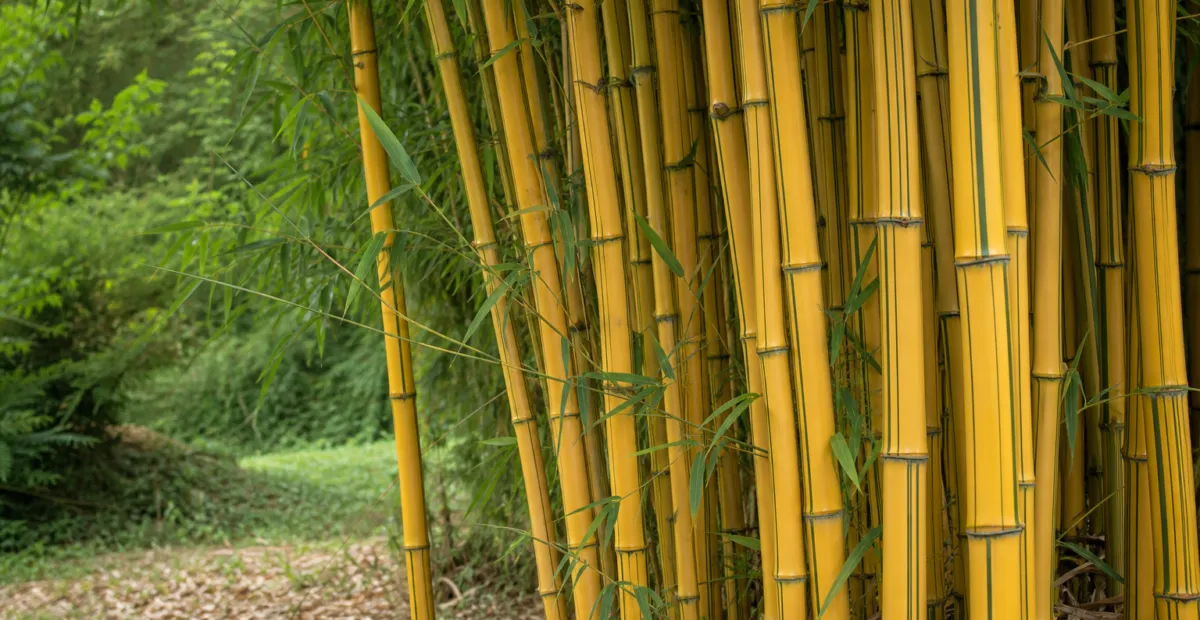
 AI-generated illustration
Aureocaulis (Phyllostachys aureosulcata ‘Aureocaulis’) short overview
Phyllostachys aureosulcata 'Aureocaulis' is a striking running bamboo valued for its rich golden-yellow culms, upright form, and year-round screening potential. New canes may show reddish highlights before settling into yellow, while narrow green leaves provide a fine-textured evergreen canopy. It is vigorous, cold-hardy, and useful for large privacy screens, but its spreading rhizomes require a properly installed barrier or a confined planting area.
Taxonomic classification
Aureocaulis (Phyllostachys aureosulcata ‘Aureocaulis’) care guide
Light and placement
Plant in full sun for the strongest golden culm color, especially where southern or western light reaches the canes. Partial shade is tolerated, particularly in hot climates, but can reduce vigor and color intensity. Excessive exposure in very hot, dry sites may scorch leaves; insufficient light produces a thinner, less vigorous stand and less vivid culms.
Watering and humidity
Water deeply when the upper few inches of soil begin to dry, especially during the first two growing seasons and during spring shoot production. Maintain consistent moisture without leaving roots saturated. Established plants tolerate short dry periods, but drought can reduce shoot size and cause leaf curling or browning. Mulch helps moderate soil moisture and temperature.
Soil and growing medium
Use fertile loam or amended garden soil that retains moisture while draining freely. Incorporate organic matter before planting, but avoid permanently waterlogged sites. The species tolerates a broad pH range from acidic to alkaline; structure and drainage matter more than precise pH correction. Heavy clay should be improved with organic matter and, where necessary, raised planting.
Feeding
Top-dress with compost or use a balanced slow-release fertilizer in early spring as new growth begins. A second light application may be useful during vigorous shoot production in poor soil. Do not overfertilize drought-stressed or newly transplanted plants, and avoid late-season high-nitrogen feeding that may encourage tender growth before winter.
Growth and habit
This is a leptomorph, running bamboo that spreads through elongated rhizomes and produces new culms seasonally. Growth is rapid in warm, moist conditions, and the stand can expand beyond its intended footprint. Install a robust rhizome barrier or grow it in a substantial container, then inspect edges and remove escape shoots routinely.
Planting and repotting
Choose a site with full sun to partial shade, moisture-retentive but well-drained soil, and enough room for a large running bamboo. Install a durable rhizome barrier before planting, generally around 30–36 inches deep with the upper edge slightly above grade, or use a large, robust container. Water thoroughly after planting and mulch without burying the culms.
Container plants need a large, heavy container with drainage and periodic root or rhizome division. Repot or divide in spring when growth is beginning. Refresh exhausted mix and avoid reducing the root mass so severely that the plant cannot support its culms. Containers dry quickly in summer and may need more frequent irrigation than plants in the ground.
Propagation and pruning
Propagation
Propagate mainly by division of established rhizome-and-culm sections in spring, just as growth begins. Use sharp tools and retain viable rhizomes with roots and buds. Division is practical but physically demanding because mature plants develop dense woody rhizomes. Seed propagation is uncommon because flowering and seed production are infrequent.
Pruning
Remove dead, damaged, weak, or unwanted culms at ground level in late winter or spring before vigorous shooting begins. Thin selected culms to display the golden stems and improve access. Cut back escaping shoots and remove unwanted rhizomes at the containment boundary. Avoid indiscriminate topping if a natural upright screen is desired.
Overwintering
Established plants are outdoor hardy in much of the United States, but exposed sites may suffer leaf burn, culm injury, or dieback during prolonged severe cold. Mulch the root zone before winter, especially for young plants. Container specimens are more vulnerable because roots are above ground; insulate the container or move it to a sheltered, unheated location during extreme cold.
Uses
Use as a tall ornamental accent, privacy screen, wind buffer, or architectural hedge where its running habit can be controlled. It is also suitable for large containers, though container plants require more frequent watering and periodic root management. Do not plant near natural areas, property lines, drains, or unmanaged woodland edges without containment because escaped rhizomes can form dense stands.
Appearance
The defining feature is the rich yellow to golden-yellow culm, sometimes with green striping near the base. Young canes may show reddish or magenta tones before maturing. Culms are jointed and hollow, with a noticeable groove; lower sections may develop characteristic zigzag bends, while upper culms remain upright. Leaves are narrow, lance-shaped, mid-green, and fine-textured.
Flowering
Flowering is an unusual, infrequent event rather than a dependable annual display. Bamboo flowering may occur synchronously across genetically related plants, but the interval for this exact cultivar is not reliably documented. Seed production may follow flowering, and flowering shoots or culms can decline afterward. No dependable U.S. flowering months are established.
Pollination and visitors
The reduced florets of Phyllostachys bamboos are primarily adapted to wind pollination rather than nectar-based animal attraction. Bamboo flower visitors have been documented in some species, but a characteristic animal pollinator or visitor for this exact cultivar is not established.
Diseases and pests
Diseases
Good drainage, air circulation, clean tools, and avoidance of chronic drought or waterlogging reduce problems. Watch for foliage spotting, culm discoloration, or dieback and remove affected material. Severe or spreading symptoms may require local extension diagnosis because the exact cause cannot be identified reliably from appearance alone.
Pests
Bamboo mites, aphids, scale insects, and occasional chewing pests may occur, especially on stressed plants. Inspect leaf undersides and new shoots, wash light infestations with water, and improve irrigation and site conditions. Remove heavily infested material when practical; use targeted treatments only when pest pressure warrants them and according to the product label.
Related diseases and pests
Only Plant Doctor profiles whose host data indicate this plant may be affected are shown here.

Toxicity and pollen
Independent authoritative evidence for Phyllostachys aureosulcata 'Aureocaulis' itself is limited. Do not treat the absence of a listing as proof of safety. Prevent children and pets from chewing ornamental plant material, and seek medical or veterinary advice after a substantial or concerning ingestion. The hard, sharp culms can also cause mechanical injury.
- Typical season
- Rare flowering only; no routine U.S. season
- Pollination / pollen
- Light grass pollen released into the air by wind during rare flowering events
This bamboo rarely flowers in cultivation, so routine airborne pollen exposure is expected to be low. As a grass, its flowers produce wind-dispersed pollen when flowering does occur, and that pollen may be relevant to people sensitive to grass pollen. The exact cultivar’s allergenicity has not been specifically studied.
Native habitat
The species is native to temperate eastern China, where it grows as a woody rhizomatous grass in climates ranging from warm-temperate to subtropical. It favors soils with available moisture but can tolerate varied pH and seasonal conditions. In the United States it is cultivated well beyond its native range and can spread aggressively in warm, moist environments.
Interesting fact
The cultivar name refers to its golden culms, which distinguish it from the yellow-grooved species form. New culms may briefly develop reddish or magenta highlights in strong directional light. Lower culms can bend in a zigzag pattern, a useful identification feature shared with the species. Like other running Phyllostachys bamboos, each new culm reaches its seasonal height in one concentrated growth period.
Frequently asked questions (FAQ)
The most relevant questions about this plant, with short and direct answers.
🌱Quick care
What is Phyllostachys aureosulcata 'Aureocaulis'?⌄
Phyllostachys aureosulcata 'Aureocaulis' is a running bamboo valued for its bright yellow culms, narrow upright habit, and cold hardiness. It can form a tall privacy screen but spreads by underground rhizomes.
What is the common name for Phyllostachys aureosulcata 'Aureocaulis'?⌄
Golden Crookstem Bamboo is a documented common name for Phyllostachys aureosulcata 'Aureocaulis'. It may also be sold under cultivar or species-level names such as Aureocaulis bamboo or yellow-groove bamboo.
How tall does Phyllostachys aureosulcata 'Aureocaulis' get?⌄
Phyllostachys aureosulcata 'Aureocaulis' commonly reaches about 25 feet tall and may approach 30 feet in favorable conditions. Mature culms can be approximately 2 inches in diameter, depending on climate and establishment.
🌤️Environment and placement
Is Phyllostachys aureosulcata 'Aureocaulis' a running or clumping bamboo?⌄
Phyllostachys aureosulcata 'Aureocaulis' is a running bamboo, not a clumping bamboo. Its rhizomes can spread well beyond the original planting area unless they are contained or regularly controlled.
What USDA hardiness zones can grow Phyllostachys aureosulcata 'Aureocaulis'?⌄
Phyllostachys aureosulcata 'Aureocaulis' is generally listed for USDA Zones 5 through 10. In colder parts of its range, severe winter weather can damage foliage or young culms even when the rhizomes survive.
How cold hardy is Phyllostachys aureosulcata 'Aureocaulis'?⌄
Phyllostachys aureosulcata 'Aureocaulis' is one of the hardiest yellow-culm bamboos and is often rated to roughly -10°F. Foliage may still brown or shed after extreme cold, drying wind, or rapid temperature changes.
Does Phyllostachys aureosulcata 'Aureocaulis' need full sun?⌄
Phyllostachys aureosulcata 'Aureocaulis' grows best in full sun to partial shade, with several hours of direct light for stronger growth and brighter culm color. Afternoon sun can intensify the yellow and temporary reddish or magenta tones on new culms.
Where should I plant Phyllostachys aureosulcata 'Aureocaulis' for the best yellow color?⌄
Plant Phyllostachys aureosulcata 'Aureocaulis' where the culms receive direct sun, especially from the south or west, to encourage vivid yellow coloring. New spring culms may briefly develop a reddish or magenta highlight in sunny locations.
Can Phyllostachys aureosulcata 'Aureocaulis' be used as a privacy screen?⌄
Phyllostachys aureosulcata 'Aureocaulis' can make an effective tall, narrow privacy screen because its culms grow mostly upright and densely. Install rhizome containment before planting and allow enough room for mature height and maintenance access.
💧Care and problems
How often should I water Phyllostachys aureosulcata 'Aureocaulis'?⌄
Water Phyllostachys aureosulcata 'Aureocaulis' regularly enough to keep the soil evenly moist, especially during its first growing season and during summer drought. Do not leave the roots in standing water because good drainage is important.
How fast does Phyllostachys aureosulcata 'Aureocaulis' grow?⌄
Phyllostachys aureosulcata 'Aureocaulis' is a fast-growing bamboo once established, producing new shoots in spring and expanding through rhizomes. Growth rate varies with heat, moisture, fertility, available space, and the length of the growing season.
How do I stop Phyllostachys aureosulcata 'Aureocaulis' from spreading?⌄
Control Phyllostachys aureosulcata 'Aureocaulis' with a properly installed rhizome barrier, a large isolated planting bed, or repeated inspection and removal of escaping rhizomes and shoots. A barrier should be monitored because rhizomes can travel over or beneath weak installations.
How do I fertilize Phyllostachys aureosulcata 'Aureocaulis'?⌄
Fertilize Phyllostachys aureosulcata 'Aureocaulis' in spring with a balanced, slow-release fertilizer or compost applied according to the product label. Avoid excessive nitrogen late in the season because it can encourage tender growth before winter.
Why are the leaves on my Phyllostachys aureosulcata 'Aureocaulis' turning brown?⌄
Brown leaves on Phyllostachys aureosulcata 'Aureocaulis' commonly result from winter cold, drying wind, drought, root stress, or transplant shock. Check soil moisture and drainage first, and wait until spring to determine whether the culms and rhizomes remain alive.
Why is my Phyllostachys aureosulcata 'Aureocaulis' losing leaves in winter?⌄
Phyllostachys aureosulcata 'Aureocaulis' is generally evergreen to semi-evergreen, but it may lose foliage after severe cold, winter wind, drought, or abrupt weather changes. Healthy rhizomes can produce new foliage when growing conditions improve in spring.
🪴Planting and repotting
What soil does Phyllostachys aureosulcata 'Aureocaulis' prefer?⌄
Phyllostachys aureosulcata 'Aureocaulis' prefers moist, fertile, well-drained loam. It tolerates a range of soil pH, but compacted, permanently waterlogged, or very poor soil can reduce vigor and culm quality.
How far apart should I plant Phyllostachys aureosulcata 'Aureocaulis' for a screen?⌄
For a screen, space Phyllostachys aureosulcata 'Aureocaulis' according to the desired density and available maintenance space, commonly about 5 to 10 feet apart for relatively quick coverage. Because it is a running bamboo, spacing does not replace rhizome containment.
Can Phyllostachys aureosulcata 'Aureocaulis' grow in a container?⌄
Phyllostachys aureosulcata 'Aureocaulis' can be grown temporarily in a large, sturdy container, but it is not a low-maintenance permanent container plant. The rhizomes eventually crowd the pot, so divide, repot, or root-prune it regularly and protect the container from winter cracking.
When is the best time to plant Phyllostachys aureosulcata 'Aureocaulis'?⌄
Plant Phyllostachys aureosulcata 'Aureocaulis' in spring or early fall, when soil moisture is reliable and temperatures are moderate. Spring planting is especially useful in colder USDA Zones because it gives the rhizomes a longer period to establish before winter.
✂️Propagation and pruning
How do I prune Phyllostachys aureosulcata 'Aureocaulis'?⌄
Prune Phyllostachys aureosulcata 'Aureocaulis' by removing dead, damaged, weak, or unwanted culms at ground level with clean loppers or a saw. Thin older culms to reveal the yellow stems, and remove unwanted shoots during the growing season to maintain boundaries.
Can I cut back Phyllostachys aureosulcata 'Aureocaulis' to control its height?⌄
You can remove tall culms at ground level, but cutting the top of an individual bamboo culm will not make it branch lower or regain a shorter natural form. For long-term height control, selectively remove the tallest culms and manage new shoots.
How do I propagate Phyllostachys aureosulcata 'Aureocaulis'?⌄
Propagate Phyllostachys aureosulcata 'Aureocaulis' most reliably by dividing rhizome sections with healthy buds and culms during the active growing season. Keep divisions consistently moist while they establish, and contain them before planting in the landscape.
⚠️Toxicity and safety
Is Phyllostachys aureosulcata 'Aureocaulis' invasive in the United States?⌄
Phyllostachys aureosulcata 'Aureocaulis' has the spreading habit of its species, and yellow-groove bamboo is considered invasive or potentially invasive in parts of the United States. Check your state and local regulations before planting and use containment where it is allowed.
Is Phyllostachys aureosulcata 'Aureocaulis' toxic to dogs, cats, or people?⌄
No reliable exact-cultivar toxicity classification was found for Phyllostachys aureosulcata 'Aureocaulis'. Do not assume that an unverified safety claim applies to pets or people; contact a veterinarian or poison-control service if plant material has been swallowed.
🌸Flowering and special interest
Does Phyllostachys aureosulcata 'Aureocaulis' flower?⌄
Phyllostachys aureosulcata 'Aureocaulis' rarely flowers, as bamboo flowering can occur only after long intervals and is difficult to predict. Any flowering event may reduce vigor, but routine flowering is not a normal annual feature of this plant.
Are the yellow culms of Phyllostachys aureosulcata 'Aureocaulis' present all year?⌄
The yellow culms of Phyllostachys aureosulcata 'Aureocaulis' are a persistent feature, although color intensity changes with age, sunlight, and weather. New culms are often brightest after they finish extending in late spring or early summer.
Similar plants
 Azure Monkshood (Aconitum carmichaelii) care guideAconitum carmichaelii
 Monkshood (Aconitum ‘Stainless Steel’)Aconitum 'Stainless Steel'
 Monkshood (Aconitum ‘Bressingham Spire’)Aconitum 'Bressingham Spire'
 Golden full moon maple (Acer shirasawanum ‘Aureum’)Acer shirasawanum 'Aureum'
 Globosum (Acer platanoides ‘Globosum’)Acer platanoides 'Globosum'
 Striped maple (Acer pensylvanicum) care guideAcer pensylvanicum