
 Source:
 Royal Fern (Osmunda regalis) short overview
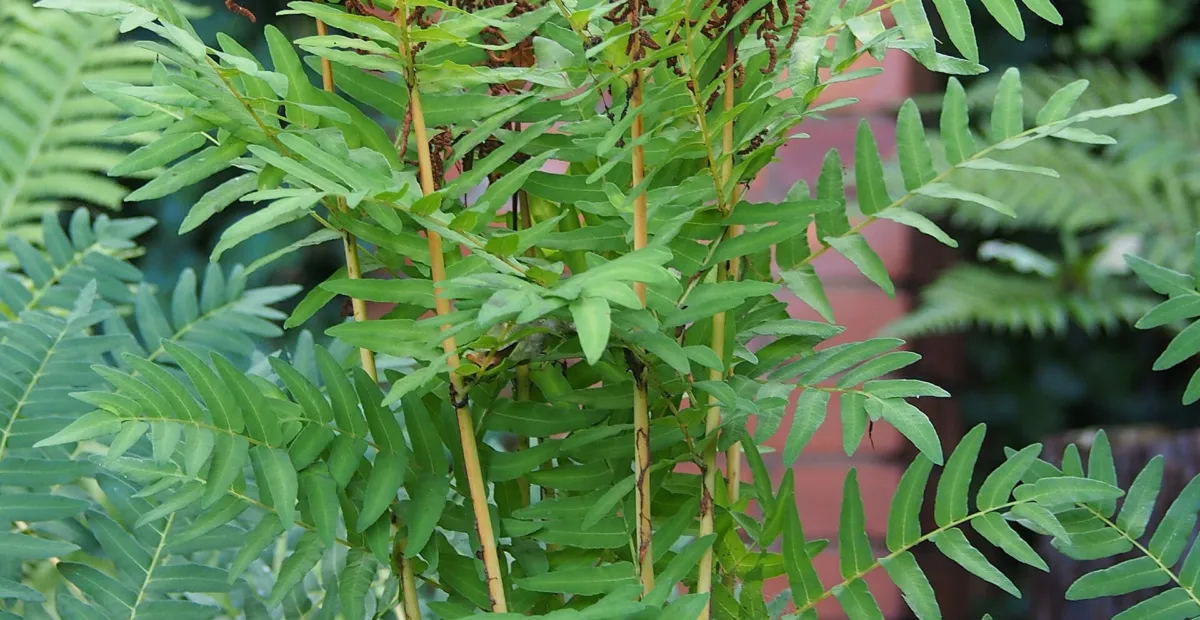
Royal Fern (Osmunda regalis) is a bold, deciduous fern for consistently moist gardens, pond margins, rain gardens, and damp woodland borders. Its broad, widely spaced leaflets create an airy, architectural effect, while young fronds can emerge with pink tones before turning green. Brown spore-bearing tips appear in summer and can resemble flowers, although this plant reproduces by spores rather than seeds or true flowers.
Taxonomic classification
Royal Fern (Osmunda regalis) care guide
Light and placement
Give partial shade or dappled light for the most reliable growth, especially in warm climates. It can take nearly full sun in cool regions if soil never dries, while deep shade may produce softer, less vigorous fronds. Bleached, scorched margins indicate excessive sun or drought; sparse, weak fronds suggest insufficient light or competition.
Watering and humidity
Keep the root zone consistently moist from spring through fall, watering deeply whenever the surface begins to dry. Increase frequency during hot weather and the first growing season. A thick organic mulch helps stabilize moisture. The plant tolerates wet conditions better than repeated drying, but stagnant water around a buried crown can cause decline.
Soil and growing medium
Use moisture-retentive, humus-rich soil with good structure and reliable drainage. Acidic soil around pH 4–6 is preferred, although the species can tolerate neutral and somewhat alkaline conditions when organic matter is plentiful. Do not allow the root zone to become compacted or chronically stagnant.
Feeding
Top-dress in spring with compost, leaf mold, or a thin layer of well-rotted organic matter. If growth is weak, use a balanced fertilizer at half strength during active spring growth. Avoid heavy nitrogen feeding, late-season fertilizing, and fertilizer application to dry soil.
Growth and habit
This fern forms a slowly enlarging crown of upright to arching fronds and becomes most impressive when given uninterrupted moisture. It is deciduous, dying back after autumn frosts. Keep competing roots and drought-prone trees away from the planting site, and refresh organic mulch periodically.
Planting and repotting
Plant in spring or early fall while temperatures are moderate. Set the crown at soil level rather than burying it deeply. Space plants about 24–36 inches apart for a substantial clump, and mulch with leaf mold or compost while keeping mulch off the crown.
Repot or divide container-grown plants in early spring, before vigorous frond expansion. Use a large container with drainage holes and a moisture-retentive, organic-rich mix. Transplant promptly because the thick rhizome and roots dislike prolonged drying.
Propagation and pruning
Propagation
Sow fresh spores as soon as they are ripe on a sterile, constantly moist medium; spores are short-lived and the gametophyte stage requires patience. Established clumps can also be divided in early spring or fall, making division the more practical method for gardeners.
Pruning
Cut back dead or damaged fronds in late winter or early spring before new growth emerges. Removing old fronds after dormancy improves the display without disturbing the crown. Avoid cutting green fronds during the growing season unless they are broken or diseased.
Overwintering
Leave dormant fronds in place through winter where they provide crown protection, then remove them before spring growth. Established plants are cold hardy over a broad U.S. range. Container plants are more exposed to freezing and should be sheltered in an unheated garage or protected location in severe winters.
Uses
A strong ornamental for pond edges, rain gardens, wet borders, woodland gardens, streamside plantings, and large containers that remain moist. Its tall, architectural fronds provide seasonal structure and contrast with broad-leaved moisture-loving plants. Do not market it as edible or medicinal without species-specific safety evidence.
Appearance
The fronds are broad, bipinnate, and airy, with widely separated leaflets that can resemble locust-tree foliage. New growth may be pinkish, while mature fronds are green and arch gracefully. Fertile pinnae form congested brown clusters at the tips of otherwise familiar fronds, creating the misleading impression of flowers.
Pollination and visitors
This species has no flowers and is not documented as an animal-pollinated plant. Its reproductive spores are dispersed primarily by air currents, so it should not be promoted as a nectar or pollen resource for bees, butterflies, or other flower visitors.
Osmunda regalis photos
Click any photo for a larger view. Source, author and license are shown separately.
Diseases and pests
Diseases
Usually trouble-free outdoors. Reduce disease pressure by improving air circulation, avoiding dense overhead irrigation, and removing badly damaged or collapsed fronds. Persistent crown or root decline usually indicates poor drainage, drought stress, or unsuitable planting conditions rather than a serious foliar disease.
Pests
Outdoor plants are generally pest-free. Inspect stressed plants for slugs, snails, or occasional chewing damage, especially where foliage is dense and constantly damp. Hand-pick pests or use physical barriers before resorting to treatments.
Related diseases and pests
Only Plant Doctor profiles whose host data indicate this plant may be affected are shown here.


Toxicity and pollen
No authoritative evidence located that identifies Osmunda regalis as a known poisonous garden plant. Avoid eating it, because species-level edibility and exposure data are limited; supervise children and pets around any plant material and seek professional advice after significant ingestion.
- Pollination / pollen
- Airborne spores, not pollen
Ferns do not produce pollen; Osmunda regalis produces spores instead. Those spores are not equivalent to flowering-plant pollen, but airborne spores can still be irritating to some people. Species-specific allergy data are limited, so sensitive gardeners should avoid handling mature fertile fronds in dusty, dry conditions.
Native habitat
Naturally associated with swamps, marshes, wet woods, stream banks, moist depressions, and other sites with dependable groundwater or seasonal saturation. It favors cool, humid conditions and organic soils, but can tolerate some sun when the root zone remains wet.
Interesting fact
The species name regalis means “royal,” reflecting its imposing fronds. Fertile pinnae are concentrated at the frond tips, creating a flower-like appearance. Its fibrous rhizome material has historically been used as an orchid-growing medium.
Frequently asked questions (FAQ)
The most relevant questions about this plant, with short and direct answers.
🌱Quick care
What is Osmunda regalis commonly called in the United States?⌄
Osmunda regalis is commonly called Royal Fern. It is a large, deciduous perennial fern in the family Osmundaceae.
Is Royal Fern easy to grow?⌄
Royal Fern is relatively easy to grow when planted in consistently moist, humus-rich soil. The main challenge is preventing the root zone from drying out for extended periods.
How big does Royal Fern get?⌄
Royal Fern commonly grows about 5 to 6 feet tall and 2 to 3 feet wide in favorable conditions. Size varies with moisture, climate, soil quality, and cultivar.
Is Royal Fern hardy in the United States?⌄
Royal Fern is hardy outdoors across much of the United States, with commonly listed hardiness ranges around USDA Zones 3 through 9 or 10. Local moisture and summer heat can affect performance.
🌤️Environment and placement
Does Royal Fern grow in sun or shade?⌄
Royal Fern grows in partial shade to full shade, but it can tolerate nearly full sun when the soil remains consistently wet or very moist. Afternoon sun is more stressful in hot, dry climates.
Can Royal Fern grow in full sun?⌄
Royal Fern can grow in full sun if it has abundant, reliable moisture and relatively cool conditions. In ordinary garden soil, partial shade is safer and helps prevent frond scorch.
Where should I plant Royal Fern?⌄
Plant Royal Fern beside a pond, stream, rain garden, wet meadow, bog garden, or other site that stays reliably moist. Give it enough room to form a broad clump without crowding nearby plants.
Can Royal Fern grow in standing water?⌄
Royal Fern can tolerate very wet soil and occasional standing water, especially when the site is rich in organic matter. Avoid permanently submerged crowns or stagnant conditions that exclude oxygen from the roots.
What soil does Royal Fern need?⌄
Royal Fern prefers moist, humus-rich, acidic soil, but it can adapt to loam, clay, or peat-like conditions if moisture is dependable. The soil should retain water without leaving the crown continuously submerged.
Does Royal Fern need acidic soil?⌄
Royal Fern generally performs best in acidic soil, commonly below pH 6.0. It may tolerate less acidic ground, but poor moisture retention or alkaline, compacted soil can reduce vigor.
💧Care and problems
How often should I water Royal Fern?⌄
Water Royal Fern whenever the soil surface begins to dry so the root zone stays consistently moist. Increase watering during hot, sunny, or drought-prone weather, and do not allow prolonged drying.
Why is my Royal Fern turning brown?⌄
Royal Fern fronds usually turn brown because the soil has dried, the plant is exposed to excessive heat or sun, or the fronds are naturally aging in fall. Restore steady moisture and provide more shade if browning occurs during the growing season.
Why is my Royal Fern wilting?⌄
Wilting usually indicates inadequate moisture, especially after heat, wind, transplanting, or increased sunlight. Water deeply and check whether the soil is drying faster than the plant can tolerate.
Should Royal Fern be fertilized?⌄
Royal Fern usually needs little fertilizer when grown in rich, organic soil. If growth is weak, apply a light spring feeding formulated for acid-loving or woodland plants, avoiding heavy fertilizer around the crown.
Does Royal Fern have serious pests or diseases?⌄
Royal Fern generally has few serious pest or disease problems when grown in suitable wet, shaded conditions. Stress from drought, heat, or poor planting conditions is more likely to cause symptoms than a major disease.
Does Royal Fern lose its leaves in winter?⌄
Yes, Royal Fern is deciduous and its fronds typically yellow, brown, and die back in autumn. The plant survives winter as a crown and produces new fronds the following spring.
Should I cut back Royal Fern in fall?⌄
Cut back dead Royal Fern fronds in late fall, winter, or early spring before new growth emerges. Removing old foliage improves appearance, but leaving it until spring can provide some crown protection.
🪴Planting and repotting
When is the best time to plant Royal Fern?⌄
Plant Royal Fern in spring or early fall when temperatures are moderate and soil moisture is dependable. Spring planting is especially useful in colder regions because it gives the crown a full growing season to establish.
How far apart should Royal Fern be planted?⌄
Space Royal Fern plants about 2 to 3 feet apart for individual clumps, or farther apart when a more open planting is desired. Allow extra room in rich, wet soil where plants may reach their largest size.
Can Royal Fern grow in a container?⌄
Royal Fern can grow in a large container if the pot holds moisture, drains excess water, and provides enough room for its substantial crown and root system. Containers require more frequent watering than in-ground plantings.
Can I plant Royal Fern in clay soil?⌄
Royal Fern can grow in clay soil if it remains moist and is improved with organic matter. Avoid placing the crown in a compacted depression where water remains stagnant for long periods.
Can Royal Fern be planted near a pond?⌄
Royal Fern is well suited to planting near ponds because it prefers moist to wet soil and can tolerate occasional flooding. Keep the crown at or just above the soil surface rather than placing it underwater.
✂️Propagation and pruning
How do you propagate Royal Fern?⌄
Royal Fern can be propagated by dividing established clumps or by raising plants from spores. Division is generally the more practical method for home gardeners because spore propagation is slower and more demanding.
Can Royal Fern be grown from spores?⌄
Yes, Royal Fern can be grown from spores collected from its brown fertile fronds. Spores require carefully controlled moisture and a suitable propagation setup, and young plants usually develop much more slowly than divisions.
When should Royal Fern be divided?⌄
Divide Royal Fern in early spring before the new fronds expand, or in early fall when temperatures are mild. Replant divisions immediately and keep them consistently moist while they establish.
Can Royal Fern be divided into small pieces?⌄
Royal Fern divisions need a viable section of crown with healthy roots, so very small pieces may fail. Larger divisions establish more reliably and should be kept moist after planting.
⚠️Toxicity and safety
Is Royal Fern poisonous to people or pets?⌄
No known species-specific toxicity classification is established for Royal Fern, but evidence is limited. Do not eat the plant, and contact a poison-control professional or veterinarian if ingestion causes concern.
Is Royal Fern safe to plant around children?⌄
Royal Fern is generally grown as an ornamental fern and has no well-established species-specific toxicity classification. Because evidence is limited, supervise children around the plant and discourage chewing any part of it.
Is Royal Fern deer resistant?⌄
Royal Fern is often considered relatively resistant to deer browsing, although no plant is completely deer-proof. Pressure can vary with local deer populations and the availability of other food.
🌸Flowering and special interest
Does Royal Fern flower?⌄
Royal Fern does not produce true flowers. Its brown, tassel-like fertile fronds carry spores and create the flowering appearance responsible for the common name sometimes used for this fern.
What are the brown tassels on Royal Fern?⌄
The brown tassels at the tips of Royal Fern fronds are fertile pinnae containing sporangia and spores. They are reproductive structures, not flowers or seed pods.
When does Royal Fern produce spores?⌄
Royal Fern usually produces its conspicuous fertile structures in spring or early summer, with the spore-bearing portions becoming brown as they mature. Timing varies with climate and growing conditions.
What color are Royal Fern fronds in fall?⌄
Royal Fern fronds commonly change from green to yellow, tan, or red-brown in fall before dying back. The intensity of the color depends on weather, plant health, and local growing conditions.
Similar plants
 Azure Monkshood (Aconitum carmichaelii) care guideAconitum carmichaelii
 Monkshood (Aconitum ‘Stainless Steel’)Aconitum 'Stainless Steel'
 Monkshood (Aconitum ‘Bressingham Spire’)Aconitum 'Bressingham Spire'
 Golden full moon maple (Acer shirasawanum ‘Aureum’)Acer shirasawanum 'Aureum'
 Globosum (Acer platanoides ‘Globosum’)Acer platanoides 'Globosum'
 Striped maple (Acer pensylvanicum) care guideAcer pensylvanicum