 Source:
 Hollyleaved Barberry (Mahonia aquifolium) short overview
Hollyleaved Barberry is an evergreen North American shrub valued for glossy, sharply toothed foliage, bright yellow spring flowers, and clusters of blue-purple berries. It forms a useful woodland, hedge, or foundation planting in well-drained soil and tolerates partial shade better than many flowering shrubs. Plants establish best with regular moisture, while mature specimens can handle short dry periods. The berries attract birds, but their tart flavor and berberine content call for sensible handling around children and pets.
Taxonomic classification
Hollyleaved Barberry (Mahonia aquifolium) care guide
Light and placement
Grow in full sun to partial shade; in hot-summer regions, morning sun with afternoon shade helps preserve foliage color and reduces drought stress. Sheltered woodland edges and north- or east-facing exposures work well. Sparse growth and weak flowering can indicate excessive shade, while bleached leaves, scorch, or premature leaf drop suggest intense heat, reflected sun, or drought.
Watering and humidity
Water deeply when the upper few inches of soil begin to dry, directing water to the root zone rather than repeatedly wetting the foliage. Keep newly planted shrubs evenly moist during their first growing season. Reduce frequency after establishment, but water during prolonged summer drought or before the ground freezes. Average humidity is adequate; extra misting is unnecessary outdoors.
Soil and growing medium
Use fertile soil that drains freely but retains enough moisture for steady growth. Loam improved with compost is suitable; avoid persistently waterlogged sites, where roots may decline. A slightly acidic to neutral reaction is appropriate. Heavy clay should be amended broadly with organic matter and planted slightly high rather than placed in a water-holding pocket.
Feeding
Apply a thin layer of compost or a restrained, balanced slow-release fertilizer in early spring as new growth begins. Water after feeding. Avoid heavy nitrogen applications, which can produce lush, softer growth at the expense of a compact habit and may increase stress during drought. Do not fertilize during late summer or while the plant is dormant.
Growth and habit
This species forms a branched, upright shrub and may gradually broaden through basal shoots. Its evergreen structure gives year-round presence, while suckering or low branches can help create a dense screen. Allow room for natural spread, and remove poorly placed basal shoots selectively if a tidier outline is wanted.
Planting and repotting
Plant in a broad hole no deeper than the root ball and two to three times its width. Loosen circling roots, backfill with native soil amended modestly with compost, and water thoroughly. Mulch 2–3 inches deep while keeping mulch away from stems. Maintain regular irrigation through the first growing season, especially during dry weather.
For container culture, repot in early spring before strong new growth, moving up only one container size. Use a sturdy, well-drained shrub or patio-tree mix and ensure drainage holes remain open. Root-prune lightly only when necessary. Containers expose roots to greater cold and drought than garden soil, so monitor moisture and winter protection carefully.
Propagation and pruning
Propagation
Propagate from seed, semi-ripe cuttings, or layering. Freshly cleaned seed generally benefits from a period of cold, moist stratification and may germinate unevenly. Take cuttings in summer from healthy, nonflowering shoots and keep them evenly moist under high humidity. Layering is slower but straightforward for low flexible stems.
Pruning
Prune after flowering or selectively remove unwanted basal shoots at any time during active growth. Thin congested, damaged, or crossing stems rather than shearing heavily. Renewal pruning can remove the oldest stems at the base, but avoid removing all flowering wood if berries are desired.
Overwintering
Plants in the ground are generally winter hardy in USDA Zones 5–8. Apply mulch over the root zone before severe cold, especially for newly planted shrubs. In exposed locations, protect foliage from drying winter wind with a sheltered placement or temporary windbreak. Container specimens need insulation around the pot and should not be allowed to become completely dry.
Uses
Useful as an evergreen foundation shrub, informal hedge, woodland-edge planting, shade-tolerant accent, or wildlife-garden component. Its flowers support early-season bees and its berries are used by birds. Some references describe the ripe fruit as edible after preparation, but identification must be certain and portions should be limited; do not treat the plant as a medicinal remedy.
Appearance
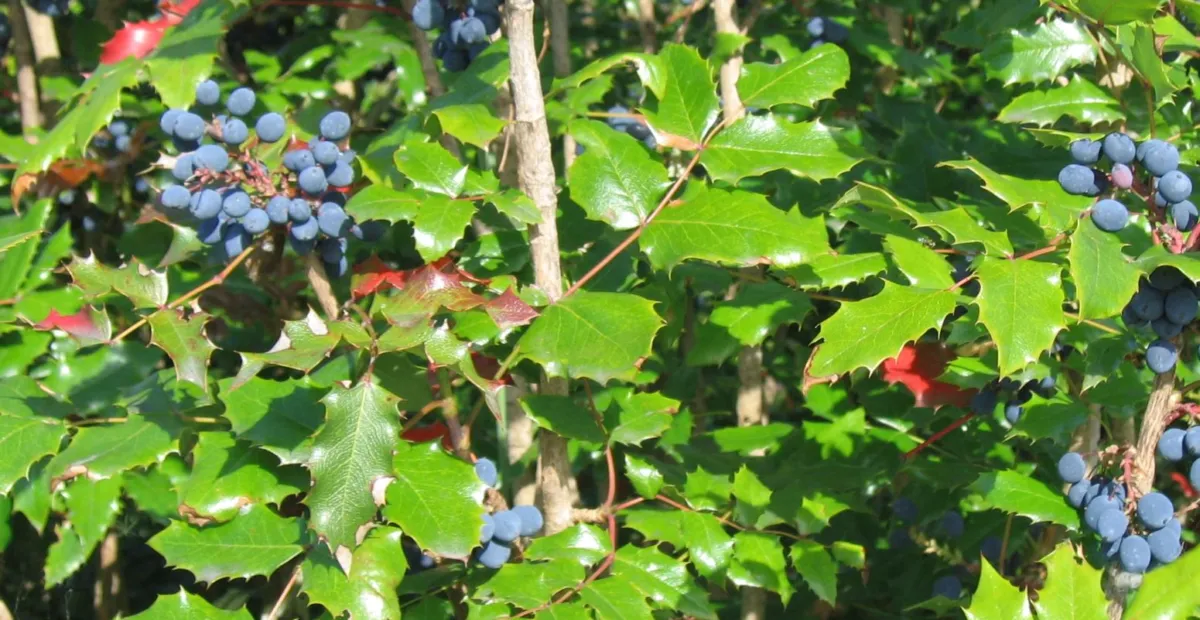
Leaves are leathery and pinnate, with multiple glossy leaflets ending in sharp, holly-like teeth. Young foliage may show bronze or reddish tones before becoming deep green. Stems are woody and upright to arching. Yellow flower clusters appear above the foliage, followed by rounded blue-purple berries with a waxy bloom.
Flowering
Small yellow flowers are arranged in conspicuous terminal racemes and open in spring. The flowers provide an early-season nectar and pollen resource, and successful pollination is followed by blue-purple berries that mature later in the season. Flowering is usually strongest in brighter exposures with adequate spring moisture.
Pollination and visitors
Open yellow flowers provide accessible nectar and pollen and are documented as attractive to bees, including native bee visitors. Pollination is animal-mediated rather than wind-driven. Berry production can be reduced when flowering conditions are poor or pollinator activity is limited.
Mahonia aquifolium photos
Click any photo for a larger view. Source, author and license are shown separately.
Diseases and pests
Diseases
Avoid chronic wet soil and improve air circulation to reduce root and foliar problems. Watch for leaf spots, rust-like discoloration, or stem dieback. Remove affected leaves, prune damaged tissue into healthy wood, sanitize tools, and water at the soil line. Confirm the diagnosis before using a fungicide, and follow the product label.
Pests
Scale insects, aphids, and occasional chewing insects may occur. Inspect new growth and leaf undersides regularly. Use a strong water spray for light aphid infestations, hand-remove localized pests, and encourage natural enemies. Horticultural oil or insecticidal soap can be used when appropriate and according to the label; avoid spraying open flowers when bees are active.
Toxicity and pollen
ASPCA lists Mahonia aquifolium as non-toxic to dogs, cats, and horses. Human references commonly describe the ripe berries as edible after preparation, while noting berberine and possible stomach upset. Because species identification, ripeness, preparation, and individual sensitivity matter, discourage children from eating plant parts and seek medical advice after significant ingestion.
- Typical season
- Spring, typically April–May in much of the United States
- Pollination / pollen
- Insect-carried pollen released from open flowers
The flowers produce pollen, but the species is insect-pollinated and its pollen is primarily carried by visiting bees rather than dispersed freely by wind. That usually limits airborne exposure compared with wind-pollinated plants, but it does not make allergy risk impossible for sensitive people working directly among flowering shrubs.
Native habitat
In its native range, Hollyleaved Barberry occurs in forest margins, open coniferous and mixed woodlands, rocky slopes, streamside areas, and other well-drained sites. It tolerates seasonal summer dryness but performs best where roots can access moisture and organic matter. Natural populations are associated mainly with western North American climates and landscapes.
Interesting fact
The species has also been treated taxonomically under the name Berberis aquifolium. Its common name reflects the holly-like teeth on the leaflets, not a close relationship to true hollies. It is Oregon’s state flower. The blue-purple fruits carry a conspicuous waxy coating and are important to wildlife.
Frequently asked questions (FAQ)
The most relevant questions about this plant, with short and direct answers.
🌱Quick care
How do you care for Hollyleaved Barberry (Mahonia aquifolium)?⌄
Grow Hollyleaved Barberry in full sun to shade, using moist, well-drained soil and moderate water. It becomes somewhat drought tolerant after establishment but performs best when protected from hot, dry conditions.
Is Hollyleaved Barberry evergreen?⌄
Yes, Hollyleaved Barberry is an evergreen shrub in most suitable climates. Its glossy, holly-like leaves may turn bronze, red, or purplish in winter, especially in colder or sunnier sites.
🌤️Environment and placement
How much sunlight does Mahonia aquifolium need?⌄
Mahonia aquifolium grows in full sun, partial shade, or shade. Partial shade is often best in hot, dry regions, while more sun can encourage denser growth and stronger flowering where moisture is adequate.
Can Hollyleaved Barberry grow in full shade?⌄
Yes, Hollyleaved Barberry can grow in full shade, although it may become more open and produce fewer flowers. Bright filtered light or partial shade usually provides a better balance of foliage quality and bloom.
What USDA hardiness zones can grow Hollyleaved Barberry?⌄
Hollyleaved Barberry is generally cold hardy from about USDA Zones 5 through 8, although exact performance varies by cultivar and local exposure. Protect young plants from severe drying winter winds.
Is Hollyleaved Barberry deer resistant?⌄
Hollyleaved Barberry is often considered resistant to deer browsing because of its spiny foliage, although no shrub is completely deer proof. Browsing pressure and local deer behavior can affect results.
💧Care and problems
Is Hollyleaved Barberry drought tolerant?⌄
Established Hollyleaved Barberry is somewhat drought tolerant, but it is not a reliable choice for hot, permanently dry sites. Water new plants regularly and provide mulch to moderate soil moisture and temperature.
How often should you water Mahonia aquifolium?⌄
Water Mahonia aquifolium when the upper few inches of soil begin to dry, applying water deeply rather than lightly and frequently. Newly planted shrubs need more consistent irrigation than established plants.
Does Hollyleaved Barberry spread by suckers or runners?⌄
Yes, Hollyleaved Barberry can spread from the base by suckers or short underground stems, especially when established. Remove unwanted shoots at their origin if you want to keep the shrub within a defined area.
Why is my Hollyleaved Barberry losing leaves or developing brown leaf edges?⌄
Brown leaf edges or leaf loss commonly indicate drought stress, hot exposure, winter wind, root problems, or leaf scorch. Check soil moisture and drainage first, then move or protect the shrub if the site is excessively hot or exposed.
What pests and diseases affect Mahonia aquifolium?⌄
Mahonia aquifolium is generally trouble free, but it can experience leaf spots, rusts, leaf scorch, scale, whiteflies, aphids, or root weevils. Improve air circulation, avoid overhead watering, and investigate persistent symptoms before treating.
🪴Planting and repotting
What soil is best for Mahonia aquifolium?⌄
Use moist, well-drained loam enriched with organic matter, preferably slightly acidic soil. Avoid compacted or poorly drained ground, as consistently wet roots can lead to decline.
When is the best time to plant Mahonia aquifolium?⌄
Plant Mahonia aquifolium in spring or fall when temperatures are moderate and the soil can be worked. Fall planting is useful where winters are mild, while spring is safer in colder regions.
How far apart should Hollyleaved Barberry be planted?⌄
Space Hollyleaved Barberry according to the mature size of the cultivar, commonly about 3 to 6 feet apart for hedge or mass plantings. Allow extra room for taller, spreading forms and check the nursery label before planting.
Can Hollyleaved Barberry grow in containers?⌄
Hollyleaved Barberry can grow in a large container for a limited time, especially a compact cultivar. Use a pot with drainage, a well-drained organic potting mix, and winter protection because container roots are less cold hardy than roots in the ground.
✂️Propagation and pruning
How do you prune Hollyleaved Barberry?⌄
Prune Hollyleaved Barberry after flowering or whenever corrective pruning is needed. Remove dead, damaged, crossing, or overly old stems at the base, and use light tip pruning to encourage fuller growth.
Can you cut Hollyleaved Barberry back hard?⌄
Yes, established Hollyleaved Barberry generally tolerates hard renewal pruning. Remove no more than about one-third of the oldest stems in one season unless the shrub is severely overgrown and recovery can be monitored.
How do you propagate Mahonia aquifolium?⌄
Mahonia aquifolium can be propagated by seed, root cuttings, or rooted suckers. Seed usually requires cleaning and a period of cold, moist stratification, so vegetative methods are often more practical for home gardeners.
⚠️Toxicity and safety
Are Hollyleaved Barberry berries edible?⌄
The berries are reported as edible when fully ripe and are traditionally used in products such as jam, but they are sharply acidic and should not be eaten casually. Do not consume berries unless the plant is positively identified and properly prepared.
Is Hollyleaved Barberry poisonous to dogs and cats?⌄
ASPCA lists Mahonia aquifolium as non-toxic to dogs, cats, and horses. Even non-toxic plant material can cause stomach upset if eaten in quantity, so contact a veterinarian if an animal shows symptoms after ingestion.
Do Hollyleaved Barberry leaves have thorns?⌄
Yes, Hollyleaved Barberry leaves have stiff, spine-tipped margins that can scratch skin. Wear gloves when planting, pruning, or handling the shrub, and avoid placing it beside narrow walkways or play areas.
🌸Flowering and special interest
Why is my Hollyleaved Barberry not flowering?⌄
Poor flowering is often caused by deep shade, severe pruning at the wrong time, drought stress, or a young plant that is still establishing. Provide adequate light and moisture, and prune after bloom rather than before it.
When does Hollyleaved Barberry bloom?⌄
Hollyleaved Barberry usually blooms from late winter through spring, with regional timing varying from roughly February to May. Its flowers are bright yellow and appear in upright clusters near the ends of branches.
Does Mahonia aquifolium produce berries?⌄
Yes, Mahonia aquifolium produces blue to blue-black berries with a powdery bloom after flowering, typically ripening in summer. Fruit production is usually better when the shrub receives adequate light and moisture during flowering and fruit set.
Is Mahonia aquifolium good for pollinators?⌄
Yes, the yellow flowers of Mahonia aquifolium can provide forage for bees and other early-season insects. Its berries may also benefit birds and other wildlife after flowering.