
 Source:
 Cranesbill (Geranium ‘Johnson’s Blue’) short overview
Geranium 'Johnson's Blue' is a spreading hardy cranesbill with deeply cut green foliage and large violet-blue flowers. This rhizomatous perennial suits sunny borders, cottage gardens, rock gardens, containers and informal groundcover planting. It grows best in well-drained soil with regular moisture during establishment, tolerates some drought once mature, and can flower from late spring into summer, with lighter rebloom after cutting back.
Taxonomic classification
Cranesbill (Geranium ‘Johnson’s Blue’) care guide
Light and placement
Grow in full sun to partial shade. In cooler regions, an open west- or south-facing bed can support heavier flowering. In hot-summer climates, morning sun with afternoon shade is often preferable. Sparse, stretched stems and reduced flowering suggest insufficient light; scorched leaves, rapid wilting, or faded flowers suggest excessive heat or reflected afternoon sun.
Watering and humidity
Water deeply when the upper soil begins to dry, rather than sprinkling lightly. Keep new plantings evenly moist through their first season; established plants can tolerate short dry periods but flower better with moisture during bud formation and bloom. Reduce watering in cool weather and winter, especially in heavy soil or containers. Average humidity is adequate.
Soil and growing medium
Use average, moderately fertile soil that drains freely but does not dry rapidly. A loam amended with compost suits this cultivar well. It prefers moist, organic soil, but established plants tolerate periodic dryness. Avoid persistently saturated ground, especially in winter. A slightly acidic to neutral soil reaction is a reasonable horticultural range; exact cultivar-specific pH data are not consistently published.
Feeding
Apply a thin layer of compost in spring or use a balanced, slow-release perennial fertilizer at label strength when growth begins. Avoid heavy nitrogen feeding, which can produce floppy foliage at the expense of flowering. Do not fertilize drought-stressed, newly divided, or dormant plants until they are actively growing.
Growth and habit
The plant develops from rhizomes into a dense, spreading mound. Flowering stems may lean or flop after the first flush, especially in rich soil or shade. Cutting back spent stems can refresh the clump, improve its outline, and encourage later flowering without harming the perennial crown.
Planting and repotting
Plant in spring or early fall, setting the crown at the same depth as in its nursery container. Space plants about 24–30 inches apart to allow the broad mound to develop. Water deeply after planting and keep the root zone evenly moist during the first growing season. Mulch lightly, keeping mulch away from the crown.
For containers, repot in spring when roots fill the pot or growth becomes crowded. Move the plant into fresh, well-drained potting mix and a container only modestly larger than the root ball. Divide an overgrown plant at the same time if desired. Ensure drainage holes are open and avoid leaving the pot standing in water.
Propagation and pruning
Propagation
Divide established clumps in spring or early fall, separating pieces with healthy roots and shoots. Basal or softwood cuttings may also be possible during active growth, though division is the most practical method for preserving the cultivar. Seed may not come true to 'Johnson's Blue' because it is a hybrid.
Pruning
After the first major flowering flush, cut back tired or sprawling stems to the basal foliage or remove selected side stems to control spread. This can encourage fresh leaves and later flowers. Remove dead foliage after dormancy or in early spring, depending on local winter conditions.
Overwintering
Plants are dormant and herbaceous in winter. Leave healthy stems standing until late fall or early spring if they provide shelter and winter interest, then remove dead material before new growth begins. In containers, protect the root ball from repeated hard freezing by grouping pots in a sheltered location or sinking them into the ground.
Uses
Useful in perennial borders, cottage gardens, rock gardens, containers, mass plantings, and informal groundcover. Its flowers support ornamental pollinator planting, and its dense foliage can help cover open soil. It is not documented here as an edible or medicinal plant.
Appearance
The plant has deeply divided, dark green leaves and soft, herbaceous stems that rise from a rhizomatous crown. Its broad mound can spread outward, while the flower stems may arch after blooming. The combination of cut foliage, large blue-violet saucers, and crane-bill seed capsules is distinctive among hardy garden geraniums.
Flowering
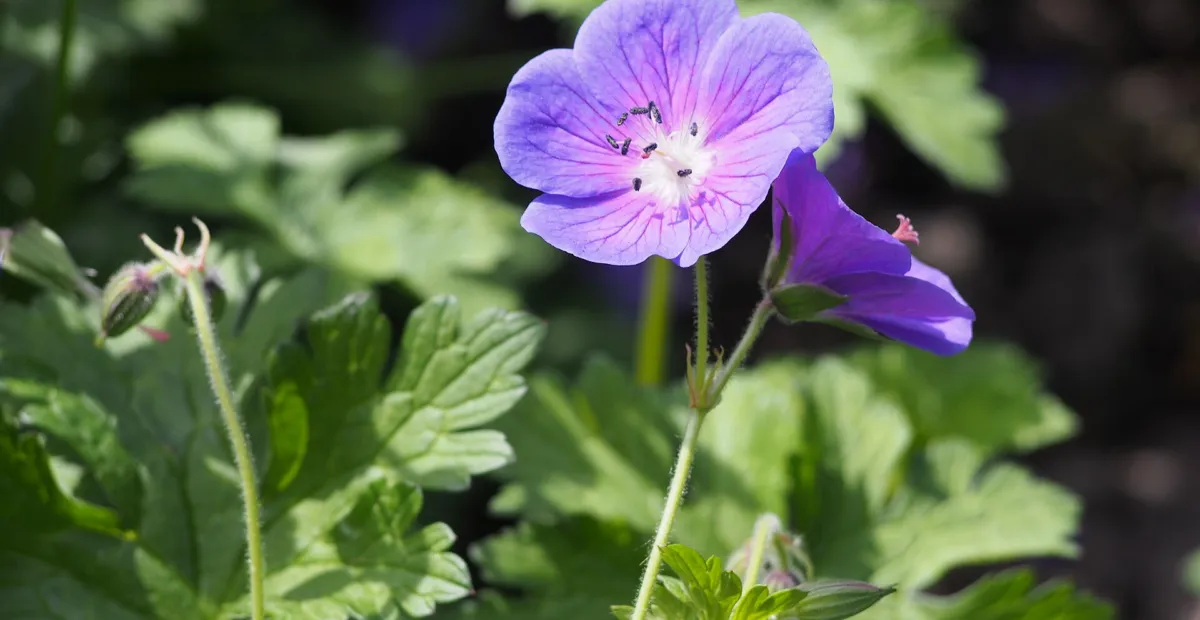
Large, five-petaled, saucer-shaped flowers are borne in clusters above the foliage. Bloom generally begins in late spring or early summer. In cooler climates flowering can continue through summer; heat may shorten the main flush, followed by lighter rebloom after cutting back.
Pollination and visitors
The flowers are documented as attractive to butterflies and are included in pollinator-oriented horticultural guidance. The open, nectar-bearing flower structure can provide access for insect visitors, but cultivar-specific records naming a particular pollinator species are not established here.
Geranium 'Johnson's Blue' photos
Click any photo for a larger view. Source, author and license are shown separately.
Diseases and pests
Diseases
Usually trouble-free, but leaf spots and rust can occur, particularly where foliage stays wet or air circulation is poor. Water at the soil line, avoid overcrowding, remove badly affected leaves, and cut back and discard spent foliage at the end of the season. Do not compost diseased material.
Pests
Generally resistant to serious pest pressure, though aphids, vine weevil larvae, slugs, and snails may occur depending on site. Inspect new growth and container plants regularly. Improve drainage, remove hiding debris, and use proportionate controls only when damage is significant.
Related diseases and pests
Only Plant Doctor profiles whose host data indicate this plant may be affected are shown here.

Toxicity and pollen
Reliable sources specifically evaluating Geranium 'Johnson's Blue' for human or pet toxicity are limited. Poison-control information commonly labeled “geranium” concerns Pelargonium species, which are taxonomically different from hardy Geranium. Do not treat that Pelargonium evidence as proof of toxicity or safety for this cultivar. Discourage ingestion and seek medical or veterinary advice after substantial exposure.
- Typical season
- Late spring through summer during flowering
- Pollination / pollen
- Insect-dispersed pollen
This is an insect-pollinated flowering perennial, so pollen is generally transferred by flower visitors rather than deliberately released into the air. That suggests a lower airborne exposure potential than wind-pollinated plants, but it does not establish zero allergy risk. Individual sensitivity and close contact with flowers can still matter.
Native habitat
This cultivated hybrid does not have a single native wild habitat. Its reported parentage combines temperate Eurasian Geranium species associated with open meadows, woodland margins, and well-drained soils. In gardens it adapts to ordinary, moderately moist soil and performs best where roots remain cool but are not waterlogged.
Interesting fact
‘Johnson’s Blue’ appeared in English gardens in the 1950s and is widely reported as a hybrid of Geranium himalayense and G. pratense. Its rhizomatous habit helps it form broad, dense clumps. The genus name Geranium refers to the crane-bill-like seed capsule.
Frequently asked questions (FAQ)
The most relevant questions about this plant, with short and direct answers.
🌱Quick care
What is Geranium 'Johnson's Blue'?⌄
Geranium 'Johnson's Blue' is a hardy herbaceous cranesbill perennial grown for large sky-blue to violet-blue flowers and deeply cut foliage. It typically forms a spreading mound about 12–18 inches tall and 2–3 feet wide. ([missouribotanicalgarden.org](https://www.missouribotanicalgarden.org/PlantFinder/PlantFinderDetails.aspx?basic=Geranium%25&isprofile=0&taxonid=245610&utm_source=openai))
How much sun does Geranium 'Johnson's Blue' need?⌄
Grow Geranium 'Johnson's Blue' in full sun to partial shade. In hot-summer regions, some afternoon shade can help reduce stress and prolong flowering. ([missouribotanicalgarden.org](https://www.missouribotanicalgarden.org/PlantFinder/PlantFinderDetails.aspx?basic=Geranium%25&isprofile=0&taxonid=245610&utm_source=openai))
How often should I water Geranium 'Johnson's Blue'?⌄
Water Geranium 'Johnson's Blue' moderately, keeping the soil evenly moist while the plant establishes and during extended dry periods. Once established, it has some drought tolerance, but regular deep watering supports better growth and flowering. ([missouribotanicalgarden.org](https://www.missouribotanicalgarden.org/PlantFinder/PlantFinderDetails.aspx?basic=Geranium%25&isprofile=0&taxonid=245610&utm_source=openai))
Is Geranium 'Johnson's Blue' a hardy geranium or a true geranium?⌄
Geranium 'Johnson's Blue' is a hardy geranium, also called a cranesbill, in the genus Geranium. It is different from tender florist or scented geraniums, which belong to the genus Pelargonium. ([missouribotanicalgarden.org](https://www.missouribotanicalgarden.org/PlantFinder/PlantFinderDetails.aspx?basic=Geranium%25&isprofile=0&taxonid=245610&utm_source=openai))
🌤️Environment and placement
What USDA hardiness zones are suitable for Geranium 'Johnson's Blue'?⌄
Geranium 'Johnson's Blue' is generally grown in USDA Zones 4–8, although some nursery references list a broader range. In colder areas, the foliage dies back in winter and regrows from the crown in spring. ([missouribotanicalgarden.org](https://www.missouribotanicalgarden.org/PlantFinder/PlantFinderDetails.aspx?basic=Geranium%25&isprofile=0&taxonid=245610&utm_source=openai))
Can Geranium 'Johnson's Blue' grow in shade?⌄
Yes, Geranium 'Johnson's Blue' can grow in partial shade, especially with morning sun or filtered light. Too much shade may reduce flowering and make the plant more open or floppy. ([missouribotanicalgarden.org](https://www.missouribotanicalgarden.org/PlantFinder/PlantFinderDetails.aspx?basic=Geranium%25&isprofile=0&taxonid=245610&utm_source=openai))
What type of soil is best for Geranium 'Johnson's Blue'?⌄
Use well-drained, moderately fertile soil enriched with organic matter. It tolerates ordinary loam and can adapt to sandy or clay soil if drainage is adequate and the soil is not persistently waterlogged. ([missouribotanicalgarden.org](https://www.missouribotanicalgarden.org/PlantFinder/PlantFinderDetails.aspx?basic=Geranium%25&isprofile=0&taxonid=245610&utm_source=openai))
Is Geranium 'Johnson's Blue' drought tolerant?⌄
Established Geranium 'Johnson's Blue' plants have moderate drought tolerance, but they perform best with regular watering during prolonged heat or drought. Do not keep the soil constantly saturated. ([missouribotanicalgarden.org](https://www.missouribotanicalgarden.org/PlantFinder/PlantFinderDetails.aspx?basic=Geranium%25&isprofile=0&taxonid=245610&utm_source=openai))
How wide does Geranium 'Johnson's Blue' spread?⌄
Geranium 'Johnson's Blue' commonly spreads about 2–3 feet wide. Give individual plants roughly 20–24 inches of space if you want them to fill in without excessive crowding. ([missouribotanicalgarden.org](https://www.missouribotanicalgarden.org/PlantFinder/PlantFinderDetails.aspx?basic=Geranium%25&isprofile=0&taxonid=245610&utm_source=openai))
Is Geranium 'Johnson's Blue' good for containers?⌄
Yes, Geranium 'Johnson's Blue' can grow in containers if the pot has drainage holes and is large enough for its spreading root system. Use a well-drained potting mix and water when the surface begins to dry. ([gurneys.com](https://www.gurneys.com/products/johnsons-blue-geranium?utm_source=openai))
💧Care and problems
Why is my Geranium 'Johnson's Blue' flopping?⌄
Geranium 'Johnson's Blue' can become floppy after its first major flush of flowers, particularly in rich soil, partial shade, or hot weather. Cut the plant back after flowering to encourage fresh basal growth and restore a neater mound. ([perennials.com](https://www.perennials.com/plants/geranium-johnsons-blue.html?utm_source=openai))
Should I deadhead Geranium 'Johnson's Blue'?⌄
Deadhead Geranium 'Johnson's Blue' by removing faded flower stems to improve its appearance and encourage additional flowering. Deadheading is optional because the plant can also produce attractive crane-bill-shaped seed capsules. ([gurneys.com](https://www.gurneys.com/products/johnsons-blue-geranium?utm_source=openai))
When should I cut back Geranium 'Johnson's Blue'?⌄
Cut Geranium 'Johnson's Blue' back after its main bloom flush or whenever the stems become untidy. Remove dead foliage and stems in fall after the plant becomes dormant, or leave them until late winter for added protection. ([missouribotanicalgarden.org](https://www.missouribotanicalgarden.org/PlantFinder/PlantFinderDetails.aspx?basic=Geranium%25&isprofile=0&taxonid=245610&utm_source=openai))
How do I encourage Geranium 'Johnson's Blue' to rebloom?⌄
Remove faded flowers and cut back tired or floppy stems after the first bloom period. In favorable conditions, this can stimulate fresh foliage and a lighter late-summer or early-fall rebloom. ([missouribotanicalgarden.org](https://www.missouribotanicalgarden.org/PlantFinder/PlantFinderDetails.aspx?basic=Geranium%25&isprofile=0&taxonid=245610&utm_source=openai))
What problems affect Geranium 'Johnson's Blue'?⌄
Geranium 'Johnson's Blue' usually has few serious pest or disease problems, but leaf spot and rust can occur. Improve air circulation, avoid wetting the foliage late in the day, and remove heavily affected leaves. ([missouribotanicalgarden.org](https://www.missouribotanicalgarden.org/PlantFinder/PlantFinderDetails.aspx?basic=Geranium%25&isprofile=0&taxonid=245610&utm_source=openai))
Does Geranium 'Johnson's Blue' need fertilizer?⌄
Geranium 'Johnson's Blue' generally needs little fertilizer when grown in moderately fertile soil containing organic matter. A light annual application of balanced perennial fertilizer in spring is usually sufficient; excessive nitrogen can encourage weak, leafy growth. ([missouribotanicalgarden.org](https://www.missouribotanicalgarden.org/PlantFinder/PlantFinderDetails.aspx?basic=Geranium%25&isprofile=0&taxonid=245610&utm_source=openai))
Is Geranium 'Johnson's Blue' deer resistant?⌄
Geranium 'Johnson's Blue' is commonly described as deer tolerant or avoided by deer, although no plant is completely deer-proof. Browsing pressure can vary with local wildlife conditions and available food. ([missouribotanicalgarden.org](https://www.missouribotanicalgarden.org/PlantFinder/PlantFinderDetails.aspx?basic=Geranium%25&isprofile=0&taxonid=245610&utm_source=openai))
Is Geranium 'Johnson's Blue' rabbit resistant?⌄
Geranium 'Johnson's Blue' is reported to have some rabbit resistance. Protection may still be needed where rabbit pressure is high, particularly while new growth is tender. ([missouribotanicalgarden.org](https://www.missouribotanicalgarden.org/PlantFinder/PlantFinderDetails.aspx?basic=Geranium%25&isprofile=0&taxonid=245610&utm_source=openai))
🪴Planting and repotting
When is the best time to plant Geranium 'Johnson's Blue'?⌄
Plant Geranium 'Johnson's Blue' in spring or early fall while temperatures are moderate. Spring planting is especially useful in colder regions, while fall planting allows roots to establish before winter. ([brecks.com](https://www.brecks.com/products/geranium-johnson-blue?utm_source=openai))
How deep should I plant Geranium 'Johnson's Blue'?⌄
Plant Geranium 'Johnson's Blue' at the same depth it was growing in its nursery container, with the crown at or just above soil level. For bare-root plants, position the shoots just below the soil surface and spread the roots naturally. ([brecks.com](https://www.brecks.com/products/geranium-johnson-blue?utm_source=openai))
How far apart should I plant Geranium 'Johnson's Blue'?⌄
Space Geranium 'Johnson's Blue' about 20–24 inches apart for a filled-in border or groundcover planting. Wider spacing gives better airflow, while closer spacing produces faster visual coverage. ([brecks.com](https://www.brecks.com/products/geranium-johnson-blue?utm_source=openai))
Can Geranium 'Johnson's Blue' grow in clay soil?⌄
Geranium 'Johnson's Blue' can tolerate clay soil if it drains well. Incorporate organic matter and avoid planting in a low spot where water remains around the crown. ([missouribotanicalgarden.org](https://www.missouribotanicalgarden.org/PlantFinder/PlantFinderDetails.aspx?basic=Geranium%25&isprofile=0&taxonid=245610&utm_source=openai))
Can Geranium 'Johnson's Blue' be grown as ground cover?⌄
Yes, its dense, spreading habit makes Geranium 'Johnson's Blue' useful as a groundcover beneath or around taller perennials. Allow enough room for its 2–3-foot spread and trim the stems if they encroach on nearby plants. ([missouribotanicalgarden.org](https://www.missouribotanicalgarden.org/PlantFinder/PlantFinderDetails.aspx?basic=Geranium%25&isprofile=0&taxonid=245610&utm_source=openai))
✂️Propagation and pruning
How do I propagate Geranium 'Johnson's Blue'?⌄
The most practical way to propagate Geranium 'Johnson's Blue' is by dividing established plants in spring or fall. Seed may not reproduce the named cultivar reliably, so division is preferred when you want plants true to type. ([perennials.com](https://www.perennials.com/plants/geranium-johnsons-blue.html?utm_source=openai))
Can I divide Geranium 'Johnson's Blue' in spring?⌄
Yes, divide Geranium 'Johnson's Blue' in early spring as new growth begins. Lift the clump, separate sections with healthy roots and shoots, replant them promptly, and keep them evenly watered while they establish. ([perennials.com](https://www.perennials.com/plants/geranium-johnsons-blue.html?utm_source=openai))
Can Geranium 'Johnson's Blue' be divided in fall?⌄
Yes, fall division is suitable where plants have enough time to root before the ground freezes. Divide after flowering and avoid late-season disturbance in areas with an early, severe winter. ([perennials.com](https://www.perennials.com/plants/geranium-johnsons-blue.html?utm_source=openai))
Does Geranium 'Johnson's Blue' self-seed?⌄
Geranium 'Johnson's Blue' can produce distinctive seed capsules, but self-seeding is not usually its main method of spread. Any seedlings may differ from the named cultivar, so remove developing seed heads if you want to limit volunteer plants. ([missouribotanicalgarden.org](https://www.missouribotanicalgarden.org/PlantFinder/PlantFinderDetails.aspx?basic=Geranium%25&isprofile=0&taxonid=245610&utm_source=openai))
⚠️Toxicity and safety
Is Geranium 'Johnson's Blue' toxic to dogs and cats?⌄
The exact toxicity status of Geranium 'Johnson's Blue' is uncertain, so do not allow pets to eat it. It is a hardy Geranium cranesbill, not a Pelargonium commonly sold as a tender “geranium,” and plant identification matters; contact a veterinarian or poison service after ingestion. ([getgrowli.app](https://www.getgrowli.app/toxic-to/dogs/geranium-johnsons-blue?utm_source=openai))
Is Geranium 'Johnson's Blue' safe for people?⌄
Toxicity for this exact cultivar is not clearly established, so avoid eating any part and keep it away from children who may chew plants. Handling the plant is generally treated as ordinary garden work, but discontinue contact if skin irritation occurs.
🌸Flowering and special interest
When does Geranium 'Johnson's Blue' bloom?⌄
Geranium 'Johnson's Blue' typically blooms from late spring into summer, often beginning in May or June. In cooler climates it may flower intermittently into early fall, while hot-summer conditions can shorten the strongest bloom period. ([missouribotanicalgarden.org](https://www.missouribotanicalgarden.org/PlantFinder/PlantFinderDetails.aspx?basic=Geranium%25&isprofile=0&taxonid=245610&utm_source=openai))
What color are Geranium 'Johnson's Blue' flowers?⌄
The flowers are large, saucer-shaped, sky-blue to violet-blue, often with darker veining and subtly pinkish centers. Individual flowers can reach about 2 inches across. ([missouribotanicalgarden.org](https://www.missouribotanicalgarden.org/PlantFinder/PlantFinderDetails.aspx?basic=Geranium%25&isprofile=0&taxonid=245610&utm_source=openai))
Why is my Geranium 'Johnson's Blue' not blooming?⌄
Insufficient light, excessive nitrogen, drought, transplant stress, or intense heat can reduce flowering. Move the plant toward more sun if practical, keep moisture consistent during dry periods, and avoid heavy feeding. ([missouribotanicalgarden.org](https://www.missouribotanicalgarden.org/PlantFinder/PlantFinderDetails.aspx?basic=Geranium%25&isprofile=0&taxonid=245610&utm_source=openai))
Does Geranium 'Johnson's Blue' bloom all summer?⌄
Geranium 'Johnson's Blue' can flower for much of the summer, but the bloom is usually heaviest in late spring and early summer. Cutting back after the first flush may encourage lighter repeat flowering later in the season. ([missouribotanicalgarden.org](https://www.missouribotanicalgarden.org/PlantFinder/PlantFinderDetails.aspx?basic=Geranium%25&isprofile=0&taxonid=245610&utm_source=openai))
Does Geranium 'Johnson's Blue' attract pollinators?⌄
Yes, Geranium 'Johnson's Blue' is considered pollinator-friendly and attracts butterflies. Its open blue flowers are useful in borders, cottage gardens, and mixed perennial plantings. ([missouribotanicalgarden.org](https://www.missouribotanicalgarden.org/PlantFinder/PlantFinderDetails.aspx?basic=Geranium%25&isprofile=0&taxonid=245610&utm_source=openai))
Similar plants
 Azure Monkshood (Aconitum carmichaelii) care guideAconitum carmichaelii
 Monkshood (Aconitum ‘Stainless Steel’)Aconitum 'Stainless Steel'
 Monkshood (Aconitum ‘Bressingham Spire’)Aconitum 'Bressingham Spire'
 Golden full moon maple (Acer shirasawanum ‘Aureum’)Acer shirasawanum 'Aureum'
 Globosum (Acer platanoides ‘Globosum’)Acer platanoides 'Globosum'
 Striped maple (Acer pensylvanicum) care guideAcer pensylvanicum