
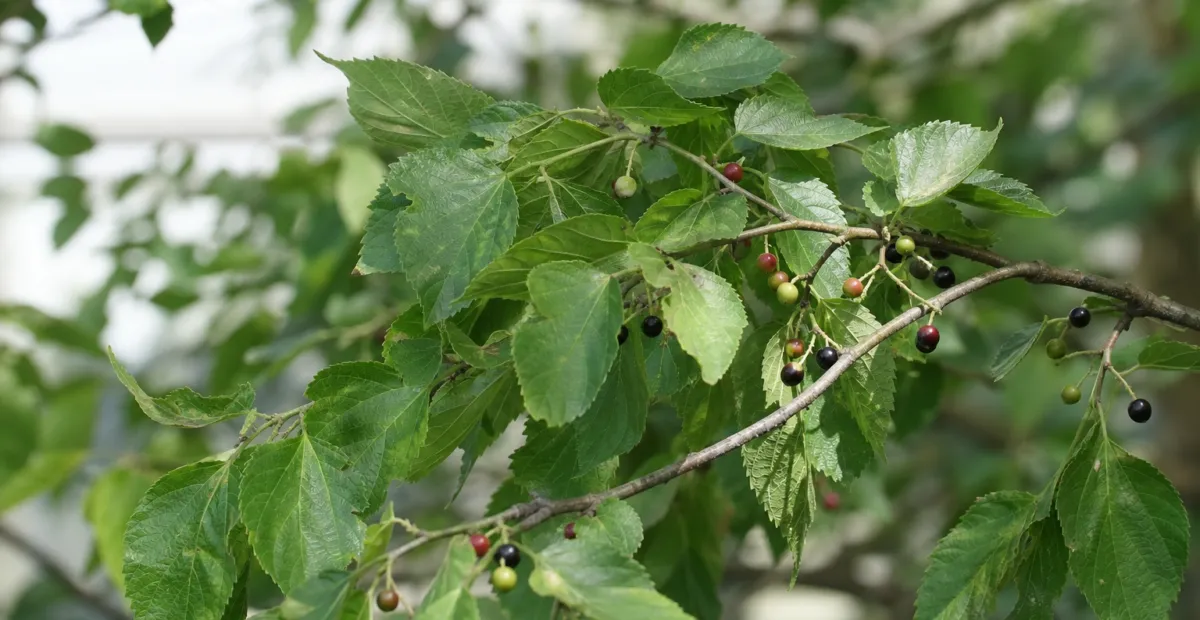
 AI-generated illustration
Beaverwood (Celtis occidentalis) short overview
Beaverwood is a long-lived, deciduous North American tree valued for its distinctive corky bark, rough asymmetrical leaves, wildlife-supporting fruit, and tolerance of urban conditions. It grows best in full sun and well-drained to moderately moist soil, but adapts to clay, sand, rocky ground, and occasional flooding once established. Small greenish flowers appear with the leaves in spring and mature into purple to reddish drupes in fall.
Taxonomic classification
Beaverwood (Celtis occidentalis) care guide
Light and placement
Plant in full sun for the strongest crown, especially in open landscapes, streetscapes, or woodland edges. Partial shade is tolerated, but deep shade can produce a thinner, less vigorous crown. Pale, sparse growth may indicate insufficient light; scorched foliage or drought stress in hot reflected sites suggests excessive heat combined with inadequate moisture rather than a need for shade alone.
Watering and humidity
Water deeply and slowly during the first two growing seasons, allowing the upper soil to dry slightly between irrigations. Once established, the tree tolerates short dry periods but performs best with consistent moisture in well-drained soil. Increase watering during prolonged summer heat and drought; avoid persistent saturation around young roots.
Soil and growing medium
Beaverwood accepts clay, loam, sand, shallow rocky soils, and high-organic-matter ground, provided drainage is adequate. Moist alluvial soils support strong growth, while established trees tolerate occasional flooding. Avoid chronically waterlogged sites for young trees. It is adaptable across mildly acidic, neutral, and alkaline soils, including limestone-derived ground.
Feeding
Established trees generally need no routine fertilizer when growing in reasonably fertile soil. If growth is weak, apply a soil-test-guided, slow-release tree fertilizer in early spring, or spread a thin layer of compost beneath the canopy without piling it against the trunk. Do not fertilize drought-stressed, newly transplanted, or late-season trees.
Growth and habit
This species develops a broad, often irregular crown with spreading or slightly drooping branches. Growth is commonly moderate to fast when young and site conditions are favorable. Its substantial mature size and durable urban tolerance make early structural training useful, particularly where clearance beneath branches or protection from weak crotches is needed.
Planting and repotting
Choose a site with ample room for a large canopy and avoid burying the root flare. Dig a broad, shallow planting hole no deeper than the root system, backfill with native soil, and mulch 2–3 inches deep while keeping mulch away from the trunk. Water thoroughly after planting and maintain regular deep irrigation during establishment.
Not normally suited to long-term container culture because it becomes a large tree and develops an extensive root system. If a young tree is grown in a container, shift it to a larger vessel before roots circle heavily, use a well-drained structural mix, and transplant to the landscape while still small.
Propagation and pruning
Propagation
Propagate primarily from seed. Clean mature drupes and provide moist cold stratification, commonly about 60–90 days near 41°F, before sowing. Seedlings transplant most successfully while small. Vegetative regeneration from sprouts is possible, but routine rooted-cutting propagation is less dependable than seed.
Pruning
Prune in late winter or early spring before vigorous growth begins, removing dead, damaged, crossing, or poorly attached branches. Train a central leader or strong scaffold structure while young if clearance is needed. Avoid topping, excessive crown reduction, and large unnecessary cuts, which encourage weak regrowth and decay.
Overwintering
No special winter protection is usually needed in the ground within its hardiness range. Protect newly planted trees from winter desiccation with adequate autumn watering and a loose mulch layer over the root zone, keeping mulch away from the trunk. Young trees in exposed sites may benefit from temporary trunk protection against animal browsing.
Uses
Useful as a shade tree, street or urban tree, windbreak component, streambank and erosion-control planting, and native wildlife tree. Its fruits are eaten by birds and small mammals, while the foliage supports hackberry-associated butterfly caterpillars. The thin-fleshed drupes are edible, but they are not a major cultivated fruit crop.
Appearance
Leaves are alternate, simple, oval to lance-shaped, sharply pointed, and noticeably asymmetrical at the base, with a coarse, rough texture and serrated margins. Young twigs often zigzag. Mature bark is gray to gray-brown and marked by conspicuous corky ridges or wart-like projections. Small drupes change from green to orange-red, purple, or dark reddish-purple.
Flowering
Flowers are produced with the emerging foliage, commonly from April into May in the United States, earlier in southern portions of the range and later farther north. The species is polygamomonoecious, with staminate and pistillate flowers occurring on the same tree. Flowers are visually insignificant but develop into single-seeded drupes after pollination.
Pollination and visitors
The species is documented as wind-pollinated rather than dependent on animal pollinators. Its ecological value is nevertheless substantial: foliage supports larvae of hackberry-associated butterflies, including hackberry emperor and American snout, and fruits feed birds and small mammals. Occasional insect visits to pollen-bearing flowers should not be confused with primary pollination.
Celtis occidentalis photos
Click any photo for a larger view. Source, author and license are shown separately.
Diseases and pests
Diseases
Common problems include witches'-broom associated with eriophyid mites, powdery mildew, leaf spots, and occasional wood decay in damaged or stressed trees. Improve air circulation, avoid unnecessary wounds, remove badly affected dead material, and water during drought. Most leaf galls are cosmetic and do not justify treatment.
Pests
Hackberry nipple galls and other Pachypsylla-related galls are characteristic and usually cosmetic. Scale insects, aphids, and caterpillars may occasionally occur. Monitor rather than automatically spray; preserve beneficial insects, improve tree vigor, and use targeted management only when pests cause sustained decline or unacceptable damage.
Related diseases and pests
Only Plant Doctor profiles whose host data indicate this plant may be affected are shown here.
Toxicity and pollen
Authoritative plant-toxicology references do not identify Celtis occidentalis as a recognized poisonous ornamental. The mature drupes are described as edible, but any plant material can cause choking, digestive upset, or individual sensitivity when eaten in quantity. Prevent children and pets from consuming large amounts, and seek professional advice if ingestion causes symptoms or if plant identity is uncertain.
- Typical season
- Typically April–May in much of the United States
- Pollination / pollen
- Light, wind-dispersed tree pollen
Because flowers are wind-pollinated, pollen is released into the air rather than transferred primarily by insects. Hackberry pollen is recognized in US airborne-pollen and allergy references, although its clinical importance varies by region and individual sensitivity. People with seasonal allergies may wish to limit exposure during spring pollen periods and keep windows closed during high outdoor pollen counts.
Native habitat
Beaverwood occurs in floodplain forests, bottomlands, woodland edges, upland slopes, limestone areas, rocky sites, and disturbed or urban landscapes. It grows across a broad moisture range, from moist alluvial soils to periodically dry ground, and mature trees can tolerate occasional spring flooding. Its native range extends from central and eastern Canada through much of the central and eastern United States.
Interesting fact
The species can live for roughly 150–200 years under favorable conditions. Its bark becomes corky and warty with age, making mature trees easy to distinguish from many elms. Fruits may remain attached well into winter or even the following spring. The tree is an important host plant for several hackberry-related butterflies.
Frequently asked questions (FAQ)
The most relevant questions about this plant, with short and direct answers.
🌱Quick care
What is beaverwood (Celtis occidentalis)?⌄
Beaverwood is a hardy, deciduous North American tree in the hackberry genus, Celtis, and the Cannabaceae family. It is also widely known in the United States as common hackberry.
How much sunlight does beaverwood need?⌄
Beaverwood grows best in full sun but also tolerates partial shade. Trees in brighter locations generally develop denser crowns and stronger growth.
How often should I water beaverwood?⌄
Water beaverwood moderately, allowing the soil to dry slightly between waterings once the tree is established. Newly planted trees need regular deep watering during their first growing season, especially during hot or dry weather.
Is beaverwood cold hardy?⌄
Yes, beaverwood is highly cold hardy and is generally suitable for USDA Zones 3 through 9. Local performance can still vary with exposure, winter injury, and soil drainage.
🌤️Environment and placement
Where should I plant beaverwood?⌄
Plant beaverwood in a location with room for a large mature shade tree and full sun to partial shade. It works well in yards, parks, boulevards, and other spacious urban settings.
What soil is best for beaverwood?⌄
Beaverwood adapts to loam, clay, sandy, or rocky soil, provided the site is reasonably well drained. It also tolerates moderately moist conditions and brief periods of wet soil better than many landscape trees.
Can beaverwood grow in clay soil?⌄
Yes, beaverwood can grow in clay soil if water does not remain stagnant around the roots. Improve drainage where necessary, but avoid heavily amending only the planting hole because that can restrict root development.
Is beaverwood drought tolerant?⌄
Established beaverwood has good tolerance of periodic drought, but it performs best with moderate moisture. Provide supplemental water during prolonged heat or drought, particularly while the tree is young.
Can beaverwood tolerate wet soil or flooding?⌄
Beaverwood tolerates moderately wet soil and short-term flooding better than many trees. It should not be planted where the roots remain continuously submerged or where drainage is permanently poor.
Is beaverwood a good street or urban tree?⌄
Beaverwood can be a good urban and street tree because it tolerates heat, wind, salt exposure, varied soils, and occasional flooding. Give it adequate overhead and underground space, and consider fruit and seed cleanup near paved areas.
How large does beaverwood get?⌄
Beaverwood commonly reaches about 40 to 70 feet tall and 25 to 45 feet wide, although size varies with soil, climate, and growing conditions. Rich, moist sites can produce larger trees.
💧Care and problems
Does beaverwood need fertilizer?⌄
Usually, established beaverwood does not need routine fertilizer when planted in reasonably fertile soil. Test the soil before feeding, and correct a documented nutrient deficiency rather than applying fertilizer automatically.
Why does beaverwood have bumps or galls on its leaves?⌄
The bumps are commonly hackberry nipple or blister galls caused by tiny psyllid insects. They can disfigure the leaves but usually cause little lasting harm, so treatment is rarely necessary on a healthy tree.
What are common problems with beaverwood?⌄
Common problems include nipple galls, witches’ brooms, leaf spot, powdery mildew, root rot, lacebugs, and scale. Most are cosmetic or manageable, but poor drainage and dead branches can increase serious stress.
What are witches’ brooms on beaverwood?⌄
Witches’ brooms are dense clusters of shortened, distorted twigs that can form on beaverwood branches. They are often unattractive but usually do little harm; prune affected branches selectively when practical.
🪴Planting and repotting
When is the best time to plant beaverwood?⌄
Plant beaverwood during the dormant season, ideally in fall after leaf drop or in early spring before new growth begins. Avoid planting frozen, waterlogged, or excessively hot, dry soil.
How do I plant a beaverwood tree?⌄
Plant beaverwood with the root flare level with or slightly above the surrounding soil, then water the root zone deeply. Apply a 2- to 3-inch layer of mulch over the root area, keeping it away from the trunk.
How far apart should beaverwood trees be planted?⌄
Space beaverwood trees according to their mature canopy, commonly about 25 to 45 feet apart in open landscapes. Use greater spacing near buildings, overhead utility lines, sidewalks, and other permanent structures.
Can beaverwood be grown in a container?⌄
Beaverwood is not a practical long-term container plant because it develops into a large tree with an extensive root system. A young tree can be container-grown temporarily, but it should be planted in the landscape before becoming root-bound.
✂️Propagation and pruning
How do you propagate beaverwood from seed?⌄
Propagate beaverwood primarily from ripe fruits or cleaned seeds, followed by a period of cold, moist stratification before sowing. Germination can be uneven, and seedlings are usually easier to establish than large transplants.
Can beaverwood be propagated from cuttings?⌄
Beaverwood is most reliably propagated from seed rather than ordinary home-garden cuttings. Vegetative propagation may be possible with specialized techniques, but it is not generally the simplest method for this species.
Can beaverwood be transplanted?⌄
Young beaverwood trees can be transplanted successfully when handled during dormancy and given consistent aftercare. Larger specimens are more difficult to move because of their extensive root systems and transplant shock.
How should beaverwood be pruned?⌄
Prune beaverwood mainly to remove dead, damaged, crossing, or poorly attached branches and to establish a strong structure while young. Make corrective cuts during the dormant season or according to local arboricultural guidance, and avoid excessive topping.
⚠️Toxicity and safety
Is beaverwood toxic to people or pets?⌄
There is no established toxicity classification for beaverwood. Its ripe, fleshy fruits are reported as edible, but plant identification should be certain and consumption should be limited because individual reactions and contamination risks can vary.
Are beaverwood berries poisonous?⌄
Beaverwood fruits are not generally considered poisonous and are eaten by birds and other wildlife. The fruits contain a hard seed and may be messy, so do not confuse them with berries from another species.
Is beaverwood safe to plant near a house?⌄
Beaverwood can be planted near a house only when its mature height, canopy spread, roots, and branch clearance are considered. Choose a site well away from foundations, rooflines, utility lines, and narrow walkways.
🌸Flowering and special interest
Does beaverwood flower?⌄
Yes, beaverwood produces small, inconspicuous greenish flowers in spring, usually as the leaves emerge. The flowers are not its main ornamental feature, but they are followed by wildlife-attracting fruits.
When does beaverwood bloom?⌄
Beaverwood usually blooms in April or May in the United States, with earlier flowering in southern areas and later flowering in northern regions. Bloom timing varies with latitude and spring temperatures.
Does beaverwood produce berries?⌄
Beaverwood produces small, berry-like drupes that ripen from dark red to purple, usually in late summer or fall. The fruits often remain on the branches into winter and provide food for birds and other wildlife.
Does beaverwood support wildlife?⌄
Yes, beaverwood supports wildlife by producing persistent fruits eaten by birds and small mammals. Its dense branching structure also contributes shelter and nesting habitat in suitable landscapes.
Similar plants
 Azure Monkshood (Aconitum carmichaelii) care guideAconitum carmichaelii
 Monkshood (Aconitum ‘Stainless Steel’)Aconitum 'Stainless Steel'
 Monkshood (Aconitum ‘Bressingham Spire’)Aconitum 'Bressingham Spire'
 Golden full moon maple (Acer shirasawanum ‘Aureum’)Acer shirasawanum 'Aureum'
 Globosum (Acer platanoides ‘Globosum’)Acer platanoides 'Globosum'
 Striped maple (Acer pensylvanicum) care guideAcer pensylvanicum