
 Source:
 Repens (Ceanothus thyrsiflorus ‘Repens’) short overview
Ceanothus thyrsiflorus 'Repens' is a low-growing, spreading form of blueblossom ceanothus, valued for glossy evergreen leaves and clouds of powder-blue flower clusters in spring. It performs best in full sun, sheltered from harsh winter winds, with excellent drainage and modest summer watering after establishment. In suitable parts of the United States, this woody perennial works especially well on slopes, at the front of borders, or as a wildlife-friendly ground-covering shrub.
Taxonomic classification
Repens (Ceanothus thyrsiflorus ‘Repens’) care guide
Light and placement
Give full sun, ideally against a south- or west-facing wall, on a slope, raised bed, or other site with excellent air movement and winter drainage. Inadequate light produces looser growth and fewer flowers; excessive reflected heat can scorch foliage, especially in containers. Shelter from harsh, drying winter winds in colder regions.
Watering and humidity
Water deeply and infrequently once established, allowing the soil to dry between applications. During the first growing season, irrigate when the upper few inches become dry, then reduce watering through summer as roots develop. Avoid frequent shallow irrigation and never leave the root zone saturated during winter. Supplemental humidity is unnecessary outdoors.
Soil and growing medium
Use a sharply drained soil or mineral-rich planting mix, preferably loam or sand. Ceanothus tolerates a broad pH range from mildly acidic through alkaline, but persistent winter wetness is more damaging than imperfect pH. Improve heavy clay with drainage and avoid sites that stay saturated.
Feeding
Feed sparingly. A thin spring mulch of mature compost is usually sufficient in the ground; avoid high-nitrogen fertilizer, which can promote soft leafy growth and reduce flowering. Do not fertilize drought-stressed, newly transplanted, or winter-wet plants. Container specimens may receive a dilute, balanced feed during active spring growth.
Growth and habit
This is a vigorous, low, arching form that develops a broad mound rather than a rigid upright framework. Establishment is helped by careful first-year watering, but mature plants prefer a lean, dry summer regime. Avoid hard rejuvenation cuts into old wood; shape lightly after flowering instead.
Planting and repotting
Plant in spring or early fall while temperatures are moderate. Set the root crown at the same level as in the nursery container and do not bury the stem base. Space plants about 6–8 feet apart for a broad ground-covering mound, allowing extra room where a wider spread is desired. Water regularly through the first growing season, then taper.
Container-grown plants should be moved carefully in spring or early fall, keeping the root ball intact. Repot only when roots fill the container; use a gritty, fast-draining shrub mix and a pot with generous drainage holes. Avoid unnecessary root disturbance because established ceanothus can resent transplanting.
Propagation and pruning
Propagation
Propagate from semi-ripe cuttings in mid to late summer, using clean material and a free-draining rooting medium. Seed propagation is possible for the species, but seedlings may not reproduce the selected 'Repens' habit. Cuttings are therefore preferable when maintaining the cultivar's low, spreading form.
Pruning
Prune lightly immediately after flowering to remove spent shoots, correct unwanted spread, or maintain a compact outline. Avoid severe cutting into old, leafless wood because ceanothus may regenerate poorly from substantial old-wood pruning. Remove dead or damaged branches whenever noticed.
Overwintering
Protect young plants from prolonged freezes, desiccating winds, and winter waterlogging. A sheltered wall or protected slope improves survival. In containers, move the pot to a protected location before severe cold, insulate the container, and keep the mix barely moist rather than wet. Do not bring it into a warm indoor room unless necessary.
Uses
Use as a low spreading shrub for sunny borders, slopes, banks, rock gardens, coastal-style plantings, and wildlife gardens. It can soften retaining walls or spill from raised beds. It is ornamental rather than a recommended food crop; do not promote medicinal or edible use without separate authoritative evidence.
Appearance
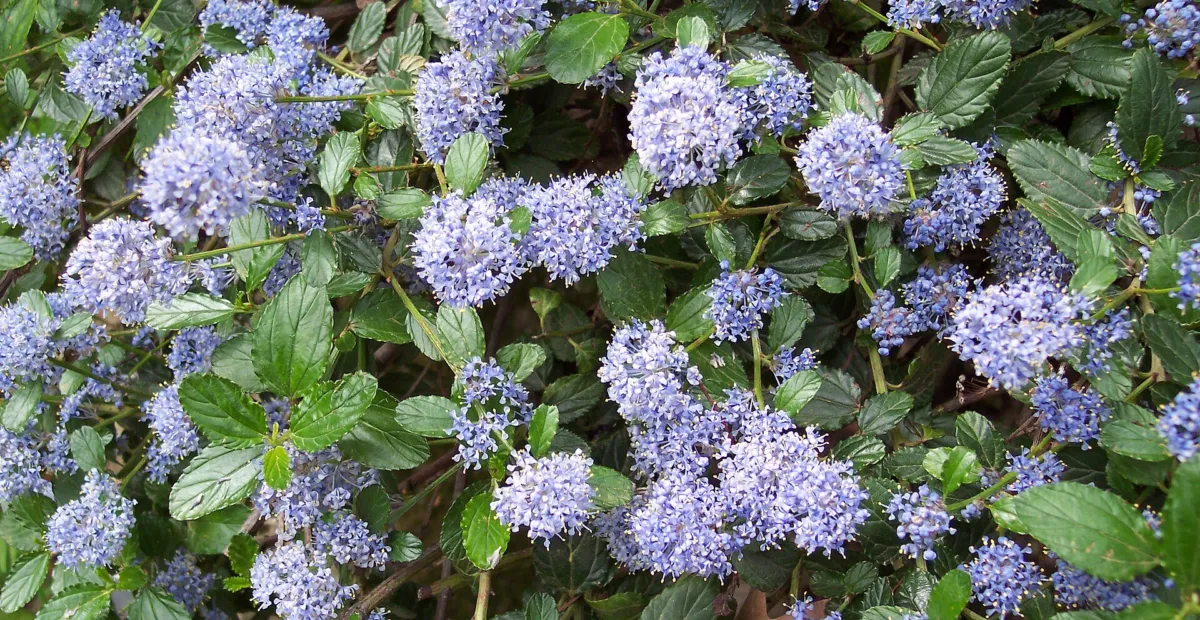
The plant has glossy, alternate, elliptic to ovate green leaves with finely toothed margins and prominent veins beneath. Arching branches create a low, spreading outline, while compact blue flower clusters sit along the shoots. The evergreen foliage gives year-round structure even when the spring bloom has finished.
Flowering
Compact, spike-like panicles of small blue flowers appear on the current seasonal display in spring and may continue into early summer, depending on region and weather. The flowers are produced abundantly along arching branches, creating a dense blue effect before the plant settles back into an evergreen foliage role.
Pollination and visitors
Ceanothus flowers are documented as resources for native bees, honey bees, bumblebees, butterflies, hoverflies, wasps, and other insects. The species is also associated with butterfly and moth larvae, while birds and small mammals may use the seeds. No single pollinator species is assigned here because cultivar-specific visitor records are limited.
Ceanothus thyrsiflorus 'Repens' photos
Click any photo for a larger view. Source, author and license are shown separately.
Diseases and pests
Diseases
Avoid waterlogged soil, which encourages root decline and general dieback. Honey fungus has been reported as a possible problem in ceanothus. Maintain drainage, avoid injuring the root crown, and remove severely affected material rather than repeatedly irrigating a declining plant.
Pests
Scale insects may occur, especially on stressed plants. Inspect stems and leaf undersides, encourage natural enemies, and prune out heavily infested small sections. Treat only when necessary with a labeled horticultural oil or soap, following the product label and avoiding heat-stressed plants.
Related diseases and pests
Only Plant Doctor profiles whose host data indicate this plant may be affected are shown here.





Toxicity and pollen
No reliable authoritative source was located establishing toxicity for this exact cultivar in humans, dogs, cats, or children. Do not treat the absence of a listing as proof of safety; prevent ingestion of unfamiliar plant material and contact a veterinarian or poison service if symptoms occur.
- Typical season
- Spring to early summer
- Pollination / pollen
- Insect-dispersed flower pollen
The flowers are insect-visited rather than adapted for large-scale wind dispersal, but reliable cultivar-specific airborne-allergy studies were not located. Pollen exposure is likely concentrated near flowering plants and visiting insects. People with known pollen sensitivity should avoid handling flowers during peak bloom and monitor personal reactions.
Native habitat
The parent species is native to coastal and near-coastal regions from California into Oregon, occurring in open scrub, rocky maritime slopes, bluffs, and mixed evergreen communities. It is adapted to sun, seasonal dryness, and well-drained soils, with winter moisture tolerance depending strongly on drainage and local climate.
Interesting fact
The name repens refers to its low, spreading habit. The form is associated with coastal populations north of San Francisco and in Monterey County. Ceanothus thyrsiflorus can host larvae of multiple butterfly and moth species, while its mature seeds contribute food for birds and small mammals.
Frequently asked questions (FAQ)
The most relevant questions about this plant, with short and direct answers.
🌱Quick care
What is Ceanothus thyrsiflorus 'Repens' commonly called?⌄
It is commonly sold as creeping blueblossom, prostrate blueblossom, or creeping ceanothus. Common-name usage varies by nursery, so the botanical name is the most reliable way to identify it.
Is Ceanothus thyrsiflorus 'Repens' evergreen?⌄
Yes, Ceanothus thyrsiflorus 'Repens' is an evergreen, low-growing shrub. Its glossy green foliage provides year-round structure in suitable climates.
How much sun does Ceanothus thyrsiflorus 'Repens' need?⌄
Grow it in full sun, ideally with at least 6 hours of direct light daily. It may tolerate some light afternoon shade in very hot locations, but reduced sun can mean weaker growth and fewer flowers.
How much water does Ceanothus thyrsiflorus 'Repens' need?⌄
Water it regularly during its first growing season, then reduce watering substantially once the root system is established. Mature plants prefer dry conditions between occasional deep waterings and can suffer from excess moisture.
How fast does Ceanothus thyrsiflorus 'Repens' grow?⌄
It is generally a vigorous, spreading shrub that can fill its planting area over several years. Growth rate depends strongly on drainage, sun, summer heat, and winter conditions.
🌤️Environment and placement
How large does Ceanothus thyrsiflorus 'Repens' get?⌄
Expect a low mound roughly 1 to 3 feet tall and about 6 to 8 feet wide in many garden settings. Its final size varies with climate, pruning, and whether it is allowed to spread naturally.
Is Ceanothus thyrsiflorus 'Repens' suitable as ground cover?⌄
Yes, its broad, arching growth makes it useful as a flowering ground cover for slopes, banks, rock gardens, and the front of borders. Give it enough horizontal space rather than treating it like a compact edging plant.
Can Ceanothus thyrsiflorus 'Repens' grow on a slope?⌄
Yes, it is well suited to sunny slopes and banks because its spreading habit helps cover soil. Plant it where runoff drains freely, since saturated winter soil can damage the roots.
What soil is best for Ceanothus thyrsiflorus 'Repens'?⌄
Use well-drained loam, sandy soil, or another soil that sheds water quickly. It can tolerate a range of pH conditions, but heavy, poorly drained soil is a greater problem than moderate soil acidity or alkalinity.
Is Ceanothus thyrsiflorus 'Repens' drought tolerant?⌄
Yes, it is drought tolerant after establishment and usually needs little supplemental summer water. Newly planted shrubs still require consistent irrigation until roots are established.
Is Ceanothus thyrsiflorus 'Repens' cold hardy?⌄
It is best in mild, protected outdoor locations and may be damaged by severe freezes or cold, drying winds. In the United States, it is generally a better choice for milder regions, often around USDA Zones 8 and warmer, depending on exposure.
Can Ceanothus thyrsiflorus 'Repens' tolerate coastal conditions?⌄
Yes, it can perform well in many coastal gardens with sun and sharply drained soil. Protection from unusually cold inland freezes is still important.
💧Care and problems
Why is my Ceanothus thyrsiflorus 'Repens' turning yellow?⌄
Yellow foliage commonly indicates excess moisture, poor drainage, root stress, or sometimes nutrient-related chlorosis. Check the soil and irrigation first, because overwatering is a frequent problem for established ceanothus.
Why is my Ceanothus thyrsiflorus 'Repens' dying after winter?⌄
Winter loss is often caused by waterlogged soil, hard freezes, or cold drying winds rather than ordinary summer drought. Improve drainage and place the shrub in a sheltered, sunny location before replanting.
Does Ceanothus thyrsiflorus 'Repens' need fertilizer?⌄
Usually, no regular fertilizer is needed when it is planted in reasonably fertile soil. Avoid high-nitrogen feeding, which can promote leafy growth while reducing flowering and may stress a plant adapted to lean soils.
How do I prevent root rot in Ceanothus thyrsiflorus 'Repens'?⌄
Prevent root rot by planting in fast-draining soil, avoiding low spots, and allowing the soil to dry between deep waterings. Do not keep the root zone constantly wet, especially during cool weather.
What pests affect Ceanothus thyrsiflorus 'Repens'?⌄
Scale insects are among the pests reported on this plant. Inspect stems and leaf undersides periodically, particularly when growth appears weak or foliage becomes discolored.
What diseases affect Ceanothus thyrsiflorus 'Repens'?⌄
Reported problems include honey fungus and root diseases associated with excessive soil moisture, including Phytophthora-type infections. Good drainage, careful irrigation, and avoiding damaged roots are the most useful preventive measures.
🪴Planting and repotting
When is the best time to plant Ceanothus thyrsiflorus 'Repens'?⌄
Plant it in spring or fall when temperatures are moderate and the soil is workable. Fall planting can work well in mild regions, while spring is safer where winter freezes are severe.
How do I plant Ceanothus thyrsiflorus 'Repens' in heavy clay soil?⌄
Improve drainage by planting on a raised mound or slope rather than placing the shrub in a water-retaining hole. If the site stays wet after rain, choose a better-drained location instead of relying only on soil amendments.
Can Ceanothus thyrsiflorus 'Repens' be grown in a container?⌄
It can be grown temporarily in a large container with ample drainage holes and a gritty, well-drained potting mix. Containers dry and freeze faster than garden soil, so monitor moisture and protect the plant from severe cold.
How far apart should I plant Ceanothus thyrsiflorus 'Repens'?⌄
Space plants about 5 to 8 feet apart when you want their mature spread to merge into a ground-covering mass. Use closer spacing only if more rapid coverage is worth the increased pruning and competition.
✂️Propagation and pruning
How do I propagate Ceanothus thyrsiflorus 'Repens' from cuttings?⌄
Take semi-ripe or semi-hardwood cuttings in mid to late summer, remove the lower leaves, and root them in a sterile, sharply drained medium. Rooting can be inconsistent, so take several cuttings rather than relying on one.
Can Ceanothus thyrsiflorus 'Repens' be grown from seed?⌄
It may be propagated from seed, but cuttings are generally preferred when you want plants that retain the parent’s ornamental characteristics. Seed-grown plants may vary and can require specialized treatment for reliable germination.
When should I prune Ceanothus thyrsiflorus 'Repens'?⌄
Prune it immediately after flowering, usually in late spring or early summer in much of the United States. This timing allows you to shape the shrub without removing the next season’s developing flower growth.
How hard can I prune Ceanothus thyrsiflorus 'Repens'?⌄
Use light to moderate pruning to remove spent flower clusters, dead wood, or wayward shoots. Avoid cutting deeply into old, leafless wood because ceanothus may not reliably resprout from severe cuts.
⚠️Toxicity and safety
Is Ceanothus thyrsiflorus 'Repens' toxic to people or pets?⌄
There is no established toxicity classification confirming this plant as poisonous to people or pets. Even so, prevent children and animals from chewing ornamental plants, and seek professional advice if ingestion occurs.
Is Ceanothus thyrsiflorus 'Repens' deer resistant?⌄
It is often described as deer resistant, although no plant is completely deer proof. Deer pressure, local wildlife behavior, and seasonal food availability can change how much browsing occurs.
Does Ceanothus thyrsiflorus 'Repens' attract pollinators?⌄
Yes, its abundant blue flower clusters are attractive to bees and other insect pollinators. Avoid broad-spectrum insecticide use during bloom to reduce harm to visiting insects.
🌸Flowering and special interest
When does Ceanothus thyrsiflorus 'Repens' bloom?⌄
It typically blooms in spring, often from late spring into early summer depending on the local climate. Flowering time may shift with winter temperatures, exposure, and pruning.
What color are the flowers of Ceanothus thyrsiflorus 'Repens'?⌄
The flowers are usually light blue to powder blue and appear in dense, fluffy clusters. The display is especially noticeable against the plant’s evergreen foliage.
Why is my Ceanothus thyrsiflorus 'Repens' not flowering?⌄
Insufficient sunlight, excessive nitrogen, overwatering, severe pruning, or winter damage can all reduce flowering. Give the plant full sun, avoid high-nitrogen fertilizer, and prune only after it finishes blooming.
Similar plants
 Yellow lantern chili (Capsicum chinense) care guideCapsicum chinense
 Capsicum baccatum care guideCapsicum baccatum
 Serrano (Capsicum annuum ‘Serrano’)Capsicum annuum 'Serrano'
 Purple Beauty (Capsicum annuum ‘Purple Beauty’)Capsicum annuum 'Purple Beauty'
 Numex Twilight (Capsicum annuum ‘Numex Twilight’)Capsicum annuum 'Numex Twilight'
 Explosive Ember Chili Pepper (Capsicum annuum ‘Explosive Ember’)Capsicum annuum 'Explosive Ember'