
 Source:
 Agave parrasana short overview
Agave parrasana is a compact, evergreen century plant from northeastern Mexico, valued for its symmetrical cabbage-like rosette of blue-gray leaves and contrasting reddish marginal teeth. It thrives in full sun, sharply drained soil, and dry conditions, making it well suited to rock gardens, xeric borders, and containers. Mature plants eventually produce a tall flowering stalk and typically die after blooming, while offsets may continue the clump.
Taxonomic classification
Agave parrasana care guide
Light and placement
Give this agave full sun, ideally in a south- or west-facing position with unobstructed light. In hot desert climates, some afternoon protection can reduce leaf scorch, but insufficient light produces a looser rosette and weaker color. Rotate container plants periodically for even growth. Acclimate greenhouse or nursery plants gradually before placing them in intense outdoor sun.
Watering and humidity
Water deeply, then allow the soil to dry completely before watering again. In containers, empty drainage saucers and never leave the rosette sitting in water. Water more often during active summer growth and much less in cool weather; in winter, provide only enough moisture to prevent severe shriveling when plants are kept under cover. Humidity is not needed if drainage and airflow are good.
Soil and growing medium
Use a predominantly mineral, gritty mix that drains immediately, such as coarse sand, pumice, gravel, and a modest amount of loam or compost. Avoid heavy clay and water-retentive potting soil. A slightly alkaline or calcareous substrate is acceptable, while prolonged saturation around the roots is the main soil-related risk. Raised beds, berms, and unglazed clay pots improve drainage.
Feeding
Apply a dilute, balanced or low-nitrogen succulent fertilizer once in spring after growth resumes. A second light application may be used in early summer for actively growing container plants, but overfeeding can produce softer foliage and reduce the compact form. Do not fertilize newly transplanted, dormant, stressed, or cold-wet plants, and avoid routine feeding in winter.
Growth and habit
This species grows slowly and maintains a compact, architectural rosette for many years. It is monocarpic: after reaching maturity, the central rosette produces a tall inflorescence and dies after flowering. Offsets can develop around the parent and preserve the planting. Keep adequate clearance from paths because the leaf tips and marginal teeth are sharp.
Planting and repotting
Plant during warm weather in a raised, gravelly bed or another site where rainwater drains quickly. Set the root ball no deeper than it was growing, keep the crown above surrounding soil, and avoid burying the lower leaves. Water once to settle the roots, then let the planting dry substantially before repeating. Protect newly planted specimens from severe cold and prolonged wet conditions while they establish.
Repot container plants in spring or early summer only when the mix has become compacted, drainage has declined, or roots have filled the pot. Choose a heavy container with a drainage hole and only modestly larger dimensions. Handle the plant with protective barriers, keep the crown dry, and delay watering briefly after root disturbance.
Propagation and pruning
Propagation
Propagate chiefly from offsets when they are large enough to handle and have begun forming roots. Separate pups in warm, dry weather, allow cut surfaces to callus briefly, and pot them into a gritty mix. Seed propagation is possible but slower and less predictable for maintaining a particular appearance. Avoid frequent disturbance of the parent rosette.
Pruning
Little pruning is required. Remove only fully dead leaves, using thick gloves, eye protection, and clean tools. Cut spent flowering stalks at the base after they have dried, taking care not to injure offsets. Do not trim healthy leaf tips simply to reduce their spines; wounds are unattractive and can invite decay.
Overwintering
In USDA Zone 7 or other marginal areas, use a rain shelter, excellent drainage, and protection from prolonged freezes. Container plants can be moved into a bright, cool, dry greenhouse, sunroom, or sheltered porch before hard frost. Keep winter watering minimal and provide strong light to prevent weak growth.
Uses
Use as an architectural specimen in rock gardens, gravel gardens, xeric borders, desert-style plantings, and large containers. Its compact rosette works well as a focal plant where sharp spines can be kept away from children, pets, and walkways. It is primarily ornamental here; no culinary or medicinal use should be assumed for this species without specific authoritative evidence.
Appearance
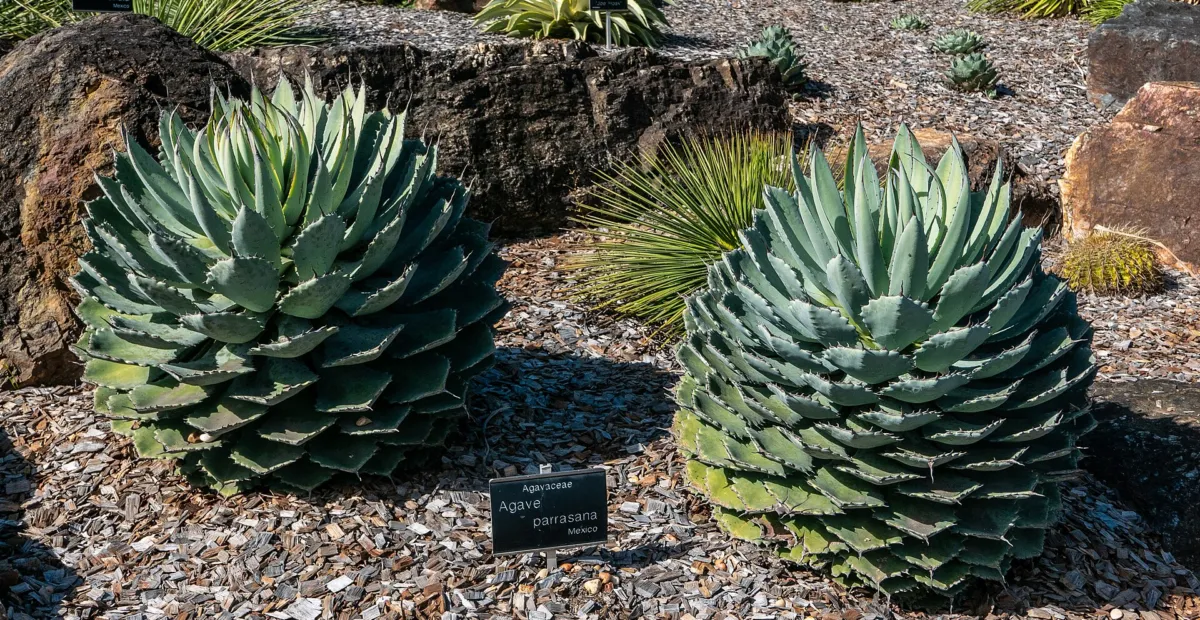
The rosette resembles a tightly packed cabbage, with broad, thick blue-gray leaves arranged in overlapping spirals. Leaves carry reddish to dark marginal teeth and a firm terminal spine, providing strong textural contrast. Mature specimens may send up a dramatic, many-foot-tall flower stalk. The compact symmetry and colored teeth are useful identification features.
Flowering
Flowering occurs only after many years, when the plant produces a conspicuous terminal stalk far taller than the rosette. Individual flowers are arranged along branched portions of the inflorescence, with reddish tones opening and becoming more yellow. The flowering event is terminal for that rosette, although offsets can remain and develop.
Pollination and visitors
Agave flowers provide nectar and pollen to visiting insects, and agaves as a group may also be visited by nocturnal nectar-feeding bats in their native range. A species-specific pollinator record for Agave parrasana was not located in the cross-checked sources, so the visitor listing is conservative rather than definitive.
Agave parrasana photos
Click any photo for a larger view. Source, author and license are shown separately.
Diseases and pests
Diseases
The main prevention is fast drainage, dry foliage, and good airflow. Root and crown rots develop when the plant remains cold and wet; remove damaged tissue, discard saturated mix, and replant only healthy material in dry, sterile, gritty substrate. Watch for blackened or collapsing leaf bases and isolate affected container plants.
Pests
Scale insects and occasional sap-feeding pests may collect in leaf axils. Inspect regularly, especially on overwintered plants. Remove light infestations with a cotton swab or directed water where practical, then use a labeled horticultural oil or insecticidal product according to the U.S. label. Avoid spraying during extreme heat or on drought-stressed foliage.
Related diseases and pests
Only Plant Doctor profiles whose host data indicate this plant may be affected are shown here.
Toxicity and pollen
Agave sap and leaf tissues can irritate skin, eyes, and the mouth, and the spines can cause puncture injuries. Ingestion may cause gastrointestinal irritation; species-specific clinical toxicity data for Agave parrasana are limited, so do not treat it as edible. Wear gloves and eye protection when planting, dividing, or removing leaves, and seek medical or veterinary advice after significant exposure.
- Typical season
- During flowering; timing varies with climate and plant maturity.
- Pollination / pollen
- Pollen released from exposed anthers during flowering; airborne significance is not well documented.
This is a flowering, insect-associated agave that produces pollen during its brief mature flowering event. Reliable species-specific evidence quantifying airborne pollen or human allergy risk was not located. Do not infer zero risk from insect visitation; people with known plant-pollen sensitivity should avoid handling flowers closely and use normal garden hygiene.
Native habitat
The species is native to northeastern Mexico, where it occurs in dry desert or shrubland environments. It is adapted to intense sunlight, seasonal rainfall, mineral soils, and rapid drainage. Its thick leaves store water, while the compact rosette reduces exposed surface area and helps the plant persist through dry periods.
Interesting fact
The accepted name is Agave parrasana A.Berger. A former treatment placed it as Agave wislizeni subsp. parrasana. The species is notable for a highly symmetrical cabbage-like rosette and a flowering stalk many times taller than the vegetative plant. Its flowering rosette dies after blooming, but offsets may continue the lineage.
Frequently asked questions (FAQ)
The most relevant questions about this plant, with short and direct answers.
🌱Quick care
How do you care for Agave parrasana?⌄
Grow Agave parrasana in full sun, gritty sharply drained soil, and with low, infrequent watering. Let the soil dry completely before watering again, especially during winter.
Is Agave parrasana easy to grow?⌄
Yes, Agave parrasana is generally easy to grow when given strong light, excellent drainage, and restrained watering. The main risk is root or crown rot from persistently wet soil.
How big does Agave parrasana get?⌄
Agave parrasana typically forms a compact rosette about 2 feet tall and wide, although mature plants can become larger. Its flower stalk may rise roughly 20 feet above the rosette.
🌤️Environment and placement
Does Agave parrasana need full sun?⌄
Yes, Agave parrasana performs best in full sun, which helps maintain a compact rosette and blue-gray foliage. Acclimate plants gradually when moving them from shade or indoors into intense sunlight.
Can Agave parrasana grow indoors?⌄
Agave parrasana can grow indoors near a very bright, sunny window, but it may need supplemental light to remain compact. Use a pot with drainage and keep the plant away from high humidity and cold drafts.
Can Agave parrasana survive winter outdoors in the United States?⌄
Agave parrasana can survive outdoor winters in some warmer parts of USDA Zones 7–10, but hard freezes and wet winter soil can cause damage. In colder or wetter regions, grow it in a container and protect it.
How cold hardy is Agave parrasana?⌄
Agave parrasana may tolerate temperatures near 10°F when established in very dry, sharply drained soil, but this is not a guarantee of survival. Protect it from hard freezes, prolonged cold, and winter moisture.
Can Agave parrasana tolerate humidity?⌄
Agave parrasana tolerates some humidity if air circulation and drainage are excellent, but it dislikes prolonged dampness. In humid climates, use a raised, gravelly site or a container protected from heavy rain.
💧Care and problems
How often should you water Agave parrasana?⌄
Water Agave parrasana thoroughly only after the soil has dried completely. The interval may range from every couple of weeks in active summer growth to much less often in winter, depending on heat, light, pot size, and drainage.
How do you water Agave parrasana in winter?⌄
Water Agave parrasana very sparingly in winter and only when the potting mix is completely dry. Keep it nearly dry during cold spells because wet roots are more vulnerable to rot and freeze damage.
Why is my Agave parrasana turning brown or soft?⌄
Brown, soft, or collapsing tissue on Agave parrasana often indicates overwatering, poor drainage, or cold damage. Move it to dry, porous soil, remove clearly rotted tissue, and avoid watering until the root zone is dry.
What soil is best for Agave parrasana?⌄
The best soil for Agave parrasana is a gritty, sharply drained mineral mix containing materials such as pumice, coarse sand, gravel, or perlite. Avoid heavy clay and mixes that remain wet for long periods.
Does Agave parrasana need fertilizer?⌄
Agave parrasana needs little fertilizer and can grow well in lean soil. If feeding, apply a diluted, low-nitrogen cactus or succulent fertilizer during active spring or summer growth.
What pests affect Agave parrasana?⌄
Agave parrasana is usually relatively pest-resistant, but scale insects can occasionally occur. Inspect leaf bases and undersides, isolate affected plants, and treat infestations promptly with an appropriate labeled product.
🪴Planting and repotting
When should you plant Agave parrasana outdoors?⌄
Plant Agave parrasana outdoors in spring after the threat of hard frost has passed, giving the roots a warm growing season to establish. Choose a sunny, elevated, fast-draining location.
Can Agave parrasana grow in a pot?⌄
Yes, Agave parrasana grows well in a sturdy container with drainage holes and a gritty cactus or succulent mix. Choose a pot only slightly larger than the root ball to reduce excess wet soil.
When should you repot Agave parrasana?⌄
Repot Agave parrasana in spring when the container is crowded, drainage has declined, or roots have filled the pot. Allow damaged roots to dry briefly before watering after repotting.
How do you plant Agave parrasana in the ground?⌄
Plant Agave parrasana with its crown at or slightly above soil level in a raised, gravelly, sharply drained bed. Do not bury the rosette or allow water to collect around its base.
✂️Propagation and pruning
How do you propagate Agave parrasana?⌄
Propagate Agave parrasana mainly by separating offsets when they are well established, or by sowing seed. Let separated offsets dry briefly before planting them in dry, gritty mix.
Does Agave parrasana produce pups?⌄
Agave parrasana may produce offsets at the base, although some plants remain solitary. These pups can replace the flowering rosette after the parent plant dies.
Does Agave parrasana need pruning?⌄
Agave parrasana generally needs no pruning. Remove only dead or badly damaged leaves with protective gloves and tools, taking care around the sharp marginal teeth and terminal spine.
⚠️Toxicity and safety
Is Agave parrasana poisonous to dogs and cats?⌄
Agave parrasana should be treated as potentially harmful to dogs and cats if eaten, and its sap can irritate skin and eyes. Keep pets and children away from the leaves, spines, and cut plant tissue.
Can Agave parrasana cause skin irritation?⌄
Yes, the sap of Agave parrasana can cause skin irritation, and the leaf teeth and terminal spine can puncture or scratch. Wear gloves, long sleeves, and eye protection when handling or pruning it.
Is Agave parrasana safe to plant near walkways?⌄
Agave parrasana is not ideal beside walkways, patios, or play areas because its leaves have sharp marginal teeth and a pointed terminal spine. Position it where people and pets will not brush against it.
🌸Flowering and special interest
Does Agave parrasana flower only once?⌄
Yes, Agave parrasana is monocarpic: an individual rosette flowers once and then dies. Offsets at the base may continue growing and preserve the plant in the garden.
How long does Agave parrasana take to flower?⌄
Agave parrasana is slow-growing and may take many years to reach flowering size, often more than a decade under cultivation. The exact timing varies with climate, light, water, and growing conditions.
What does an Agave parrasana flower stalk look like?⌄
A flowering Agave parrasana sends up a very tall stalk bearing clustered flowers that are often reddish in bud and open yellow. The flowering rosette gradually declines after blooming.
What should you do after Agave parrasana blooms?⌄
After Agave parrasana blooms, leave the declining rosette in place until offsets are established and the foliage has dried back. Remove the spent plant carefully, because the leaves and sap remain hazardous to handle.
Similar plants
 Azure Monkshood (Aconitum carmichaelii) care guideAconitum carmichaelii
 Monkshood (Aconitum ‘Stainless Steel’)Aconitum 'Stainless Steel'
 Monkshood (Aconitum ‘Bressingham Spire’)Aconitum 'Bressingham Spire'
 Golden full moon maple (Acer shirasawanum ‘Aureum’)Acer shirasawanum 'Aureum'
 Globosum (Acer platanoides ‘Globosum’)Acer platanoides 'Globosum'
 Striped maple (Acer pensylvanicum) care guideAcer pensylvanicum