
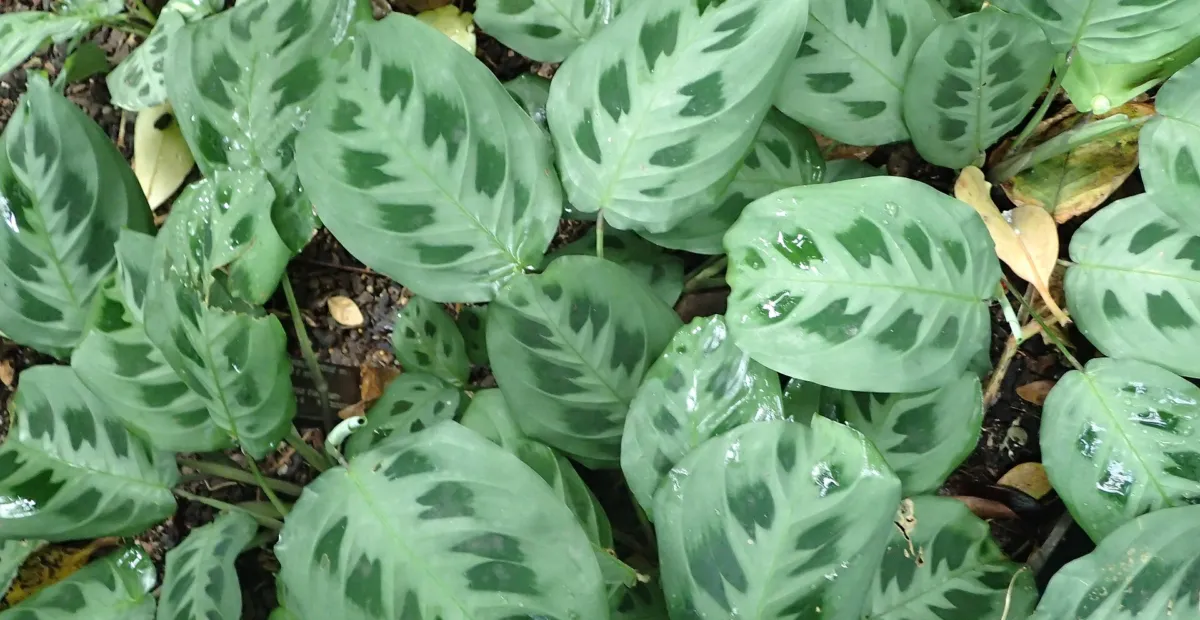
 Source:
Prayer plant (Maranta leuconeura ‘Kerchoveana’) short overview
Maranta leuconeura 'Kerchoveana' is a compact tropical prayer plant grown primarily for its attractive foliage. Its oval, mid-green leaves carry paired brown to olive blotches along the midrib and fold upward at night. Keep it warm and sheltered from frost, with bright filtered light, evenly moist but well-drained soil, and moderate to high humidity. It is best suited to indoor containers in the United States.
Taxonomic classification
Prayer plant (Maranta leuconeura ‘Kerchoveana’) care guide
Light and placement
Provide bright filtered light or gentle partial shade. An east- or north-facing window is usually suitable; near a south or west window, use a sheer curtain or place the plant several feet back. Harsh direct sun can bleach or scorch leaves, while very low light may produce slower growth, smaller leaves, and weaker patterning.
Watering and humidity
Water when the upper 1 inch of mix begins to dry, then soak thoroughly until excess drains away. Empty the saucer and do not leave the roots standing in water. Water somewhat less often in winter, but do not allow the entire root ball to become bone dry. Humidity of roughly 50–70% helps reduce crisp edges.
Soil and growing medium
Use a loose, moisture-retentive but well-aerated potting mix containing fine bark or coco coir, peat-free compost, and perlite. The substrate should drain freely while remaining lightly moist. A slightly acidic to neutral reaction is suitable; avoid compacted, waterlogged soil and heavy accumulations of fertilizer salts.
Feeding
Feed during active spring and summer growth with a balanced liquid houseplant fertilizer diluted to half strength about monthly, or follow the product label at a reduced houseplant rate. Water first if the mix is dry. Do not fertilize a stressed, freshly repotted, dormant, or severely pest-damaged plant.
Growth and habit
This evergreen rhizomatous perennial forms a low, spreading clump from short stems and shallow roots. Its natural movement and dense foliage make it useful in broad containers. Keep the plant evenly nourished and periodically divide crowded clumps rather than allowing the center to become congested.
Planting and repotting
Plant at the same depth as the original root ball, leaving the crown uncovered. Space individual plants about 8–12 inches apart when combining them in a broad container, allowing room for the clump to spread. Establish in spring or summer indoors, when warmth and active growth support recovery.
Repot in spring or early summer when roots fill the container or growth slows. Move only one pot size larger, because oversized containers stay wet too long. Handle the shallow root system gently and water thoroughly after repotting, then keep the plant warm and out of strong light while it re-establishes.
Propagation and pruning
Propagation
Divide established clumps during active growth, ensuring each division has roots and several stems. Basal cuttings can also be rooted in a warm, humid medium. Seed propagation is possible but uncommon for maintaining a named form because seedlings may not reproduce the parent’s exact foliage pattern.
Pruning
Little pruning is required. Remove yellow, damaged, or badly spotted leaves at the base with clean scissors. Trim individual brown tips only for appearance, but correct low humidity, salt buildup, watering stress, or excessive light to prevent recurrence.
Overwintering
Keep indoors before nighttime temperatures fall below 60°F. Protect from cold drafts, radiators, and contact with chilly windows. Maintain filtered light and reduce watering frequency in winter while keeping the root ball lightly moist. Do not expose it to frost or freezing temperatures.
Uses
Used as an indoor foliage plant in containers, terrariums with adequate ventilation, offices, bathrooms, and shaded conservatories. Its patterned leaves work well in mixed tropical displays. It has no established culinary or medicinal use in this profile.
Appearance
Leaves are broad, oval, and short-stalked, with a mid-green surface marked by gray-green tones and conspicuous paired brown or olive blotches beside the midrib. The plant forms a dense clump with shallow roots. Leaves often fold upward after dark, and new foliage unfurls from a rolled tube.
Flowering
Small white flowers may appear on slender stalks above the foliage, especially when plants receive consistently warm, humid conditions. Flowering is secondary to the ornamental leaves and is not always reliable indoors. The flowers are inconspicuous compared with the foliage.
Pollination and visitors
The small flowers are insect-compatible, but reliable cultivar-specific records identifying the principal visitor group were not found. Because indoor flowering is sparse and the flowers are inconspicuous, documented pollinator attraction is best classified as unknown rather than assumed.
Maranta leuconeura 'Kerchoveana' photos
Click any photo for a larger view. Source, author and license are shown separately.
Diseases and pests
Diseases
Prevent fungal and bacterial leaf problems by avoiding persistently wet foliage, improving air circulation, and watering the root zone rather than the leaves. Brown or water-soaked spots can indicate excess moisture or infection; remove badly affected leaves with clean tools and correct watering and ventilation.
Pests
Inspect regularly for spider mites, mealybugs, scale, and whiteflies, especially when air is dry. Isolate affected plants, wipe or rinse foliage, and use insecticidal soap according to its label. Repeat treatments as needed and avoid letting the plant remain waterlogged.
Toxicity and pollen
Maranta leuconeura is widely treated in reputable horticultural and pet-plant references as non-toxic to cats and dogs. Normal handling is not considered hazardous, but chewing any houseplant can cause mild gastrointestinal upset or mechanical irritation. Prevent ingestion of potting media, fertilizer, and pest-control products.
- Typical season
- Not usually a significant indoor seasonal exposure; occasional flowering is most likely in summer
- Pollination / pollen
- Small quantities associated with insect-pollinated flowers
This is an angiosperm that can produce pollen when it flowers, but its small, insect-associated flowers are not known as a major source of airborne pollen in homes. Flowering is intermittent indoors, so practical pollen exposure is expected to be low, not necessarily zero.
Native habitat
The species is native to tropical Brazil, where Maranta grows in warm, humid forest environments with filtered light, organic soils, and regular moisture. Indoor cultivation should reproduce the sheltered understory conditions rather than direct sun, dry air, or sharp temperature swings.
Interesting fact
The leaves change position through the day and commonly fold upward at night, giving prayer plants their familiar name. New leaves emerge tightly rolled before expanding. The paired blotches of 'Kerchoveana' are a key identification feature and may appear darker on younger leaves.
Frequently asked questions (FAQ)
The most relevant questions about this plant, with short and direct answers.
🌱Quick care
What is Maranta leuconeura 'Kerchoveana' commonly called?⌄
Maranta leuconeura 'Kerchoveana' is commonly called a prayer plant, and it is also sold as a rabbit’s foot prayer plant. Plant labels may use the botanical name, cultivar name, or the older variety form “var. kerchoveana.”
How do you care for Maranta leuconeura 'Kerchoveana'?⌄
Give it bright filtered or shaded light, evenly moist well-drained soil, warm temperatures, and moderate to high humidity. Protect it from frost, harsh direct sun, and waterlogged soil.
How often should you water Maranta leuconeura 'Kerchoveana'?⌄
Water when the surface of the potting mix feels slightly dry, while keeping the root ball from drying completely. Water thoroughly until excess drains, then empty the saucer.
Does Maranta leuconeura 'Kerchoveana' need distilled water?⌄
Distilled, rain, or filtered water can help prevent brown leaf tips when household tap water is hard or heavily treated. If your tap water does not cause damage, it may be suitable, but avoid letting mineral deposits build up in the soil.
How much light does Maranta leuconeura 'Kerchoveana' need?⌄
Place it in bright indirect or filtered light, although it can tolerate fairly shaded indoor conditions. Avoid strong direct afternoon sun, which can bleach or scorch the leaves.
🌤️Environment and placement
Can Maranta leuconeura 'Kerchoveana' grow in low light?⌄
It can survive in lower light, but growth and leaf coloration are usually better in bright filtered light. Very dim conditions can contribute to slow growth and persistently wet soil.
Where should I place a Maranta leuconeura 'Kerchoveana' indoors?⌄
Place it near an east- or north-facing window, or several feet back from a brighter window with a sheer curtain. Keep it away from heating vents, air-conditioning drafts, and cold glass.
What humidity does Maranta leuconeura 'Kerchoveana' need?⌄
It grows best with moderate to high humidity, especially during dry indoor winters. A humidifier, plant grouping, or naturally humid bathroom with suitable light is more reliable than occasional misting.
Can Maranta leuconeura 'Kerchoveana' live in a bathroom?⌄
Yes, a bright bathroom can be an excellent location because the humidity is often higher. Make sure the room has adequate filtered light and does not become cold or poorly ventilated.
What temperature is best for Maranta leuconeura 'Kerchoveana'?⌄
Keep it warm and stable, preferably in typical indoor temperatures above about 60°F. Protect it from frost, cold drafts, and sudden temperature changes.
💧Care and problems
Why are the leaves of my Maranta leuconeura 'Kerchoveana' curling?⌄
Curling leaves commonly indicate insufficient moisture, dry air, excessive light, or temperature stress. Check the soil moisture and humidity first, then move the plant away from direct sun and drafts if needed.
Why does Maranta leuconeura 'Kerchoveana' have brown leaf tips?⌄
Brown tips are often linked to dry air, inconsistent watering, salty or hard water, or fertilizer buildup. Improve humidity, keep moisture more consistent, and occasionally flush the pot with clean water if drainage is good.
Why are the leaves of my Maranta leuconeura 'Kerchoveana' turning yellow?⌄
Yellow leaves most often result from excess moisture, poor drainage, aging foliage, or insufficient light. Let the surface dry slightly between waterings and check that the potting mix and container drain freely.
Why is my Maranta leuconeura 'Kerchoveana' drooping?⌄
Drooping can follow underwatering, root problems from waterlogged soil, low humidity, cold temperatures, or recent relocation. Check the root-zone moisture and drainage before adding more water.
Why is my Maranta leuconeura 'Kerchoveana' not growing?⌄
Slow growth is commonly caused by low light, cool conditions, dry air, depleted soil, or watering problems. Provide bright filtered light, warmth, steady moisture, and light feeding during active growth.
Why does Maranta leuconeura 'Kerchoveana' move its leaves at night?⌄
The leaves naturally rise or fold after dark because of movement at the leaf joints, a behavior called nyctinasty. This is normal and usually indicates that the plant is responding to its daily light cycle.
How should I fertilize Maranta leuconeura 'Kerchoveana'?⌄
Feed lightly with a balanced, diluted houseplant fertilizer during active growth. Avoid fertilizing dry soil or applying strong doses, because concentrated fertilizer can damage the roots and worsen leaf-tip burn.
Is Maranta leuconeura 'Kerchoveana' prone to pests?⌄
It can attract spider mites, mealybugs, thrips, and other common houseplant pests, particularly when conditions are hot and dry. Inspect leaf undersides regularly and isolate affected plants promptly.
🪴Planting and repotting
What soil is best for Maranta leuconeura 'Kerchoveana'?⌄
Use a loose, moisture-retentive, well-drained indoor potting mix containing organic matter and an aerating ingredient such as perlite or fine bark. The mix should stay lightly moist without becoming dense or waterlogged.
What type of pot does Maranta leuconeura 'Kerchoveana' need?⌄
Choose a pot with drainage holes that is only slightly larger than the root ball. A shallow container can work well because this plant has a spreading, rhizomatous growth habit.
When should I repot Maranta leuconeura 'Kerchoveana'?⌄
Repot in spring or when roots fill the container, growth stalls, or water runs rapidly through the pot. Move it into a slightly larger container rather than making a large jump in pot size.
How often should Maranta leuconeura 'Kerchoveana' be repotted?⌄
Repot when the plant becomes root-bound rather than on a rigid calendar, often every one to two years in good growing conditions. Replace compacted or deteriorated mix sooner if drainage has declined.
✂️Propagation and pruning
How do you propagate Maranta leuconeura 'Kerchoveana'?⌄
The most dependable methods are division and stem cuttings with a viable node. Propagate during active growth, keep the new sections warm and lightly moist, and provide higher humidity while they establish.
Can you propagate Maranta leuconeura 'Kerchoveana' in water?⌄
Yes, a stem cutting with a node can often root in water before being transferred to potting mix. Keep leaves above the water, change the water regularly, and pot the cutting once roots are established.
Can Maranta leuconeura 'Kerchoveana' be propagated from a leaf?⌄
A leaf by itself usually cannot produce a new plant because propagation requires a stem or rhizome node. Use a cutting that includes a node or divide a rooted clump instead.
How do you divide Maranta leuconeura 'Kerchoveana'?⌄
Remove the plant from its pot and gently separate the rhizomatous root mass into sections, ensuring each division has roots and several stems or leaves. Replant at the original depth and keep the divisions evenly moist while they recover.
Should I prune Maranta leuconeura 'Kerchoveana'?⌄
Prune yellow, damaged, or dead leaves at the base and trim excessively long stems just above a node to encourage fuller growth. Use clean scissors and avoid removing more than necessary at one time.
⚠️Toxicity and safety
Is Maranta leuconeura 'Kerchoveana' toxic to cats and dogs?⌄
Maranta leuconeura 'Kerchoveana' is generally regarded as non-toxic to cats and dogs. Pets can still develop stomach upset if they eat large quantities of any plant material, so discourage chewing.
Is Maranta leuconeura 'Kerchoveana' safe for children?⌄
It is generally considered a low-risk ornamental plant, but it should not be treated as edible. Keep plants and potting materials out of reach of young children to prevent choking or stomach irritation.
🌸Flowering and special interest
Does Maranta leuconeura 'Kerchoveana' flower indoors?⌄
Yes, it can produce small white or pale flowers indoors, although flowering is less important than its patterned foliage. Good filtered light, steady moisture, warmth, and suitable humidity can encourage blooming.
Why is my Maranta leuconeura 'Kerchoveana' flowering?⌄
Flowering is generally a normal sign of maturity and suitable growing conditions rather than a problem. You can leave the flowers in place or remove spent blooms to keep the plant tidy.
Similar plants
 Fascinator (Maranta leuconeura ‘Fascinator’)Maranta leuconeura 'Fascinator'
 Marble Queen pothos (Epipremnum aureum ‘Marble Queen’)Epipremnum aureum 'Marble Queen'
 Satin (Epipremnum aureum ‘Satin’)Epipremnum aureum 'Satin'
 Green Queen (Epipremnum aureum ‘Green Queen’)Epipremnum aureum 'Green Queen'
 Neon (Epipremnum aureum ‘Neon’)Epipremnum aureum 'Neon'
 Manjula (Epipremnum aureum ‘Manjula’)Epipremnum aureum 'Manjula'