
 AI-generated illustration
Satin (Epipremnum aureum ‘Satin’) short overview
Epipremnum aureum 'Satin' is a cultivated pothos name used for a silver-marked, indoor foliage vine, but the label is not well standardized and can be confused with Scindapsus pictus, the plant more commonly sold as satin pothos. Plants marketed under this name are evergreen tropical climbers with heart-shaped matte green leaves, irregular silvery markings, and a preference for warm conditions, filtered light, and evenly moderate moisture.
Taxonomic classification
Satin (Epipremnum aureum ‘Satin’) care guide
Light and placement
Provide bright filtered light, such as an east-facing window or a position several feet from a south- or west-facing window. It tolerates lower light but may grow slowly, lose density, and show weaker silver markings. Harsh direct afternoon sun can bleach or scorch leaves, producing pale patches and crisp brown margins. Rotate the pot periodically for even growth.
Watering and humidity
Water thoroughly when the top 1–2 inches of mix feels partly dry, then let excess drain fully. Do not leave the pot standing in water. In winter, reduce frequency as growth and evaporation slow, but do not allow the root ball to remain bone-dry for long periods. Humidity is helpful but is less important than good drainage and stable warmth.
Soil and growing medium
Use a loose, airy houseplant mix based on peat or coco coir with bark and perlite. The substrate should hold some moisture but drain quickly, because saturated roots are more damaging than brief dryness. A mildly acidic to neutral reaction is suitable. Heavy garden soil or compact mixes should be avoided in containers.
Feeding
Feed during active spring and summer growth with a balanced liquid houseplant fertilizer diluted to half the label rate every 4–6 weeks. Water the plant first if the mix is dry. Reduce or stop feeding in winter or during stress, and flush the container periodically to limit soluble-salt buildup.
Growth and habit
The plant produces flexible, node-bearing stems that trail from containers or climb when given support. Regularly pinching or pruning long stems encourages branching and a fuller display. Mature leaves may become larger under warm, humid conditions and when stems are allowed to climb rather than remain tightly trailing.
Planting and repotting
In the United States this tropical plant is normally grown in containers rather than planted outdoors. Set the rooted cutting or nursery plant at the same depth as before, leaving the crown and stem base uncovered. Space multiple cuttings around the container edge for a fuller trailing display.
Repot in spring or early summer when roots circle the pot or emerge from drainage holes. Move up only one pot size and refresh part of the mix rather than burying the stem deeply. Use a container with drainage holes; a moss pole or trellis can be added when a climbing form is desired.
Propagation and pruning
Propagation
Propagate from stem cuttings containing at least one node. Root cuttings in water, moist sphagnum, or a porous propagation mix in warm, bright filtered light. Transfer water-rooted cuttings after roots are established. Spring through summer is the most practical period, although indoor propagation can succeed year-round with warmth.
Pruning
Trim above a node with clean scissors to control length and encourage branching. Remove yellow, damaged, or overcrowded leaves at their base. Pruned healthy sections can be reused as cuttings. Avoid removing a large proportion of foliage at once, particularly during winter or after repotting.
Overwintering
Keep indoors before nighttime temperatures approach 50°F. Protect from cold windows, drafts, and heating vents. Reduce watering as light levels fall, pause fertilizer during slow growth, and check regularly for pests. Outdoor plants in frost-free climates still benefit from shelter during cool, wet periods.
Uses
Used primarily as an indoor foliage plant, trailing basket subject, shelf plant, or climber trained on a moss pole or trellis. It is ornamental rather than edible and should not be used as food or medicine. Outdoor use is limited to frost-free climates or seasonal containers.
Appearance
Plants sold under this name are described as evergreen vines with heart-shaped, matte green leaves marked by irregular silvery-white patches or streaks. Stems are flexible and node-bearing, allowing both trailing and climbing growth. Because 'Satin' is inconsistently applied in commerce, leaf pattern and texture should be checked against the purchased plant rather than assumed from the label.
Flowering
Flowering is not a normal feature of container-grown plants marketed under this name. Mature Epipremnum aureum can produce aroid inflorescences in favorable tropical conditions, but indoor blooming is uncommon and the exact cultivar's flowering behavior is not well documented.
Pollination and visitors
No reliable pollinator or visitor record was found for this exact cultivar. Indoor plants rarely flower, and any species-level aroid inflorescence does not justify assigning a specific visitor group to the cultivar.
Diseases and pests
Diseases
The main risks are root or stem rot from persistently wet media and leaf-spot problems under poor airflow. Use a draining mix, water only when the upper layer has begun to dry, remove badly affected tissue with sterile tools, and isolate plants showing spreading lesions. Avoid wetting foliage at night and discard severely rotted roots during repotting.
Pests
Watch for mealybugs, scale, spider mites, and thrips, especially on stressed or dusty foliage. Inspect leaf undersides and stem joints regularly. Remove small infestations manually or with a water rinse, then use insecticidal soap or horticultural oil according to the product label. Improve light and airflow, and quarantine affected plants.
Toxicity and pollen
Epipremnum aureum contains insoluble calcium oxalates. Chewing or ingesting leaves, stems, or sap can cause immediate mouth irritation, drooling, vomiting, and difficulty swallowing in people and pets. Keep the plant away from children and animals, wear gloves if sap irritates your skin, and seek medical or veterinary advice for significant exposure or breathing difficulty.
- Typical season
- Not normally relevant indoors; flowering is uncommon
- Pollination / pollen
- Not meaningfully dispersed indoors; flowering uncommon
This is a foliage plant rarely seen flowering indoors, so routine airborne pollen exposure should be very low. The pollen relevance of the exact cultivar has not been independently documented. Do not confuse low airborne pollen exposure with pet or child safety, because the sap and tissues contain irritating calcium oxalates.
Native habitat
The accepted species is a wet-tropical climber native to the Society Islands, especially Mo'orea, and is widely cultivated and naturalized in tropical and subtropical regions. It favors warm, humid conditions, filtered light, organic substrates, and access to structural support.
Interesting fact
The name 'Satin' is not consistently standardized for Epipremnum aureum.
Satin pothos usually refers to a different genus, Scindapsus.
Epipremnum aureum is native to the Society Islands.
The species is a climbing aroid that can develop larger leaves when supported.
Its common indoor form is maintained mainly for foliage, not flowers.
Frequently asked questions (FAQ)
The most relevant questions about this plant, with short and direct answers.
🌱Quick care
What is Epipremnum aureum 'Satin'?⌄
Epipremnum aureum 'Satin' is a cultivated form of Epipremnum aureum, a tropical climbing aroid with green leaves marked by silvery-white patterns. Do not automatically treat it as Scindapsus pictus, which is also commonly sold under the name satin pothos.
Is Epipremnum aureum 'Satin' easy to grow indoors?⌄
Yes, Epipremnum aureum 'Satin' is generally suitable for indoor growing when it receives filtered light, has airy soil, and is not overwatered. It may grow more slowly in dim conditions or during winter.
How much light does Epipremnum aureum 'Satin' need?⌄
Give Epipremnum aureum 'Satin' bright filtered light to partial shade. Protect it from strong direct afternoon sun, which can scorch the foliage.
🌤️Environment and placement
Can Epipremnum aureum 'Satin' grow in low light?⌄
It can tolerate lower light, but bright filtered light usually supports stronger growth and better leaf markings. Very dim conditions may produce sparse, slow growth and less pronounced variegation.
Where should I place Epipremnum aureum 'Satin' indoors?⌄
Place it near an east- or north-facing window, or a few feet from a brighter south- or west-facing window with a sheer curtain. Keep the plant away from cold drafts, heating vents, and harsh direct sunlight.
Does Epipremnum aureum 'Satin' need high humidity?⌄
Epipremnum aureum 'Satin' generally adapts to normal household humidity, although moderate humidity can support healthier foliage. Extra humidity is most useful when indoor air is unusually dry, but good air circulation remains important.
What temperature is best for Epipremnum aureum 'Satin'?⌄
Keep Epipremnum aureum 'Satin' warm, ideally in typical indoor temperatures above 60°F. Protect it from temperatures below 50°F because it is frost-tender and may suffer chilling damage.
💧Care and problems
How often should I water Epipremnum aureum 'Satin'?⌄
Water when the surface of the potting mix has partially dried, then moisten the root ball thoroughly and let excess drain away. The interval varies with light, pot size, season, and indoor temperature.
How do I know when Epipremnum aureum 'Satin' needs water?⌄
Check the surface of the mix with your finger and water when it feels partly dry rather than following a fixed calendar. Drooping, curling, or dull foliage can indicate dryness, but severe wilting should not be a routine watering signal.
Why are the leaves of my Epipremnum aureum 'Satin' turning yellow?⌄
Yellow leaves are often associated with consistently wet soil, poor drainage, or natural aging of older foliage. Check the roots and potting mix before watering again, and remove only leaves that are fully yellow or damaged.
Why are the leaves of Epipremnum aureum 'Satin' turning brown?⌄
Brown leaf edges can result from dry soil, very dry air, direct sun, or fertilizer buildup. Review the plant's moisture and light conditions, and avoid letting the root ball remain bone-dry for extended periods.
Why is my Epipremnum aureum 'Satin' not growing?⌄
Slow growth is commonly caused by insufficient light, cool temperatures, water stress, or exhausted or poorly aerated soil. Move it to brighter filtered light and check that the roots are healthy before increasing fertilizer.
Why is my Epipremnum aureum 'Satin' losing its silver markings?⌄
Reduced markings may occur when light is too low or when new growth naturally shows less patterning. Provide bright filtered light, but avoid intense direct sun that can damage the leaves.
Does Epipremnum aureum 'Satin' need fertilizer?⌄
It benefits from light feeding during active growth with a balanced houseplant fertilizer used according to the product label. Avoid fertilizing dry, stressed, recently repotted, or dormant plants.
🪴Planting and repotting
What soil is best for Epipremnum aureum 'Satin'?⌄
Use an airy, well-drained, slightly acidic houseplant mix that allows water to pass through readily. A mix containing potting soil with ingredients such as orchid bark, perlite, or another aerating amendment is suitable.
What type of pot is best for Epipremnum aureum 'Satin'?⌄
Choose a pot with drainage holes that is only slightly larger than the root ball. A pot that is too large can hold excess moisture and increase the risk of root problems.
When should I repot Epipremnum aureum 'Satin'?⌄
Repot when roots are tightly crowded, circling the container, emerging from drainage holes, or when the mix has broken down and drains poorly. Move it into the next pot size rather than a substantially oversized container.
Can Epipremnum aureum 'Satin' grow in a hanging basket?⌄
Yes, it can be grown in a hanging basket as a trailing plant. Use a lightweight, well-drained mix and make sure the basket has adequate drainage before watering.
✂️Propagation and pruning
How do I propagate Epipremnum aureum 'Satin'?⌄
Propagate it from stem cuttings that include at least one healthy node. Place the node in water or a clean, lightly moist rooting medium, then pot the cutting once it has developed a useful root system.
Can I propagate Epipremnum aureum 'Satin' from a leaf alone?⌄
A leaf without a stem node generally cannot produce a new vine because the growth point is located at the node. Use a cutting containing a node and, preferably, an attached leaf.
Where should I cut Epipremnum aureum 'Satin' for propagation?⌄
Make the cut just below a node, because roots develop from the node rather than from the leaf blade. Keep at least one node on each cutting and remove leaves that would sit below water or inside the rooting medium.
Should I prune Epipremnum aureum 'Satin'?⌄
Prune it to control length, remove damaged growth, or encourage a fuller appearance. Make clean cuts just above a node, and healthy cuttings can be used for propagation.
Can Epipremnum aureum 'Satin' climb?⌄
Yes, it can trail or climb when given support such as a trellis, stake, or moss pole. A climbing support may encourage stronger, more mature growth, although the response depends on the plant's conditions and age.
⚠️Toxicity and safety
Is Epipremnum aureum 'Satin' toxic to cats and dogs?⌄
Yes, it is toxic if chewed or ingested and should be kept away from cats, dogs, and other pets. Contact a veterinarian or animal poison service promptly if a pet eats part of the plant.
Is Epipremnum aureum 'Satin' poisonous to people?⌄
Yes, chewing or ingesting it can cause harmful irritation, so keep it away from children and adults who may handle plants unsafely. Seek medical advice or contact Poison Control if ingestion occurs.
What happens if Epipremnum aureum 'Satin' is chewed?⌄
Chewing or ingesting the plant may cause irritation and discomfort because it contains insoluble calcium oxalate crystals. Rinse the mouth and seek appropriate medical or poison-control guidance if symptoms develop.
🌸Flowering and special interest
Does Epipremnum aureum 'Satin' produce flowers indoors?⌄
It rarely flowers under ordinary indoor conditions. Mature specimens may flower in favorable tropical conditions, but foliage growth rather than indoor flowering is the usual expectation.
How large can Epipremnum aureum 'Satin' become?⌄
Its stems can become long and trailing or climb when supported, while the overall size depends on light, container space, warmth, and pruning. Regular trimming keeps the plant compact and encourages branching.
Similar plants
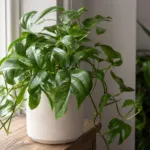 Pinnuta (Epipremnum aureum ‘Pinnuta’)Epipremnum aureum 'Pinnuta'
 Manjula (Epipremnum aureum ‘Manjula’)Epipremnum aureum 'Manjula'
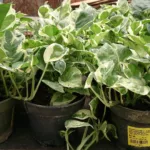 Jade pothos (Epipremnum aureum ‘Jade’)Epipremnum aureum 'Jade'
 Green Queen (Epipremnum aureum ‘Green Queen’)Epipremnum aureum 'Green Queen'
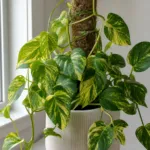 Hawaiian (Epipremnum aureum ‘Hawaiian’)Epipremnum aureum 'Hawaiian'
 Glacier (Epipremnum aureum ‘Glacier’)Epipremnum aureum 'Glacier'