
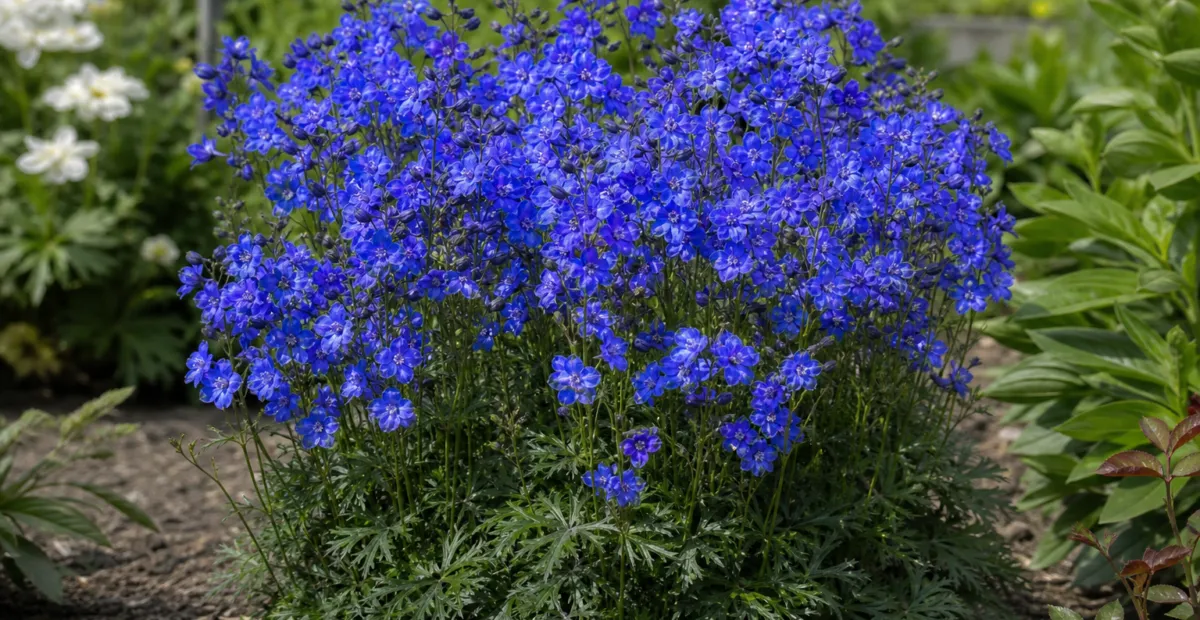
 AI-generated illustration
 Delphinium ‘Blue Mirror’ short overview
Delphinium 'Blue Mirror' is a compact Siberian larkspur cultivar valued for its intense blue flowers, finely divided foliage, and generous summer bloom. Unlike tall border delphiniums, it forms a low, bushy mound and often needs little or no staking. Grow it in full sun or light afternoon shade, in fertile, well-drained soil that stays evenly moist. It works well in borders, containers, cottage gardens, and small cut-flower plantings.
Taxonomic classification
Delphinium ‘Blue Mirror’ care guide
Light and placement
Grow in full sun for the strongest flowering, especially in cooler parts of the United States. In hot-summer regions, morning sun with light afternoon shade can reduce heat and moisture stress. Too little light produces weak, stretched stems and fewer flowers; excessive reflected heat or intense afternoon sun may scorch foliage and shorten bloom.
Watering and humidity
Water deeply when the upper inch of soil begins to dry, keeping the root zone evenly moist without saturation. Increase frequency during flowering, container culture, and hot weather; reduce watering after the foliage dies back. Water at soil level where possible, because wet foliage and stagnant air encourage disease.
Soil and growing medium
Use fertile, humus-enriched soil that drains freely but does not dry sharply. A loam-based garden soil is suitable; improve heavy clay with organic matter and avoid waterlogged sites. Published guidance is broadly tolerant of soil pH, so slightly acidic through slightly alkaline conditions are reasonable.
Feeding
Apply a balanced, slow-release perennial fertilizer or a thin layer of finished compost in spring as growth resumes. A second light feeding after the first bloom may support rebloom in poor soil. Avoid heavy nitrogen applications, which can produce soft growth and increase disease risk.
Growth and habit
Forms a compact, bushy mound with flowering stems rising above basal foliage. It is shorter and generally less prone to lodging than tall border delphiniums, although rich soil, heavy rain, or exposed sites can still make light support useful. Cutting back after flowering may promote a second display.
Planting and repotting
Plant in spring after the soil can be worked, or in early fall where plants have time to root before hard freezes. Set the crown at the same depth as in the nursery pot. Space plants about 12–18 inches apart, allowing airflow around the mound.
Move container plants in early spring when roots fill the pot. Use a deep container with drainage holes and fresh, fertile, well-drained potting mix. Handle the crown gently and water thoroughly after transplanting.
Propagation and pruning
Propagation
Seed is the most practical method, although seedlings may not reproduce the cultivar perfectly. Sow fresh seed in containers or a prepared bed; a period of cool, moist treatment may improve uniformity. Division or basal cuttings can be attempted during active growth, but cultivar-specific success data are limited.
Pruning
Deadhead spent flower clusters to extend the display and reduce unwanted self-sowing. After the main flush, cut flowering stems back to healthy basal growth; remove yellowing foliage once it has naturally declined. Sanitize tools when cutting diseased tissue.
Overwintering
Plants in Zones 3–7 generally overwinter outdoors in the ground. After foliage declines, remove dead material and apply a light mulch in colder or exposed sites, keeping mulch away from the crown. Container plants are more vulnerable to root freezing and should be wintered in a sheltered, unheated location where they remain dormant.
Uses
Use in sunny borders, cottage gardens, containers, rock-garden edges, and small cut-flower plantings. The compact habit is useful where tall delphiniums would overwhelm neighboring plants. Because delphiniums are toxic if eaten, do not use them for culinary or edible landscaping.
Appearance
The plant forms a rounded to bushy mound of dark green, deeply divided, almost fern-like leaves. Slender branching stems rise above the foliage and carry open blue flowers. The compact architecture distinguishes it from tall, heavily staked border delphiniums; flower color may appear blue, marine blue, or violet-blue under different light.
Flowering
The cultivar produces loose, branching clusters of vivid blue flowers over a compact mound. Bloom commonly begins in late spring or early summer and may continue through summer; cutting back after the first flush can encourage rebloom where growing conditions permit.
Pollination and visitors
The blue flowers are reported to attract bees and butterflies, and delphiniums generally provide accessible floral resources for insect visitors. Evidence located for this exact cultivar supports visitor groups rather than a named pollinator species.
Diseases and pests
Diseases
Prevent problems by providing good air circulation, avoiding overhead irrigation, and removing crowded or declining foliage. Delphiniums may develop powdery mildew, rust, leaf spots, crown rot, or bacterial issues, especially in humid, poorly ventilated, or waterlogged conditions. Remove affected tissue and improve drainage before considering labeled treatments.
Pests
Slugs and snails may damage young foliage. Aphids, spider mites, and leaf-mining or chewing insects can occur. Inspect new growth, reduce hiding places for slugs, hand-pick where practical, and use targeted controls only when damage is persistent.
Toxicity and pollen
Delphinium species contain toxic diterpenoid alkaloids and should not be eaten. Exposure is primarily a concern after chewing or swallowing plant material; symptoms can include gastrointestinal, neurologic, muscular, or cardiovascular effects depending on dose and species. Wear gloves if sensitive, keep trimmings away from children and animals, and seek professional poison or veterinary advice after ingestion.
- Typical season
- During flowering, typically May–September in the United States
- Pollination / pollen
- Insect-dispersed pollen
This is an insect-pollinated flowering perennial, so its pollen is usually transferred close to the flowers rather than released in large airborne clouds. Airborne exposure is nevertheless not zero, and sensitive gardeners may prefer gloves and avoid handling flowers during peak symptoms.
Native habitat
The cultivar derives from the Siberian larkspur group, associated with cool-temperate regions of northern China, Siberia, and adjacent parts of Eurasia. It performs best in climates with cool summers, fertile soils, reliable moisture, and good drainage rather than hot, drought-prone conditions.
Interesting fact
Blue Mirror is notably shorter and more compact than many classic border delphiniums. Its finely divided foliage creates a fern-like texture beneath the flowers. The cultivar is also used as a container plant and may flower without the prolonged cold treatment used in some greenhouse schedules.
Frequently asked questions (FAQ)
The most relevant questions about this plant, with short and direct answers.
🌱Quick care
How do you care for Delphinium 'Blue Mirror'?⌄
Grow Delphinium 'Blue Mirror' in full sun to partial shade, fertile well-drained soil, and evenly moist conditions. Avoid waterlogged soil, especially around the crown and roots.
Is Delphinium 'Blue Mirror' a perennial?⌄
Yes, Delphinium 'Blue Mirror' is a hardy herbaceous perennial, although it may be relatively short-lived and can perform like a biennial or annual in some gardens.
How big does Delphinium 'Blue Mirror' get?⌄
Delphinium 'Blue Mirror' typically forms a compact mound about 12–18 inches tall and 10–18 inches wide, with flowering stems reaching up to about 24 inches.
🌤️Environment and placement
What USDA hardiness zones are best for Delphinium 'Blue Mirror'?⌄
Delphinium 'Blue Mirror' is generally listed for USDA Zones 3–7. In hotter areas, afternoon shade and consistent moisture may help it tolerate summer conditions.
Does Delphinium 'Blue Mirror' need full sun?⌄
It grows and flowers best in full sun, but partial shade is useful in hot climates. Morning sun with afternoon shade can reduce heat stress while maintaining good flowering.
Can Delphinium 'Blue Mirror' grow in a container?⌄
Yes, its compact, mounded habit makes Delphinium 'Blue Mirror' suitable for containers. Use a pot with drainage holes and a well-drained mix, and monitor moisture closely because containers dry out faster.
What soil does Delphinium 'Blue Mirror' prefer?⌄
Plant it in fertile, humus-rich, well-drained soil that stays evenly moist but never soggy. Neutral to slightly alkaline soil is commonly recommended, although it can tolerate a broader soil range if drainage is good.
Where should I plant Delphinium 'Blue Mirror' in the garden?⌄
Place it in a sunny border, edging, rock garden, cottage garden, or container where its blue flowers can be viewed up close. Shelter from strong winds helps protect the flowering stems.
💧Care and problems
How often should I water Delphinium 'Blue Mirror'?⌄
Water when the soil surface begins to dry, keeping the root zone consistently moist during active growth and flowering. Do not let the plant sit in standing water, because excessive moisture can encourage root or crown rot.
Why is my Delphinium 'Blue Mirror' wilting?⌄
Wilting is commonly caused by dry soil, heat stress, root damage, or overly wet conditions that have weakened the roots. Check soil moisture and drainage before watering more, especially during cool or rainy weather.
Does Delphinium 'Blue Mirror' need fertilizer?⌄
It benefits from fertile soil and a moderate application of compost or balanced fertilizer before the main blooming period. Avoid heavy late-season feeding, which can encourage tender growth as the plant prepares for dormancy.
Does Delphinium 'Blue Mirror' need staking?⌄
Usually not, because this cultivar is shorter and more compact than tall delphiniums. Staking may still be helpful in windy locations or after heavy rain when stems become weighed down.
What pests or diseases affect Delphinium 'Blue Mirror'?⌄
Delphinium 'Blue Mirror' can be affected by common delphinium problems such as aphids, slugs, snails, and root or crown rot. Good air circulation, careful watering, and well-drained soil reduce disease risk.
Should I deadhead Delphinium 'Blue Mirror'?⌄
Yes, remove faded flower stems to improve the plant’s appearance and encourage additional flowering. Leave some seedheads only if you want the plant to self-sow.
🪴Planting and repotting
When should I plant Delphinium 'Blue Mirror' outdoors?⌄
Plant it outdoors after the danger of severe frost has passed, or in early fall where plants have time to establish before winter. In colder regions, spring planting is generally the safer choice.
How far apart should Delphinium 'Blue Mirror' plants be spaced?⌄
Space plants about 12–18 inches apart to allow air circulation and room for the mature mound. Use the wider spacing in humid climates or areas with frequent summer rainfall.
Can Delphinium 'Blue Mirror' bloom in its first year?⌄
Yes, plants started early from seed can flower in their first year under favorable conditions. Flowering is usually stronger when seedlings receive adequate light, steady moisture, and a long enough growing season.
✂️Propagation and pruning
How do you grow Delphinium 'Blue Mirror' from seed?⌄
Sow the seeds indoors about 8–10 weeks before the last expected spring frost, pressing them into the mix and covering them only lightly. Keep the medium evenly moist and provide bright light after germination.
Do Delphinium 'Blue Mirror' seeds need cold stratification?⌄
Cold stratification can improve or speed germination, although this cultivar may germinate without it. A short period of chilling in moist conditions is a reasonable option when germination has been unreliable.
How long do Delphinium 'Blue Mirror' seeds take to germinate?⌄
Seeds commonly germinate in about 2–4 weeks under suitable conditions, though cooler temperatures or variable seed quality can make the process take longer. Keep the sowing medium moist but not saturated.
Can Delphinium 'Blue Mirror' self-seed?⌄
Yes, it can self-sow when flowers are allowed to mature into seedheads. Seed-grown plants may vary somewhat, so self-sown seedlings should not be assumed to be perfectly identical to the parent cultivar.
Can you divide Delphinium 'Blue Mirror'?⌄
Division may be possible for established clumps, preferably in early spring or early fall, but seed propagation is often more practical for this relatively short-lived delphinium. Handle the crown carefully and replant divisions promptly.
⚠️Toxicity and safety
Is Delphinium 'Blue Mirror' poisonous to people?⌄
Yes, all parts of Delphinium 'Blue Mirror', including the seeds, are toxic if ingested. Keep it away from children and do not use any part of the plant as food or medicine.
Is Delphinium 'Blue Mirror' toxic to dogs and cats?⌄
Yes, delphiniums are considered toxic to pets if eaten. Prevent access to the plant and contact a veterinarian or pet poison service promptly if ingestion is suspected.
🌸Flowering and special interest
When does Delphinium 'Blue Mirror' bloom?⌄
It generally blooms from late spring or early summer through summer, and may flower again later in the season after deadheading. Exact timing depends on climate, planting date, and growing conditions.
What color are Delphinium 'Blue Mirror' flowers?⌄
The flowers are vivid electric blue to violet-blue, often described as having blue flowers with violet overtones. Color intensity can vary with light, temperature, soil, and the individual plant.
Is Delphinium 'Blue Mirror' good for cut flowers?⌄
Yes, its flowering stems can be used as cut flowers. Cut stems when the lower flowers are open and place them in water promptly for the best vase performance.
Does Delphinium 'Blue Mirror' attract pollinators?⌄
Yes, its flowers can attract butterflies, hummingbirds, and other pollinators. Planting it in groups can create a more noticeable display and provide a stronger visual target for garden visitors.
Similar plants
 Doubtful knight’s-spur (Delphinium ajacis) care guideDelphinium ajacis
 Delphinium ‘Magic Fountains’Delphinium 'Magic Fountains'
 Delphinium elatum care guideDelphinium elatum elatum
 Delphinium ‘Summer Nights’Delphinium 'Summer Nights'
 Delphinium elatum care guideDelphinium elatum
 Delphinium ‘Black Knight’Delphinium 'Black Knight'