
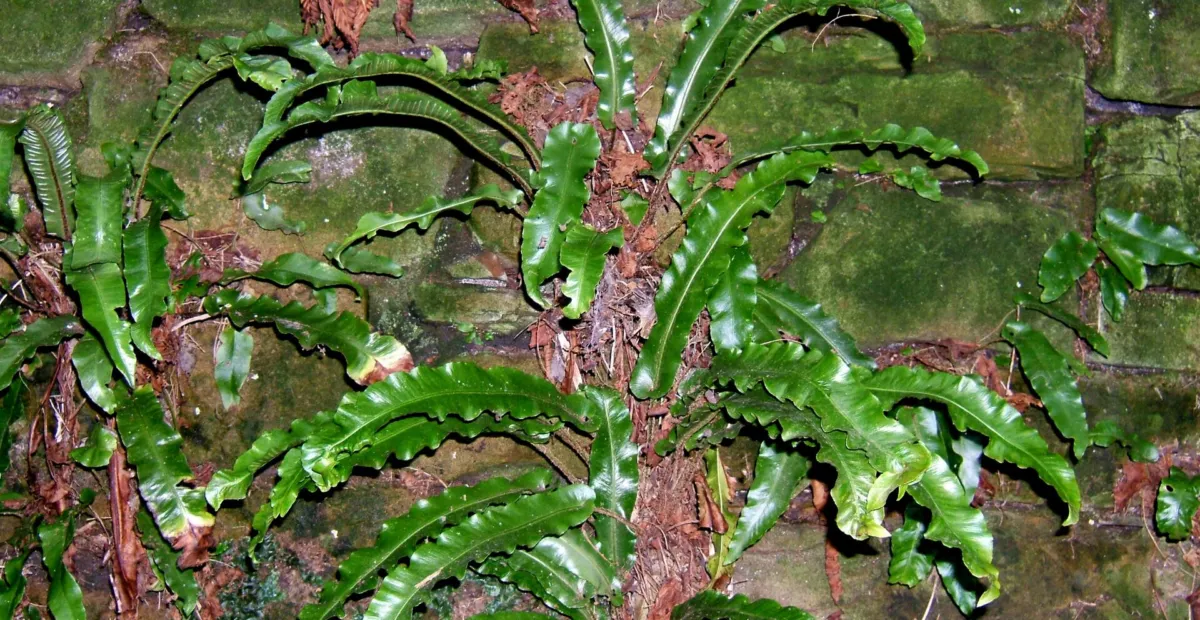
 Source:
 Hart’s-tongue fern (Asplenium scolopendrium) short overview
Hart's-tongue fern is an evergreen, clump-forming spleenwort valued for its glossy, undivided fronds that rise in an elegant rosette. Native across temperate regions of the Northern Hemisphere, it prefers cool, moist but sharply drained soil, especially where limestone or other alkaline conditions are present. In U.S. gardens, it suits shaded woodland borders, rock gardens, shaded containers, and protected crevices. It reproduces by spores rather than flowers or seeds.
Taxonomic classification
Hart’s-tongue fern (Asplenium scolopendrium) care guide
Light and placement
Grow in partial shade to full shade, ideally with bright indirect or filtered light and protection from intense midday and afternoon sun. East- or north-facing exposures, woodland edges, shaded walls, and protected crevices are suitable. Bleached, scorched, or papery fronds suggest excessive sun or drying; weak, elongated growth can indicate inadequate light combined with poor airflow or nutrition.
Watering and humidity
Keep the soil evenly and moderately moist, especially during the first growing season and during summer drought. Water deeply when the surface begins to dry, then allow excess water to drain fully; never leave the crown sitting in water. Reduce watering somewhat in cool weather, but do not allow container plants to dry completely. Humidity is helpful, but ventilation prevents disease.
Soil and growing medium
Use a humus-rich, moisture-retentive but well-drained mix. Loam amended with leaf mold, compost, or fine bark works well; avoid stagnant wetness around the crown. The species commonly favors neutral to alkaline conditions and often performs especially well in limestone-derived or calcareous soil. In containers, use an open fern mix with excellent drainage.
Feeding
Feed sparingly. Incorporate compost or leaf mold when planting, then apply a dilute balanced liquid fertilizer in spring only if growth is pale or weak. Avoid heavy nitrogen feeding, which can produce soft growth, and do not fertilize drought-stressed, newly divided, or waterlogged plants.
Growth and habit
This evergreen fern forms a compact rosette from a short, upright rhizome. It is generally slow to moderate in establishment and remains well behaved in garden settings. Keep the crown free from deep mulch and divide only established clumps, since disturbance and drying can slow recovery.
Planting and repotting
Plant in spring or fall, setting the crown level with the surrounding soil rather than deeply burying it. Space plants about 12–18 inches apart, allowing room for the rosette to broaden. Water regularly during the first growing season and mulch lightly with leaf mold or compost, keeping mulch away from the crown.
Repot container plants in spring when the root mass fills the pot, moving up only one container size. Handle the short rhizome carefully and keep the crown at the same level as before. Refresh part of the growing medium rather than burying the crown, then water thoroughly and keep the plant shaded while it re-establishes.
Propagation and pruning
Propagation
Propagate by division in spring when a mature clump can be lifted and separated carefully. Spores may be sown as soon as ripe on the surface of sterilized, moist medium at about 59°F, but this method is slow and technically demanding. Some sterile cultivars can be multiplied from old frond bases or leaf bases under humid conditions.
Pruning
Remove dead, damaged, or badly tattered fronds at the base in late winter or early spring, before new croziers expand. Avoid cutting healthy green fronds, which continue contributing to the plant's energy reserves. Clean away fallen debris if fungal problems have occurred.
Overwintering
In USDA Zones 5–9, established plants generally overwinter outdoors. In colder or exposed sites, apply a light leaf-mold mulch after the ground cools, keeping the crown uncovered. Container plants are more vulnerable to root freezing and should be sheltered in an unheated protected space if severe cold is expected.
Uses
Use as an ornamental foliage plant in shaded borders, woodland gardens, limestone rockeries, shaded walls, and containers. Its evergreen rosettes provide structure through winter in suitable climates. It is not recommended as a culinary or medicinal plant without specialist identification and safety guidance.
Appearance
The defining feature is a rosette of simple, leathery, strap-shaped fronds rather than finely divided leaves. Fronds are glossy bright green, often with gently undulate margins, and may arch slightly outward. The brownish stipes arise from a short rhizome. Mature fronds reveal paired, elongated sori arranged in conspicuous transverse lines on the underside.
Pollination and visitors
As a fern, it has no flowers, nectar, or pollen-bearing floral structures and is not an animal-pollinated plant. Reproduction involves spores and gametophytes, with spore dispersal primarily influenced by air movement rather than insect or vertebrate visitation.
Asplenium scolopendrium photos
Click any photo for a larger view. Source, author and license are shown separately.
Diseases and pests
Diseases
Generally reliable outdoors, but rust diseases may occur in mild, damp conditions. Improve air circulation, avoid overhead watering late in the day, remove badly affected fronds, and avoid planting into persistently waterlogged soil. Disinfect tools between plants if disease is suspected.
Pests
Usually pest-free outdoors, though slugs and snails may occasionally damage young fronds in damp gardens. Inspect new growth, remove hiding places, and use non-toxic barriers or hand-picking where needed. Avoid routinely applying fungicides because the species can be sensitive to some treatments.
Related diseases and pests
Only Plant Doctor profiles whose host data indicate this plant may be affected are shown here.

Toxicity and pollen
No authoritative evidence located in the reviewed sources identifying Asplenium scolopendrium as toxic to humans or companion animals. Do not treat historical medicinal use as a safety guarantee; avoid consuming ornamental plants unless identity and food safety are specifically confirmed, and seek professional advice after ingestion or unusual exposure.
- Typical season
- Not applicable; spores may be released mainly in summer and early fall.
- Pollination / pollen
- Fine airborne spores, not pollen
Ferns do not produce pollen; they release spores. This distinction means conventional pollen-season ratings do not apply. Airborne fern spores can occur during spore release, but species-specific clinical allergy evidence for Hart's-tongue fern was not established in the reviewed sources.
Native habitat
It occurs in temperate habitats including shaded deciduous woodland, moist rocky cliffs, limestone crevices, ravines, and old walls. Natural sites are typically cool and sheltered, with consistent moisture but effective drainage. Calcareous or alkaline substrates are particularly characteristic, although regional populations can occupy somewhat broader soil conditions.
Interesting fact
The species name scolopendrium refers to the centipede-like appearance of the linear sori beneath the fronds. Its simple, undivided blades are unusual among many garden ferns, which more commonly have divided fronds. Some horticultural cultivars are sterile and require vegetative propagation rather than spores.
Frequently asked questions (FAQ)
The most relevant questions about this plant, with short and direct answers.
🌱Quick care
What is Asplenium scolopendrium called?⌄
Asplenium scolopendrium is commonly called Hart's-tongue fern. It is an evergreen fern in the Aspleniaceae family, also known as a spleenwort.
How much light does Hart's-tongue fern need?⌄
Hart's-tongue fern grows best in partial shade to full shade. Protect it from strong midday and afternoon sun, which can scorch the fronds.
How often should I water Hart's-tongue fern?⌄
Water Hart's-tongue fern whenever the soil surface begins to dry, keeping the root zone moderately and consistently moist. Avoid leaving the plant in saturated soil because poor drainage can cause root rot.
Is Hart's-tongue fern evergreen?⌄
Yes, Hart's-tongue fern is generally evergreen in suitable climates. Individual fronds may become damaged or discolored and can be removed as needed.
Is Hart's-tongue fern easy to grow?⌄
Hart's-tongue fern is relatively low-maintenance when grown in shade, humus-rich soil, and reliable moisture. Good drainage is essential, even though the plant prefers moist conditions.
🌤️Environment and placement
What USDA hardiness zones can grow Hart's-tongue fern?⌄
Hart's-tongue fern is commonly grown in USDA Zones 5 through 9, with some cultivars and references extending into Zone 4. Local winter exposure and snow cover can affect its performance.
Can Hart's-tongue fern grow in deep shade?⌄
Yes, Hart's-tongue fern tolerates full shade and can perform well in deeply shaded woodland or north-facing locations. Growth may be slower, but excessive light is usually a greater problem than too little light.
Does Hart's-tongue fern need high humidity?⌄
Outdoor Hart's-tongue fern usually does not require unusually high humidity if its soil remains evenly moist. In dry indoor air, browning may occur, but this species is generally better suited to outdoor shade than to typical heated rooms.
Can Hart's-tongue fern grow in a container?⌄
Yes, Hart's-tongue fern can be grown in a container with drainage holes and a moisture-retentive but well-drained potting mix. Choose a shaded location and do not allow the container to dry out completely.
Can Hart's-tongue fern tolerate dry shade?⌄
Hart's-tongue fern can tolerate some dry shade after establishment, but it grows best with regular moisture. Water it consistently during its first growing season and mulch the surrounding soil to reduce drying.
Does Hart's-tongue fern prefer acidic or alkaline soil?⌄
Hart's-tongue fern generally prefers neutral to alkaline, calcium-rich soil and often thrives in humus-rich limestone or other calcareous conditions. It can tolerate some variation, but strongly acidic soil may be less suitable.
💧Care and problems
Why are my Hart's-tongue fern fronds turning brown?⌄
Brown fronds commonly result from drought, excessive sun, winter damage, or root stress from poor drainage. Check soil moisture and light exposure, then remove only fronds that are fully dead.
Why is my Hart's-tongue fern turning yellow?⌄
Yellowing may indicate waterlogged soil, root damage, excessive sunlight, or natural aging of older fronds. Improve drainage and shade before increasing watering, since constantly wet roots can worsen the problem.
Why is my Hart's-tongue fern not growing?⌄
Slow growth is normal in Hart's-tongue fern, especially in deep shade or during establishment. Confirm that the soil is moist but drained, the plant is not exposed to harsh sun, and the crown is not buried.
How do I prevent root rot in Hart's-tongue fern?⌄
Prevent root rot by planting Hart's-tongue fern in moist but well-drained soil and avoiding heavy, persistently saturated conditions. Amend compact soil with organic matter and use a container with unobstructed drainage.
Does Hart's-tongue fern have common pests or diseases?⌄
Hart's-tongue fern is generally pest-free outdoors and has few serious disease problems. Rust can occur in mild, damp conditions, while poorly drained soil increases the risk of root rot.
🪴Planting and repotting
When should I plant Hart's-tongue fern outdoors?⌄
Plant Hart's-tongue fern in spring or fall when temperatures are moderate and the soil can be worked. Avoid planting during hot, dry weather unless you can provide regular irrigation.
How do I plant Hart's-tongue fern?⌄
Plant Hart's-tongue fern with the crown at soil level in a shaded site containing humus-rich, moist but well-drained soil. Water thoroughly after planting and apply a light organic mulch without covering the crown.
How far apart should Hart's-tongue ferns be planted?⌄
Space Hart's-tongue ferns about 12 to 18 inches apart to allow their rosettes to develop. Use the wider spacing where airflow is limited or where the soil stays especially moist.
Can Hart's-tongue fern grow in limestone or rock gardens?⌄
Yes, Hart's-tongue fern is well suited to shady limestone rock gardens and crevices with moisture-retentive soil. Provide excellent drainage because calcareous soil does not compensate for waterlogged roots.
✂️Propagation and pruning
How do you propagate Hart's-tongue fern?⌄
Hart's-tongue fern can be propagated by division or by sowing mature spores. Division is usually the more practical method for gardeners, while spore propagation is slower and requires consistently moist conditions.
Can Hart's-tongue fern be propagated from fronds or cuttings?⌄
No, Hart's-tongue fern is not normally propagated from detached fronds or stem cuttings. Use division or collect and sow spores instead.
When should I divide Hart's-tongue fern?⌄
Divide Hart's-tongue fern in spring or early fall when temperatures are mild and the plant is not under drought stress. Replant divisions promptly, keeping the crown at the same depth.
How do I propagate Hart's-tongue fern from spores?⌄
Collect spores from mature sori on the undersides of fronds and sow them on a sterile, moist growing medium. Keep the container humid and warm; spore propagation is slow and may not produce an exact copy of some cultivated forms.
Should I prune Hart's-tongue fern?⌄
Hart's-tongue fern needs little pruning. Remove dead, damaged, or badly discolored fronds at the base with clean shears, while leaving healthy evergreen fronds intact.
⚠️Toxicity and safety
Is Hart's-tongue fern poisonous to people or pets?⌄
No documented toxicity was located for Hart's-tongue fern, but that does not establish that it is edible or completely safe for every person or animal. Do not consume it, and contact a poison-control or veterinary professional if ingestion occurs.
🌸Flowering and special interest
Does Hart's-tongue fern produce flowers?⌄
No, Hart's-tongue fern does not produce flowers. Like other ferns, it reproduces with spores formed in rows of sori on the undersides of mature fronds.
What are the brown lines on the underside of Hart's-tongue fern fronds?⌄
The brown lines are sori, which contain the fern's spores. Their transverse stripe pattern is a useful identifying feature of Asplenium scolopendrium.
How large does Hart's-tongue fern get?⌄
Hart's-tongue fern typically grows about 12 to 18 inches tall and wide, although conditions and cultivar can change its size. Mature plants form a clump of upright to arching, strap-shaped fronds.
Similar plants
 Azure Monkshood (Aconitum carmichaelii) care guideAconitum carmichaelii
 Monkshood (Aconitum ‘Stainless Steel’)Aconitum 'Stainless Steel'
 Monkshood (Aconitum ‘Bressingham Spire’)Aconitum 'Bressingham Spire'
 Golden full moon maple (Acer shirasawanum ‘Aureum’)Acer shirasawanum 'Aureum'
 Globosum (Acer platanoides ‘Globosum’)Acer platanoides 'Globosum'
 Striped maple (Acer pensylvanicum) care guideAcer pensylvanicum