
 Source:
 Taxodium ‘Distichum’ short overview
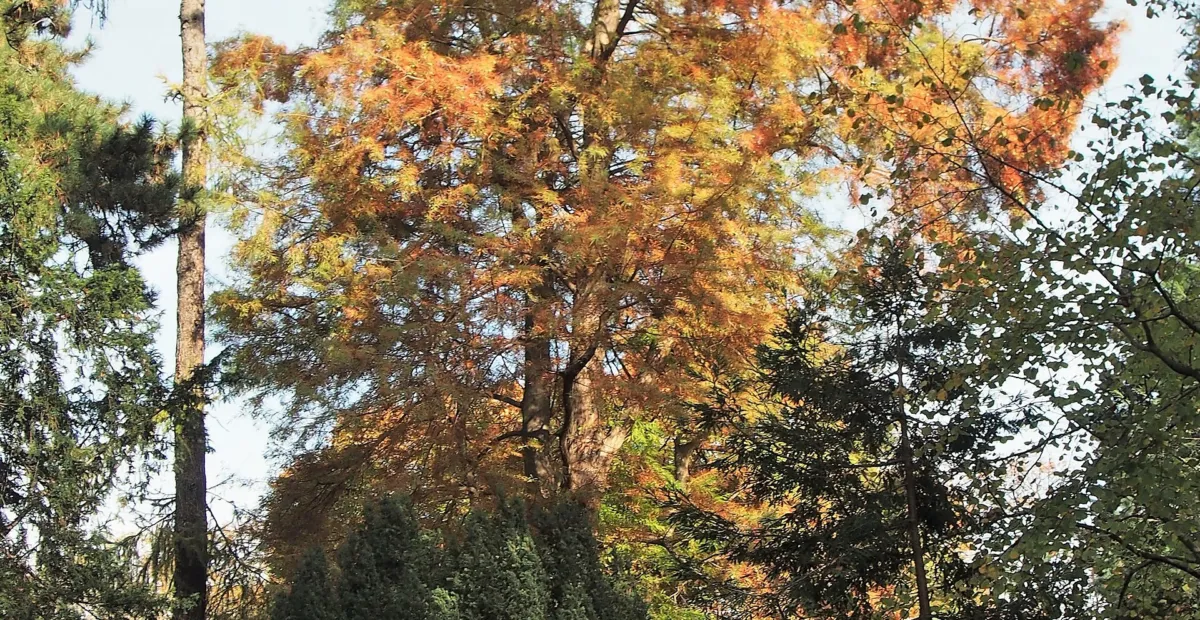
Taxodium 'Distichum' is an editor-supplied horticultural identity aligned with the baldcypress species Taxodium distichum. This large, deciduous conifer develops feathery green foliage, reddish-brown bark, rounded seed cones, and often a broad, buttressed base. It suits sunny landscapes, wet sites, rain gardens, stream margins, and large properties, but its mature size requires careful placement. Taxodium 'Distichum' is retained as the requested exact name, while available evidence supports interpretation at the species level as Taxodium distichum, a large deciduous conifer commonly known as baldcypress.
Taxonomic classification
Taxodium ‘Distichum’ care guide
Light and placement
Choose full sun for the strongest growth, best crown development, and reliable autumn color; partial shade is tolerated but may produce a less vigorous, more open tree. Place it where the crown and broadening base have room to develop, preferably with southern or southeastern exposure in cooler regions. Sparse growth, weak branching, or reduced color can indicate inadequate light; scorch or drought stress indicates excessive heat combined with insufficient water rather than excessive light alone.
Watering and humidity
Water deeply and slowly whenever the upper soil begins to dry during establishment, generally once or twice weekly in hot, dry weather depending on soil and rainfall. Keep moisture consistent through the first two growing seasons, then reduce irrigation as roots become established except during prolonged drought. Mature trees tolerate wet conditions and some dry upland sites, but avoid abrupt cycles of severe drying and saturation in containers or newly planted specimens.
Soil and growing medium
Use fertile, moisture-retentive soil for strongest growth, although established trees tolerate a broad range from wet clay to ordinary loam and sandy soil. Good drainage is acceptable in cultivation, but avoid persistently alkaline conditions because chlorosis can develop. A slightly acidic to neutral soil is preferred.
Feeding
Usually needs little fertilizer after establishment when planted in reasonably fertile soil. If growth is weak or foliage is pale for reasons other than high pH or water stress, use a soil test before feeding. Apply a slow-release, balanced tree fertilizer in early spring only when indicated, and avoid heavy nitrogen applications that encourage weak, overly lush growth.
Growth and habit
Young trees are typically pyramidal and strongly upright, then become broader and more open with age. Growth is often rapid when moisture and fertility are adequate. Mature trees can develop a pronounced buttressed base and surface roots, so lawn equipment, paving, and compacted soil should be managed carefully around the root zone.
Planting and repotting
Plant in fall through early spring while the tree is dormant, avoiding frozen or waterlogged planting holes. Set the root flare level with or slightly above the surrounding soil. Water deeply during the first two growing seasons and allow ample room for the eventual trunk flare, crown, and surface roots.
Not generally suitable for long-term container culture because the species becomes a very large tree. Young nursery plants can be shifted into progressively larger containers only temporarily; plant into the landscape before the root system becomes congested.
Propagation and pruning
Propagation
Propagate primarily from seed, which should be sown fresh or after appropriate moist stratification because viability declines with storage. Semi-hardwood or hardwood cuttings may root under controlled nursery conditions, but are less routine than seed. Plant seedlings out while young because large root systems transplant less readily.
Pruning
Prune only to remove dead, damaged, crossing, or poorly attached branches and to establish a sound central structure in young trees. Perform structural work during dormancy or dry weather. Avoid topping, large unnecessary cuts, and repeated removal of lower limbs that contribute to the tree’s characteristic form.
Overwintering
Fully outdoor and winter hardy across much of the United States when established. Young trees benefit from a deep organic mulch layer over the root zone, kept several inches away from the trunk. In colder regions, protect newly planted roots from winter drying and frost heaving; do not wrap the entire crown unless local conditions demand it.
Uses
A major ornamental and ecological tree for ponds, stream margins, wet meadows, rain gardens, drainage areas, parks, and large residential landscapes. It provides structure, nesting habitat, flood-buffering benefits, and seeds used by wildlife. Its wood has traditional utility, but landscape use should focus on living trees and site suitability.
Appearance
A distinctive deciduous conifer with soft, flat, linear needles arranged along delicate deciduous branchlets. The bark is reddish brown to gray brown and becomes furrowed or fibrous with age. Young trees are pyramidal; older trees develop an open crown, a broadened trunk base, and sometimes woody knees in wet ground. Small rounded seed cones contrast with the fine foliage.
Pollination and visitors
The reproductive structures are adapted primarily to wind pollination rather than animal visitation. Animal pollinator attraction is therefore rated none, even though the tree supports broader wetland food webs and wildlife habitat.
Taxodium 'Distichum' photos
Click any photo for a larger view. Source, author and license are shown separately.
Diseases and pests
Diseases
Twig blight may occur, particularly on dead or weakened twigs. Improve air circulation, avoid unnecessary wounds, and prune out affected dry or dead material during dry weather. Chlorosis is more likely on high-pH soils than from a specific infectious disease.
Pests
Generally low-maintenance, but inspect stressed trees for bagworms, spider mites, scale insects, and occasional twig problems. Maintain vigor through correct planting, mulch kept away from the trunk, and irrigation during drought. Identify the cause before using insecticides; treatment is rarely justified for minor damage.
Toxicity and pollen
No reliable source located in this review documents clinically significant toxicity for Taxodium distichum in humans, dogs, cats, or children. Do not treat the absence of a documented warning as proof of complete safety. Avoid ingesting plant material, supervise children and pets around cones and foliage, and seek professional advice after a substantial ingestion or unusual reaction.
- Typical season
- Late winter to spring in much of the United States
- Pollination / pollen
- Light, wind-dispersed conifer pollen
Male cones release airborne pollen during late winter or spring. The pollen concern is assessed as low rather than none because wind-dispersed pollen can affect sensitive people, although species-specific clinical allergy evidence is limited in the sources reviewed. Keep pollen exposure in perspective and consult a clinician for persistent seasonal symptoms.
Native habitat
Native populations occur across much of the southeastern and south-central United States, especially along rivers, streams, swamps, bayous, floodplains, and seasonally inundated lowlands. It tolerates prolonged flooding but is also unusually adaptable in cultivation, where it can grow on upland soils if establishment moisture is sufficient.
Interesting fact
Baldcypress is a deciduous conifer, so it loses its soft needle-like foliage each year. Trees growing in wet ground may form woody projections called knees, although knee development varies with site and age. The species is exceptionally long-lived, and old trees can develop massive flared bases and rot-resistant heartwood.
Frequently asked questions (FAQ)
The most relevant questions about this plant, with short and direct answers.
🌱Quick care
What is Taxodium 'Distichum'?⌄
Taxodium 'Distichum' is a horticultural identity within the baldcypress group, related to the accepted species Taxodium distichum. Because the exact cultivar or rank is not clearly documented in major plant references, care guidance should follow baldcypress requirements.
Is Taxodium 'Distichum' evergreen or deciduous?⌄
Taxodium 'Distichum' should be treated as a deciduous conifer that drops its soft, needle-like foliage in fall. It leafs out again in spring.
How much sun does Taxodium 'Distichum' need?⌄
Give Taxodium 'Distichum' full sun for the strongest growth, although it tolerates partial shade. At least 6 hours of direct sunlight is preferable.
How often should I water Taxodium 'Distichum'?⌄
Water Taxodium 'Distichum' deeply whenever the soil begins to dry, especially during its first growing season. Established trees tolerate some dry soil but perform best with consistent moisture.
How cold hardy is Taxodium 'Distichum'?⌄
Taxodium 'Distichum' is very cold hardy once established and can tolerate substantial winter cold. Protect young trees from drying winds and severe exposure until their root systems develop.
🌤️Environment and placement
Can Taxodium 'Distichum' grow in standing water?⌄
Taxodium 'Distichum' can grow in wet soil and tolerate seasonal or prolonged flooding. It also adapts surprisingly well to ordinary upland garden soil if moisture is adequate.
Can I grow Taxodium 'Distichum' in dry soil?⌄
Taxodium 'Distichum' can survive in moderately dry, well-drained soil after establishment, but it is not a drought-specialist tree. Regular watering is important during extended heat or drought.
What soil is best for Taxodium 'Distichum'?⌄
Use moist, fertile, moisture-retentive loam, clay, or sand with acidic to neutral pH. The tree is adaptable, but compacted or permanently dry soil can reduce growth.
Will Taxodium 'Distichum' grow in clay soil?⌄
Taxodium 'Distichum' generally grows well in clay soil when it receives adequate moisture. Improve drainage only if the site remains stagnant and oxygen-poor outside the tree’s normal wet-season tolerance.
Is Taxodium 'Distichum' suitable for a rain garden?⌄
Taxodium 'Distichum' can be suitable for a large rain garden or wet landscape because it tolerates saturated soil and periodic flooding. Allow enough room for its eventual height, trunk flare, and root system.
How large does Taxodium 'Distichum' get?⌄
A typical baldcypress form can reach about 50 to 70 feet tall and 20 to 30 feet wide. The exact mature size of Taxodium 'Distichum' is uncertain because its horticultural rank is not clearly documented.
Does Taxodium 'Distichum' produce cypress knees?⌄
Taxodium 'Distichum' may produce woody cypress knees, especially when grown in or near water for much of the year. Knees are less predictable in ordinary dry landscape conditions.
💧Care and problems
Why is my Taxodium 'Distichum' turning brown?⌄
Brown foliage on Taxodium 'Distichum' may result from normal fall color, drought stress, transplant shock, root problems, or pests. Check the season, soil moisture, and whether browning begins at the branch tips or throughout the crown.
Why is Taxodium 'Distichum' losing its needles in fall?⌄
Taxodium 'Distichum' naturally loses its needle-like leaves in fall because it is a deciduous conifer. Reddish-brown or copper fall color before leaf drop is normal.
Does Taxodium 'Distichum' need fertilizer?⌄
Taxodium 'Distichum' usually does not need fertilizer when planted in reasonably fertile soil. Apply a soil-test-based, slow-release fertilizer only if growth is weak and a nutrient deficiency is identified.
What pests affect Taxodium 'Distichum'?⌄
Taxodium 'Distichum' is generally low-maintenance but can occasionally experience bagworms, spider mites, scale, or foliage-chewing insects. Inspect stressed trees regularly and address the underlying watering or site problem.
Can Taxodium 'Distichum' tolerate salt?⌄
Taxodium 'Distichum' has some salt tolerance but is not fully salt-resistant. Avoid repeated exposure to concentrated road salt or salty irrigation water, particularly around young trees.
🪴Planting and repotting
When is the best time to plant Taxodium 'Distichum'?⌄
Plant Taxodium 'Distichum' in fall or early spring when temperatures are mild and soil moisture is reliable. Container-grown trees can be planted during the growing season if watered carefully.
How do I plant Taxodium 'Distichum'?⌄
Plant Taxodium 'Distichum' with the root flare level with or slightly above the surrounding soil, then water deeply and mulch without covering the trunk. Choose a site that can accommodate a large mature tree.
How far from a house should I plant Taxodium 'Distichum'?⌄
Place Taxodium 'Distichum' well away from buildings, driveways, septic systems, and overhead utilities because it can become a very large tree. A conservative spacing of at least 20 to 30 feet from structures is advisable, with more room preferred for full-sized forms.
Can Taxodium 'Distichum' be grown in a container?⌄
Taxodium 'Distichum' can be grown temporarily in a large container, but it is not a good long-term container plant because it develops a substantial root system and becomes a large tree. Use a container only for young specimens or bonsai-style culture.
✂️Propagation and pruning
How do you propagate Taxodium 'Distichum' from seed?⌄
Propagate Taxodium 'Distichum' from mature cones by extracting the seeds and sowing them in a moist, well-drained medium. Keep the medium consistently moist; cold stratification may improve germination, although requirements can vary by seed lot.
Can Taxodium 'Distichum' be propagated from cuttings?⌄
Taxodium 'Distichum' can be propagated from cuttings, but rooting success is less dependable than with seed or nursery-grown plants. Use young, vigorous shoots and controlled humidity if attempting cuttings.
How do I prune Taxodium 'Distichum'?⌄
Prune Taxodium 'Distichum' mainly to remove dead, damaged, crossing, or poorly attached branches and to establish one strong leader when young. Make clean cuts outside the branch collar and avoid excessive crown removal.
Can Taxodium 'Distichum' be kept small by pruning?⌄
Taxodium 'Distichum' cannot be kept truly small indefinitely by routine pruning because it is naturally a large tree. Choose a documented compact cultivar instead if the planting site has limited space.
⚠️Toxicity and safety
Is Taxodium 'Distichum' poisonous to dogs or cats?⌄
No specific toxicity is well documented for Taxodium 'Distichum' in the available references. Nevertheless, prevent pets from chewing or ingesting plant material because individual reactions and misidentification are possible.
Is Taxodium 'Distichum' poisonous to people?⌄
No specific human toxicity is documented for Taxodium 'Distichum', but its cones, foliage, and other parts should not be eaten. Seek medical advice or contact Poison Control if ingestion causes symptoms.
Are Taxodium 'Distichum' cypress knees dangerous?⌄
Cypress knees from Taxodium 'Distichum' are not generally poisonous, but they can create tripping hazards and interfere with mowing or paths. Avoid planting the tree where future knees or trunk flare would obstruct traffic.
🌸Flowering and special interest
Does Taxodium 'Distichum' have flowers?⌄
Taxodium 'Distichum' does not produce showy flowers; it produces inconspicuous male and female reproductive structures typical of a conifer. Its most noticeable seasonal features are soft foliage, fall color, cones, and sometimes cypress knees.
When does Taxodium 'Distichum' produce cones?⌄
Taxodium 'Distichum' usually develops rounded seed cones after pollination, with cones maturing in the same general growing cycle or toward fall. Production varies with tree age, climate, and growing conditions.
Why is my Taxodium 'Distichum' dropping round green balls?⌄
The round green balls are usually immature seed cones, not fruit or disease galls. They typically darken as they mature and may break apart to release seeds.
Do birds and wildlife use Taxodium 'Distichum'?⌄
Taxodium 'Distichum' provides habitat and structural cover in wet landscapes, while its seeds can be used by some birds and small mammals. Its value is greatest when grown near ponds, streams, wetlands, or other wildlife-supporting plantings.
Similar plants
 Cryptomeria (Cryptomeria japonica) care guideCryptomeria japonica
 Mediterranean Cypress (Cupressus sempervirens) care guideCupressus sempervirens
 Hesperotropsis leylandii care guideHesperotropsis leylandii
 Incense Cedar (Calocedrus decurrens) care guideCalocedrus decurrens
 Globosa Nana (Cryptomeria japonica ‘Globosa Nana’)Cryptomeria japonica 'Globosa Nana'