Source:
 Narcissus ‘Bridal Crown’ short overview
Narcissus 'Bridal Crown' is a fragrant Division 4 double daffodil with creamy-white, softly yellow-centered flowers in mid-spring. This bulbous perennial suits sunny to partly shaded beds, borders, containers, and cut-flower displays. Plant bulbs in fall in well-drained soil, then allow the strap-shaped foliage to yellow naturally after flowering so the bulbs can replenish for the following spring.
Taxonomic classification
Narcissus ‘Bridal Crown’ care guide
Light and placement
Grow in full sun for strongest flowering, or partial shade where the plants receive several hours of direct light. East-, south-, or west-facing beds are suitable; light shade beneath open deciduous trees can also work. Sparse flowering and floppy, elongated foliage suggest insufficient light, while scorched leaves usually indicate heat or drought rather than excessive light alone.
Watering and humidity
Water thoroughly after fall planting and whenever the soil becomes dry during root establishment. Keep soil evenly moist through active growth and flowering, but never saturated. Reduce watering after the foliage yellows and the bulb enters dormancy. Outdoor humidity is normally adequate; avoid wet leaves and stagnant, poorly drained sites.
Soil and growing medium
Use moderately fertile, well-drained soil that does not remain waterlogged. Daffodils tolerate loam, sand, clay, chalk, and a broad pH range, but drainage is especially important in heavy soil. Improve compact clay with organic matter and avoid fresh manure directly around the bulbs.
Feeding
Work a modest amount of bulb fertilizer into poor soil at planting if needed, then feed lightly as flowering ends rather than applying heavy nitrogen. Avoid fresh manure and excessive fertilizer, both of which can encourage lush foliage or bulb problems. Do not feed dormant bulbs in summer.
Growth and habit
This seasonal bulb emerges from dormancy in late winter or spring, forms an upright clump of strap-like leaves and flower stems, then goes dormant after the foliage matures. Leave the leaves intact until they yellow naturally; premature cutting or tying can reduce flowering in the following year.
Planting and repotting
Plant healthy bulbs in fall, with the pointed end up, at roughly two to three times the bulb's height; use the deeper end of that range in light soil. Space bulbs about 4–6 inches apart for a natural clump, or closer in containers. Water thoroughly after planting.
Container-grown bulbs can remain in place for several seasons if flowering remains strong. Repot or divide the clump after the foliage has died back, using fresh, well-drained potting mix and planting bulbs at their normal outdoor depth.
Propagation and pruning
Propagation
Propagate vegetatively by separating offsets as the foliage fades in early summer. Lift the clump only when needed, detach well-formed offsets carefully, and replant them promptly or store them briefly in a cool, dry place. Seed propagation is possible for breeding but does not reproduce the named cultivar reliably.
Pruning
No routine pruning is required. Remove spent flower heads if seed formation is unwanted, but leave the leaves untouched until they yellow and collapse naturally. Do not braid, tie, or cut back green foliage after bloom.
Overwintering
Leave bulbs outdoors in the ground in suitable climates. Apply a light mulch after the soil cools if winter temperatures are severe or snow cover is unreliable, but do not bury emerging shoots deeply. In containers, protect pots from repeated freeze-thaw cycles by moving them to a sheltered, unheated location or insulating the container.
Uses
Use in spring borders, cottage-style plantings, containers, naturalistic beds, and fragrant cut-flower arrangements. The bulbs are not edible and should never be confused with onions or other culinary bulbs. Flowers can be cut for indoor display, but keep plant material away from children and pets.
Appearance
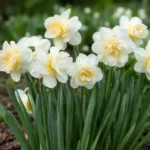
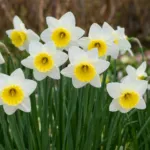
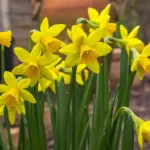
The plant forms an upright, clumping display of narrow, strap-shaped blue-green leaves and leafless flowering stems. Its defining feature is the fully double bloom: creamy-white outer segments surround short yellow inner segments, with some corona tissue mixed among the petal-like whorls. The flowers are notably fragrant.
Flowering
This Division 4 double daffodil produces fully double blooms with multiple whorls of petal-like segments and short yellow corona segments interspersed among them. Flowers appear in mid-spring, commonly March–April in the United States, with several blooms possible on a stem depending on bulb size and growing conditions.
Pollination and visitors
The fragrant flowers may receive occasional visits from early-season insects, but double flowers can make nectar and pollen less accessible than single daffodils. Reliable cultivar-specific visitor records are limited, so this plant should not be treated as a major pollinator resource.
Narcissus 'Bridal Crown' photos
Click any photo for a larger view. Source, author and license are shown separately.
Diseases and pests
Diseases
Reduce risk of basal rot and other bulb diseases by planting only firm, healthy bulbs in well-drained soil and avoiding excessive nitrogen or prolonged saturation. Remove badly diseased bulbs and foliage, and avoid planting narcissus repeatedly in the same poorly drained site.
Pests
Watch for narcissus bulb fly, narcissus eelworm, bulb scale mite, and slugs. Buy clean, firm bulbs, avoid planting in wet soil, remove plant debris, and discard badly infested or rotted bulbs. Healthy established clumps usually need little intervention.
Toxicity and pollen
Narcissus plants contain toxic alkaloids, including lycorine, with the greatest concentration generally in the bulbs. Ingestion may cause nausea, vomiting, abdominal pain, or diarrhea, while sap can irritate skin. Keep bulbs and plant material away from children and pets, and wear gloves when handling large quantities.
- Typical season
- March–April in much of the United States
- Pollination / pollen
- Primarily insect-presented pollen
Daffodil pollen is primarily presented within the flower and is not typically dispersed in large airborne clouds. Some pollen exposure remains possible during flowering, especially when handling flowers or working closely among many plants, so sensitive gardeners should use ordinary precautions.
Native habitat
As a named garden cultivar, ‘Bridal Crown’ has no single natural habitat or wild distribution. It is grown in temperate gardens where cool winters, spring moisture, and well-drained soils support bulb dormancy, root growth, and spring flowering.
Interesting fact
‘Bridal Crown’ received the Royal Horticultural Society Award of Garden Merit in 2003. It belongs to Division 4, the double daffodil group. The cultivar is valued for strong fragrance and flowers with multiple whorls of petal-like segments.
Frequently asked questions (FAQ)
The most relevant questions about this plant, with short and direct answers.
🌱Quick care
What is Narcissus 'Bridal Crown'?⌄
Narcissus 'Bridal Crown' is a double-flowered daffodil cultivar in Division 4. It produces fragrant white flowers with short yellow inner segments and multiple blooms per stem.
How tall does Narcissus 'Bridal Crown' grow?⌄
Narcissus 'Bridal Crown' typically grows about 12 to 14 inches tall. Height can vary with soil, light, moisture, and local climate.
When does Narcissus 'Bridal Crown' bloom?⌄
Narcissus 'Bridal Crown' usually blooms in mid-spring, often from March through April in much of the United States. Bloom timing may be earlier in warmer regions and later in colder areas.
Is Narcissus 'Bridal Crown' fragrant?⌄
Yes, Narcissus 'Bridal Crown' is strongly fragrant. Its scent makes it especially suitable for paths, entrances, patios, and cut-flower arrangements.
🌤️Environment and placement
What USDA hardiness zones are suitable for Narcissus 'Bridal Crown'?⌄
Narcissus 'Bridal Crown' is generally listed as cold-hardy in USDA Zones 3 through 7, although some suppliers report a broader range. In warmer areas, reliable flowering may depend on adequate winter chilling.
Does Narcissus 'Bridal Crown' need full sun?⌄
Narcissus 'Bridal Crown' grows best in full sun but tolerates partial shade. Morning sun or filtered light beneath deciduous trees can work well, especially where summers are hot.
Can Narcissus 'Bridal Crown' grow in partial shade?⌄
Yes, Narcissus 'Bridal Crown' can grow in partial shade, provided it receives several hours of bright light. Too much shade may produce weaker stems and fewer flowers.
What soil is best for Narcissus 'Bridal Crown'?⌄
Narcissus 'Bridal Crown' prefers well-drained soil, including loam, sandy soil, clay improved with organic matter, or chalky soil. Drainage is more important than a specific soil texture because wet conditions can cause bulb rot.
Can Narcissus 'Bridal Crown' be naturalized in lawns or woodland edges?⌄
Yes, Narcissus 'Bridal Crown' can be planted in naturalized drifts, borders, and beneath deciduous trees. Choose a site that receives spring light and does not remain waterlogged during summer dormancy.
💧Care and problems
How often should I water Narcissus 'Bridal Crown'?⌄
Water Narcissus 'Bridal Crown' moderately during active growth, especially after planting and during dry spring weather. Reduce watering after the foliage yellows, because dormant bulbs prefer relatively dry conditions.
Does Narcissus 'Bridal Crown' need fertilizer?⌄
Narcissus 'Bridal Crown' usually needs little fertilizer when planted in reasonably fertile soil. A light application of compost or a low-nitrogen bulb fertilizer in fall, with optional early-spring feeding, is generally sufficient.
Why is Narcissus 'Bridal Crown' not flowering?⌄
Poor flowering is commonly caused by insufficient sunlight, overcrowded bulbs, immature bulbs, premature leaf removal, or inadequate winter chilling. Improve drainage and light, leave foliage intact after flowering, and divide dense clumps when dormant.
Why are the leaves of Narcissus 'Bridal Crown' turning yellow?⌄
Yellowing leaves after flowering are usually normal and indicate that the bulb is entering dormancy. If leaves yellow early or the bulb is soft, poor drainage, disease, or pest damage may be involved.
How do I prevent bulb rot in Narcissus 'Bridal Crown'?⌄
Prevent bulb rot by planting Narcissus 'Bridal Crown' in well-drained soil and avoiding consistently wet beds or containers. Do not overwater during summer dormancy, and discard bulbs that are soft, foul-smelling, or visibly diseased.
Are Narcissus 'Bridal Crown' bulbs resistant to deer and rabbits?⌄
Yes, Narcissus 'Bridal Crown' is generally avoided by deer and rabbits because Narcissus tissues contain toxic compounds. This resistance is not a guarantee against digging or incidental damage.
🪴Planting and repotting
When should I plant Narcissus 'Bridal Crown' bulbs in the United States?⌄
Plant Narcissus 'Bridal Crown' bulbs in fall, after summer heat has passed and before the ground freezes. In most U.S. regions, September through November is suitable, with earlier planting in colder zones and later planting in warmer zones.
How deep should I plant Narcissus 'Bridal Crown' bulbs?⌄
Plant Narcissus 'Bridal Crown' bulbs about three times as deep as the bulb is tall, usually around 6 inches deep for typical bulbs. Set each bulb with its pointed end facing upward.
How far apart should Narcissus 'Bridal Crown' bulbs be planted?⌄
Space Narcissus 'Bridal Crown' bulbs about 4 to 6 inches apart for a full display. Planting groups of five or more bulbs creates a stronger naturalized effect than planting single bulbs.
Can Narcissus 'Bridal Crown' be grown in containers?⌄
Yes, Narcissus 'Bridal Crown' grows well in containers with drainage holes and a free-draining potting mix. Keep the container outdoors for natural winter chilling in suitable climates, or provide the cultivar's required cold period before forcing indoors.
Can I transplant Narcissus 'Bridal Crown' while it is blooming?⌄
It is better to transplant Narcissus 'Bridal Crown' after the foliage has naturally yellowed and the bulbs are dormant. Moving plants in bloom can reduce flowering performance and disturb the roots.
✂️Propagation and pruning
How do I propagate Narcissus 'Bridal Crown'?⌄
The practical way to propagate Narcissus 'Bridal Crown' is by separating offsets from established bulb clumps. Lift and divide crowded clumps after the foliage dies back, then replant the offsets promptly.
Can Narcissus 'Bridal Crown' be grown from seed?⌄
Narcissus 'Bridal Crown' is normally propagated by offsets rather than seed. Seed-grown plants may not come true to the named cultivar and can take several years to flower.
When should I divide Narcissus 'Bridal Crown' bulbs?⌄
Divide Narcissus 'Bridal Crown' bulbs in summer or early fall after the foliage has completely died back. Division is most useful when clumps are crowded or flowering has declined.
Should I cut back Narcissus 'Bridal Crown' foliage after flowering?⌄
Do not cut back Narcissus 'Bridal Crown' foliage while it is green. Allow the leaves to yellow and die naturally so they can replenish the bulb for the following season.
Should I remove spent flowers from Narcissus 'Bridal Crown'?⌄
Yes, you may remove spent flowers and flower stalks for a neater appearance. Avoid removing the leaves, which are still supplying energy to the bulb.
⚠️Toxicity and safety
Is Narcissus 'Bridal Crown' poisonous to people?⌄
Yes, all parts of Narcissus 'Bridal Crown' should be considered toxic if eaten, with the bulbs posing the greatest risk. Ingestion can cause gastrointestinal symptoms and more serious poisoning, so keep bulbs away from children.
Is Narcissus 'Bridal Crown' toxic to dogs and cats?⌄
Yes, Narcissus 'Bridal Crown' can be toxic to dogs, cats, and other pets if eaten. The bulbs are especially hazardous and may cause vomiting, diarrhea, drooling, trembling, or more severe symptoms.
Can Narcissus 'Bridal Crown' cause skin irritation?⌄
Yes, handling Narcissus 'Bridal Crown' bulbs, leaves, stems, or sap can irritate the skin. Wear gloves when planting or dividing bulbs and wash exposed skin afterward.
Is Narcissus 'Bridal Crown' safe to use as a cut flower?⌄
Narcissus 'Bridal Crown' can be used as a cut flower, but it should be handled carefully because its sap may irritate skin and damage other flowers in mixed arrangements. Keep cut stems and vase water away from children and pets.
🌸Flowering and special interest
What do Narcissus 'Bridal Crown' flowers look like?⌄
Narcissus 'Bridal Crown' has small, double, white flowers with short yellow inner segments. Several fragrant flowers may appear on one stem, creating a clustered, bridal-looking display.
Is Narcissus 'Bridal Crown' a double daffodil?⌄
Yes, Narcissus 'Bridal Crown' is classified as a Division 4 double daffodil. Its flowers have doubled petals, corona segments, or both, rather than the single trumpet form of many traditional daffodils.
Can Narcissus 'Bridal Crown' be forced indoors?⌄
Yes, Narcissus 'Bridal Crown' can be forced indoors after a suitable cold period. Plant the bulbs in a well-drained container, provide roughly 13 weeks at about 40 to 45°F, then move them to a bright, cool room for flowering.
Why do Narcissus 'Bridal Crown' flowers fall over?⌄
Flowers may fall over because of weak stems, excessive shade, rich or overly wet soil, wind, or the natural weight of its double blooms. Plant in brighter light and well-drained soil, and use discreet support if needed.