
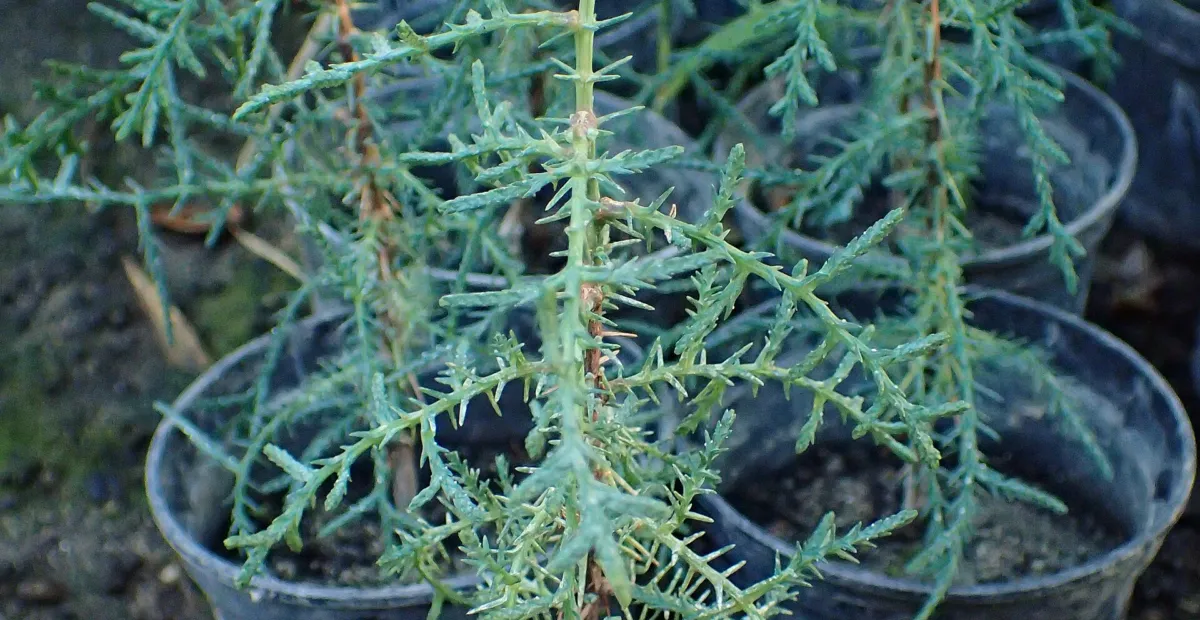
 Source:
 Mediterranean Cypress (Cupressus sempervirens) short overview
Mediterranean Cypress is a narrow, evergreen conifer valued for its formal columnar silhouette, dark scale-like foliage and strong architectural presence. Native to the Mediterranean region and western Asia, it grows best in full sun, sharply drained soil and climates with hot, dry summers. In the United States, it is most dependable in USDA Zones 7b–10, with regional variation and winter protection needed in colder areas.
Taxonomic classification
Mediterranean Cypress (Cupressus sempervirens) care guide
Light and placement
Give full sun, ideally with at least 6 hours of direct light and an open southern or western exposure. Strong light maintains dense foliage and the best columnar form. Too little light can produce thinner, weaker growth and a less balanced crown. In hot inland climates, full sun is suitable when roots receive consistent establishment moisture and the site has good airflow.
Watering and humidity
Water deeply and slowly, allowing the upper soil to dry somewhat between irrigations once established. During the first growing seasons, irrigate regularly enough to prevent the root ball from drying completely, then reduce frequency as roots spread. Increase water during prolonged summer heat, but never compensate for poor drainage with frequent shallow watering.
Soil and growing medium
Use well-drained sandy loam or another open soil that does not remain waterlogged. The species tolerates loam, sand, clay and a broad pH range, including neutral to alkaline ground, but drainage is more important than fine soil texture. Avoid compacted sites and low spots where roots stay saturated.
Feeding
Usually needs little fertilizer once established. Apply a slow-release, balanced fertilizer in early spring only if soil testing or weak growth indicates a need. Compost can be used as a thin surface mulch, but avoid heavy nitrogen feeding, late-season fertilization and fertilizer against the trunk, which can promote soft growth or winter injury.
Growth and habit
The species forms a dense, strongly vertical crown in commonly cultivated fastigiate selections, while wild populations can be more spreading. Growth is generally moderate. Select the final planting position carefully because topping or hard cutting can permanently damage the characteristic leader and silhouette.
Planting and repotting
Plant in fall or early spring when the soil can be worked. Set the root flare level with, or slightly above, surrounding soil and water deeply to settle the root ball. Mulch lightly without touching the trunk. Allow generous room for eventual height and spread; do not plant beneath utility lines or close to small buildings.
Container-grown plants should be moved into the next pot size when roots fill the container, preferably in early spring. Use a free-draining woody-plant mix and avoid burying the root collar. Because this becomes a large tree, containers are best treated as temporary growing quarters rather than a permanent solution.
Propagation and pruning
Propagation
Propagate from seed or semi-hardwood cuttings; layering is also documented. Sow fresh or properly stored seed when mature, while taking cuttings in the active growing season from healthy, vigorous shoots. Vegetative propagation is preferred for preserving a narrow cultivar form.
Pruning
Little pruning is normally required. Remove dead, damaged or crossing branches while young, but avoid topping and deep cuts into old, leafless wood. Pruning cannot reliably restore a narrow form after the central leader has been removed, so choose an appropriate cultivar and planting location from the outset.
Overwintering
In Zones 7b and warmer, established trees generally overwinter outdoors. Young trees and marginal Zone 7 specimens benefit from root-zone mulch and protection from cold, drying winds. Avoid late nitrogen fertilizer and do not wrap foliage tightly. Container plants are more vulnerable to root freezing and should be sheltered in a cool, bright protected location where necessary.
Uses
Use as a formal vertical accent, avenue tree, large-property screen or architectural specimen. It suits Mediterranean, classical and drought-conscious landscapes where summers are warm and soil drains quickly. Its mature height makes it unsuitable for many small residential lots. The durable, aromatic wood has traditional practical uses, but this profile does not make medicinal claims.
Appearance
Evergreen branchlets carry tiny, tightly appressed scale leaves in four-ranked patterns, giving the crown a fine-textured dark green appearance. Young bark is gray-brown and relatively smooth, becoming darker, ridged and flaky with age. The rounded woody cones are green when young and brown at maturity. Natural populations vary from spreading to columnar, while cultivated fastigiate forms are especially narrow and formal.
Pollination and visitors
Pollination is by wind rather than animals, so the inconspicuous cones are not expected to provide nectar or pollen rewards for bees, butterflies or other flower visitors.
Cupressus sempervirens photos
Click any photo for a larger view. Source, author and license are shown separately.
Diseases and pests
Diseases
Root rot is associated with poorly drained soil. Cankers, including serious cypress cankers caused by fungal pathogens, can kill branches or entire trees in susceptible regions. Improve drainage, avoid trunk wounds, remove badly affected material and sanitize pruning tools. Regional diagnosis is important because symptoms overlap among pathogens.
Pests
Cypress aphid, mites and occasional bagworms may occur. Inspect dense foliage for stippling, webbing, distorted shoots or visible insects. Reduce plant stress through correct watering and drainage, encourage natural enemies and use targeted controls only when monitoring shows a meaningful infestation.
Toxicity and pollen
Reliable species-specific evidence for serious human or companion-animal poisoning is limited. The foliage, resin and essential-oil-rich tissues should not be eaten, and concentrated plant material may irritate skin, eyes or the digestive tract. Keep pruning debris and plant material away from children and pets, and seek professional advice after ingestion.
- Typical season
- Typically late winter to early spring in the United States; timing varies by region.
- Pollination / pollen
- Light, wind-dispersed conifer pollen
Cupressus sempervirens releases abundant, lightweight wind-borne pollen during its reproductive season. Cypress pollen can contribute to seasonal respiratory allergy, especially in regions with substantial Cupressaceae plantings. US exposure timing varies by climate; people with known cypress sensitivity should limit exposure during local pollen peaks.
Native habitat
Native across parts of the Mediterranean basin and western Asia, where it occurs in warm, seasonally dry climates and is associated with rocky, calcareous or otherwise well-drained soils. It tolerates summer drought after establishment but benefits from adequate moisture during early root development and from protection against cold, drying winds.
Interesting fact
The familiar narrow Italian-cypress silhouette is a cultivated fastigiate form and is less typical of the species' broader natural variation. Trees are monoecious, with male and female cones on one individual. Female cones may remain closed and persistent for years, opening under heat or drying conditions. The species is long-lived and strongly associated with Mediterranean formal landscapes and cemeteries.
Frequently asked questions (FAQ)
The most relevant questions about this plant, with short and direct answers.
🌱Quick care
What is Mediterranean Cypress?⌄
Mediterranean Cypress is the accepted common name for Cupressus sempervirens, an evergreen conifer in the cypress family, Cupressaceae. It is best known for its tall, narrow, columnar form and dark green, scale-like foliage.
How much sun does Mediterranean Cypress need?⌄
Mediterranean Cypress needs full sun, ideally at least 6 hours of direct sunlight daily. Insufficient light can reduce density and weaken its naturally upright form.
How often should I water Mediterranean Cypress?⌄
Water Mediterranean Cypress moderately while it is establishing, allowing the soil to dry somewhat between thorough waterings. Once established, it becomes highly drought tolerant, but extended heat and drought may still require occasional deep watering.
Is Mediterranean Cypress evergreen?⌄
Yes, Mediterranean Cypress is an evergreen tree that retains its scale-like foliage year-round. Its foliage is typically dark green to blue-green and aromatic when crushed.
How fast does Mediterranean Cypress grow?⌄
Mediterranean Cypress grows at a medium rate, with noticeably faster growth when young. Mature trees may slow substantially, especially in poor soil, limited moisture, or climates outside their preferred warm, dry range.
🌤️Environment and placement
What USDA hardiness zones can grow Mediterranean Cypress?⌄
Mediterranean Cypress is generally suited to USDA Zones 7 through 10, with exact performance depending on the cultivar and local exposure. Protection from severe cold, drying winds, and poorly drained winter soil is especially important near the colder edge of its range.
Where should I plant Mediterranean Cypress?⌄
Plant Mediterranean Cypress in a sunny, open location with excellent drainage and enough vertical and lateral space for a large tree. It is particularly suited to formal landscapes, narrow screens, entrances, borders, and specimen planting in warm, relatively dry regions.
Can Mediterranean Cypress grow in clay soil?⌄
Mediterranean Cypress can grow in clay soil if drainage is good and water does not remain around the roots. Improve compact or poorly drained sites before planting, because persistent winter wetness can cause root and fungal problems.
What type of soil is best for Mediterranean Cypress?⌄
The best soil is well-drained sandy loam, loam, or improved clay with moderate fertility. Mediterranean Cypress tolerates acidic, neutral, and alkaline soils, provided the site does not stay waterlogged.
Can Mediterranean Cypress tolerate drought?⌄
Yes, established Mediterranean Cypress tolerates drought very well, particularly in warm Mediterranean-type climates. Young trees need consistent deep watering until their root systems develop, and even mature trees benefit from supplemental water during prolonged extreme drought.
Can Mediterranean Cypress grow in containers?⌄
Mediterranean Cypress can be grown temporarily in a large container, but it is ultimately a large tree and is not an ideal permanent patio plant. Choose a compact cultivar, provide excellent drainage, and expect frequent watering and eventual root restriction.
💧Care and problems
Why is my Mediterranean Cypress turning brown?⌄
Brown foliage can result from drought stress, root problems caused by excess moisture, winter injury, spider mites, or fungal disease. Check soil moisture and drainage first, then inspect the foliage and branches for pests, lesions, or dieback before pruning.
Does Mediterranean Cypress need fertilizer?⌄
Mediterranean Cypress usually needs little fertilizer when planted in reasonably fertile soil. If growth is weak or foliage is unusually pale, test the soil before applying a slow-release, balanced fertilizer according to its label.
Does Mediterranean Cypress have common pest problems?⌄
Mediterranean Cypress generally has few serious pest problems, although spider mites may attack the foliage in some regions. Dry, dusty conditions can worsen mite activity, so monitor stressed trees and avoid unnecessary insecticide applications that harm beneficial predators.
What diseases affect Mediterranean Cypress?⌄
Mediterranean Cypress can suffer from fungal problems, especially where foliage stays wet, air circulation is poor, or soil drainage is inadequate. Avoid chronic overwatering, provide spacing, and remove affected material with clean pruning tools.
How much space does Mediterranean Cypress need?⌄
Allow approximately 6 to 12 feet of planting space for many columnar forms, while checking the mature dimensions of the specific cultivar. Standard trees may reach roughly 40 to 70 feet tall and can become wider with age or in less columnar forms.
🪴Planting and repotting
When is the best time to plant Mediterranean Cypress?⌄
Plant Mediterranean Cypress in spring or early fall when soil moisture is reliable and temperatures are moderate. In colder USDA Zone 7 locations, spring planting gives the root system more time to establish before winter.
How do I plant Mediterranean Cypress?⌄
Dig a hole no deeper than the root ball and about twice as wide, set the tree with the root flare at soil level, and backfill with the native soil. Water deeply after planting, apply a thin mulch layer away from the trunk, and keep young trees consistently watered.
Can Mediterranean Cypress be transplanted?⌄
Mediterranean Cypress can be transplanted, but large established trees may recover slowly because conifers do not readily replace lost roots. Transplant smaller trees during active root growth, preserve as much of the root ball as possible, and provide careful aftercare.
✂️Propagation and pruning
How do you propagate Mediterranean Cypress?⌄
Mediterranean Cypress can be propagated from seeds or semi-ripe cuttings, although seed-grown plants may vary in shape and growth habit. Cuttings are generally preferred when a specific narrow cultivar must be reproduced true to type.
Can you grow Mediterranean Cypress from seed?⌄
Yes, Mediterranean Cypress can be grown from seed collected from mature woody cones. Germination may be uneven, and seedlings may not develop the same strongly columnar form as selected landscape cultivars.
Should Mediterranean Cypress be pruned?⌄
Mediterranean Cypress usually requires little pruning because its columnar habit is naturally maintained. Remove dead, damaged, or poorly positioned branches, but avoid cutting deeply into old brown wood, which may not produce new growth.
Can Mediterranean Cypress be kept narrow by trimming?⌄
Light trimming can refine the outline of Mediterranean Cypress, but it should not be relied on to control an unsuitable mature size. Avoid severe cuts into leafless interior wood, and select a naturally narrow cultivar when space is limited.
⚠️Toxicity and safety
Is Mediterranean Cypress toxic to dogs or cats?⌄
Species-specific toxicity information for Mediterranean Cypress is limited and inconsistent, so it is safest to prevent pets from chewing or ingesting the foliage, cones, or bark. Contact a veterinarian or animal poison service if ingestion is suspected, especially if symptoms develop.
Is Mediterranean Cypress poisonous to humans?⌄
The human toxicity of Cupressus sempervirens is not sufficiently documented for a definitive safety claim. Do not eat the foliage, cones, seeds, or plant extracts, and seek medical advice or poison-control guidance after suspected ingestion.
Can Mediterranean Cypress cause allergies?⌄
Mediterranean Cypress produces airborne pollen cones in spring and may contribute to seasonal pollen exposure. Sensitivity varies by person, so people with known conifer or pollen allergies should avoid handling large amounts of flowering material.
🌸Flowering and special interest
Does Mediterranean Cypress have flowers?⌄
No, Mediterranean Cypress does not produce showy flowers; it produces separate male and female cones on the same tree. Small male pollen cones appear in spring, while the larger female seed cones mature from green to brown over about two growing seasons.
When does Mediterranean Cypress produce pollen?⌄
Mediterranean Cypress generally releases pollen in spring from small male cones. The exact timing varies with temperature and region, with earlier release possible in warmer parts of the United States.
What do Mediterranean Cypress cones look like?⌄
The seed cones are rounded, hard, and woody, usually about 1 to 1.5 inches across. They begin green and mature to brown or gray-brown over approximately 20 to 24 months, often remaining on the tree afterward.
Does Mediterranean Cypress attract wildlife?⌄
Mediterranean Cypress provides evergreen shelter and structure for birds, and its cones may be used by some wildlife for seed. Its small, inconspicuous cones are not showy flowers and generally do not function as a major pollinator plant.
Similar plants
 Hesperotropsis leylandii care guideHesperotropsis leylandii
 Taxodium ‘Distichum’Taxodium 'Distichum'
 Cryptomeria (Cryptomeria japonica) care guideCryptomeria japonica
 Incense Cedar (Calocedrus decurrens) care guideCalocedrus decurrens
 Globosa Nana (Cryptomeria japonica ‘Globosa Nana’)Cryptomeria japonica 'Globosa Nana'