
 Source:
 Moso Bamboo (Phyllostachys edulis) short overview
Moso Bamboo (Phyllostachys edulis) is a towering, evergreen running bamboo from central and southern China and Taiwan. In warm, sheltered parts of the United States it forms dense stands of tall, woody culms and graceful narrow leaves, while its young shoots are harvested as a traditional food crop. Give it rich, consistently moist but well-drained soil, ample space, and a serious containment plan: vigorous rhizomes can spread beyond the planting area.
Taxonomic classification
Moso Bamboo (Phyllostachys edulis) care guide
Light and placement
Grow in full sun for strongest culm production, or partial shade in hot climates. A sheltered east- or south-facing position with protection from drying winter winds is useful. Too little light produces thinner, weaker growth; intense reflected heat combined with drought can scorch leaves. Avoid sites that remain deeply shaded or chronically waterlogged.
Watering and humidity
Water deeply and regularly during establishment, then maintain even moisture through spring and summer, especially while shoots are developing. Do not rely on shallow daily sprinkling. Reduce watering in cool weather, but do not let container plants dry completely. Mulch helps moderate soil moisture and temperature without burying the culms.
Soil and growing medium
Use fertile, humus-rich soil that holds moisture without remaining waterlogged. A loam amended with compost is suitable. Good drainage is important, especially in containers and heavy clay. A slightly acidic to neutral reaction is generally appropriate; avoid persistently dry, compacted ground.
Feeding
Apply compost or a balanced, slow-release fertilizer in spring as shoots begin active growth. A second light application may be useful in early summer on poor soils. Water fertilizer in thoroughly. Avoid heavy feeding late in the season or into drought-stressed, waterlogged, or newly transplanted soil.
Growth and habit
This is a vigorous, pachymorph-rhizome-forming running bamboo. New shoots emerge seasonally and rapidly develop into woody culms, while older culms remain useful for structure and screening. Rhizomes can extend well beyond the original planting, so annual boundary inspection and root pruning are practical maintenance requirements.
Planting and repotting
Plant in spring after the soil is workable, or in early fall where winters are moderate. Set the root ball level with the surrounding soil and water deeply. Allow substantial clearance from buildings, paving, utilities, and neighboring property. Install a robust rhizome barrier or plan for routine edge pruning before the grove becomes established.
Container-grown plants should be shifted when roots fill the pot, preferably in spring. Use a heavy, stable container with drainage and a moisture-retentive but open potting mix. Root pruning and division are possible during transplanting, but large plants become difficult to handle.
Propagation and pruning
Propagation
Propagate by division of established rhizome sections or by seed when fresh, viable seed is available. Divide in spring as new growth begins, retaining healthy rhizomes and culms with active buds. Seed propagation is less predictable because flowering is infrequent and seed availability is irregular.
Pruning
Remove dead, damaged, or weak culms at ground level after the main shooting period. Thin crowded stands selectively to improve access and appearance. Cut unwanted new shoots before they mature, and prune rhizomes at the planting boundary regularly. Do not top healthy culms unless a shortened screen is specifically desired.
Overwintering
In colder regions, protect the rhizome zone with a thick organic mulch and shield young plants from drying wind. Severe cold can damage foliage and culms. In areas colder than the plant’s reliable outdoor range, grow in a large container and overwinter it in a bright, cool greenhouse, sunroom, or similarly protected space.
Uses
Use as a large-scale screen, hedge, grove, erosion-control planting, or architectural background where spread can be managed. Mature culms are used for timber, fencing, furniture, flooring, paper, musical instruments, and other products. Young shoots are an established food crop when harvested and prepared correctly; this does not make raw shoots safe.
Appearance
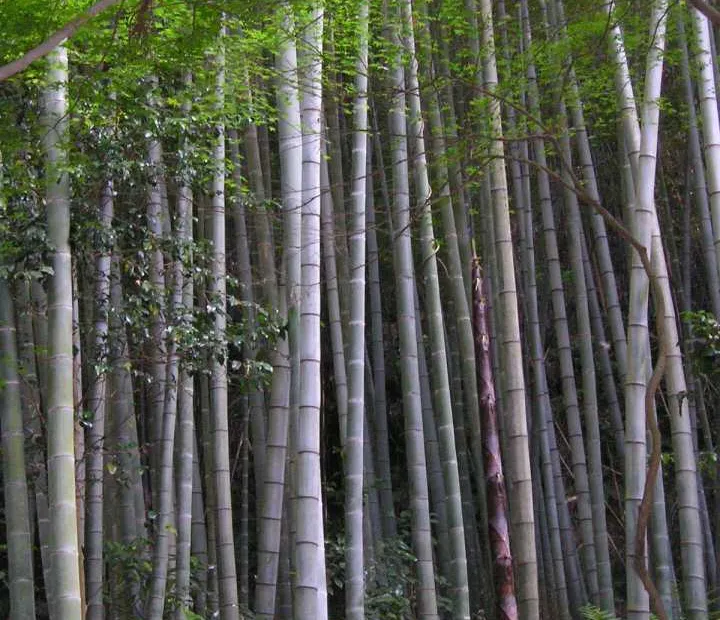
Tall, columnar culms are hollow between nodes and may reach several inches in diameter. Young stems can have a velvety gray surface and pale waxy rings below the nodes, while older culms become green or yellow-green. Numerous narrow, paper-thin, lance-shaped leaves form elegant side branches near the upper culm.
Flowering
Moso Bamboo flowers very rarely, with reports of flowering intervals around several decades. The flowers are small, inconspicuous, and borne in leafy inflorescences rather than showy floral clusters. Flowering can consume substantial stored energy, and post-flowering decline or dieback may occur, although complete death is not universal.
Pollination and visitors
Moso Bamboo flowers so infrequently that dependable animal-pollinator relationships are not well documented. Its small flowers are not a prominent garden nectar display, so no characteristic visitor group is assigned.
Phyllostachys edulis photos
Click any photo for a larger view. Source, author and license are shown separately.
Diseases and pests
Diseases
Rust and stem smut may affect culms and foliage. Reduce prolonged leaf wetness, maintain air movement, remove badly affected material, and avoid unnecessary wounding. Confirm the diagnosis before using any fungicide, and follow the product label and local regulations.
Pests
Slugs and snails may damage emerging shoots. Inspect new growth frequently, remove hiding places, and use physical barriers or labeled controls when needed. The principal long-term management concern is not an insect pest but vigorous rhizomatous spread, which should be controlled before shoots emerge beyond the intended boundary.
Toxicity and pollen
No reliable authoritative evidence was found establishing significant poisoning risk from ordinary contact with living Moso Bamboo. Young shoots are traditionally edible when correctly identified and properly prepared, but raw or improperly prepared bamboo shoots may contain cyanogenic compounds. Do not allow people or pets to consume unidentified, raw, or poorly prepared shoots.
- Pollination / pollen
- Fine grass pollen released during rare flowering events; airborne relevance uncertain
Bamboo pollen is produced only when the plant flowers, and Moso Bamboo flowers very infrequently. Species-specific airborne-allergy evidence for the United States was not located, so allergy relevance is left unknown rather than treated as zero. People with known grass-pollen sensitivity should use reasonable precautions during any flowering event.
Native habitat
The species is native to temperate and subtropical woodland regions of central, southern, and southeastern China and Taiwan. It favors warm summers, adequate moisture, fertile soils, and sheltered woodland-edge conditions. In the United States it performs best in warm regions and may be shorter, less vigorous, or winter-damaged in colder climates.
Interesting fact
Moso Bamboo is one of the principal timber bamboos cultivated in China and Japan. Its culms can reach several inches in diameter and are used for flooring, furniture, paper, instruments, and construction. The species is also widely harvested for edible shoots. Despite its tree-like size, it is a grass with hollow, jointed culms.
Frequently asked questions (FAQ)
The most relevant questions about this plant, with short and direct answers.
🌱Quick care
What is the common name for Phyllostachys edulis?⌄
The documented common name is Moso Bamboo. Phyllostachys edulis is a large, running timber bamboo in the grass family Poaceae.
How fast does Moso Bamboo grow?⌄
Established Moso Bamboo can grow very rapidly during its seasonal shooting period, with new culms reaching their mature height in a short time. Overall size and speed depend heavily on heat, moisture, soil fertility, plant age, and winter conditions.
How tall does Moso Bamboo get?⌄
In favorable climates, Moso Bamboo commonly reaches about 25–60 feet tall and may grow taller in exceptional conditions. Cold, drought, or poor soil can produce a much shorter plant.
🌤️Environment and placement
How much sun does Moso Bamboo need?⌄
Moso Bamboo grows best in full sun to partial shade. In hot climates, protection from intense afternoon sun can help reduce leaf scorch and moisture stress.
What USDA zones are suitable for Moso Bamboo?⌄
Moso Bamboo performs best in USDA Zones 8–9 and may survive in parts of Zones 6b and 7 with reduced vigor and shorter culms. In colder areas, protect the rhizomes and foliage from winter exposure.
How wide does Moso Bamboo spread?⌄
A mature Moso Bamboo planting may spread roughly 10–25 feet or more through its rhizomes. The eventual footprint depends on climate, soil, moisture, barriers, and how consistently new growth is removed.
Can Moso Bamboo tolerate frost?⌄
Moso Bamboo tolerates some frost, but its leaves and newly emerging shoots are vulnerable to cold damage. Provide a sheltered site, mulch the rhizome zone, and protect container plants in colder areas.
💧Care and problems
How often should I water Moso Bamboo?⌄
Water Moso Bamboo regularly to maintain moderate, consistent moisture, especially during establishment, summer heat, and active spring shooting. Allow excess water to drain rather than letting the root zone remain saturated.
Does Moso Bamboo spread aggressively?⌄
Yes, Moso Bamboo is a running bamboo that can spread through underground rhizomes in warm, moist, favorable conditions. Install a strong rhizome barrier or grow it in a controlled container, and check the perimeter regularly.
How do I stop Moso Bamboo from spreading?⌄
The most reliable approach is to install a properly designed rhizome barrier and inspect it at least annually for escapes. Cutting unwanted shoots alone does not remove the underground rhizome network, so persistent monitoring is necessary.
When does Moso Bamboo produce new shoots?⌄
Moso Bamboo generally produces its main new shoots in spring. Early shoots can be damaged by late freezes, so protect emerging growth where sudden cold is common.
Why are my new Moso Bamboo shoots dying?⌄
New Moso Bamboo shoots may die after late spring freezes, drought, transplant stress, physical damage, or insufficient root establishment. The rhizome may survive and produce replacement shoots, although they can be smaller that season.
How should I protect Moso Bamboo in winter?⌄
Mulch the root and rhizome area heavily before severe cold, and shelter the plant from drying winter winds. Container-grown Moso Bamboo is more exposed and may need to be moved into a protected, frost-free space.
Why is my Moso Bamboo not growing tall?⌄
Moso Bamboo may remain short because of cold winters, drought, poor soil, limited root space, transplant shock, or insufficient heat during the growing season. Young divisions also need several shooting seasons before producing culms comparable to those of mature plants.
Does Moso Bamboo lose its leaves in winter?⌄
Moso Bamboo is generally evergreen, but cold, drought, or winter wind can cause leaf browning and some leaf drop. Healthy plants often replace damaged foliage when favorable spring growth resumes.
🪴Planting and repotting
Can Moso Bamboo grow in containers?⌄
Moso Bamboo can grow in a large container, but its vigorous rhizomes require substantial root space and regular division or root pruning. In colder regions, container plants may need winter protection in a greenhouse, sunroom, or similarly sheltered location.
What soil is best for Moso Bamboo?⌄
Use fertile, humus-rich, moist but well-drained loam for Moso Bamboo. Avoid persistently waterlogged soil, which can reduce root health even though the plant prefers consistent moisture.
How do I plant Moso Bamboo in the ground?⌄
Plant Moso Bamboo in fertile, well-drained soil at the same depth as its original container, water it thoroughly, and mulch the root zone. Install a rhizome barrier before backfilling if the planting must remain contained.
When is the best time to plant Moso Bamboo?⌄
Plant Moso Bamboo in spring or early summer after severe freezes have passed, giving the rhizomes a long growing season to establish. In mild climates, early fall can also work if consistent moisture is available.
✂️Propagation and pruning
How do you propagate Moso Bamboo?⌄
Moso Bamboo is most commonly propagated by division or by planting viable rhizome sections, preferably in spring. Seed propagation is possible but uncommon because flowering and seed production are rare and irregular.
Can Moso Bamboo be grown from seed?⌄
Moso Bamboo can be grown from seed, but seed is rarely available because the species flowers infrequently. Seedlings grow slowly at first and may not reproduce the exact characteristics of a selected mature clone.
Can I divide Moso Bamboo?⌄
Yes, Moso Bamboo can be divided by separating sections that include healthy rhizome tissue and viable buds or culms. Division is best done in spring, followed by careful watering while the divisions reestablish.
When should Moso Bamboo be pruned?⌄
Prune Moso Bamboo in spring by removing weak, dead, damaged, or spindly culms and thinning crowded growth. Make cuts near ground level and avoid removing more healthy culms than necessary.
⚠️Toxicity and safety
Can Moso Bamboo be used for edible shoots?⌄
Yes, Moso Bamboo is cultivated for edible shoots, but raw shoots require caution because they can contain naturally occurring cyanogenic compounds. Harvest young shoots and cook them thoroughly before eating; do not treat raw shoots as ready-to-eat food.
Is Moso Bamboo toxic to dogs or cats?⌄
There is no established major toxicity classification commonly associated with Moso Bamboo as an ornamental plant. However, pets should not be allowed to consume raw bamboo shoots, and any animal that eats an unusual amount should be monitored and discussed with a veterinarian.
Are Moso Bamboo leaves safe to touch?⌄
Moso Bamboo leaves are not generally known for causing serious contact toxicity, although their edges can be sharp and may irritate sensitive skin. Wear gloves when handling dense foliage, divisions, or rough culms.
🌸Flowering and special interest
Does Moso Bamboo flower?⌄
Moso Bamboo does flower, but flowering is rare, irregular, and usually separated by many decades. Research on cultivated stands has documented flowering after roughly 66–69 years, while the timing can vary among lineages and locations.
What should I do if my Moso Bamboo flowers?⌄
Remove flowering shoots promptly if practical and continue monitoring the planting. Flowering can be followed by reduced vigor or decline, but Moso Bamboo does not always die immediately or uniformly after flowering.
Does Moso Bamboo die after flowering?⌄
Moso Bamboo may decline or die after flowering because bamboo reproduction can consume substantial stored resources, but this outcome is not inevitable for every plant or clone. The species has shown variation in flowering behavior and post-flowering survival.
Similar plants
 Azure Monkshood (Aconitum carmichaelii) care guideAconitum carmichaelii
 Monkshood (Aconitum ‘Stainless Steel’)Aconitum 'Stainless Steel'
 Monkshood (Aconitum ‘Bressingham Spire’)Aconitum 'Bressingham Spire'
 Golden full moon maple (Acer shirasawanum ‘Aureum’)Acer shirasawanum 'Aureum'
 Globosum (Acer platanoides ‘Globosum’)Acer platanoides 'Globosum'
 Striped maple (Acer pensylvanicum) care guideAcer pensylvanicum