
 Source:
Metallic Fishtail Palm (Chamaedorea metallica) short overview
Chamaedorea metallica, commonly called the Metallic Fishtail Palm, is a distinctive small palm from Mexico with upright, dark blue-green leaves that show a striking metallic sheen. It grows slowly and is valued primarily as an indoor or conservatory specimen. Provide bright filtered light, warm temperatures, moderate humidity, and evenly moist but well-drained soil. Protect it from frost, harsh afternoon sun, and prolonged dryness.
Taxonomic classification
Metallic Fishtail Palm (Chamaedorea metallica) care guide
Light and placement
Give bright filtered light, partial shade, or shade. An east- or north-facing window is suitable indoors; near a brighter south or west window, use a sheer curtain or set the palm back from direct rays. Pale, stretched growth suggests insufficient light, while bleached patches, crispy margins, or scorch indicate excessive direct sun.
Watering and humidity
Water when the upper inch of mix begins to dry, then soak thoroughly until excess drains away. Empty standing water from the saucer. Keep the root ball evenly moist during active growth, but reduce frequency slightly in winter when light and growth decline. Moderate to high humidity helps, especially in heated homes, but never compensate for poor drainage with constant saturation.
Soil and growing medium
Use a loose, humus-rich palm mix with excellent drainage but enough organic matter to remain lightly moist. A peat-free mix based on fine bark, coir or peat substitute, and perlite works well. Slightly acidic to neutral conditions are suitable; avoid dense, stagnant soil and containers without drainage.
Feeding
Feed during active spring and summer growth with a complete liquid fertilizer diluted to half the label rate about once a month. Do not fertilize dry, recently repotted, diseased, or dormant plants. Flush the pot occasionally to reduce salt accumulation.
Growth and habit
This is a slow-growing, solitary palm that keeps a neat upright habit in cultivation. Growth is strongest in warm conditions with steady moisture, filtered light, and adequate humidity. Remove only fully dead fronds; repeated cutting of healthy foliage reduces vigor and disfigures the crown.
Planting and repotting
In the United States, plant outdoors only in frost-free climates and a sheltered, shaded site. Set the palm at the same depth at which it was growing in its container. Water thoroughly after planting and keep the root zone consistently but not excessively moist while it establishes.
Repot in spring only when roots have filled the container or the mix has broken down. Move up one pot size rather than making a large jump, and disturb the root ball as little as practical. Ensure the crown and stem remain at their original depth.
Propagation and pruning
Propagation
Propagate from fresh seed when available. Sow soon after cleaning in a sterile, moisture-retentive but well-drained medium and keep warm. Germination can be slow and irregular; seedlings require protection from drying and harsh direct sun.
Pruning
Prune only completely brown or damaged fronds, cutting the stalk cleanly near the stem without injuring the crown. Do not remove partially green leaves merely to improve appearance, and never cut the central growing point.
Overwintering
Bring container plants indoors before temperatures approach the upper 30s°F. Keep them in bright filtered light, away from heating vents and cold drafts, and water somewhat less often during winter while preventing the mix from becoming bone dry. Outdoor plants need a reliably frost-free, sheltered climate.
Uses
Used mainly as an indoor foliage plant, conservatory specimen, or shaded container palm. In frost-free regions it can be grown in sheltered shade gardens and small tropical landscapes. It is ornamental rather than a documented culinary or medicinal plant.
Appearance
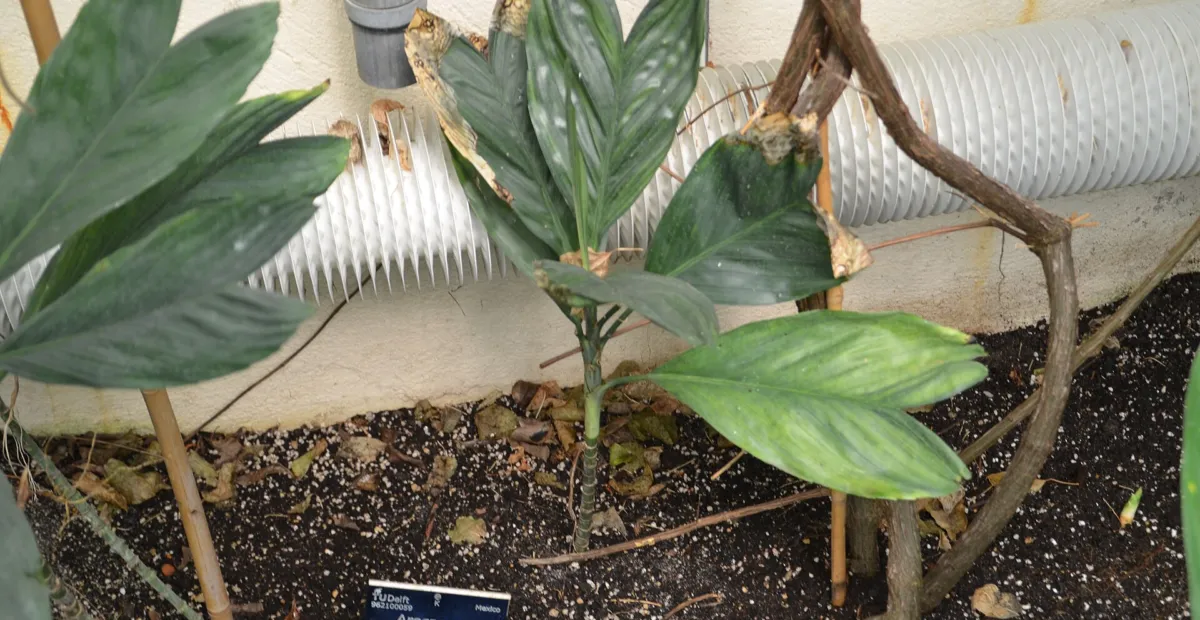
A solitary, slender-stemmed palm with closely ringed green stems and a crown of upright leaves. Leaves may be simple and bifid or occasionally pinnate, with a thick texture and distinctive dark blue-green, metallic surface. The combination of solitary habit and reflective foliage is useful for identification.
Flowering
Chamaedorea metallica is dioecious, with male and female flowers borne on separate plants. Small unisexual flowers occur on spike-like inflorescences, and cultivated specimens may flower in spring under suitable conditions. Female plants can develop black, rounded fruits after pollination.
Pollination and visitors
The species is described as biotically pollinated, but a dependable specific pollinator or visitor record was not established in the reviewed sources. Because plants are dioecious, fruit production requires compatible male and female plants and successful pollen transfer.
Chamaedorea metallica photos
Click any photo for a larger view. Source, author and license are shown separately.
Diseases and pests
Diseases
Prevent disease by avoiding waterlogged soil, poor air circulation, and wet foliage in cool conditions. Root and stem problems are most likely when drainage is poor. Remove badly damaged tissue, improve airflow, and correct watering before using any fungicide.
Pests
Inspect leaf undersides and stems for scale, mealybugs, and spider mites, especially in dry indoor air. Isolate affected plants, wipe or wash pests away, and repeat treatment with insecticidal soap or horticultural oil as directed. Avoid stressing the palm with severe dryness or harsh sun.
Toxicity and pollen
Reliable species-specific human toxicity information is limited. The fruit and plant should not be eaten, and sap or plant material may irritate sensitive people. Keep fallen fruits away from children and pets as a general precaution. Do not treat the plant as edible.
- Typical season
- Spring during flowering, when plants bloom
- Pollination / pollen
- Flower pollen released from small unisexual inflorescences
As a flowering palm, it produces pollen during flowering, but reliable species-specific airborne pollen or allergy studies were not located. Indoor plants are unlikely to create a major airborne pollen burden outside bloom, though sensitive people should avoid handling flowers if symptoms occur.
Native habitat
In nature it occurs in tropical Mexico, including Veracruz and Oaxaca, in shaded forest understories. It is associated with warm climates, organic soils, and filtered light rather than exposed, dry sites. Cultivation outside tropical regions generally requires a container, conservatory, or protected indoor position.
Interesting fact
The species name metallica refers to the metallic sheen of its leaves.
It is a solitary-stemmed palm rather than a clumping species.
Male and female flowers occur on separate plants.
Female plants can produce rounded black fruits after pollination.
Its native range is limited to Mexico.
Similar plants
 Gray-goddess (Brahea armata) care guideBrahea armata
 Palmyra palm (Borassus flabellifer) care guideBorassus flabellifer
 Rattan (Calamus rotang) care guideCalamus rotang
 Burmese Fishtail-palm (Caryota mitis) care guideCaryota mitis
 Attalea butyracea care guideAttalea butyracea
 Arenga hookeriana care guideArenga hookeriana