
 Source:
 Ceanothus ‘Dark Star’ short overview
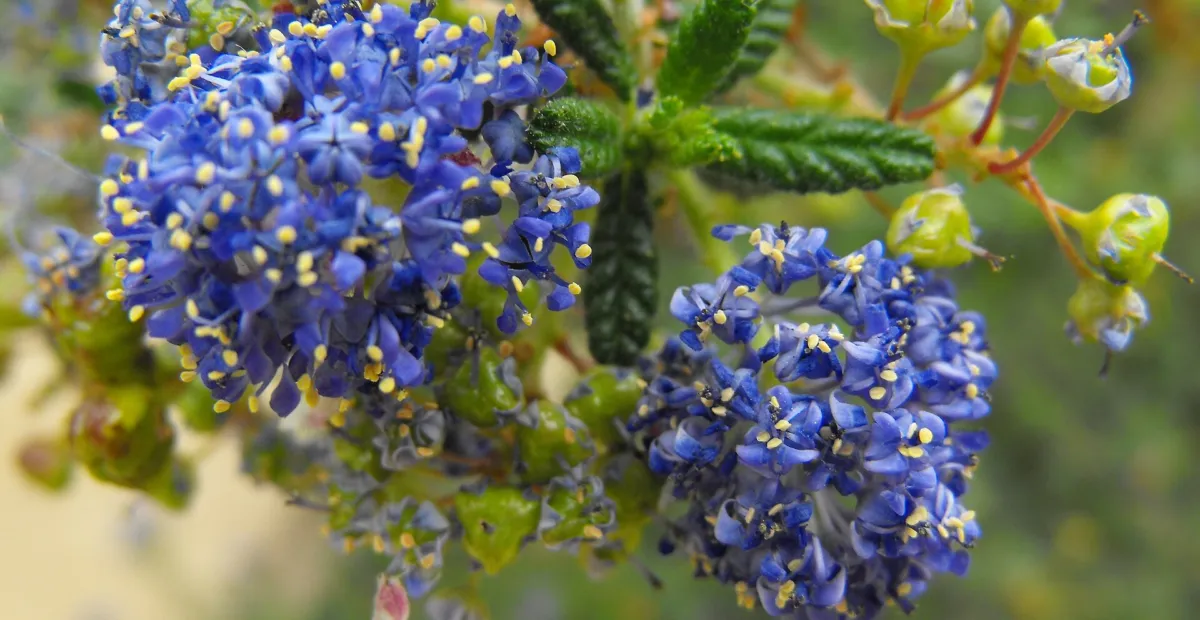
Ceanothus 'Dark Star' is a compact, spreading evergreen shrub valued for its glossy dark foliage and clouds of intensely cobalt-blue flowers in late spring. This California-bred selection performs best in full sun, lean soil, and excellent drainage. Once established, it tolerates summer drought and needs little supplemental irrigation, but winter cold, wet roots, and hard pruning can shorten its life. It is an outstanding choice for mild-climate pollinator and water-wise gardens.
Taxonomic classification
Ceanothus ‘Dark Star’ care guide
Light and placement
Give full sun, ideally six or more hours of direct light, with shelter from strong cold winds. A south- or west-facing position is suitable in mild climates. Too little light produces looser growth and fewer flowers; excessive heat combined with reflected pavement can cause stress, especially inland. Prioritize drainage and ventilation over partial shade.
Watering and humidity
Water deeply and infrequently during the first one or two growing seasons, allowing the upper soil to dry between irrigations. Once established, provide little or no routine summer water in climates with dry summers. In hotter inland regions, occasional deep watering may be needed, but frequent shallow irrigation or wet winter soil can encourage decline.
Soil and growing medium
Use a lean, sharply draining soil or planting mix with substantial mineral content. Sandy, gravelly, rocky, or well-drained loamy soil is suitable. Avoid sites that remain wet in winter or receive routine summer irrigation. Ceanothus tolerates a broad pH range from acidic to alkaline; drainage is more important than precise pH.
Feeding
Established plants generally need little or no fertilizer, especially in naturally lean soil. If growth is weak because the soil is genuinely deficient, apply a light, balanced fertilizer or a thin compost top-dressing in early spring. Avoid heavy nitrogen feeding and do not fertilize drought-stressed, newly transplanted, or winter-wet plants.
Growth and habit
This is a dense, spreading, arching shrub that can grow quickly when young and conditions are favorable. It is generally shorter and more compact than some large ceanothus selections, but mature size varies considerably. The plant is often relatively short-lived compared with many woody landscape shrubs, so excellent drainage and restrained irrigation are important.
Planting and repotting
Plant in fall or early spring when soil can be worked. Set the root crown at the same level as in the nursery container and do not bury the stem. Space about 6–10 feet from buildings or neighboring shrubs, depending on the desired form. Water deeply during the first one or two growing seasons, then reduce irrigation as roots establish.
Not generally recommended as a long-term container plant. If container growing is necessary, use a deep, very free-draining mix and transplant while young, disturbing the root ball as little as possible. Move to the landscape before the plant becomes root-bound, because established ceanothus can resent root disturbance.
Propagation and pruning
Propagation
Propagate commercially and horticulturally by semi-ripe cuttings taken in mid to late summer. Use clean material from healthy shoots and a very free-draining rooting medium. Seed is not a reliable way to reproduce the named cultivar because seedlings may not come true.
Pruning
Prune lightly immediately after flowering, removing dead, damaged, crossing, or poorly placed stems. Avoid cutting hard into old wood, because ceanothus may not regenerate reliably from leafless older branches. Do not prune in late winter if spring flower display is important, since flower buds are formed on older growth.
Overwintering
In Zones 8–10, protect plants from severe cold and drying winds with a sheltered site and avoid winter overwatering. Young plants in marginal Zone 7 locations may benefit from temporary frost protection, but prolonged freezing can cause damage. Container specimens are more vulnerable and should be protected from hard freezes while maintaining cool, bright conditions.
Uses
Use as a specimen shrub, informal hedge, screen, slope planting, wildlife garden feature, or water-wise foundation planting in mild climates. Its spring flowers provide nectar and pollen for insects, while ceanothus shrubs can provide cover and seeds used by birds. It is not recommended as a culinary or medicinal plant without species- and preparation-specific evidence.
Appearance
The shrub has small, glossy, dark-green leaves with strongly impressed veins and a dense branching framework. Branches arch outward, creating a broad, rounded to spreading outline. In bloom, the deep blue flower clusters can nearly obscure the foliage. Evergreen leaves provide year-round structure in climates where the plant is hardy.
Flowering
Small, fragrant, deep blue to blue-purple flowers are produced in dense clusters along the previous season's growth. The spring display can be extremely heavy, sometimes visually covering much of the shrub. Bloom timing varies with climate, but reliable U.S. reports place the main display from late April through May in Pacific Northwest trials and in spring in California.
Pollination and visitors
The cultivar is documented as attractive to bees, and horticultural sources also report strong visitation by butterflies and other pollinating insects. General Ceanothus references support broad insect visitation, but no single pollinator species is reliably documented specifically for ‘Dark Star’.
Diseases and pests
Diseases
Honey fungus has been reported, particularly where roots remain wet or plants are stressed. Prevent problems with excellent drainage, careful irrigation, clean planting stock, and good air circulation. Remove badly affected plants and avoid replanting susceptible shrubs immediately in the same contaminated soil.
Pests
Scale insects may occur, especially on stressed plants. Inspect stems and leaf undersides, encourage natural enemies, avoid excess nitrogen, and use horticultural oil only when the label permits and weather conditions are suitable. Severe infestations may require targeted removal of affected branches.
Related diseases and pests
Only Plant Doctor profiles whose host data indicate this plant may be affected are shown here.


Toxicity and pollen
No reliable authoritative source located for cultivar-specific toxicity in humans, dogs, cats, or children. Do not treat the plant as proven edible or proven toxic; prevent chewing of leaves, flowers, bark, or seeds and seek medical or veterinary advice after significant ingestion or symptoms.
- Typical season
- Spring
- Pollination / pollen
- Primarily insect-carried pollen
Ceanothus is insect-pollinated, so pollen is not typically released in the same way as wind-pollinated trees and grasses. However, cultivar-specific airborne allergen data are lacking, and individual sensitivity cannot be ruled out. Avoid handling heavy bloom close to the face if symptoms occur.
Native habitat
The cultivar derives from California ceanothus breeding and is suited to the ecological pattern of sunny, dry, well-drained coastal or Mediterranean-climate landscapes. Its likely parentage includes California species associated with chaparral, coastal scrub, and rocky slopes. It performs poorly where summer irrigation and winter saturation combine.
Interesting fact
‘Dark Star’ was discovered by Ken Taylor as a seedling in a California garden in 1968 and introduced in 1971. It is widely described as a selection or hybrid associated with Ceanothus impressus. Its very dark blue flowers contrast strongly with the small, glossy, deeply veined leaves.
Frequently asked questions (FAQ)
The most relevant questions about this plant, with short and direct answers.
🌱Quick care
What is Ceanothus 'Dark Star' commonly called?⌄
Ceanothus 'Dark Star' is commonly called Dark Star ceanothus or California lilac. The cultivar is also listed botanically as Ceanothus × impressus 'Dark Star' and Ceanothus × 'Dark Star'.
How big does Ceanothus 'Dark Star' get?⌄
Ceanothus 'Dark Star' typically grows about 4–6 feet tall and 6–10 feet wide, although particularly vigorous plants may approach 8 feet tall. Give it enough room to develop its naturally broad, dense form.
Is Ceanothus 'Dark Star' evergreen?⌄
Yes, Ceanothus 'Dark Star' is an evergreen shrub with small, dark green leaves. It provides year-round foliage in climates where it is hardy.
Is Ceanothus 'Dark Star' easy to grow?⌄
Ceanothus 'Dark Star' is relatively easy to grow when planted in full sun and sharply drained soil, then kept fairly dry after establishment. It is less forgiving of wet roots, heavy feeding, and unsuitable humid or hot-inland conditions.
🌤️Environment and placement
Where should I plant Ceanothus 'Dark Star'?⌄
Plant Ceanothus 'Dark Star' in a sunny, open location with excellent drainage and good air circulation. It works well as a flowering hedge, screen, slope plant, wildlife shrub, or drought-tolerant landscape accent.
How much sun does Ceanothus 'Dark Star' need?⌄
Ceanothus 'Dark Star' needs full sun, ideally at least 6 hours of direct sunlight daily. Insufficient light can reduce flowering and produce a less dense, weaker-growing shrub.
What USDA hardiness zones are suitable for Ceanothus 'Dark Star'?⌄
Ceanothus 'Dark Star' is generally rated for USDA Zones 8–10, with some references listing Zone 7 as marginally suitable. In colder areas, protect it from severe freezes and winter wet, or grow it in a sheltered microclimate.
Can Ceanothus 'Dark Star' grow in hot inland areas?⌄
Ceanothus 'Dark Star' is usually better suited to coastal and moderate climates than to very hot inland regions. In inland areas, choose a site with excellent drainage, avoid summer irrigation once established, and expect greater stress during prolonged heat.
What type of soil does Ceanothus 'Dark Star' prefer?⌄
Ceanothus 'Dark Star' prefers lean, sandy or loamy soil that drains sharply. It can tolerate some clay if drainage is improved, but amended planting areas should never remain saturated after rain or irrigation.
Can Ceanothus 'Dark Star' tolerate drought?⌄
Yes, established Ceanothus 'Dark Star' is drought tolerant and generally needs little or no summer water in suitable climates. Newly planted shrubs need regular but deep irrigation until their roots establish.
Can I plant Ceanothus 'Dark Star' near the coast?⌄
Yes, Ceanothus 'Dark Star' is well suited to many coastal California conditions, especially sunny sites with good drainage. Protection from salt-laden wind may still be helpful in exposed locations.
💧Care and problems
How often should I water Ceanothus 'Dark Star'?⌄
Water Ceanothus 'Dark Star' deeply but infrequently while it establishes, allowing the soil to dry between applications. After establishment, reduce watering substantially and avoid routine summer irrigation unless the plant shows stress or the climate is exceptionally dry.
Should I fertilize Ceanothus 'Dark Star'?⌄
Usually, Ceanothus 'Dark Star' does not need regular fertilizer and performs well in lean soil. Excess fertilizer, especially nitrogen, can encourage weak growth and may shorten the plant’s useful life.
Why is my Ceanothus 'Dark Star' dying?⌄
The most common concern is excessive moisture around the roots, particularly from summer irrigation, poor drainage, or frequent lawn watering. Improve drainage and watering practices first, and inspect the roots for rot if foliage is declining rapidly.
Why are the leaves on my Ceanothus 'Dark Star' turning brown?⌄
Brown leaves can result from drought stress, root damage, heat, transplant shock, or root rot caused by wet soil. Check soil moisture and drainage before increasing irrigation, because adding water to a poorly drained site can worsen the problem.
Is Ceanothus 'Dark Star' deer resistant?⌄
Ceanothus 'Dark Star' is commonly considered deer resistant, although no plant is completely deer proof. Hungry deer may browse it, especially when preferred food is scarce.
Does Ceanothus 'Dark Star' attract bees and butterflies?⌄
Yes, the abundant blue spring flowers attract bees, butterflies, and other beneficial insects. The shrub can also provide cover and seeds for some garden birds.
🪴Planting and repotting
When is the best time to plant Ceanothus 'Dark Star'?⌄
Plant Ceanothus 'Dark Star' in fall or during the cool part of the growing season so roots can establish before summer heat. Avoid planting into cold, waterlogged soil or just before severe freezing weather.
How far apart should I plant Ceanothus 'Dark Star'?⌄
Space Ceanothus 'Dark Star' about 6–10 feet apart, depending on whether you want individual specimens or a more continuous screen. Use the wider spacing for mature airflow and the narrower spacing only where some overlap is desired.
Can Ceanothus 'Dark Star' be grown in a container?⌄
Ceanothus 'Dark Star' can be grown temporarily in a large container, but it is generally best planted in the ground. Use a fast-draining potting mix, avoid overwatering, and expect a shorter-lived or less vigorous plant in a confined root system.
Does Ceanothus 'Dark Star' transplant well?⌄
Ceanothus 'Dark Star' may establish poorly after major root disturbance, especially when mature. Plant it carefully while young, preserve the root ball, and avoid relocating an established shrub unless necessary.
✂️Propagation and pruning
How is Ceanothus 'Dark Star' propagated?⌄
Ceanothus 'Dark Star' is generally propagated from cuttings to preserve its exact cultivar traits. Seed is not a reliable way to reproduce the named cultivar because offspring may differ from the parent.
Can I grow Ceanothus 'Dark Star' from seed?⌄
You can grow Ceanothus from seed, but seed-grown plants will not necessarily be true to Ceanothus 'Dark Star'. Ceanothus seeds commonly require specialized treatment such as scarification and stratification, so cuttings are preferable for cultivar-quality plants.
When should I prune Ceanothus 'Dark Star'?⌄
Prune Ceanothus 'Dark Star' immediately after flowering, removing spent flowering shoots and only light amounts of additional growth. Avoid hard pruning into old, leafless wood because ceanothus often recovers poorly from severe cuts.
Can Ceanothus 'Dark Star' be pruned into a tree form?⌄
Ceanothus 'Dark Star' can sometimes be trained into a small tree-like form when young, but it is not especially tolerant of repeated or heavy pruning. Select a main stem early and make limited cuts rather than trying to convert a mature shrub.
⚠️Toxicity and safety
Is Ceanothus 'Dark Star' toxic to dogs, cats, or people?⌄
Cultivar-specific toxicity information for Ceanothus 'Dark Star' is unresolved, so do not assume that it is safe to eat. Keep pets and children from chewing the plant, and contact a veterinarian or poison-control service if ingestion causes symptoms.
🌸Flowering and special interest
When does Ceanothus 'Dark Star' bloom?⌄
Ceanothus 'Dark Star' usually blooms in late winter or spring, depending on local climate. Its dense clusters of deep cobalt-blue flowers can cover much of the shrub for several weeks.
Why is my Ceanothus 'Dark Star' not flowering?⌄
Insufficient sun, excessive summer water, overfertilization, severe pruning, or young age can reduce flowering. Give the shrub full sun, lean soil, good drainage, and prune only after flowering rather than removing developing flower wood.
Are Ceanothus 'Dark Star' flowers fragrant?⌄
Ceanothus 'Dark Star' is often described as fragrant, although fragrance intensity can vary with weather, plant age, and individual growing conditions. The strongest display comes from its mass of blue flower clusters rather than from fragrance alone.
Similar plants
 Blue Blossom Ceanothus (Ceanothus thyrsiflorus) care guideCeanothus thyrsiflorus
 California lilac (Ceanothus × delileanus ‘Gloire de Versailles’)Ceanothus × delileanus 'Gloire de Versailles'
 New Jersey tea (Ceanothus americanus) care guideCeanothus americanus
 Repens (Ceanothus thyrsiflorus ‘Repens’)Ceanothus thyrsiflorus 'Repens'
 Ceanothus ‘Concha’Ceanothus 'Concha'