
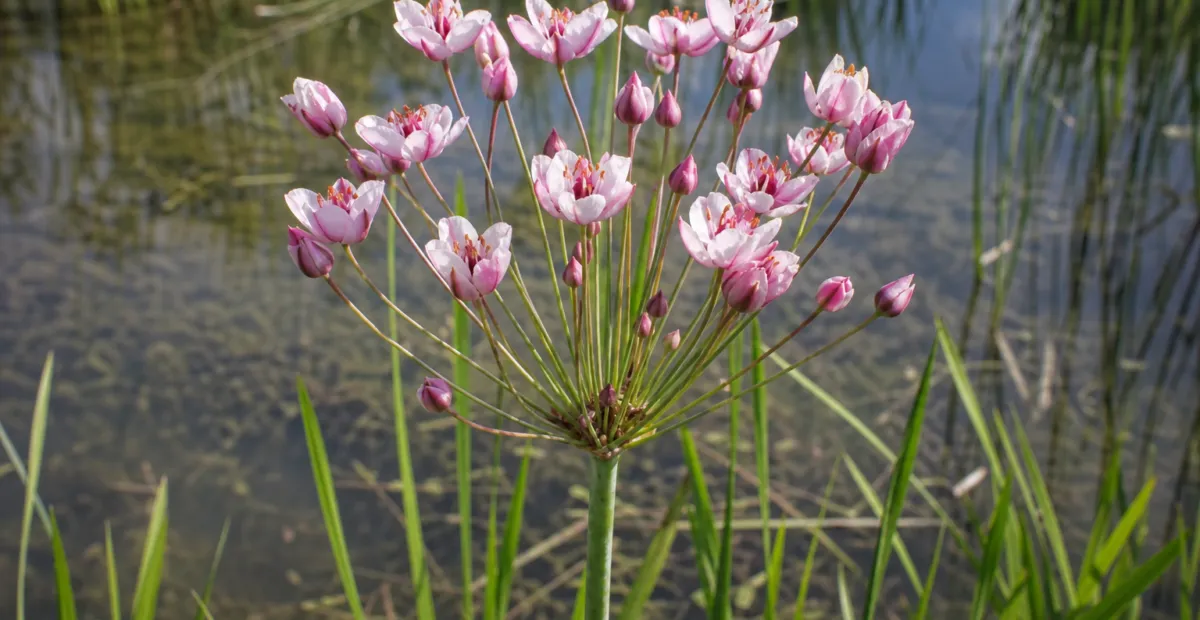
 AI-generated illustration
Flowering-rush (Butomus umbellatus) short overview
Flowering-rush (Butomus umbellatus) is an emergent aquatic perennial native to Eurasia and widely naturalized in parts of the United States. It forms clumps of upright, narrow, somewhat twisted leaves and produces rounded umbels of pink to rose flowers in summer. Although attractive in ponds and wetland plantings, it spreads readily by rhizomes, fragments and bulbils and is considered invasive in many regions.
Taxonomic classification
Flowering-rush (Butomus umbellatus) care guide
Light and placement
Provide full sun for the strongest flowering, with partial shade tolerated. A pond edge facing south or west is generally suitable when water levels remain stable. Insufficient light may produce weak, floppy growth and fewer umbels; excessive exposure is rarely a problem if the roots remain continuously wet. Avoid dry terrestrial beds.
Watering and humidity
Keep the rhizome continuously wet, either in saturated mud or shallow standing water. Do not allow a container to dry during active growth. In hot weather, check water depth frequently; in autumn and winter, maintain moisture while reducing disturbance. Extra humidity is unnecessary beyond the naturally wet environment.
Soil and growing medium
Plant in permanently wet mud, saturated loam or shallow water. Heavy organic or mineral mud is suitable, provided the rhizomes remain anchored. Slightly neutral to slightly alkaline conditions are generally tolerated; avoid saline or brackish water. In containers, use heavy aquatic loam rather than lightweight potting mix.
Feeding
Established plants normally obtain sufficient nutrients from wetland mud and pond sediments. If growth is weak in a contained ornamental planter, use only a restrained aquatic-plant fertilizer according to its label during active growth. Do not fertilize natural water bodies or add nitrogen merely to increase flowering, as excess nutrients can worsen algal growth.
Growth and habit
This aquatic perennial develops horizontal rhizomes and can form persistent clumps. It may grow as an emergent plant in shallow water and can also occur in deeper submerged conditions. Rhizome fragmentation and bulbils make disturbance a major spread risk, so maintenance should avoid breaking and transporting plant parts.
Planting and repotting
Plant during the active growing season, setting the rhizome just below the mud surface and keeping the crown near the waterline or in shallow water. Allow room for clumping, but contain the plant wherever escape into natural waterways is possible. Do not plant in regions where it is regulated or invasive.
Container-grown specimens can be divided and replanted in spring or early summer when active growth begins. Use a heavy aquatic substrate and a container without drainage if it is intended to remain submerged or saturated. Check regularly for rhizomes escaping the container.
Propagation and pruning
Propagation
Divide rhizomes in spring or early summer, keeping a viable crown on each section. Detached rhizome fragments and bulbils can establish new plants, so handle all material carefully and dispose of unwanted pieces securely away from drains and waterways. Seed propagation is possible on fertile diploid plants but is less predictable than vegetative propagation.
Pruning
Cut back dead foliage after the growing season or before new growth begins. Remove flower heads only if seed production must be reduced, but do not assume this prevents spread because bulbils and rhizome fragments can remain important propagules. Bag and dispose of removed material securely.
Overwintering
Outdoor plants in suitable climates can remain dormant in wet soil or shallow water. Do not bring wild-collected material indoors, and do not overwinter loose rhizome fragments where they could escape. In containers subject to freezing, keep the root zone wet and protected from complete desiccation.
Uses
Historically and horticulturally used as an ornamental emergent plant for pond margins and aquatic displays. In the United States, use is often inappropriate because escaped plants can invade wetlands, shorelines and waterways. Choose noninvasive native alternatives where local authorities or invasive-plant lists identify flowering-rush as a concern.
Appearance
Leaves are narrow, upright, linear and often slightly twisted, with a distinctive triangular or three-angled cross-section and a pithy interior. Smooth flowering scapes rise above the foliage and carry rounded umbels. Horizontal rhizomes and small bulbils distinguish its persistent aquatic growth habit.
Flowering
Flowering stems rise above the foliage and terminate in rounded, umbrella-like cymose clusters. Individual flowers are approximately 3/4–1 inch wide, with pink petals, three sepals, nine stamens and six carpels. Fertile diploid plants can produce seed, while triploid plants often flower rarely or produce sterile flowers.
Pollination and visitors
The flowers produce nectar and pollen and are visited by multiple insect groups, including bees, bumblebees, hoverflies and beetles. Research on floral biology documents sequential insect visits and strong timing between pollen release and stigma receptivity. Visitor composition can vary by site.
Butomus umbellatus photos
Click any photo for a larger view. Source, author and license are shown separately.
Diseases and pests
Diseases
No single disease is consistently reported as a defining problem. Reduce stress by maintaining stable water levels, avoiding damaged rhizomes and removing decaying material. Investigate persistent leaf lesions or crown decline before using any treatment, because symptoms may also reflect herbicide injury, poor anchoring or water-quality problems.
Pests
Rhizome-feeding insects and aquatic herbivores may damage plants locally, but no single pest is consistently characteristic. Inspect leaves and crowns, remove heavily damaged material and avoid moving infested rhizome pieces between water bodies. Invasive spread and mechanical fragmentation are usually greater management concerns than insect pests.
Toxicity and pollen
Authoritative plant-toxicity references do not provide a well-established, species-specific poisoning profile for humans or common pets. This absence is not proof of safety. Prevent ingestion of aquatic plant material, supervise children and pets near plantings, and contact a poison center or veterinarian if significant ingestion causes symptoms.
- Typical season
- During flowering, generally June–October in the United States where plants bloom.
- Pollination / pollen
- Insect-associated floral pollen; airborne-allergy significance not established
Flowering-rush produces pollen, but reliable US-specific data on airborne pollen counts, allergenicity and clinical allergy risk were not located. Its emergent aquatic habit and insect-associated flowers do not justify assuming either zero or high allergy risk. People with known pollen sensitivity should limit direct exposure during bloom.
Native habitat
Naturally associated with shallow lakes, slow-moving rivers, marshes, riparian margins and other freshwater wetlands. It roots in mud and tolerates substantial water depth, but is intolerant of saline or brackish conditions. In the United States it is introduced from Eurasia and has become invasive in several aquatic systems.
Interesting fact
The species is the sole widely recognized member of the family Butomaceae. Its flowers are protandrous, with pollen released before stigmas become receptive. Plants may spread clonally through rhizome fragments and small bulbils as well as by seed. Triploid populations can be largely sterile yet persist and spread vegetatively.
Frequently asked questions (FAQ)
The most relevant questions about this plant, with short and direct answers.
🌱Quick care
What is Flowering-rush (Butomus umbellatus)?⌄
Flowering-rush is a cold-hardy, rhizomatous aquatic perennial in the Butomaceae family. It forms strap-like leaves and rounded clusters of pink flowers on stalks rising above shallow water or saturated soil.
Is Flowering-rush a perennial?⌄
Yes, Flowering-rush is a deciduous perennial that regrows from persistent rhizomes each spring. It can survive cold winters when its rhizomes remain underwater or in saturated mud.
🌤️Environment and placement
Where should Flowering-rush be planted?⌄
Plant Flowering-rush at a pond margin, wetland edge, or other permanently wet site with full sun to partial shade. It prefers heavy aquatic mud or saturated loam rather than ordinary dry garden soil.
How deep can Flowering-rush grow in water?⌄
Flowering-rush commonly grows in shallow water around the pond edge, but established plants can tolerate substantially deeper water, including submerged conditions. For contained garden plantings, shallow water is easier to manage and encourages flowering.
Does Flowering-rush grow in shade?⌄
Flowering-rush tolerates partial shade but flowers and grows most reliably in full sun. Dense shade may reduce flowering and produce weaker, more open growth.
What soil does Flowering-rush need?⌄
Use fertile, heavy aquatic mud or consistently saturated loam. The planting medium should stay wet year-round, because Flowering-rush is not suited to normal, freely draining garden soil.
Is Flowering-rush suitable for a backyard pond?⌄
Flowering-rush can grow well in a contained backyard pond, but it is a poor choice where rhizomes, bulbils, or plant fragments could escape into natural waterways. Check your state and local invasive-plant rules before planting.
💧Care and problems
How much water does Flowering-rush need?⌄
Keep Flowering-rush in shallow water or saturated mud throughout the growing season. It may tolerate temporary water-level changes, but prolonged drying can reduce or eliminate a planting.
How much sun does Flowering-rush need?⌄
Provide full sun for the strongest flowering, although partial shade is acceptable. At least several hours of direct sunlight is usually beneficial during the growing season.
How do you care for Flowering-rush in winter?⌄
Leave the rhizomes in place and keep them moist or submerged through winter. Remove only dead, collapsing foliage if needed, and avoid disturbing the sediment because detached pieces can regenerate.
What problems commonly affect Flowering-rush?⌄
Flowering-rush is generally low-maintenance and relatively disease-free, but water-lily aphids and similar sap-feeding insects may occasionally occur. The more serious problem is aggressive spread through rhizomes, fragments, bulbils, or seeds.
Why is my Flowering-rush not flowering?⌄
Insufficient sunlight, deep water, young age, or a sterile form of the plant can explain poor flowering. Some North American populations rarely flower because they are triploid, so lack of flowers does not always indicate poor care.
🪴Planting and repotting
When is the best time to plant Flowering-rush?⌄
Plant Flowering-rush in spring or early summer after active growth begins. Planting during the growing season makes it easier to position the rhizome and confirm that water depth remains suitable.
How do you plant Flowering-rush in a pond?⌄
Set the rhizome in firm aquatic mud with the growing points near the soil surface, then keep the site shallowly flooded or saturated. Use a sturdy aquatic container if you need to limit spread, and remove fragments from the water.
Can Flowering-rush grow in a container?⌄
Yes, Flowering-rush can be grown in a large, sturdy aquatic container filled with heavy loam or aquatic planting medium. Containers help reduce rhizome spread but must be checked for escaping bulbils and fragments.
✂️Propagation and pruning
How do you propagate Flowering-rush?⌄
Flowering-rush can be propagated by rhizome division, seeds, or small bulbils produced on rhizomes or flower structures. Rhizome division and bulbils are generally more practical than seed for controlled propagation.
Can Flowering-rush be grown from bulbils?⌄
Yes, bulbils can be detached and planted in wet aquatic medium to produce new plants. Handle them carefully and keep every propagating piece contained because bulbils can contribute to unwanted spread.
How long does Flowering-rush take to grow from seed?⌄
Flowering-rush seeds typically require several months of cold, wet stratification before spring germination. Seed-grown plants may take several years to reach flowering size.
Can you divide Flowering-rush rhizomes?⌄
Yes, divide the rhizomes in spring by separating healthy sections that contain viable growing points. Replant divisions immediately in saturated soil or shallow water and prevent pieces from washing into natural waterways.
Should Flowering-rush be cut back after flowering?⌄
Cut back dead or declining foliage after flowering or in late fall if the planting is contained. Bag removed material rather than composting it or placing it near a drainage channel, because fragments and seeds may spread.
⚠️Toxicity and safety
Is Flowering-rush invasive in the United States?⌄
Yes, Flowering-rush is nonnative and invasive in parts of the United States, especially portions of the Great Lakes region and Pacific Northwest. It can displace native aquatic vegetation and spread through rhizomes, fragments, bulbils, and seeds.
Should I plant Flowering-rush near a natural pond or lake?⌄
No, avoid planting Flowering-rush where it can reach a natural pond, lake, stream, ditch, or wetland. Escaped fragments and rhizomes can establish new populations, and regulations vary by state and locality.
How do you remove Flowering-rush from a pond?⌄
Small contained infestations can sometimes be removed by digging out the entire rhizome system and collecting every fragment. Larger or natural-water infestations require site-specific aquatic invasive-plant management, and herbicides should be used only according to the product label and local rules.
Is Flowering-rush poisonous to people or pets?⌄
Species-specific toxicity information for Flowering-rush is insufficient to confirm that it is safe to eat or harmless to pets. Do not consume it, and contact a medical professional or poison-control service if ingestion occurs.
🌸Flowering and special interest
When does Flowering-rush bloom?⌄
Flowering-rush generally blooms from early summer into fall, with timing varying by climate and water conditions. Its pink, six-petaled flowers appear in rounded umbels above the foliage.
What do Flowering-rush flowers look like?⌄
The flowers are pink to pinkish-white, about three-quarters to 1¼ inches across, and arranged in an umbrella-shaped cluster at the top of a leafless stalk. Each flower typically has six petal-like tepals and prominent stamens.
How do you identify Flowering-rush?⌄
Look for a rhizomatous aquatic perennial with basal, narrow leaves that may be upright or floating, plus pink flowers in an umbel on a triangular stalk. The combination of twisting, three-sided leaves and umbrella-like flower clusters helps distinguish it from true rushes.
Similar plants
 Azure Monkshood (Aconitum carmichaelii) care guideAconitum carmichaelii
 Monkshood (Aconitum ‘Stainless Steel’)Aconitum 'Stainless Steel'
 Monkshood (Aconitum ‘Bressingham Spire’)Aconitum 'Bressingham Spire'
 Golden full moon maple (Acer shirasawanum ‘Aureum’)Acer shirasawanum 'Aureum'
 Globosum (Acer platanoides ‘Globosum’)Acer platanoides 'Globosum'
 Striped maple (Acer pensylvanicum) care guideAcer pensylvanicum